Bhagavad Gita 18.41: meaning and translation
Chapter 18: Moksha Sannyasa Yoga. Krishna says
Krishna says that the duties (karma) of Brāhmaṇas, Kṣatriyas, Vaiśyas and Śūdras are divided according to the guṇas that arise from their own nature (svabhāva).
Click or tap a word for its meaning and its dictionary page.
Text and layers
Text and layers
These choices stay in this browser.
Bhagavad Gita 18.41
ब्राह्मणक्षत्रियविशां शूद्राणां च परन्तप ।कर्माणि प्रविभक्तानि स्वभावप्रभवैर्गुणैः ॥
Brahmanakshatriyavisham shudranam cha parantapaKarmani pravibhaktani svabhavaprabhavairgunaih
brāhmaṇakṣatriyaviśāṃ śūdrāṇāṃ ca parantapa |karmāṇi pravibhaktāni svabhāvaprabhavairguṇaiḥ ||
Our explanation Krishna says that the duties (karma) of Brāhmaṇas, Kṣatriyas, Vaiśyas and Śūdras are divided according to the guṇas that arise from their own nature (svabhāva). Both old translations write 'duties' or 'Karmas'; Besant's note says the word means action arising from a nature shaped by past thoughts and desires. Shankara gives three readings of 'nature' and Ramanuja reads it as past karma (see the views). Readings of these verses differ between schools and teachers, and the wording is the text's, not the view of this library.
हिंदी अर्थ कृष्ण कहते हैं कि ब्राह्मणों, क्षत्रियों, वैश्यों और शूद्रों के कर्म उनके स्वभाव से उत्पन्न गुणों के अनुसार बाँटे गए हैं। तेलंग “duties” लिखते हैं और बेसेंट “Karmas”; बेसेंट की टिप्पणी कहती है कि कर्म वह क्रिया है जो पिछले विचारों और इच्छाओं से बने स्वभाव से उठती है। शंकराचार्य “स्वभाव” के तीन अर्थ देते हैं और रामानुजाचार्य इसे पिछले कर्म मानते हैं। इन श्लोकों को अलग-अलग परंपराएँ और आचार्य अलग ढंग से पढ़ते हैं, और ये शब्द पाठ के हैं, इस पुस्तकालय का मत नहीं।
Word by word
Every word, with its dictionary page
Word by word
- ब्राह्मणक्षत्रियविशाम् brāhmaṇakṣatriyaviśām · of Brahmins, Kshatriyas and Vaishyas (compound (masculine), genitive plural) Dictionary: brāhmaṇa, Monier-Williams 1899, p. 741, col. 2 “one who has divine knowledge”; kṣatriya, Monier-Williams 1899, p. 325, col. 2 “a member of the military or reigning order (which in later times constituted the second caste)”; 2. viś, Monier-Williams 1899, p. 989, col. 2 “a man of the third caste”
- शूद्राणाम् śūdrāṇām · of Shudras (noun (masculine), genitive plural) Dictionary: śūdra, Monier-Williams 1899, p. 1085, col. 3 “a Śūdra, a man of the fourth or lowest of the four original classes or castes”
- च ca · and (indeclinable) Dictionary: 2. ca, Monier-Williams 1899, p. 380, col. 1 “and, both, also, moreover, as well as”
- परन्तप parantapa · O scorcher of foes (compound (masculine), vocative singular) Dictionary: param-tapa, Monier-Williams 1899, p. 586, col. 3 “destroying foes (said of heroes)”
- कर्माणि karmāṇi · the duties, works (noun (neuter), nominative plural) Dictionary: karman, Monier-Williams 1899, p. 258, col. 2 “act, action, performance, business”
- प्रविभक्तानि pravibhaktāni · are divided (past participle (neuter), nominative plural) Dictionary: pra-vibhakta, Monier-Williams 1899, p. 692, col. 1 “separated, divided, distributed”
- स्वभावप्रभवैः svabhāvaprabhavaiḥ · arising from their own nature (compound (masculine), instrumental plural) Dictionary: sva-bhāva, Monier-Williams 1899, p. 1276, col. 1 “innate or inherent disposition, nature”; pra-bhava, Monier-Williams 1899, p. 684, col. 2 “m. production, source, origin, cause of existence”
- गुणैः guṇaiḥ · by the guṇas (noun (masculine), instrumental plural) Dictionary: guṇa, Monier-Williams 1899, p. 357, col. 1 “(in Sāṃkhya phil.) an ingredient or constituent of Prakṛiti, chief quality of all existing beings”
Old translations
Kashinath Trimbak Telang, 1882. Public domain. Page 126.
The duties of Brâhmanas, Kshatriyas, and Vaisyas, and of Sûdras, too, O terror of your foes! are distinguished according to the qualities born of nature1.
Footnotes (the translator’s own) - Cf. p. 59. ↩
Compare 3 translations
Kashinath Trimbak Telang, 1882. Public domain. Page 126.
The duties of Brâhmanas, Kshatriyas, and Vaisyas, and of Sûdras, too, O terror of your foes! are distinguished according to the qualities born of nature1.
Footnotes (the translator’s own) - Cf. p. 59. ↩
You are reading this one
Annie Besant, 1895. Public domain. Page 160.
Of Brâhmans, Kshattriyas, Vaishyas and Shûdras, O Parantapa, the Karmas1 have been distributed, according to the qualities born of their own natures.
Footnotes (the translator’s own) - "Duty" might here be used throughout, but the word Karma is now well understood and is more significant; it is action arising from the nature fashioned by past thoughts and desires. ↩
You are reading this one
Swami Swarupananda, 1909 (first printed 1907). Public domain. Page 336–337.
Of Bráhmanas and Kshatriyas and Vaishyas, as also of Shudras, O scorcher of foes, the duties are distributed according to the Gunas born of their own nature.
You are reading this one
Cite this verse
The translation: K. T. Telang, The Bhagavadgîtâ (The Sacred Books of the East, vol. VIII, Oxford: Clarendon Press, 1882), p. 126. Bhagavad Gita 18.41.
The translation: Annie Besant, The Bhagavad Gîtâ, or The Lord's Song (London: Theosophical Publishing Society, 1895), p. 160. Bhagavad Gita 18.41.
The translation: Swami Swarupananda, Srimad-Bhagavad-Gita (Mayavati: Prabuddha Bharata Press, 1909; first printed in Prabuddha Bharata, 1907–1909), pp. 336–337. Bhagavad Gita 18.41.
Our explanation: “Bhagavad Gita 18.41: meaning and translation.” Pujadeep. Updated October 25, 2026. https://pujadeep.com/bhagavad-gita/18/41/
Pujadeep’s explanations are free to quote with credit: name Pujadeep and link to the page. How to credit
Classical readings, by school
Each reading is named by its school. None is presented as the only meaning.
What Advaita, Vishishtadvaita and Dvaita teach, in short
Shankara Advaita
Shankara gives three readings of svabhāva, 'nature': the Lord's prakṛti, the māyā made of the three guṇas; or the mix of guṇas in each class (sattva for the Brāhmaṇa, rajas with sattva for the Kṣatriya, rajas with tamas for the Vaiśya, tamas with rajas for the Śūdra); or the tendencies (saṃskāra) carried over from past births, which bring the guṇas out. The duties are laid down by the śāstra, he adds, but in keeping with the guṇas.
Source: The Bhagavad-Gita, with the commentary of Sri Sankaracharya, translated by A. Mahadeva Sastri (2nd ed., Mysore: G. T. A. Printing Works, 1901), commentary on 18.41, pp. 426–428. Summarised in our own words; none of its text is reproduced.
Ramanuja Vishishtadvaita
Ramanuja reads svabhāva as the past karma that caused each birth as Brāhmaṇa and so on; the guṇas arise from it, and the śāstras set out the duties that fit each. He presents the duties of all four as forms of worship of the Supreme Person, the means to reach him.
Source: Sri Bhagavad-Gita with Sri Ramanujacharya's Visishtadvaita commentary, translated by A. Govindacharya (Madras, 1898), commentary on 18.41, p. 547. Summarised in our own words; none of its text is reproduced.
Share
Show the ways to share
Send one picture or the text to one chat. The picture names its source and the address of this page.
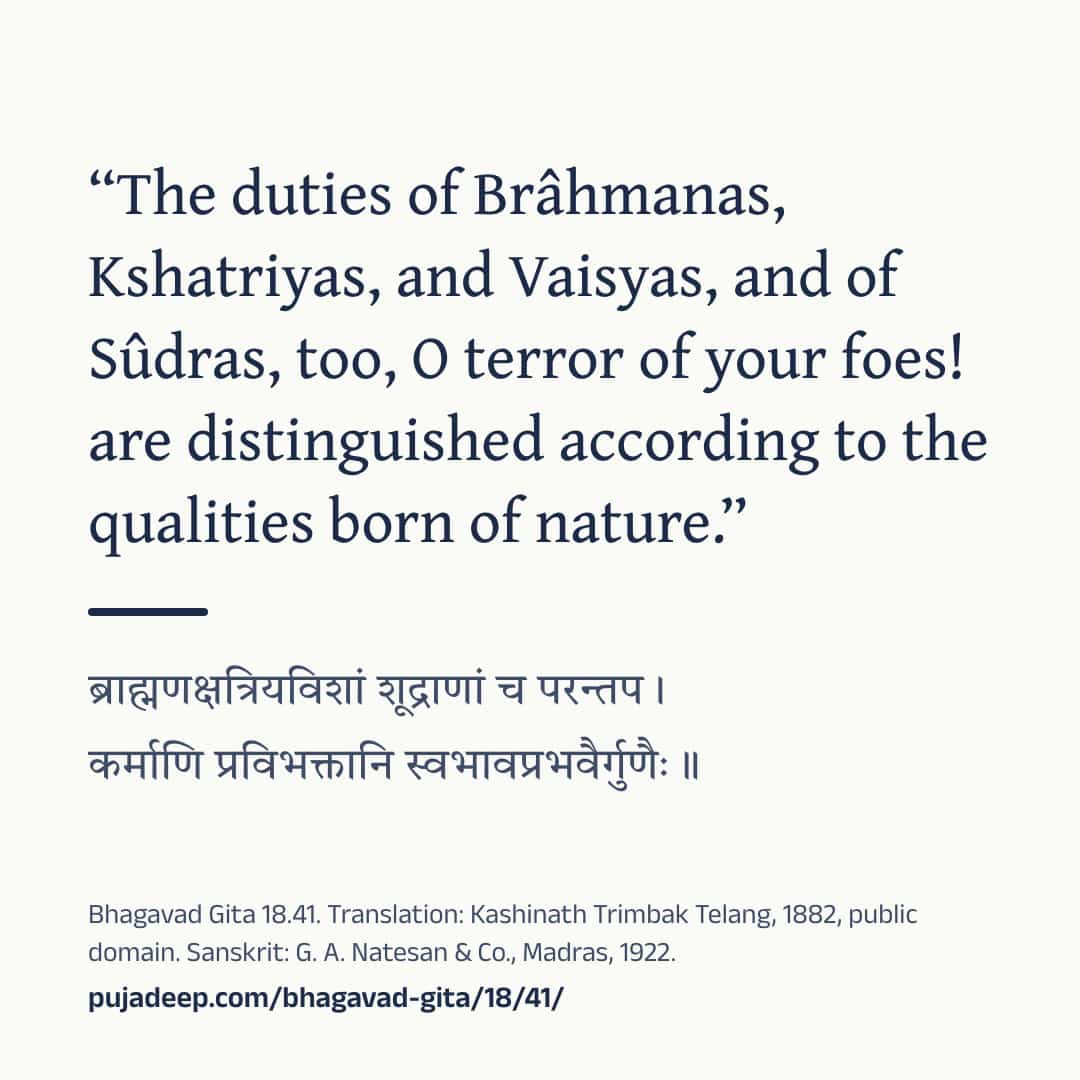
Drawing the picture
See the words
Bhagavad Gita 18.41

ब्राह्मणक्षत्रियविशां शूद्राणां च परन्तप ।
कर्माणि प्रविभक्तानि स्वभावप्रभवैर्गुणैः ॥

“The duties of Brâhmanas, Kshatriyas, and Vaisyas, and of Sûdras, too, O terror of your foes! are distinguished according to the qualities born of nature.”
(K. T. Telang, The Bhagavadgîtâ (The Sacred Books of the East, vol. VIII, Oxford: Clarendon Press, 1882), p. 126, public domain)

“Of Brâhmans, Kshattriyas, Vaishyas and Shûdras, O Parantapa, the Karmas have been distributed, according to the qualities born of their own natures.”
(Annie Besant, The Bhagavad Gîtâ, or The Lord's Song (London: Theosophical Publishing Society, 1895), p. 160, public domain)

“Of Bráhmanas and Kshatriyas and Vaishyas, as also of Shudras, O scorcher of foes, the duties are distributed according to the Gunas born of their own nature.”
(Swami Swarupananda, Srimad-Bhagavad-Gita (Mayavati: Prabuddha Bharata Press, 1909; first printed in Prabuddha Bharata, 1907–1909), pp. 336–337, public domain)

Sanskrit: G. A. Natesan & Co., Madras, 1922.
https://pujadeep.com/bhagavad-gita/18/41/ Nothing is sent from this site. Your own app sends it, to the chat you choose. The picture quotes the translation you chose on this page, with its name and year.
Sanskrit text: The Bhagavad-Gita, or The Lord's Song, with the text in Devanagari and an English translation, 1922. Meanings: written for Pujadeep and checked against the cited edition. Source and changes
Questions families ask
Who speaks Bhagavad Gita 18.41?
Krishna speaks this verse, in chapter 18 (Moksha Sannyasa Yoga).
Where does the Sanskrit text come from?
Sanskrit text: The Bhagavad-Gita, or The Lord's Song, with the text in Devanagari and an English translation, 1922. Meanings: written for Pujadeep and checked against the cited edition. See the source
Is the meaning on this page a translation?
Explanation written for this site from the sources listed here, and checked against the cited edition. It is not a translation and not the only way to read the text. Free to quote with credit.
Source and licence
- Sanskrit text
- The Bhagavad-Gita, or The Lord's Song, with the text in Devanagari and an English translation (Annie Besant, G. A. Natesan & Co., Madras, 1922). Public domain. The Sanskrit on these pages was read from this printing’s page images.
- Translation
- The Bhagavadgîtâ with the Sanatsugâtîya and the Anugîtâ, translated by Kâshinâth Trimbak Telang (The Sacred Books of the East, vol. VIII, ed. F. Max Müller) (Kashinath Trimbak Telang, F. Max Müller, Clarendon Press, Oxford, 1882). Public domain. Shown verbatim, as printed.
- Translation
- The Bhagavad Gîtâ, or The Lord's Song, translated by Annie Besant (Annie Besant, Theosophical Publishing Society, London, 1895). Public domain. Shown verbatim, as printed.
- Translation
- Srimad-Bhagavad-Gita, with Sanskrit Text; Paraphrase with Word-by-word Literal Translation; English Rendering and Comments, Index, &c., by the Swami Swarupananda (Himalayan Series, No. XX) (Swami Swarupananda, The Editors and Publishers, Advaita Ashrama, Mayavati, Prabuddha Bharata Press, Mayavati, Almora, Himalayas, 1909). Public domain. Shown verbatim, as printed.
- Commentary
- The Bhagavad-Gita, with the commentary of Sri Sankaracharya, translated by A. Mahadeva Sastri (2nd ed., Mysore: G. T. A. Printing Works, 1901) (Public-domain scan, University of California Libraries). Summarised in our own words; none of its text is reproduced.
- Commentary
- Sri Bhagavad-Gita with Sri Ramanujacharya's Visishtadvaita commentary, translated by A. Govindacharya (Madras, 1898) (Scan uploaded to archive.org (folkscanomy collection)). Summarised in our own words; none of its text is reproduced.
- Common wording
- In this text, 32 words follow today's common wording, checked against sanskritdocuments.org; Sanskrit Wikisource; Gita Press, Gorakhpur; GRETIL, Göttingen and Bhaktivedanta Book Trust.
- Our explanation
- Explanation written for this site from the sources listed here, and checked against the cited edition. It is not a translation and not the only way to read the text. Free to quote with credit.
- Checked
- Checked against the cited edition, October 15, 2026.
- Updated
- October 25, 2026