Bhagavad Gita 18.40: meaning and translation
Chapter 18: Moksha Sannyasa Yoga. Krishna says
Krishna says there is no being on earth, or among the gods in heaven, that is free from these three guṇas born of nature (prakṛti).
Click or tap a word for its meaning and its dictionary page.
Text and layers
Text and layers
These choices stay in this browser.
Bhagavad Gita 18.40
न तदस्ति पृथिव्यां वा दिवि देवेषु वा पुनः ।सत्त्वं प्रकृतिजैर्मुक्तं यदेभिः स्यात्त्रिभिर्गुणैः ॥
Na tadasti prithivyam va divi deveshu va punahSattvam prakritijairmuktam yadebhih syattribhirgunaih
na tadasti pṛthivyāṃ vā divi deveṣu vā punaḥ |sattvaṃ prakṛtijairmuktaṃ yadebhiḥ syāttribhirguṇaiḥ ||
Our explanation Krishna says there is no being on earth, or among the gods in heaven, that is free from these three guṇas born of nature (prakṛti).
हिंदी अर्थ कृष्ण कहते हैं कि पृथ्वी पर या स्वर्ग में देवताओं में भी ऐसा कोई प्राणी नहीं जो प्रकृति से उत्पन्न इन तीन गुणों से मुक्त हो।
Word by word
Every word, with its dictionary page
Word by word
- न na · not (indeclinable) Dictionary: 2. na, Monier-Williams 1899, p. 523, col. 1 “not, no, nor, neither”
- तत् tat · that (pronoun (neuter), nominative singular) Dictionary: tad, Monier-Williams 1899, p. 434, col. 1 “m. he, f. she, n. it, that, this”
- अस्ति asti · is (present, 3rd person singular) Dictionary: 1. as, Monier-Williams 1899, p. 117, col. 2 “to be, live, exist, be present”
- पृथिव्याम् pṛthivyām · on earth (noun (feminine), locative singular) Dictionary: pṛthivī, Monier-Williams 1899, p. 646, col. 1 “the earth or wide world”
- वा vā · or (indeclinable) Dictionary: 1. vā, Monier-Williams 1899, p. 934, col. 2 “ind. or”
- दिवि divi · in heaven (noun (feminine), locative singular) Dictionary: 3. div, Monier-Williams 1899, p. 478, col. 3 “heaven, the sky”
- देवेषु deveṣu · among the gods (noun (masculine), locative plural) Dictionary: deva, Monier-Williams 1899, p. 492, col. 2 “a deity, god”
- वा vā · or (indeclinable) Dictionary: 1. vā, Monier-Williams 1899, p. 934, col. 2 “ind. or”
- पुनः punaḥ · again (indeclinable) Dictionary: punar, Monier-Williams 1899, p. 633, col. 2 “again, once more”
- सत्त्वम् sattvam · being, creature (noun (neuter), nominative singular) Dictionary: sat-tva, Monier-Williams 1899, p. 1135, col. 2 “a living or sentient being, creature, animal”
- प्रकृतिजैः prakṛtijaiḥ · born of nature (prakṛti) (compound (masculine), instrumental plural) Dictionary: prakṛti-ja, Monier-Williams 1899, p. 654, col. 1 “springing from nature, inborn, innate”
- मुक्तम् muktam · free (past participle (neuter), nominative singular) Dictionary: mukta, Monier-Williams 1899, p. 820, col. 3 “liberated, delivered, emancipated (esp. from sin or worldly existence)”
- यत् yat · which (pronoun (neuter), nominative singular) Dictionary: yad, Monier-Williams 1899, p. 844, col. 2 “who, which, what, whichever, whatever, that”
- एभिः ebhiḥ · from these (pronoun (masculine), instrumental plural) Dictionary: 1. idam, Monier-Williams 1899, p. 165, col. 2 “this, this here, referring to something near the speaker”
- स्यात् syāt · may be (optative, 3rd person singular) Dictionary: 1. as, Monier-Williams 1899, p. 117, col. 2 “to be, live, exist, be present”
- त्रिभिः tribhiḥ · three (numeral (masculine), instrumental plural) Dictionary: tri, Monier-Williams 1899, p. 457, col. 3
- गुणैः guṇaiḥ · guṇas (noun (masculine), instrumental plural) Dictionary: guṇa, Monier-Williams 1899, p. 357, col. 1 “(in Sāṃkhya phil.) an ingredient or constituent of Prakṛiti, chief quality of all existing beings”
Old translations
Kashinath Trimbak Telang, 1882. Public domain. Page 126.
There is no entity either on earth or in heaven among the gods, which is free from these three qualities born of nature.
Compare 3 translations
Kashinath Trimbak Telang, 1882. Public domain. Page 126.
There is no entity either on earth or in heaven among the gods, which is free from these three qualities born of nature.
You are reading this one
Annie Besant, 1895. Public domain. Page 160.
There is not an entity, either on the earth or again in heaven among the Gods, that is liberated from these three qualities born of Prakriti.
You are reading this one
Swami Swarupananda, 1909 (first printed 1907). Public domain. Page 336.
There is no entity on earth, or again in heaven among the Devas, that is devoid of these three Gunas, born of Prakriti.
You are reading this one
Cite this verse
The translation: K. T. Telang, The Bhagavadgîtâ (The Sacred Books of the East, vol. VIII, Oxford: Clarendon Press, 1882), p. 126. Bhagavad Gita 18.40.
The translation: Annie Besant, The Bhagavad Gîtâ, or The Lord's Song (London: Theosophical Publishing Society, 1895), p. 160. Bhagavad Gita 18.40.
The translation: Swami Swarupananda, Srimad-Bhagavad-Gita (Mayavati: Prabuddha Bharata Press, 1909; first printed in Prabuddha Bharata, 1907–1909), p. 336. Bhagavad Gita 18.40.
Our explanation: “Bhagavad Gita 18.40: meaning and translation.” Pujadeep. Updated October 25, 2026. https://pujadeep.com/bhagavad-gita/18/40/
Pujadeep’s explanations are free to quote with credit: name Pujadeep and link to the page. How to credit
Classical readings, by school
No readings by school on this verse yet.
Share
Show the ways to share
Send one picture or the text to one chat. The picture names its source and the address of this page.
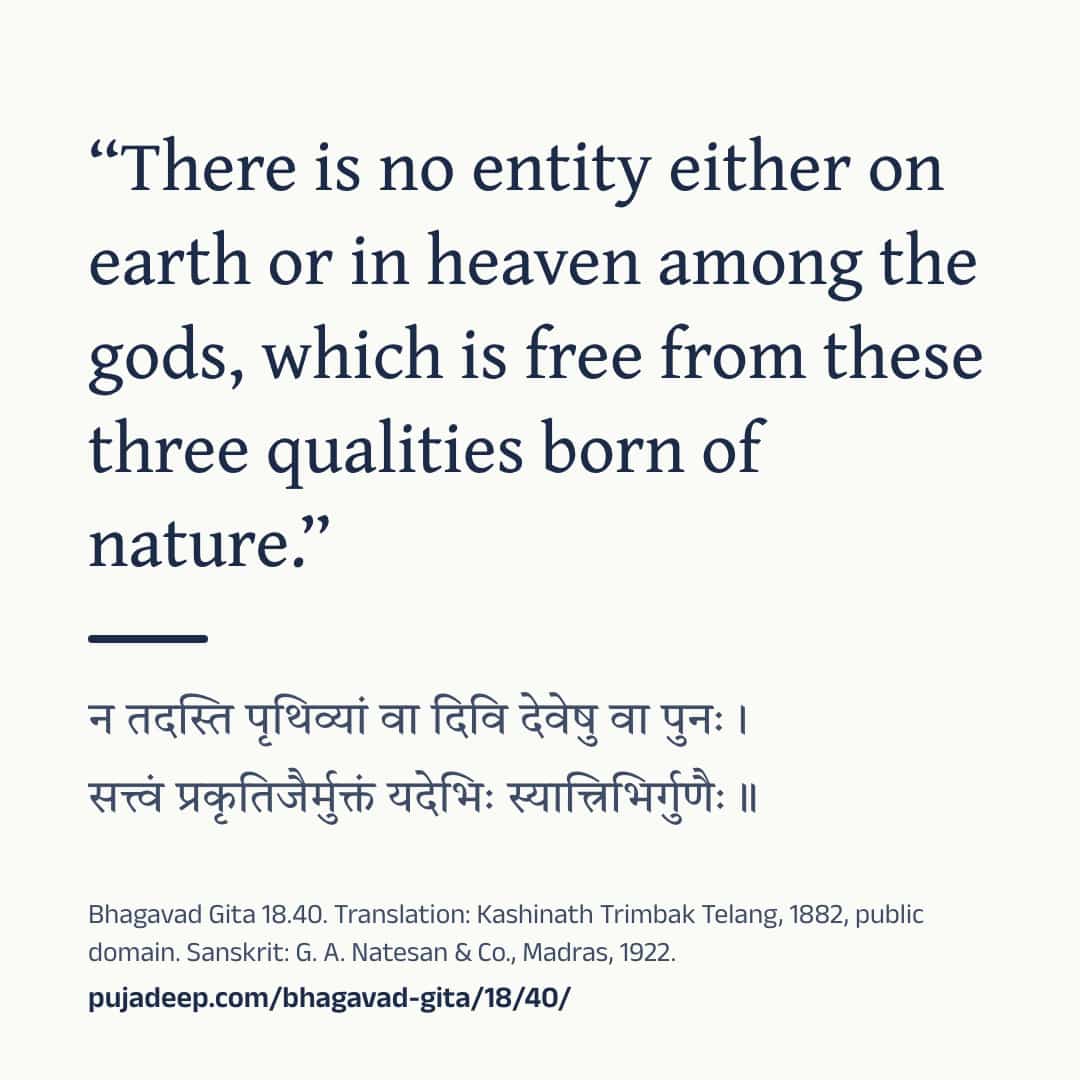
Drawing the picture
See the words
Bhagavad Gita 18.40

न तदस्ति पृथिव्यां वा दिवि देवेषु वा पुनः ।
सत्त्वं प्रकृतिजैर्मुक्तं यदेभिः स्यात्त्रिभिर्गुणैः ॥

“There is no entity either on earth or in heaven among the gods, which is free from these three qualities born of nature.”
(K. T. Telang, The Bhagavadgîtâ (The Sacred Books of the East, vol. VIII, Oxford: Clarendon Press, 1882), p. 126, public domain)

“There is not an entity, either on the earth or again in heaven among the Gods, that is liberated from these three qualities born of Prakriti.”
(Annie Besant, The Bhagavad Gîtâ, or The Lord's Song (London: Theosophical Publishing Society, 1895), p. 160, public domain)

“There is no entity on earth, or again in heaven among the Devas, that is devoid of these three Gunas, born of Prakriti.”
(Swami Swarupananda, Srimad-Bhagavad-Gita (Mayavati: Prabuddha Bharata Press, 1909; first printed in Prabuddha Bharata, 1907–1909), p. 336, public domain)

Sanskrit: G. A. Natesan & Co., Madras, 1922.
https://pujadeep.com/bhagavad-gita/18/40/ Nothing is sent from this site. Your own app sends it, to the chat you choose. The picture quotes the translation you chose on this page, with its name and year.
Sanskrit text: The Bhagavad-Gita, or The Lord's Song, with the text in Devanagari and an English translation, 1922. Meanings: written for Pujadeep and checked against the cited edition. Source and changes
Questions families ask
Who speaks Bhagavad Gita 18.40?
Krishna speaks this verse, in chapter 18 (Moksha Sannyasa Yoga).
Where does the Sanskrit text come from?
Sanskrit text: The Bhagavad-Gita, or The Lord's Song, with the text in Devanagari and an English translation, 1922. Meanings: written for Pujadeep and checked against the cited edition. See the source
Is the meaning on this page a translation?
Explanation written for this site from the sources listed here, and checked against the cited edition. It is not a translation and not the only way to read the text. Free to quote with credit.
Source and licence
- Sanskrit text
- The Bhagavad-Gita, or The Lord's Song, with the text in Devanagari and an English translation (Annie Besant, G. A. Natesan & Co., Madras, 1922). Public domain. The Sanskrit on these pages was read from this printing’s page images.
- Translation
- The Bhagavadgîtâ with the Sanatsugâtîya and the Anugîtâ, translated by Kâshinâth Trimbak Telang (The Sacred Books of the East, vol. VIII, ed. F. Max Müller) (Kashinath Trimbak Telang, F. Max Müller, Clarendon Press, Oxford, 1882). Public domain. Shown verbatim, as printed.
- Translation
- The Bhagavad Gîtâ, or The Lord's Song, translated by Annie Besant (Annie Besant, Theosophical Publishing Society, London, 1895). Public domain. Shown verbatim, as printed.
- Translation
- Srimad-Bhagavad-Gita, with Sanskrit Text; Paraphrase with Word-by-word Literal Translation; English Rendering and Comments, Index, &c., by the Swami Swarupananda (Himalayan Series, No. XX) (Swami Swarupananda, The Editors and Publishers, Advaita Ashrama, Mayavati, Prabuddha Bharata Press, Mayavati, Almora, Himalayas, 1909). Public domain. Shown verbatim, as printed.
- Common wording
- In this text, 32 words follow today's common wording, checked against sanskritdocuments.org; Sanskrit Wikisource; Gita Press, Gorakhpur; GRETIL, Göttingen and Bhaktivedanta Book Trust.
- Our explanation
- Explanation written for this site from the sources listed here, and checked against the cited edition. It is not a translation and not the only way to read the text. Free to quote with credit.
- Checked
- Checked against the cited edition, October 15, 2026.
- Updated
- October 25, 2026