Bhagavad Gita 18.36: meaning and translation
Chapter 18: Moksha Sannyasa Yoga. Krishna says
Krishna turns to happiness.
Click or tap a word for its meaning and its dictionary page.
Text and layers
Text and layers
These choices stay in this browser.
Bhagavad Gita 18.36
सुखं त्विदानीं त्रिविधं शृणु मे भरतर्षभ ।अभ्यासाद्रमते यत्र दुःखान्तं च निगच्छति ॥
Sukham tvidanim trividham shrinu me bharatarshabhaAbhyasadramate yatra duhkhantam cha nigachchhati
sukhaṃ tvidānīṃ trividhaṃ śṛṇu me bharatarṣabha |abhyāsādramate yatra duḥkhāntaṃ ca nigacchati ||
Our explanation Krishna turns to happiness. He asks Arjuna to hear about its three kinds: the happiness in which one comes to delight through practice, and in which sorrow comes to an end.
हिंदी अर्थ अब कृष्ण सुख की बात करते हैं। वे अर्जुन से तीन प्रकार के सुख के बारे में सुनने को कहते हैं: वह सुख जिसमें व्यक्ति अभ्यास से रमता है और जिसमें दुःख का अंत होता है।
Word by word
Every word, with its dictionary page
Word by word
- सुखम् sukham · happiness (noun (neuter), accusative singular) Dictionary: sukha, Monier-Williams 1899, p. 1221, col. 1 “ease, easiness, comfort, prosperity, pleasure, happiness”
- तु tu · and (indeclinable) Dictionary: 2. tu, Monier-Williams 1899, p. 449, col. 3 “but”
- इदानीम् idānīm · now (indeclinable) Dictionary: i-dānīm, Monier-Williams 1899, p. 165, col. 3 “now, at this moment”
- त्रिविधम् trividham · threefold (adjective (neuter), accusative singular) Dictionary: tri-vidha, Monier-Williams 1899, p. 460, col. 2 “of 3 kinds, triple, threefold”
- शृणु śṛṇu · hear (imperative, 2nd person singular) Dictionary: 1. śru, Monier-Williams 1899, p. 1100, col. 3 “to hear, listen or attend to anything”
- मे me · from "me" (Krishna) (pronoun, genitive singular) Dictionary: 1. mad, Monier-Williams 1899, p. 777, col. 2 “base of the first pers. pron. in the sg. number (esp. in comp.)”
- भरतर्षभ bharatarṣabha · O best of the Bharatas (compound (masculine), vocative singular) Dictionary: bharata-ṛṣabha, Monier-Williams 1899, p. 747, col. 3 “the best or a prince (lit. ‘bull’) of the Bh°s”
- अभ्यासात् abhyāsāt · by practice (noun (masculine), ablative singular) Dictionary: 2. abhy-āsa, Monier-Williams 1899, p. 76, col. 3 “repeated or permanent exercise”
- रमते ramate · one delights (present, 3rd person singular) Dictionary: ram, Monier-Williams 1899, p. 867, col. 2 “to be glad or pleased, rejoice at, delight in, be fond of (loc., instr. or inf.)”
- यत्र yatra · in which (indeclinable) Dictionary: yatra, Monier-Williams 1899, p. 841, col. 2 “in or to which place, where, wherein, wherever”
- दुःखान्तम् duḥkhāntam · the end of sorrow (compound (masculine), accusative singular) Dictionary: 1. duḥkha, Monier-Williams 1899, p. 483, col. 2 “uneasiness, pain, sorrow, trouble, difficulty”; anta, Monier-Williams 1899, p. 42, col. 3 “end, limit, boundary, term”
- च ca · and (indeclinable) Dictionary: 2. ca, Monier-Williams 1899, p. 380, col. 1 “and, both, also, moreover, as well as”
- निगच्छति nigacchati · reaches (present, 3rd person singular) Dictionary: ni-gam, Monier-Williams 1899, p. 545, col. 3 “to enter, resort to, undergo, incur, become”
Old translations
Kashinath Trimbak Telang, 1882. Public domain. Page 126.
Now, O chief of the descendants of Bharata! hear from me about the three sorts of happiness. That happiness is called good, in which one is pleased after repetition1 (of enjoyment), and reaches the close of all misery, which is like poison first and comparable to nectar in the long run, and which is produced from a clear knowledge of the self2.
This sentence covers verses 18.36 to 18.37.
Footnotes (the translator’s own) Compare 3 translations
Kashinath Trimbak Telang, 1882. Public domain. Page 126.
Now, O chief of the descendants of Bharata! hear from me about the three sorts of happiness. That happiness is called good, in which one is pleased after repetition1 (of enjoyment), and reaches the close of all misery, which is like poison first and comparable to nectar in the long run, and which is produced from a clear knowledge of the self2.
This sentence covers verses 18.36 to 18.37.
Footnotes (the translator’s own) You are reading this one
Annie Besant, 1895. Public domain. Page 159.
And now the threefold kinds of pleasure hear thou from Me, O bull of the Bhâratas; that in which one by practice rejoiceth, and which putteth an end to pain;
This sentence goes on in 18.37.
You are reading this one
Swami Swarupananda, 1909 (first printed 1907). Public domain. Page 334.
And now hear from Me, O bull of the Bháratas, of the threefold happiness. That happiness which one learns to enjoy by habit, and by which one comes to the end of pain;
This sentence goes on in 18.37.
You are reading this one
Cite this verse
The translation: K. T. Telang, The Bhagavadgîtâ (The Sacred Books of the East, vol. VIII, Oxford: Clarendon Press, 1882), p. 126. Bhagavad Gita 18.36–37.
The translation: Annie Besant, The Bhagavad Gîtâ, or The Lord's Song (London: Theosophical Publishing Society, 1895), p. 159. Bhagavad Gita 18.36.
The translation: Swami Swarupananda, Srimad-Bhagavad-Gita (Mayavati: Prabuddha Bharata Press, 1909; first printed in Prabuddha Bharata, 1907–1909), p. 334. Bhagavad Gita 18.36.
Our explanation: “Bhagavad Gita 18.36: meaning and translation.” Pujadeep. Updated October 25, 2026. https://pujadeep.com/bhagavad-gita/18/36/
Pujadeep’s explanations are free to quote with credit: name Pujadeep and link to the page. How to credit
Classical readings, by school
No readings by school on this verse yet.
Share
Show the ways to share
Send one picture or the text to one chat. The picture names its source and the address of this page.
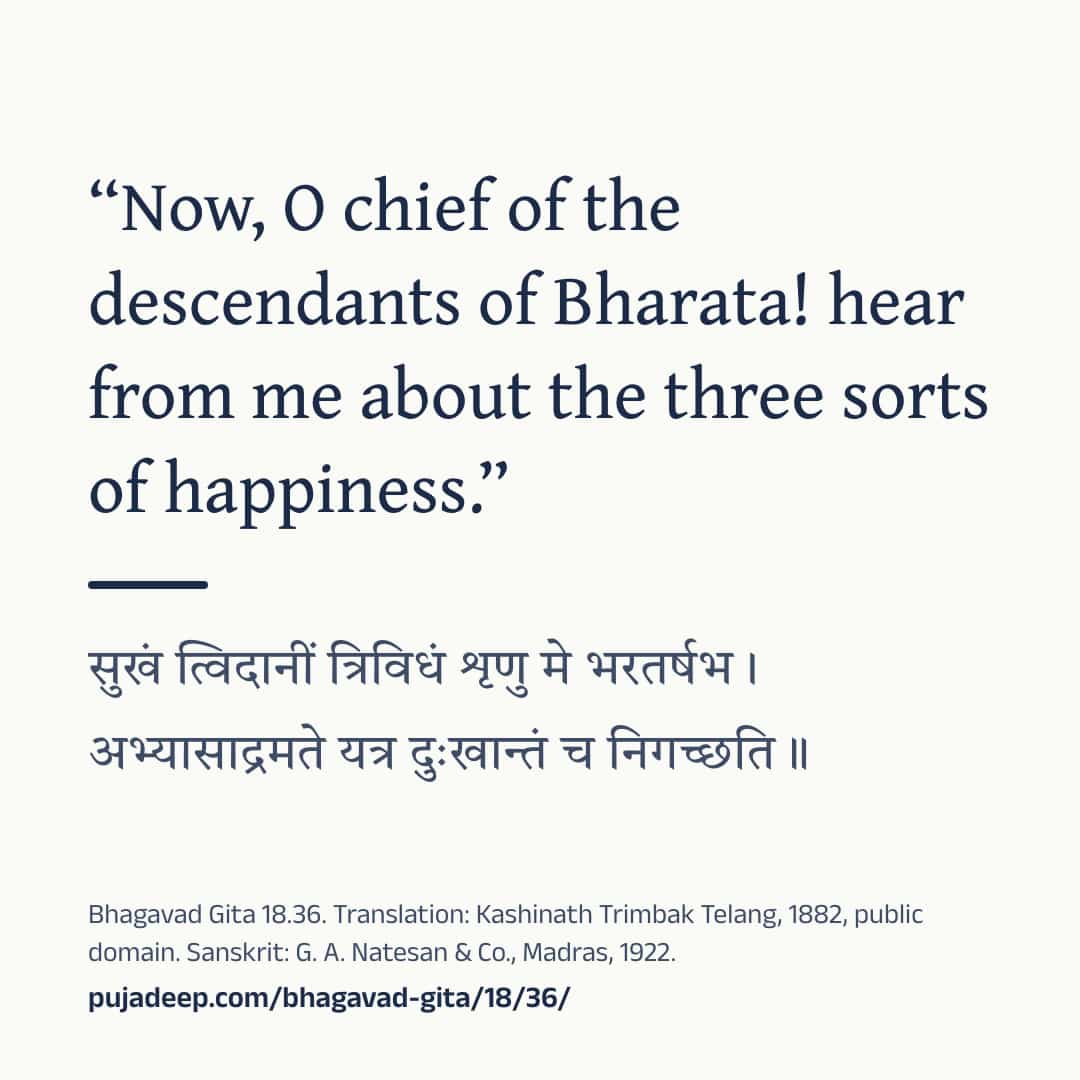
Drawing the picture
See the words
Bhagavad Gita 18.36

सुखं त्विदानीं त्रिविधं शृणु मे भरतर्षभ ।
अभ्यासाद्रमते यत्र दुःखान्तं च निगच्छति ॥

“Now, O chief of the descendants of Bharata! hear from me about the three sorts of happiness. That happiness is called good, in which one is pleased after repetition (of enjoyment), and reaches the close of all misery, which is like poison first and comparable to nectar in the long run, and which is produced from a clear knowledge of the self.”
(K. T. Telang, The Bhagavadgîtâ (The Sacred Books of the East, vol. VIII, Oxford: Clarendon Press, 1882), p. 126, public domain)
This sentence covers verses 18.36 to 18.37.

“And now the threefold kinds of pleasure hear thou from Me, O bull of the Bhâratas; that in which one by practice rejoiceth, and which putteth an end to pain;”
(Annie Besant, The Bhagavad Gîtâ, or The Lord's Song (London: Theosophical Publishing Society, 1895), p. 159, public domain)
This sentence goes on in 18.37.

“And now hear from Me, O bull of the Bháratas, of the threefold happiness. That happiness which one learns to enjoy by habit, and by which one comes to the end of pain;”
(Swami Swarupananda, Srimad-Bhagavad-Gita (Mayavati: Prabuddha Bharata Press, 1909; first printed in Prabuddha Bharata, 1907–1909), p. 334, public domain)
This sentence goes on in 18.37.

Sanskrit: G. A. Natesan & Co., Madras, 1922.
https://pujadeep.com/bhagavad-gita/18/36/ Nothing is sent from this site. Your own app sends it, to the chat you choose. The picture quotes the translation you chose on this page, with its name and year.
Sanskrit text: The Bhagavad-Gita, or The Lord's Song, with the text in Devanagari and an English translation, 1922. Meanings: written for Pujadeep and checked against the cited edition. Source and changes
Questions families ask
Who speaks Bhagavad Gita 18.36?
Krishna speaks this verse, in chapter 18 (Moksha Sannyasa Yoga).
Where does the Sanskrit text come from?
Sanskrit text: The Bhagavad-Gita, or The Lord's Song, with the text in Devanagari and an English translation, 1922. Meanings: written for Pujadeep and checked against the cited edition. See the source
Is the meaning on this page a translation?
Explanation written for this site from the sources listed here, and checked against the cited edition. It is not a translation and not the only way to read the text. Free to quote with credit.
Source and licence
- Sanskrit text
- The Bhagavad-Gita, or The Lord's Song, with the text in Devanagari and an English translation (Annie Besant, G. A. Natesan & Co., Madras, 1922). Public domain. The Sanskrit on these pages was read from this printing’s page images.
- Translation
- The Bhagavadgîtâ with the Sanatsugâtîya and the Anugîtâ, translated by Kâshinâth Trimbak Telang (The Sacred Books of the East, vol. VIII, ed. F. Max Müller) (Kashinath Trimbak Telang, F. Max Müller, Clarendon Press, Oxford, 1882). Public domain. Shown verbatim, as printed.
- Translation
- The Bhagavad Gîtâ, or The Lord's Song, translated by Annie Besant (Annie Besant, Theosophical Publishing Society, London, 1895). Public domain. Shown verbatim, as printed.
- Translation
- Srimad-Bhagavad-Gita, with Sanskrit Text; Paraphrase with Word-by-word Literal Translation; English Rendering and Comments, Index, &c., by the Swami Swarupananda (Himalayan Series, No. XX) (Swami Swarupananda, The Editors and Publishers, Advaita Ashrama, Mayavati, Prabuddha Bharata Press, Mayavati, Almora, Himalayas, 1909). Public domain. Shown verbatim, as printed.
- Common wording
- In this text, 32 words follow today's common wording, checked against sanskritdocuments.org; Sanskrit Wikisource; Gita Press, Gorakhpur; GRETIL, Göttingen and Bhaktivedanta Book Trust.
- Our explanation
- Explanation written for this site from the sources listed here, and checked against the cited edition. It is not a translation and not the only way to read the text. Free to quote with credit.
- Checked
- Checked against the cited edition, October 15, 2026.
- Updated
- October 25, 2026