Bhagavad Gita 18.48: meaning and translation
Chapter 18: Moksha Sannyasa Yoga. Krishna says
Krishna tells Arjuna, son of Kunti, that one should not give up the work one is born to (sahaja karma), even if it has faults, for every undertaking is covered by some fault, as fire by smoke.
Click or tap a word for its meaning and its dictionary page.
Text and layers
Text and layers
These choices stay in this browser.
Bhagavad Gita 18.48
सहजं कर्म कौन्तेय सदोषमपि न त्यजेत् ।सर्वारम्भा हि दोषेण धूमेनाग्निरिवावृताः ॥
Sahajam karma kaunteya sadoshamapi na tyajetSarvarambha hi doshena dhumenagnirivavritah
sahajaṃ karma kaunteya sadoṣamapi na tyajet |sarvārambhā hi doṣeṇa dhūmenāgnirivāvṛtāḥ ||
Our explanation Krishna tells Arjuna, son of Kunti, that one should not give up the work one is born to (sahaja karma), even if it has faults, for every undertaking is covered by some fault, as fire by smoke. Readings of these verses differ between schools and teachers, and the wording is the text's, not the view of this library.
हिंदी अर्थ कृष्ण अर्जुन (कौन्तेय) से कहते हैं कि सहज कर्म (जन्म के साथ मिला कर्म) दोषयुक्त हो तो भी नहीं छोड़ना चाहिए, क्योंकि हर आरंभ किसी दोष से ढका रहता है, जैसे आग धुएँ से। इन श्लोकों को अलग-अलग परंपराएँ और आचार्य अलग ढंग से पढ़ते हैं, और ये शब्द पाठ के हैं, इस पुस्तकालय का मत नहीं।
Word by word
Every word, with its dictionary page
Word by word
- सहजम् sahajam · born with one (compound (neuter), accusative singular) Dictionary: saha-ja, Monier-Williams 1899, p. 1193, col. 3 “congenital, innate, hereditary, original, natural”
- कर्म karma · work (noun (neuter), accusative singular) Dictionary: karman, Monier-Williams 1899, p. 258, col. 2 “act, action, performance, business”
- कौन्तेय kaunteya · O son of Kunti (noun (masculine), vocative singular) Dictionary: kaunteya, Monier-Williams 1899, p. 316, col. 2 “metron. fr. Kuntī, N. of Yudhishṭhira, Bhīma-sena, and Arjuna”
- सदोषम् sadoṣam · with its fault (compound (neuter), accusative singular) Dictionary: 7. sa, Monier-Williams 1899, p. 1111, col. 2 “together or along with”; 2. doṣa, Monier-Williams 1899, p. 498, col. 2 “fault, vice, deficiency, want, inconvenience, disadvantage”
- अपि api · even (indeclinable) Dictionary: api, Monier-Williams 1899, p. 55, col. 1 “in the sense of even, also, very”
- न na · not (indeclinable) Dictionary: 2. na, Monier-Williams 1899, p. 523, col. 1 “not, no, nor, neither”
- त्यजेत् tyajet · one should give up (optative, 3rd person singular) Dictionary: 1. tyaj, Monier-Williams 1899, p. 456, col. 3 “to leave, abandon, quit”
- सर्वारम्भाः sarvārambhāḥ · all undertakings (compound (masculine), nominative plural) Dictionary: sarva, Monier-Williams 1899, p. 1184, col. 3 “whole, entire, all, every”; ā-rambha, Monier-Williams 1899, p. 150, col. 1 “undertaking, beginning”
- हि hi · for (indeclinable) Dictionary: 2. hi, Monier-Williams 1899, p. 1297, col. 3 “for, because, on account of”
- दोषेण doṣeṇa · by fault (noun (masculine), instrumental singular) Dictionary: 2. doṣa, Monier-Williams 1899, p. 498, col. 2 “fault, vice, deficiency, want, inconvenience, disadvantage”
- धूमेन dhūmena · by smoke (noun (masculine), instrumental singular) Dictionary: dhūma, Monier-Williams 1899, p. 518, col. 1 “smoke, vapour, mist”
- अग्निः agniḥ · fire (noun (masculine), nominative singular) Dictionary: agni, Monier-Williams 1899, p. 5, col. 1 “fire; sacrificial fire”
- इव iva · like (indeclinable) Dictionary: iva, Monier-Williams 1899, p. 168, col. 3 “like, in the same manner as”
- आवृताः āvṛtāḥ · are covered (past participle (masculine), nominative plural) Dictionary: ā-vṛta, Monier-Williams 1899, p. 156, col. 1 “covered, concealed, hid”
Old translations
Kashinath Trimbak Telang, 1882. Public domain. Page 127.
O son of Kuntî! one should not abandon a natural duty though tainted with evil; for all actions are enveloped by evil, as fire by smoke1.
Footnotes (the translator’s own) - Cf. p. 121; the evil appears to be the quality of 'fettering' the soul. ↩
Compare 3 translations
Kashinath Trimbak Telang, 1882. Public domain. Page 127.
O son of Kuntî! one should not abandon a natural duty though tainted with evil; for all actions are enveloped by evil, as fire by smoke1.
Footnotes (the translator’s own) - Cf. p. 121; the evil appears to be the quality of 'fettering' the soul. ↩
You are reading this one
Annie Besant, 1895. Public domain. Page 161–162.
Nature-born Karma, O son of Kuntî, though (attended with) evil, one ought not to renounce. All undertakings are enveloped by evil as fire by smoke.
You are reading this one
Swami Swarupananda, 1909 (first printed 1907). Public domain. Page 340.
One should not relinquish, O son of Kunti, the duty to which he is born, though it is attended with evil, for all undertakings are enveloped by evil, as fire by smoke.
You are reading this one
Cite this verse
The translation: K. T. Telang, The Bhagavadgîtâ (The Sacred Books of the East, vol. VIII, Oxford: Clarendon Press, 1882), p. 127. Bhagavad Gita 18.48.
The translation: Annie Besant, The Bhagavad Gîtâ, or The Lord's Song (London: Theosophical Publishing Society, 1895), pp. 161–162. Bhagavad Gita 18.48.
The translation: Swami Swarupananda, Srimad-Bhagavad-Gita (Mayavati: Prabuddha Bharata Press, 1909; first printed in Prabuddha Bharata, 1907–1909), p. 340. Bhagavad Gita 18.48.
Our explanation: “Bhagavad Gita 18.48: meaning and translation.” Pujadeep. Updated October 25, 2026. https://pujadeep.com/bhagavad-gita/18/48/
Pujadeep’s explanations are free to quote with credit: name Pujadeep and link to the page. How to credit
Classical readings, by school
Each reading is named by its school. None is presented as the only meaning.
What Advaita, Vishishtadvaita and Dvaita teach, in short
Shankara Advaita
Shankara reads sahaja as the duty born with a person's birth. Every duty, one's own or another's, has faults because all is made of the three guṇas; and one who does not know the Self cannot give up action entirely, so he should not abandon his own.
Source: The Bhagavad-Gita, with the commentary of Sri Sankaracharya, translated by A. Mahadeva Sastri (2nd ed., Mysore: G. T. A. Printing Works, 1901), commentary on 18.48, pp. 430–431. Summarised in our own words; none of its text is reproduced.
Ramanuja Vishishtadvaita
Ramanuja reads the verse as advice that even one able to follow the path of knowledge should follow karma-yoga. Both paths have faults and pain, he says, but karma-yoga is easy and free of danger.
Source: Sri Bhagavad-Gita with Sri Ramanujacharya's Visishtadvaita commentary, translated by A. Govindacharya (Madras, 1898), commentary on 18.48, p. 553. Summarised in our own words; none of its text is reproduced.
Share
Show the ways to share
Send one picture or the text to one chat. The picture names its source and the address of this page.
Drawing the picture
See the words
Bhagavad Gita 18.48

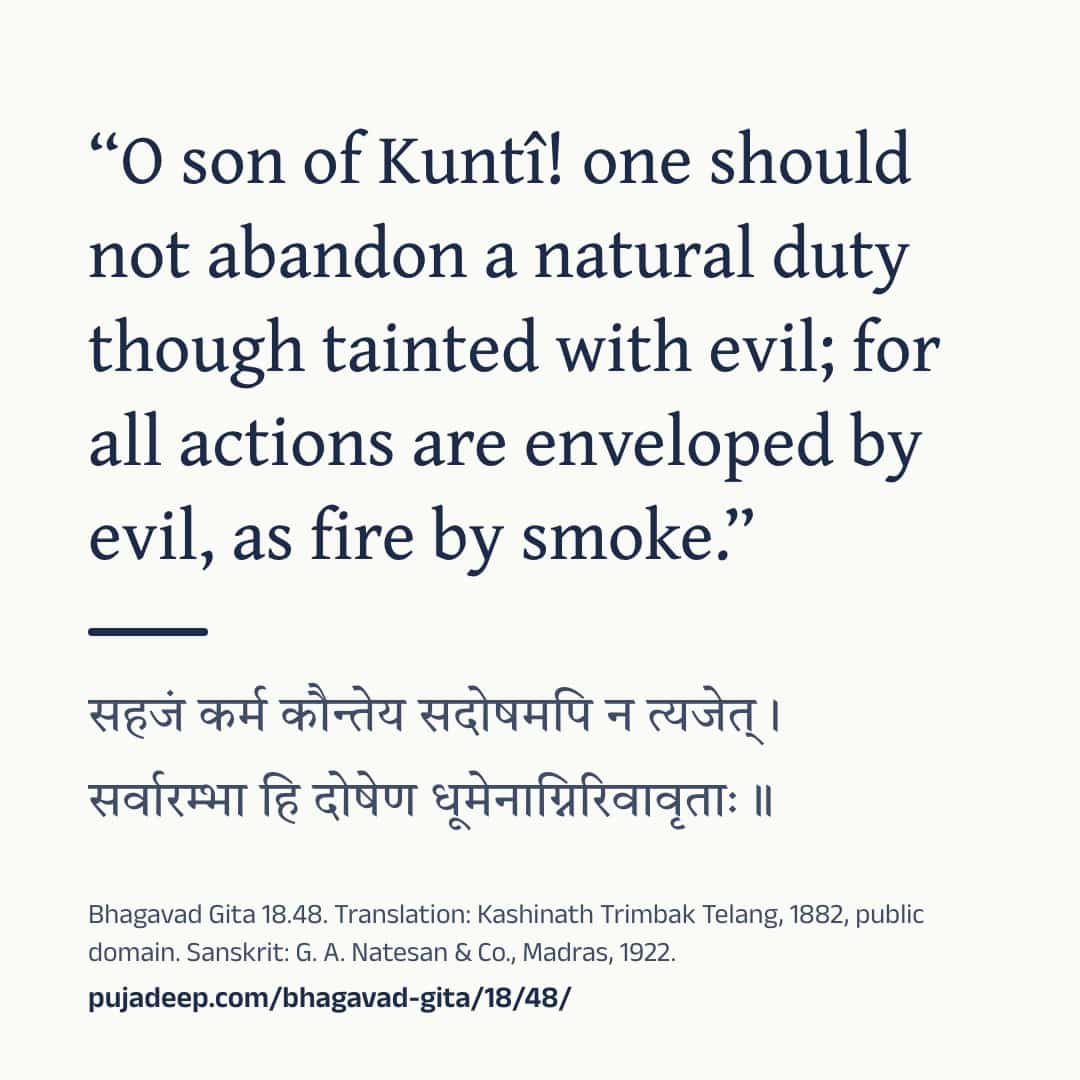
सहजं कर्म कौन्तेय सदोषमपि न त्यजेत् ।
सर्वारम्भा हि दोषेण धूमेनाग्निरिवावृताः ॥

“O son of Kuntî! one should not abandon a natural duty though tainted with evil; for all actions are enveloped by evil, as fire by smoke.”
(K. T. Telang, The Bhagavadgîtâ (The Sacred Books of the East, vol. VIII, Oxford: Clarendon Press, 1882), p. 127, public domain)

“Nature-born Karma, O son of Kuntî, though (attended with) evil, one ought not to renounce. All undertakings are enveloped by evil as fire by smoke.”
(Annie Besant, The Bhagavad Gîtâ, or The Lord's Song (London: Theosophical Publishing Society, 1895), pp. 161–162, public domain)

“One should not relinquish, O son of Kunti, the duty to which he is born, though it is attended with evil, for all undertakings are enveloped by evil, as fire by smoke.”
(Swami Swarupananda, Srimad-Bhagavad-Gita (Mayavati: Prabuddha Bharata Press, 1909; first printed in Prabuddha Bharata, 1907–1909), p. 340, public domain)

Sanskrit: G. A. Natesan & Co., Madras, 1922.
https://pujadeep.com/bhagavad-gita/18/48/ Nothing is sent from this site. Your own app sends it, to the chat you choose. The picture quotes the translation you chose on this page, with its name and year.
Sanskrit text: The Bhagavad-Gita, or The Lord's Song, with the text in Devanagari and an English translation, 1922. Meanings: written for Pujadeep and checked against the cited edition. Source and changes
Questions families ask
Who speaks Bhagavad Gita 18.48?
Krishna speaks this verse, in chapter 18 (Moksha Sannyasa Yoga).
Where does the Sanskrit text come from?
Sanskrit text: The Bhagavad-Gita, or The Lord's Song, with the text in Devanagari and an English translation, 1922. Meanings: written for Pujadeep and checked against the cited edition. See the source
Is the meaning on this page a translation?
Explanation written for this site from the sources listed here, and checked against the cited edition. It is not a translation and not the only way to read the text. Free to quote with credit.
Source and licence
- Sanskrit text
- The Bhagavad-Gita, or The Lord's Song, with the text in Devanagari and an English translation (Annie Besant, G. A. Natesan & Co., Madras, 1922). Public domain. The Sanskrit on these pages was read from this printing’s page images.
- Translation
- The Bhagavadgîtâ with the Sanatsugâtîya and the Anugîtâ, translated by Kâshinâth Trimbak Telang (The Sacred Books of the East, vol. VIII, ed. F. Max Müller) (Kashinath Trimbak Telang, F. Max Müller, Clarendon Press, Oxford, 1882). Public domain. Shown verbatim, as printed.
- Translation
- The Bhagavad Gîtâ, or The Lord's Song, translated by Annie Besant (Annie Besant, Theosophical Publishing Society, London, 1895). Public domain. Shown verbatim, as printed.
- Translation
- Srimad-Bhagavad-Gita, with Sanskrit Text; Paraphrase with Word-by-word Literal Translation; English Rendering and Comments, Index, &c., by the Swami Swarupananda (Himalayan Series, No. XX) (Swami Swarupananda, The Editors and Publishers, Advaita Ashrama, Mayavati, Prabuddha Bharata Press, Mayavati, Almora, Himalayas, 1909). Public domain. Shown verbatim, as printed.
- Commentary
- The Bhagavad-Gita, with the commentary of Sri Sankaracharya, translated by A. Mahadeva Sastri (2nd ed., Mysore: G. T. A. Printing Works, 1901) (Public-domain scan, University of California Libraries). Summarised in our own words; none of its text is reproduced.
- Commentary
- Sri Bhagavad-Gita with Sri Ramanujacharya's Visishtadvaita commentary, translated by A. Govindacharya (Madras, 1898) (Scan uploaded to archive.org (folkscanomy collection)). Summarised in our own words; none of its text is reproduced.
- Common wording
- In this text, 32 words follow today's common wording, checked against sanskritdocuments.org; Sanskrit Wikisource; Gita Press, Gorakhpur; GRETIL, Göttingen and Bhaktivedanta Book Trust.
- Our explanation
- Explanation written for this site from the sources listed here, and checked against the cited edition. It is not a translation and not the only way to read the text. Free to quote with credit.
- Checked
- Checked against the cited edition, October 15, 2026.
- Updated
- October 25, 2026