Bhagavad Gita 18.47: meaning and translation
Chapter 18: Moksha Sannyasa Yoga. Krishna says
Krishna says that one's own dharma, even done imperfectly, is better than another's dharma done well, and that doing the work set by one's own nature brings no sin.
Click or tap a word for its meaning and its dictionary page.
Text and layers
Text and layers
These choices stay in this browser.
Bhagavad Gita 18.47
श्रेयान् स्वधर्मो विगुणः परधर्मात्स्वनुष्ठितात् ।स्वभावनियतं कर्म कुर्वन्नाप्नोति किल्बिषम् ॥
Shreyan svadharmo vigunah paradharmatsvanushthitatSvabhavaniyatam karma kurvannapnoti kilbisham
śreyān svadharmo viguṇaḥ paradharmātsvanuṣṭhitāt |svabhāvaniyataṃ karma kurvannāpnoti kilbiṣam ||
Our explanation Krishna says that one's own dharma, even done imperfectly, is better than another's dharma done well, and that doing the work set by one's own nature brings no sin. The same half-line is in 3.35. The schools read 'one's own dharma' differently (see the views). Readings of these verses differ between schools and teachers, and the wording is the text's, not the view of this library.
हिंदी अर्थ कृष्ण कहते हैं कि अपना धर्म, गुणरहित होने पर भी, अच्छी तरह किए गए दूसरे के धर्म से श्रेष्ठ है, और अपने स्वभाव से नियत कर्म करने वाला पाप का भागी नहीं होता। यही आधी पंक्ति 3.35 में भी है। “अपने धर्म” को परंपराएँ अलग-अलग ढंग से पढ़ती हैं। इन श्लोकों को अलग-अलग परंपराएँ और आचार्य अलग ढंग से पढ़ते हैं, और ये शब्द पाठ के हैं, इस पुस्तकालय का मत नहीं।
Word by word
Every word, with its dictionary page
Word by word
- श्रेयान् śreyān · better (adjective (masculine), nominative singular) Dictionary: śreyas, Monier-Williams 1899, p. 1102, col. 2 “more excellent or distinguished, superior, preferable, better, better than”
- स्वधर्मः svadharmaḥ · one's own dharma (compound (masculine), nominative singular) Dictionary: sva-dharma, Monier-Williams 1899, p. 1275, col. 3 “o° own duty”
- विगुणः viguṇaḥ · without merit, imperfect (adjective (masculine), nominative singular) Dictionary: vi-guṇa, Monier-Williams 1899, p. 950, col. 2 “deficient, imperfect, destitute of (comp.)”
- परधर्मात् paradharmāt · than another's dharma (compound (masculine), ablative singular) Dictionary: 1. para, Monier-Williams 1899, p. 586, col. 2 “other than, different from”; 1. dharma, Monier-Williams 1899, p. 510, col. 3 “usage, practice, customary observance or prescribed conduct, duty”
- स्वनुष्ठितात् svanuṣṭhitāt · well carried out (past participle (masculine), ablative singular) Dictionary: 5. su, Monier-Williams 1899, p. 1219, col. 3 “good, excellent, right, virtuous, beautiful, easy, well, rightly, much, greatly, very”; anu-ṣṭhita, Monier-Williams 1899, p. 40, col. 1 “done, practised; effected, executed, accomplished”
- स्वभावनियतम् svabhāvaniyatam · set by one's own nature (compound (neuter), accusative singular) Dictionary: sva-bhāva, Monier-Williams 1899, p. 1276, col. 1 “innate or inherent disposition, nature”; ni-yata, Monier-Williams 1899, p. 552, col. 1 “fixed, established, settled, sure, regular, invariable”
- कर्म karma · work (noun (neuter), accusative singular) Dictionary: karman, Monier-Williams 1899, p. 258, col. 2 “act, action, performance, business”
- कुर्वन् kurvan · doing (present participle (masculine), nominative singular) Dictionary: 1. kṛ, Monier-Williams 1899, p. 301, col. 1 “to do, make, perform, accomplish, cause, effect, prepare, undertake”
- न na · not (indeclinable) Dictionary: 2. na, Monier-Williams 1899, p. 523, col. 1 “not, no, nor, neither”
- आप्नोति āpnoti · incurs (present, 3rd person singular) Dictionary: 1. āp, Monier-Williams 1899, p. 142, col. 1 “to reach, overtake, meet with, fall upon”
- किल्बिषम् kilbiṣam · sin, fault (noun (neuter), accusative singular) Dictionary: kilbiṣa, Monier-Williams 1899, p. 284, col. 2 “fault, offence, sin, guilt”
1 printing differs
Edition differences. Another printing or text reads this place differently.
- Spelling A digital text reads Same letters. The 1922 edition prints श्रेयान् स्वधर्मो as two words.
Old translations
Kashinath Trimbak Telang, 1882. Public domain. Page 127.
One's duty, though defective, is better than another's duty well performed1. Performing the duty prescribed by nature, one does not incur sin.
Footnotes (the translator’s own) - Cf. p. 56. ↩
Compare 3 translations
Kashinath Trimbak Telang, 1882. Public domain. Page 127.
One's duty, though defective, is better than another's duty well performed1. Performing the duty prescribed by nature, one does not incur sin.
Footnotes (the translator’s own) - Cf. p. 56. ↩
You are reading this one
Annie Besant, 1895. Public domain. Page 161.
Better is one's own Dharma, though destitute of merits, than the well-executed Dharma of another. He who doeth the Karma laid down by his own nature incurreth not sin.
You are reading this one
Swami Swarupananda, 1909 (first printed 1907). Public domain. Page 339–340.
Better is one's own Dharma, (though) imperfect, than the Dharma of another well-performed. He who does the duty ordained by his own nature incurs no evil.
You are reading this one
Cite this verse
The translation: K. T. Telang, The Bhagavadgîtâ (The Sacred Books of the East, vol. VIII, Oxford: Clarendon Press, 1882), p. 127. Bhagavad Gita 18.47.
The translation: Annie Besant, The Bhagavad Gîtâ, or The Lord's Song (London: Theosophical Publishing Society, 1895), p. 161. Bhagavad Gita 18.47.
The translation: Swami Swarupananda, Srimad-Bhagavad-Gita (Mayavati: Prabuddha Bharata Press, 1909; first printed in Prabuddha Bharata, 1907–1909), pp. 339–340. Bhagavad Gita 18.47.
Our explanation: “Bhagavad Gita 18.47: meaning and translation.” Pujadeep. Updated October 25, 2026. https://pujadeep.com/bhagavad-gita/18/47/
Pujadeep’s explanations are free to quote with credit: name Pujadeep and link to the page. How to credit
Classical readings, by school
Each reading is named by its school. None is presented as the only meaning.
What Advaita, Vishishtadvaita and Dvaita teach, in short
Shankara Advaita
Shankara reads 'one's own dharma' as the duty ordained for a person by his nature, as described for the four classes. He compares it to a worm born in a poisonous substance, which the poison does not harm.
Source: The Bhagavad-Gita, with the commentary of Sri Sankaracharya, translated by A. Mahadeva Sastri (2nd ed., Mysore: G. T. A. Printing Works, 1901), commentary on 18.47, p. 430. Summarised in our own words; none of its text is reproduced.
Ramanuja Vishishtadvaita
Ramanuja reads 'one's own dharma' as karma-yoga, the path of action, which comes easily to an embodied person, and 'another's dharma' as jñāna-yoga, the path of knowledge, which needs mastery of the senses first and is open to dangers.
Source: Sri Bhagavad-Gita with Sri Ramanujacharya's Visishtadvaita commentary, translated by A. Govindacharya (Madras, 1898), commentary on 18.47, p. 552. Summarised in our own words; none of its text is reproduced.
Share
Show the ways to share
Send one picture or the text to one chat. The picture names its source and the address of this page.
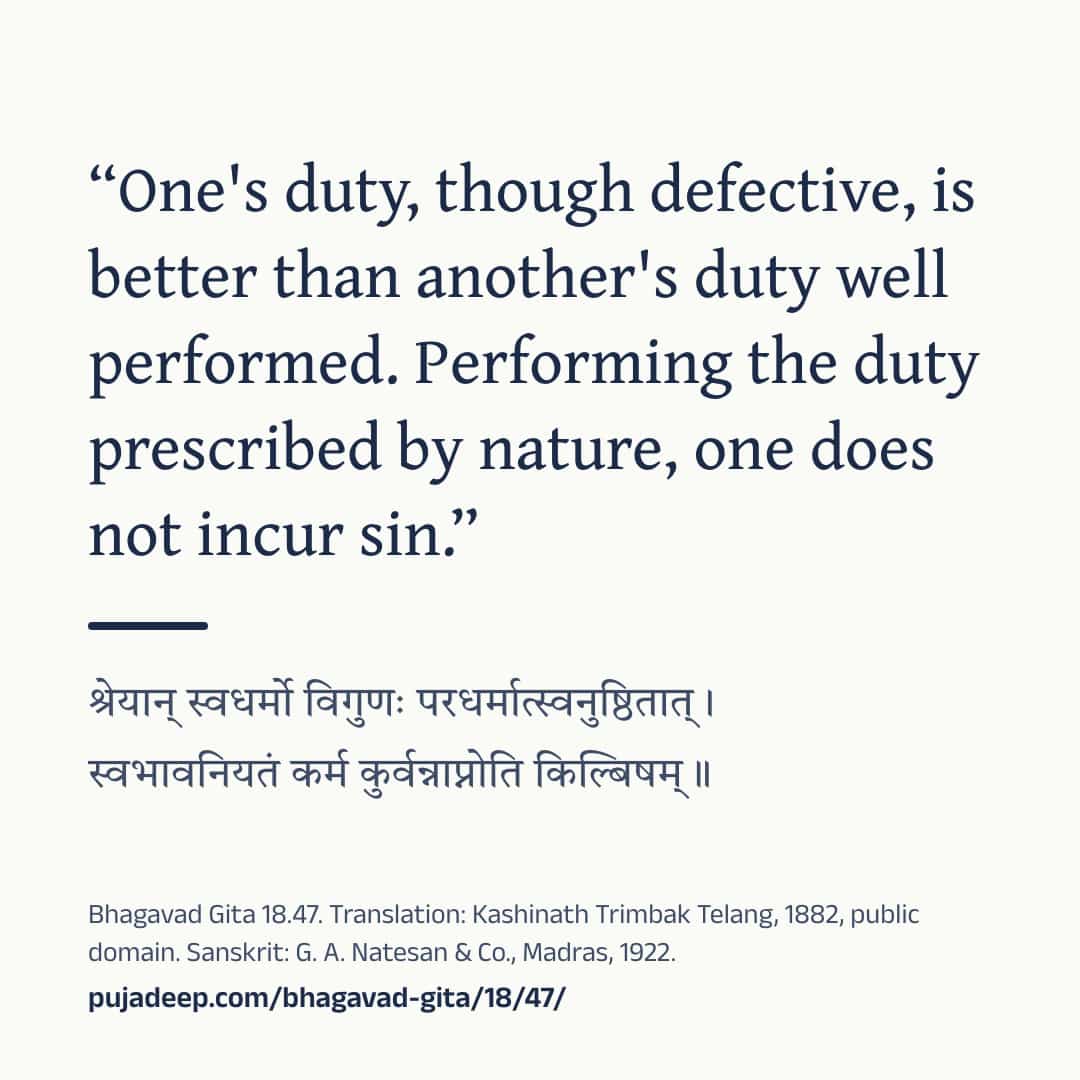
Drawing the picture
See the words
Bhagavad Gita 18.47

श्रेयान् स्वधर्मो विगुणः परधर्मात्स्वनुष्ठितात् ।
स्वभावनियतं कर्म कुर्वन्नाप्नोति किल्बिषम् ॥

“One's duty, though defective, is better than another's duty well performed. Performing the duty prescribed by nature, one does not incur sin.”
(K. T. Telang, The Bhagavadgîtâ (The Sacred Books of the East, vol. VIII, Oxford: Clarendon Press, 1882), p. 127, public domain)

“Better is one's own Dharma, though destitute of merits, than the well-executed Dharma of another. He who doeth the Karma laid down by his own nature incurreth not sin.”
(Annie Besant, The Bhagavad Gîtâ, or The Lord's Song (London: Theosophical Publishing Society, 1895), p. 161, public domain)

“Better is one's own Dharma, (though) imperfect, than the Dharma of another well-performed. He who does the duty ordained by his own nature incurs no evil.”
(Swami Swarupananda, Srimad-Bhagavad-Gita (Mayavati: Prabuddha Bharata Press, 1909; first printed in Prabuddha Bharata, 1907–1909), pp. 339–340, public domain)

Sanskrit: G. A. Natesan & Co., Madras, 1922.
https://pujadeep.com/bhagavad-gita/18/47/ Nothing is sent from this site. Your own app sends it, to the chat you choose. The picture quotes the translation you chose on this page, with its name and year.
Sanskrit text: The Bhagavad-Gita, or The Lord's Song, with the text in Devanagari and an English translation, 1922. Meanings: written for Pujadeep and checked against the cited edition. Source and changes
Questions families ask
Who speaks Bhagavad Gita 18.47?
Krishna speaks this verse, in chapter 18 (Moksha Sannyasa Yoga).
Where does the Sanskrit text come from?
Sanskrit text: The Bhagavad-Gita, or The Lord's Song, with the text in Devanagari and an English translation, 1922. Meanings: written for Pujadeep and checked against the cited edition. See the source
Is the meaning on this page a translation?
Explanation written for this site from the sources listed here, and checked against the cited edition. It is not a translation and not the only way to read the text. Free to quote with credit.
Source and licence
- Sanskrit text
- The Bhagavad-Gita, or The Lord's Song, with the text in Devanagari and an English translation (Annie Besant, G. A. Natesan & Co., Madras, 1922). Public domain. The Sanskrit on these pages was read from this printing’s page images.
- Translation
- The Bhagavadgîtâ with the Sanatsugâtîya and the Anugîtâ, translated by Kâshinâth Trimbak Telang (The Sacred Books of the East, vol. VIII, ed. F. Max Müller) (Kashinath Trimbak Telang, F. Max Müller, Clarendon Press, Oxford, 1882). Public domain. Shown verbatim, as printed.
- Translation
- The Bhagavad Gîtâ, or The Lord's Song, translated by Annie Besant (Annie Besant, Theosophical Publishing Society, London, 1895). Public domain. Shown verbatim, as printed.
- Translation
- Srimad-Bhagavad-Gita, with Sanskrit Text; Paraphrase with Word-by-word Literal Translation; English Rendering and Comments, Index, &c., by the Swami Swarupananda (Himalayan Series, No. XX) (Swami Swarupananda, The Editors and Publishers, Advaita Ashrama, Mayavati, Prabuddha Bharata Press, Mayavati, Almora, Himalayas, 1909). Public domain. Shown verbatim, as printed.
- Commentary
- The Bhagavad-Gita, with the commentary of Sri Sankaracharya, translated by A. Mahadeva Sastri (2nd ed., Mysore: G. T. A. Printing Works, 1901) (Public-domain scan, University of California Libraries). Summarised in our own words; none of its text is reproduced.
- Commentary
- Sri Bhagavad-Gita with Sri Ramanujacharya's Visishtadvaita commentary, translated by A. Govindacharya (Madras, 1898) (Scan uploaded to archive.org (folkscanomy collection)). Summarised in our own words; none of its text is reproduced.
- Common wording
- In this text, 32 words follow today's common wording, checked against sanskritdocuments.org; Sanskrit Wikisource; Gita Press, Gorakhpur; GRETIL, Göttingen and Bhaktivedanta Book Trust.
- Our explanation
- Explanation written for this site from the sources listed here, and checked against the cited edition. It is not a translation and not the only way to read the text. Free to quote with credit.
- Checked
- Checked against the cited edition, October 15, 2026.
- Updated
- October 25, 2026