Bhagavad Gita 18.37: meaning and translation
Chapter 18: Moksha Sannyasa Yoga. Krishna says
Krishna says that the happiness which is like poison at first and like nectar in the end, born of a clear understanding of the self, is called happiness of the nature of sattva.
Click or tap a word for its meaning and its dictionary page.
Text and layers
Text and layers
These choices stay in this browser.
Bhagavad Gita 18.37
यत्तदग्रे विषमिव परिणामेऽमृतोपमम् ।तत्सुखं सात्त्विकं प्रोक्तमात्मबुद्धिप्रसादजम् ॥
Yattadagre vishamiva parinamemritopamamTatsukham sattvikam proktamatmabuddhiprasadajam
yattadagre viṣamiva pariṇāme’mṛtopamam |tatsukhaṃ sāttvikaṃ proktamātmabuddhiprasādajam ||
Our explanation Krishna says that the happiness which is like poison at first and like nectar in the end, born of a clear understanding of the self, is called happiness of the nature of sattva.
हिंदी अर्थ कृष्ण कहते हैं कि जो सुख आरंभ में विष जैसा और अंत में अमृत जैसा होता है, और आत्मा को जानने वाली बुद्धि की निर्मलता से उत्पन्न होता है, वह सात्त्विक कहा गया है।
Word by word
Every word, with its dictionary page
Word by word
- यत् yat · which (pronoun (neuter), nominative singular) Dictionary: yad, Monier-Williams 1899, p. 844, col. 2 “who, which, what, whichever, whatever, that”
- तत् tat · that (pronoun (neuter), nominative singular) Dictionary: tad, Monier-Williams 1899, p. 434, col. 1 “m. he, f. she, n. it, that, this”
- अग्रे agre · at first (noun (neuter), locative singular) Dictionary: agra, Monier-Williams 1899, p. 6, col. 2 “in front, ahead of, in the beginning, first”
- विषम् viṣam · poison (noun (neuter), nominative singular) Dictionary: viṣa, Monier-Williams 1899, p. 995, col. 3 “poison, venom, bane, anything actively pernicious”
- इव iva · like (indeclinable) Dictionary: iva, Monier-Williams 1899, p. 168, col. 3 “like, in the same manner as”
- परिणामे pariṇāme · in the end (noun (masculine), locative singular) Dictionary: pari-ṇāma, Monier-Williams 1899, p. 594, col. 3 “result, consequence, issue, end”
- अमृतोपमम् amṛtopamam · like nectar (compound (neuter), nominative singular) Dictionary: a-mṛta, Monier-Williams 1899, p. 82, col. 2 “the nectar (conferring immortality, produced at the churning of the ocean), ambrosia”; 3. upa-mā, Monier-Williams 1899, p. 203, col. 3 “(mfn. ifc.) equal, similar, resembling, like”
- तत् tat · that (pronoun (neuter), nominative singular) Dictionary: tad, Monier-Williams 1899, p. 434, col. 1 “m. he, f. she, n. it, that, this”
- सुखम् sukham · happiness (noun (neuter), nominative singular) Dictionary: sukha, Monier-Williams 1899, p. 1221, col. 1 “ease, easiness, comfort, prosperity, pleasure, happiness”
- सात्त्विकम् sāttvikam · of sattva (adjective (neuter), nominative singular) Dictionary: sāttvika, Monier-Williams 1899, p. 1200, col. 1 “relating to or endowed with the quality Sattva (i.e. ‘purity’ or ‘goodness’)”
- प्रोक्तम् proktam · is called (past participle (neuter), nominative singular) Dictionary: prokta, Monier-Williams 1899, p. 690, col. 2 “called, declared, said”
- आत्मबुद्धिप्रसादजम् ātmabuddhiprasādajam · born of the clearness of one's own mind (compound (neuter), nominative singular) Dictionary: ātman, Monier-Williams 1899, p. 135, col. 1 “is used as reflexive pronoun for all three persons and all three genders”; buddhi, Monier-Williams 1899, p. 733, col. 3 “intelligence, reason, intellect, mind, discernment, judgment”; pra-sāda, Monier-Williams 1899, p. 696, col. 3 “clearness, brightness, pellucidness, purity”; 2. ja, Monier-Williams 1899, p. 407, col. 3 “ifc. born or descended from, produced or caused by”
Old translations
Kashinath Trimbak Telang, 1882. Public domain.
Telang translates verses 36–37 as one passage; see 18.36. Read it at 18.36
Compare 3 translations
Kashinath Trimbak Telang, 1882. Public domain.
Telang translates verses 36–37 as one passage; see 18.36. Read it at 18.36
You are reading this one
Annie Besant, 1895. Public domain. Page 159.
Which at first is nauseous but in the end is as the nectar of immortality; that pleasure is said to be sâttvic, born of the serenity (derived) from a knowledge of the SELF.
This sentence begins in 18.36.
You are reading this one
Swami Swarupananda, 1909 (first printed 1907). Public domain. Page 335.
That which is like poison at first, but like nectar at the end; that happiness is declared to be Sâtvic, born of the translucence of intellect due to Self-realisation.
This sentence begins in 18.36.
You are reading this one
Cite this verse
The translation: K. T. Telang, The Bhagavadgîtâ (The Sacred Books of the East, vol. VIII, Oxford: Clarendon Press, 1882), p. 126. Bhagavad Gita 18.36–37.
The translation: Annie Besant, The Bhagavad Gîtâ, or The Lord's Song (London: Theosophical Publishing Society, 1895), p. 159. Bhagavad Gita 18.37.
The translation: Swami Swarupananda, Srimad-Bhagavad-Gita (Mayavati: Prabuddha Bharata Press, 1909; first printed in Prabuddha Bharata, 1907–1909), p. 335. Bhagavad Gita 18.37.
Our explanation: “Bhagavad Gita 18.37: meaning and translation.” Pujadeep. Updated October 25, 2026. https://pujadeep.com/bhagavad-gita/18/37/
Pujadeep’s explanations are free to quote with credit: name Pujadeep and link to the page. How to credit
Classical readings, by school
No readings by school on this verse yet.
Share
Show the ways to share
Send one picture or the text to one chat. The picture names its source and the address of this page.
Drawing the picture
See the words
Bhagavad Gita 18.37

यत्तदग्रे विषमिव परिणामेऽमृतोपमम् ।
तत्सुखं सात्त्विकं प्रोक्तमात्मबुद्धिप्रसादजम् ॥

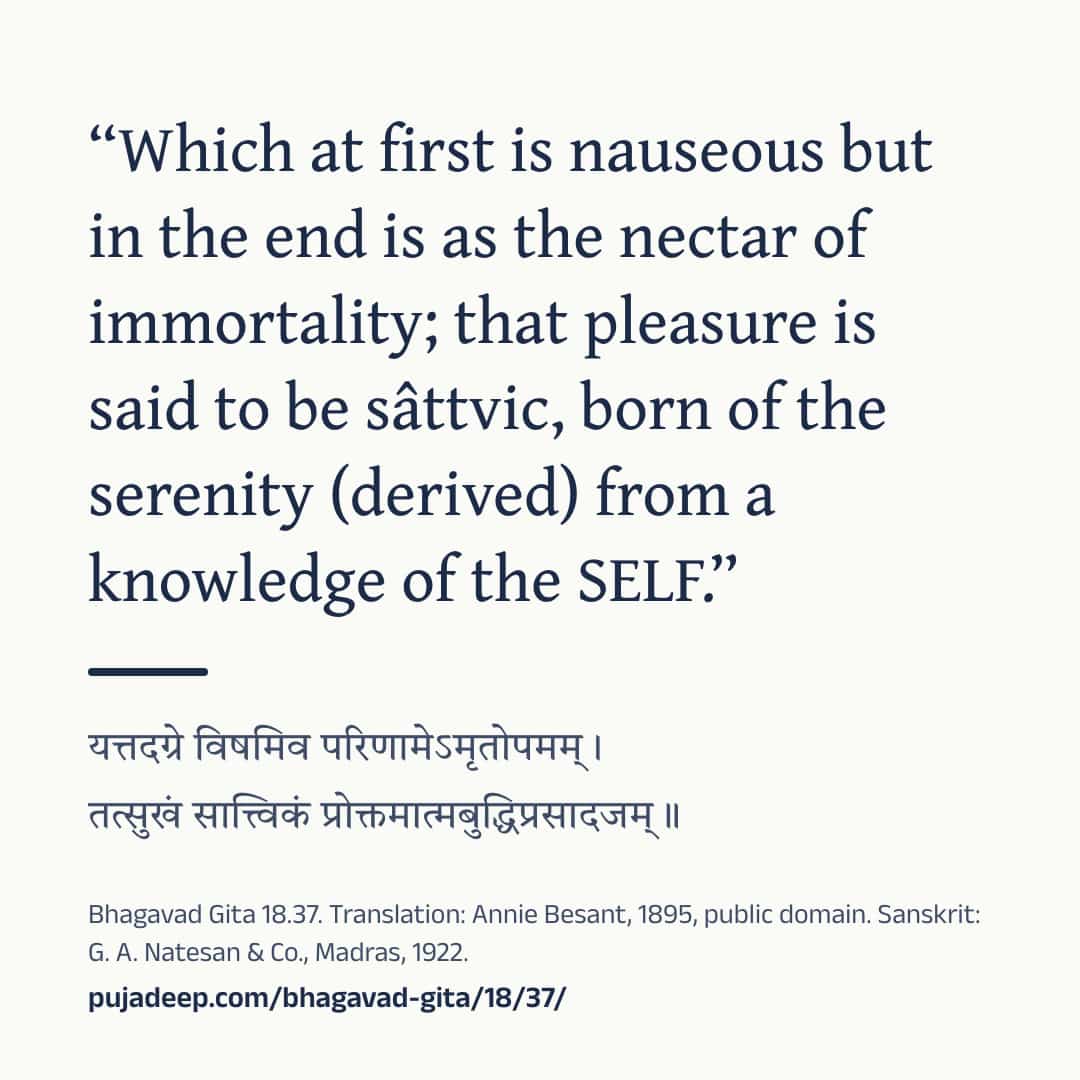
“Which at first is nauseous but in the end is as the nectar of immortality; that pleasure is said to be sâttvic, born of the serenity (derived) from a knowledge of the SELF.”
(Annie Besant, The Bhagavad Gîtâ, or The Lord's Song (London: Theosophical Publishing Society, 1895), p. 159, public domain)
This sentence begins in 18.36.

“That which is like poison at first, but like nectar at the end; that happiness is declared to be Sâtvic, born of the translucence of intellect due to Self-realisation.”
(Swami Swarupananda, Srimad-Bhagavad-Gita (Mayavati: Prabuddha Bharata Press, 1909; first printed in Prabuddha Bharata, 1907–1909), p. 335, public domain)
This sentence begins in 18.36.

Sanskrit: G. A. Natesan & Co., Madras, 1922.
https://pujadeep.com/bhagavad-gita/18/37/ Nothing is sent from this site. Your own app sends it, to the chat you choose. The picture quotes the translation you chose on this page, with its name and year.
Sanskrit text: The Bhagavad-Gita, or The Lord's Song, with the text in Devanagari and an English translation, 1922. Meanings: written for Pujadeep and checked against the cited edition. Source and changes
Questions families ask
Who speaks Bhagavad Gita 18.37?
Krishna speaks this verse, in chapter 18 (Moksha Sannyasa Yoga).
Where does the Sanskrit text come from?
Sanskrit text: The Bhagavad-Gita, or The Lord's Song, with the text in Devanagari and an English translation, 1922. Meanings: written for Pujadeep and checked against the cited edition. See the source
Is the meaning on this page a translation?
Explanation written for this site from the sources listed here, and checked against the cited edition. It is not a translation and not the only way to read the text. Free to quote with credit.
Source and licence
- Sanskrit text
- The Bhagavad-Gita, or The Lord's Song, with the text in Devanagari and an English translation (Annie Besant, G. A. Natesan & Co., Madras, 1922). Public domain. The Sanskrit on these pages was read from this printing’s page images.
- Translation
- The Bhagavadgîtâ with the Sanatsugâtîya and the Anugîtâ, translated by Kâshinâth Trimbak Telang (The Sacred Books of the East, vol. VIII, ed. F. Max Müller) (Kashinath Trimbak Telang, F. Max Müller, Clarendon Press, Oxford, 1882). Public domain. Shown verbatim, as printed.
- Translation
- The Bhagavad Gîtâ, or The Lord's Song, translated by Annie Besant (Annie Besant, Theosophical Publishing Society, London, 1895). Public domain. Shown verbatim, as printed.
- Translation
- Srimad-Bhagavad-Gita, with Sanskrit Text; Paraphrase with Word-by-word Literal Translation; English Rendering and Comments, Index, &c., by the Swami Swarupananda (Himalayan Series, No. XX) (Swami Swarupananda, The Editors and Publishers, Advaita Ashrama, Mayavati, Prabuddha Bharata Press, Mayavati, Almora, Himalayas, 1909). Public domain. Shown verbatim, as printed.
- Common wording
- In this text, 32 words follow today's common wording, checked against sanskritdocuments.org; Sanskrit Wikisource; Gita Press, Gorakhpur; GRETIL, Göttingen and Bhaktivedanta Book Trust.
- Our explanation
- Explanation written for this site from the sources listed here, and checked against the cited edition. It is not a translation and not the only way to read the text. Free to quote with credit.
- Checked
- Checked against the cited edition, October 15, 2026.
- Updated
- October 25, 2026