Bhagavad Gita 18.50: meaning and translation
Chapter 18: Moksha Sannyasa Yoga. Krishna says
Krishna tells Arjuna to learn from him, in brief, how one who has reached that perfection attains Brahman, the highest state of knowledge.
Click or tap a word for its meaning and its dictionary page.
Text and layers
Text and layers
These choices stay in this browser.
Bhagavad Gita 18.50
सिद्धिं प्राप्तो यथा ब्रह्म तथाऽऽप्नोति निबोध मे ।समासेनैव कौन्तेय निष्ठा ज्ञानस्य या परा ॥
Siddhim prapto yatha brahma tathapnoti nibodha meSamasenaiva kaunteya nishtha jnanasya ya para
siddhiṃ prāpto yathā brahma tathā’’pnoti nibodha me |samāsenaiva kaunteya niṣṭhā jñānasya yā parā ||
Our explanation Krishna tells Arjuna to learn from him, in brief, how one who has reached that perfection attains Brahman, the highest state of knowledge.
हिंदी अर्थ कृष्ण अर्जुन से कहते हैं कि वे उनसे संक्षेप में जानें कि उस सिद्धि को पाने वाला ब्रह्म को कैसे पाता है, जो ज्ञान की परम निष्ठा है।
Word by word
Every word, with its dictionary page
Word by word
- सिद्धिम् siddhim · perfection (noun (feminine), accusative singular) Dictionary: 2. siddhi, Monier-Williams 1899, p. 1216, col. 2 “final emancipation, perfection”
- प्राप्तः prāptaḥ · having reached (past participle (masculine), nominative singular) Dictionary: prāpta, Monier-Williams 1899, p. 707, col. 2 “attained to, reached, arrived at, met with, found”
- यथा yathā · how (indeclinable) Dictionary: yathā, Monier-Williams 1899, p. 841, col. 2 “in which manner or way, according as, as, like”
- ब्रह्म brahma · Brahman (noun (neuter), accusative singular) Dictionary: brahman, Monier-Williams 1899, p. 738, col. 1 “one self-existent impersonal Spirit, the one universal Soul”
- तथा tathā · so (indeclinable) Dictionary: tathā, Monier-Williams 1899, p. 433, col. 3 “in that manner, so, thus”
- आप्नोति āpnoti · reaches (present, 3rd person singular) Dictionary: 1. āp, Monier-Williams 1899, p. 142, col. 1 “to reach, overtake, meet with, fall upon”
- निबोध nibodha · learn (imperative, 2nd person singular) Dictionary: ni-budh, Monier-Williams 1899, p. 550, col. 2 “to know, understand, consider”
- मे me · from "me" (Krishna) (pronoun, genitive singular) Dictionary: 1. mad, Monier-Williams 1899, p. 777, col. 2 “base of the first pers. pron. in the sg. number (esp. in comp.)”
- समासेन samāsena · in brief (noun (masculine), instrumental singular) Dictionary: 1. sam-āsa, Monier-Williams 1899, p. 1158, col. 2 “succinctness, conciseness, condensation”
- एव eva · just (indeclinable) Dictionary: 1. eva, Monier-Williams 1899, p. 232, col. 2 “just, exactly, very, same, only, even, alone, merely”
- कौन्तेय kaunteya · O son of Kunti (noun (masculine), vocative singular) Dictionary: kaunteya, Monier-Williams 1899, p. 316, col. 2 “metron. fr. Kuntī, N. of Yudhishṭhira, Bhīma-sena, and Arjuna”
- निष्ठा niṣṭhā · the culmination (noun (feminine), nominative singular) Dictionary: ni-ṣṭhā, Monier-Williams 1899, p. 563, col. 1 “completion, perfection, culminating or extreme point”
- ज्ञानस्य jñānasya · of knowledge (noun (neuter), genitive singular) Dictionary: jñāna, Monier-Williams 1899, p. 426, col. 1 “knowing, becoming acquainted with, knowledge”
- या yā · which (pronoun (feminine), nominative singular) Dictionary: yad, Monier-Williams 1899, p. 844, col. 2 “who, which, what, whichever, whatever, that”
- परा parā · highest (adjective (feminine), nominative singular) Dictionary: 1. para, Monier-Williams 1899, p. 586, col. 1 “best or worst, highest, supreme, chief”
1 printing differs
Edition differences. Another printing or text reads this place differently.
- Spelling A digital text reads Same words. The 1922 edition marks the merged long vowel with a double avagraha (तथाऽऽप्नोति); this e-text does not.
Old translations
Kashinath Trimbak Telang, 1882. Public domain. Page 127.
Learn from me, only in brief, O son of Kuntî! how one who has obtained perfection attains the Brahman, which is the highest culmination of knowledge.
Compare 3 translations
Kashinath Trimbak Telang, 1882. Public domain. Page 127.
Learn from me, only in brief, O son of Kuntî! how one who has obtained perfection attains the Brahman, which is the highest culmination of knowledge.
You are reading this one
Annie Besant, 1895. Public domain. Page 162.
How he who hath attained perfection obtaineth Brahman, that highest end of wisdom, that learn thou from Me only succinctly, O Kaunteya.
You are reading this one
Swami Swarupananda, 1909 (first printed 1907). Public domain. Page 341.
Learn from Me in brief, O son of Kunti, how reaching such perfection, he attains to Brahman, that supreme consummation of knowledge.
You are reading this one
Cite this verse
The translation: K. T. Telang, The Bhagavadgîtâ (The Sacred Books of the East, vol. VIII, Oxford: Clarendon Press, 1882), p. 127. Bhagavad Gita 18.50.
The translation: Annie Besant, The Bhagavad Gîtâ, or The Lord's Song (London: Theosophical Publishing Society, 1895), p. 162. Bhagavad Gita 18.50.
The translation: Swami Swarupananda, Srimad-Bhagavad-Gita (Mayavati: Prabuddha Bharata Press, 1909; first printed in Prabuddha Bharata, 1907–1909), p. 341. Bhagavad Gita 18.50.
Our explanation: “Bhagavad Gita 18.50: meaning and translation.” Pujadeep. Updated October 25, 2026. https://pujadeep.com/bhagavad-gita/18/50/
Pujadeep’s explanations are free to quote with credit: name Pujadeep and link to the page. How to credit
Classical readings, by school
No readings by school on this verse yet.
Share
Show the ways to share
Send one picture or the text to one chat. The picture names its source and the address of this page.
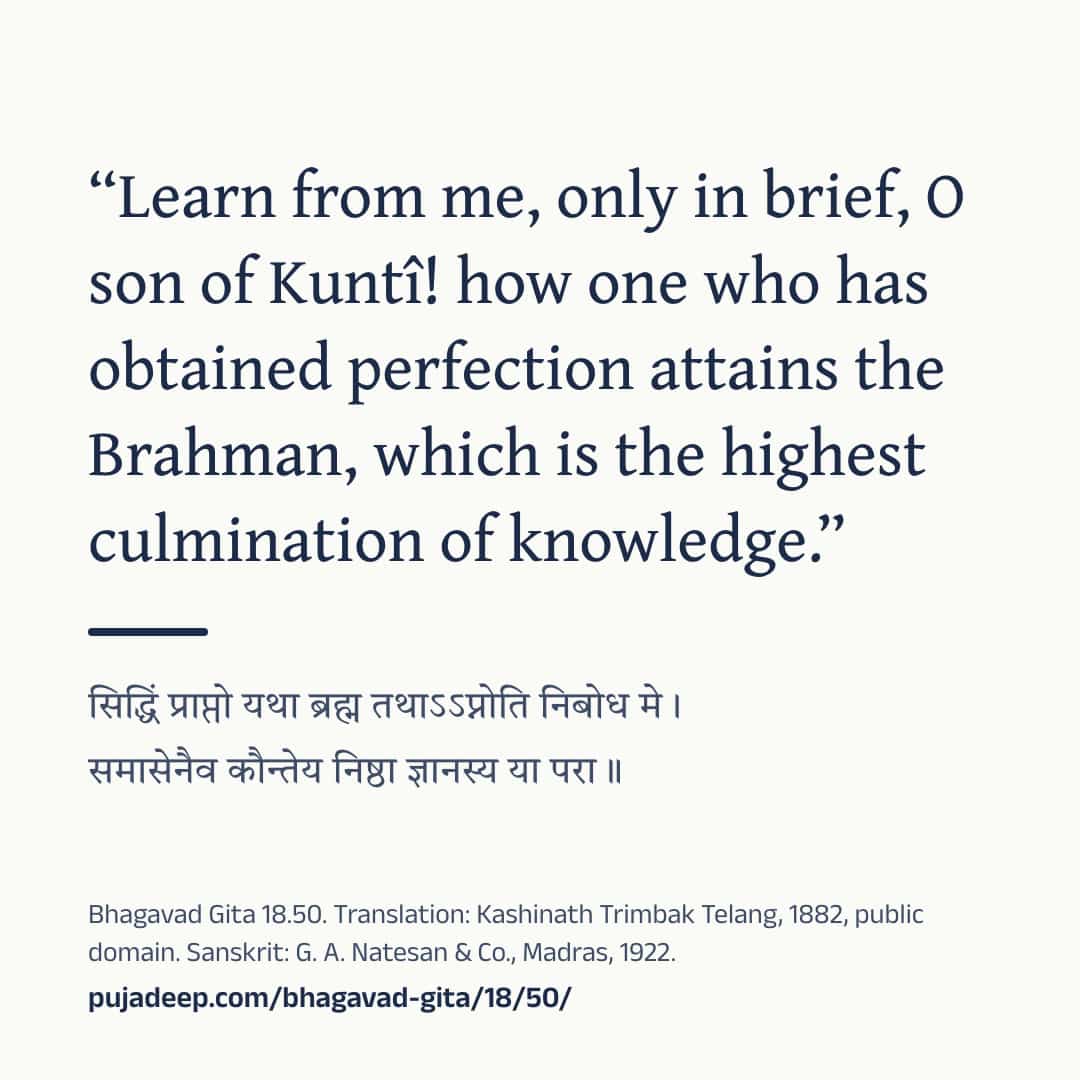
Drawing the picture
See the words
Bhagavad Gita 18.50

सिद्धिं प्राप्तो यथा ब्रह्म तथाऽऽप्नोति निबोध मे ।
समासेनैव कौन्तेय निष्ठा ज्ञानस्य या परा ॥

“Learn from me, only in brief, O son of Kuntî! how one who has obtained perfection attains the Brahman, which is the highest culmination of knowledge.”
(K. T. Telang, The Bhagavadgîtâ (The Sacred Books of the East, vol. VIII, Oxford: Clarendon Press, 1882), p. 127, public domain)

“How he who hath attained perfection obtaineth Brahman, that highest end of wisdom, that learn thou from Me only succinctly, O Kaunteya.”
(Annie Besant, The Bhagavad Gîtâ, or The Lord's Song (London: Theosophical Publishing Society, 1895), p. 162, public domain)

“Learn from Me in brief, O son of Kunti, how reaching such perfection, he attains to Brahman, that supreme consummation of knowledge.”
(Swami Swarupananda, Srimad-Bhagavad-Gita (Mayavati: Prabuddha Bharata Press, 1909; first printed in Prabuddha Bharata, 1907–1909), p. 341, public domain)

Sanskrit: G. A. Natesan & Co., Madras, 1922.
https://pujadeep.com/bhagavad-gita/18/50/ Nothing is sent from this site. Your own app sends it, to the chat you choose. The picture quotes the translation you chose on this page, with its name and year.
Sanskrit text: The Bhagavad-Gita, or The Lord's Song, with the text in Devanagari and an English translation, 1922. Meanings: written for Pujadeep and checked against the cited edition. Source and changes
Questions families ask
Who speaks Bhagavad Gita 18.50?
Krishna speaks this verse, in chapter 18 (Moksha Sannyasa Yoga).
Where does the Sanskrit text come from?
Sanskrit text: The Bhagavad-Gita, or The Lord's Song, with the text in Devanagari and an English translation, 1922. Meanings: written for Pujadeep and checked against the cited edition. See the source
Is the meaning on this page a translation?
Explanation written for this site from the sources listed here, and checked against the cited edition. It is not a translation and not the only way to read the text. Free to quote with credit.
Source and licence
- Sanskrit text
- The Bhagavad-Gita, or The Lord's Song, with the text in Devanagari and an English translation (Annie Besant, G. A. Natesan & Co., Madras, 1922). Public domain. The Sanskrit on these pages was read from this printing’s page images.
- Translation
- The Bhagavadgîtâ with the Sanatsugâtîya and the Anugîtâ, translated by Kâshinâth Trimbak Telang (The Sacred Books of the East, vol. VIII, ed. F. Max Müller) (Kashinath Trimbak Telang, F. Max Müller, Clarendon Press, Oxford, 1882). Public domain. Shown verbatim, as printed.
- Translation
- The Bhagavad Gîtâ, or The Lord's Song, translated by Annie Besant (Annie Besant, Theosophical Publishing Society, London, 1895). Public domain. Shown verbatim, as printed.
- Translation
- Srimad-Bhagavad-Gita, with Sanskrit Text; Paraphrase with Word-by-word Literal Translation; English Rendering and Comments, Index, &c., by the Swami Swarupananda (Himalayan Series, No. XX) (Swami Swarupananda, The Editors and Publishers, Advaita Ashrama, Mayavati, Prabuddha Bharata Press, Mayavati, Almora, Himalayas, 1909). Public domain. Shown verbatim, as printed.
- Common wording
- In this text, 32 words follow today's common wording, checked against sanskritdocuments.org; Sanskrit Wikisource; Gita Press, Gorakhpur; GRETIL, Göttingen and Bhaktivedanta Book Trust.
- Our explanation
- Explanation written for this site from the sources listed here, and checked against the cited edition. It is not a translation and not the only way to read the text. Free to quote with credit.
- Checked
- Checked against the cited edition, October 15, 2026.
- Updated
- October 25, 2026