Bhagavad Gita 18.42: meaning and translation
Chapter 18: Moksha Sannyasa Yoga. Krishna says
Krishna lists the work born of the nature of a Brāhmaṇa: calm, self-control, austerity, purity, patience, honesty, knowledge, deeper understanding (vijñāna) and faith (āstikya).
Click or tap a word for its meaning and its dictionary page.
Text and layers
Text and layers
These choices stay in this browser.
Bhagavad Gita 18.42
शमो दमस्तपः शौचं क्षान्तिरार्जवमेव च ।ज्ञानं विज्ञानमास्तिक्यं ब्रह्मकर्म स्वभावजम् ॥
Shamo damastapah shaucham kshantirarjavameva chaJnanam vijnanamastikyam brahmakarma svabhavajam
śamo damastapaḥ śaucaṃ kṣāntirārjavameva ca |jñānaṃ vijñānamāstikyaṃ brahmakarma svabhāvajam ||
Our explanation Krishna lists the work born of the nature of a Brāhmaṇa: calm, self-control, austerity, purity, patience, honesty, knowledge, deeper understanding (vijñāna) and faith (āstikya). Telang renders the last as 'belief (in a future world)', Shankara as faith in the teaching of the scriptures. Readings of these verses differ between schools and teachers, and the wording is the text's, not the view of this library.
हिंदी अर्थ कृष्ण ब्राह्मण के स्वभाव से उत्पन्न कर्म गिनाते हैं: शम (मन की शांति), दम (इंद्रियों का संयम), तप, शौच (पवित्रता), क्षमा, सरलता, ज्ञान, विज्ञान और आस्तिक्य। तेलंग आस्तिक्य का अनुवाद “परलोक में विश्वास” करते हैं, और शंकराचार्य इसे शास्त्रों की शिक्षा में श्रद्धा बताते हैं। इन श्लोकों को अलग-अलग परंपराएँ और आचार्य अलग ढंग से पढ़ते हैं, और ये शब्द पाठ के हैं, इस पुस्तकालय का मत नहीं।
Word by word
Every word, with its dictionary page
Word by word
- शमः śamaḥ · calm of mind (noun (masculine), nominative singular) Dictionary: śama, Monier-Williams 1899, p. 1053, col. 3 “tranquillity, calmness, rest, equanimity, quietude or quietism, absence of passion”
- दमः damaḥ · self-restraint (noun (masculine), nominative singular) Dictionary: dama, Monier-Williams 1899, p. 469, col. 2 “self-command, self-restraint, self-control”
- तपः tapaḥ · austerity (noun (neuter), nominative singular) Dictionary: tapas, Monier-Williams 1899, p. 437, col. 1 “religious austerity, bodily mortification, penance, severe meditation”
- शौचम् śaucam · purity (noun (neuter), nominative singular) Dictionary: śauca, Monier-Williams 1899, p. 1092, col. 3 “cleanness, purity, purification”
- क्षान्तिः kṣāntiḥ · forbearance (noun (feminine), nominative singular) Dictionary: kṣānti, Monier-Williams 1899, p. 326, col. 3 “patience, forbearance, endurance”
- आर्जवम् ārjavam · straightness, honesty (noun (neuter), nominative singular) Dictionary: ārjava, Monier-Williams 1899, p. 151, col. 3 “honesty, frankness, sincerity”
- एव eva · also (indeclinable) Dictionary: 1. eva, Monier-Williams 1899, p. 232, col. 2 “just, exactly, very, same, only, even, alone, merely”
- च ca · and (indeclinable) Dictionary: 2. ca, Monier-Williams 1899, p. 380, col. 1 “and, both, also, moreover, as well as”
- ज्ञानम् jñānam · knowledge (noun (neuter), nominative singular) Dictionary: jñāna, Monier-Williams 1899, p. 426, col. 1 “knowing, becoming acquainted with, knowledge”
- विज्ञानम् vijñānam · understanding, experience (noun (neuter), nominative singular) Dictionary: vi-jñāna, Monier-Williams 1899, p. 961, col. 2 “the act of distinguishing or discerning, understanding, comprehending, recognizing, intelligence, knowledge”
- आस्तिक्यम् āstikyam · faith (noun (neuter), nominative singular) Dictionary: āstikya, Monier-Williams 1899, p. 161, col. 2 “belief in God, piety, faithfulness”
- ब्रह्मकर्म brahmakarma · the work of a Brahmin (compound (neuter), nominative singular) Dictionary: brahma-karman, Monier-Williams 1899, p. 738, col. 1 “the office of the Brahman (i.e. presiding priest) or of the Brāhmans”
- स्वभावजम् svabhāvajam · born of nature (compound (neuter), nominative singular) Dictionary: sva-bhāva, Monier-Williams 1899, p. 1276, col. 1 “innate or inherent disposition, nature”; 2. ja, Monier-Williams 1899, p. 407, col. 3 “ifc. born or descended from, produced or caused by”
Old translations
Kashinath Trimbak Telang, 1882. Public domain. Page 126.
Tranquillity1, restraint of the senses, penance, purity, forgiveness, straightforwardness, also knowledge, experience, and belief (in a future world), this is the natural duty of Brâhmanas.
Footnotes (the translator’s own) - I. e. resulting from control of the mind, purity here is both external and internal. And see p. 119. ↩
Compare 3 translations
Kashinath Trimbak Telang, 1882. Public domain. Page 126.
Tranquillity1, restraint of the senses, penance, purity, forgiveness, straightforwardness, also knowledge, experience, and belief (in a future world), this is the natural duty of Brâhmanas.
Footnotes (the translator’s own) - I. e. resulting from control of the mind, purity here is both external and internal. And see p. 119. ↩
You are reading this one
Annie Besant, 1895. Public domain. Page 160.
Serenity, self-restraint, austerity, purity, forgiveness and also uprightness, knowledge, experience, piety, are the Brâhman-Karma, born of his own nature.
You are reading this one
Swami Swarupananda, 1909 (first printed 1907). Public domain. Page 337.
Control of mind and senses, austerity, purity, forbearance, and also uprightness, knowledge, realisation, belief in a hereafter,—these are the duties of Bráhmanas, born of (their own) nature.
You are reading this one
Cite this verse
The translation: K. T. Telang, The Bhagavadgîtâ (The Sacred Books of the East, vol. VIII, Oxford: Clarendon Press, 1882), p. 126. Bhagavad Gita 18.42.
The translation: Annie Besant, The Bhagavad Gîtâ, or The Lord's Song (London: Theosophical Publishing Society, 1895), p. 160. Bhagavad Gita 18.42.
The translation: Swami Swarupananda, Srimad-Bhagavad-Gita (Mayavati: Prabuddha Bharata Press, 1909; first printed in Prabuddha Bharata, 1907–1909), p. 337. Bhagavad Gita 18.42.
Our explanation: “Bhagavad Gita 18.42: meaning and translation.” Pujadeep. Updated October 25, 2026. https://pujadeep.com/bhagavad-gita/18/42/
Pujadeep’s explanations are free to quote with credit: name Pujadeep and link to the page. How to credit
Classical readings, by school
No readings by school on this verse yet.
Share
Show the ways to share
Send one picture or the text to one chat. The picture names its source and the address of this page.
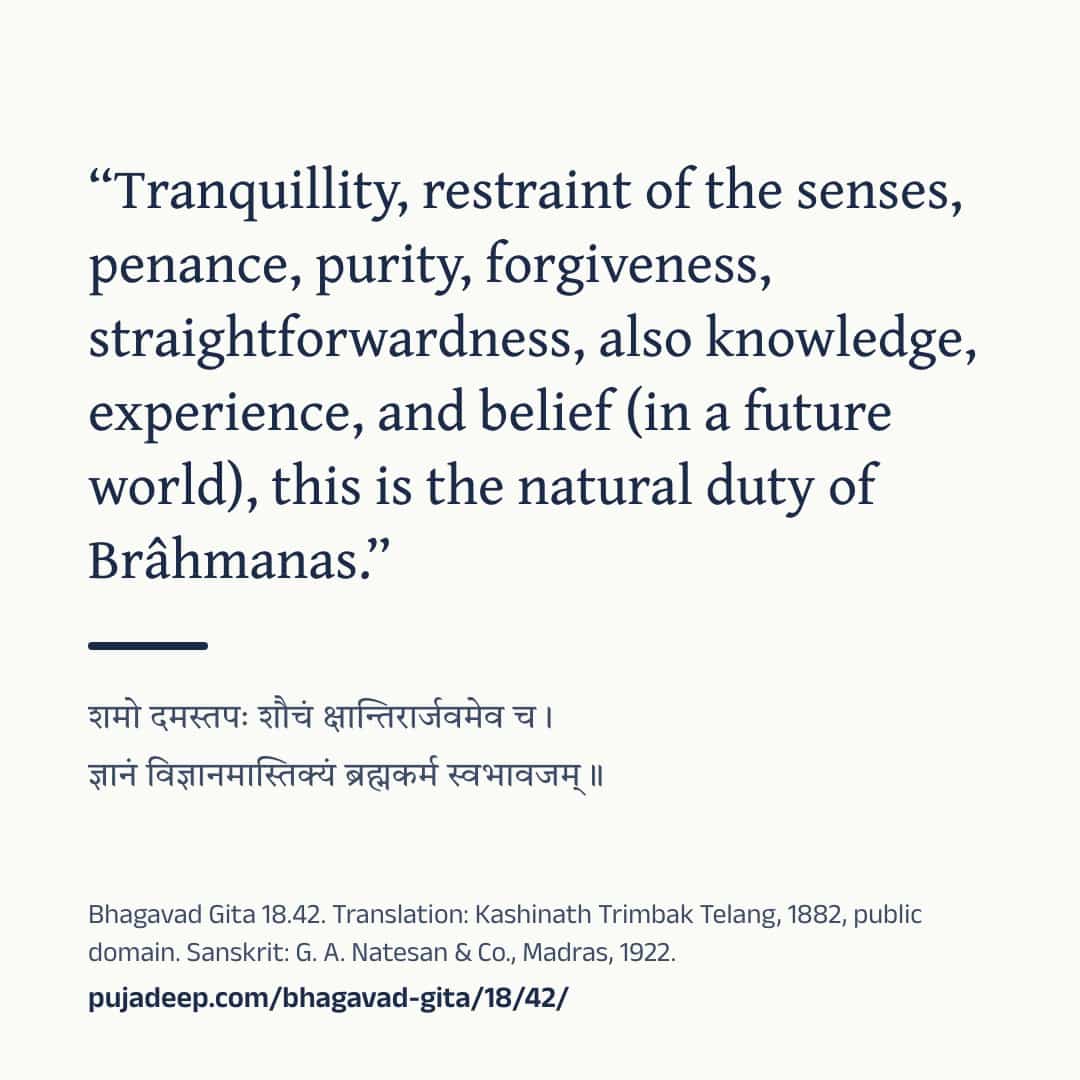
Drawing the picture
See the words
Bhagavad Gita 18.42

शमो दमस्तपः शौचं क्षान्तिरार्जवमेव च ।
ज्ञानं विज्ञानमास्तिक्यं ब्रह्मकर्म स्वभावजम् ॥

“Tranquillity, restraint of the senses, penance, purity, forgiveness, straightforwardness, also knowledge, experience, and belief (in a future world), this is the natural duty of Brâhmanas.”
(K. T. Telang, The Bhagavadgîtâ (The Sacred Books of the East, vol. VIII, Oxford: Clarendon Press, 1882), p. 126, public domain)

“Serenity, self-restraint, austerity, purity, forgiveness and also uprightness, knowledge, experience, piety, are the Brâhman-Karma, born of his own nature.”
(Annie Besant, The Bhagavad Gîtâ, or The Lord's Song (London: Theosophical Publishing Society, 1895), p. 160, public domain)

“Control of mind and senses, austerity, purity, forbearance, and also uprightness, knowledge, realisation, belief in a hereafter,—these are the duties of Bráhmanas, born of (their own) nature.”
(Swami Swarupananda, Srimad-Bhagavad-Gita (Mayavati: Prabuddha Bharata Press, 1909; first printed in Prabuddha Bharata, 1907–1909), p. 337, public domain)

Sanskrit: G. A. Natesan & Co., Madras, 1922.
https://pujadeep.com/bhagavad-gita/18/42/ Nothing is sent from this site. Your own app sends it, to the chat you choose. The picture quotes the translation you chose on this page, with its name and year.
Sanskrit text: The Bhagavad-Gita, or The Lord's Song, with the text in Devanagari and an English translation, 1922. Meanings: written for Pujadeep and checked against the cited edition. Source and changes
Questions families ask
Who speaks Bhagavad Gita 18.42?
Krishna speaks this verse, in chapter 18 (Moksha Sannyasa Yoga).
Where does the Sanskrit text come from?
Sanskrit text: The Bhagavad-Gita, or The Lord's Song, with the text in Devanagari and an English translation, 1922. Meanings: written for Pujadeep and checked against the cited edition. See the source
Is the meaning on this page a translation?
Explanation written for this site from the sources listed here, and checked against the cited edition. It is not a translation and not the only way to read the text. Free to quote with credit.
Source and licence
- Sanskrit text
- The Bhagavad-Gita, or The Lord's Song, with the text in Devanagari and an English translation (Annie Besant, G. A. Natesan & Co., Madras, 1922). Public domain. The Sanskrit on these pages was read from this printing’s page images.
- Translation
- The Bhagavadgîtâ with the Sanatsugâtîya and the Anugîtâ, translated by Kâshinâth Trimbak Telang (The Sacred Books of the East, vol. VIII, ed. F. Max Müller) (Kashinath Trimbak Telang, F. Max Müller, Clarendon Press, Oxford, 1882). Public domain. Shown verbatim, as printed.
- Translation
- The Bhagavad Gîtâ, or The Lord's Song, translated by Annie Besant (Annie Besant, Theosophical Publishing Society, London, 1895). Public domain. Shown verbatim, as printed.
- Translation
- Srimad-Bhagavad-Gita, with Sanskrit Text; Paraphrase with Word-by-word Literal Translation; English Rendering and Comments, Index, &c., by the Swami Swarupananda (Himalayan Series, No. XX) (Swami Swarupananda, The Editors and Publishers, Advaita Ashrama, Mayavati, Prabuddha Bharata Press, Mayavati, Almora, Himalayas, 1909). Public domain. Shown verbatim, as printed.
- Common wording
- In this text, 32 words follow today's common wording, checked against sanskritdocuments.org; Sanskrit Wikisource; Gita Press, Gorakhpur; GRETIL, Göttingen and Bhaktivedanta Book Trust.
- Our explanation
- Explanation written for this site from the sources listed here, and checked against the cited edition. It is not a translation and not the only way to read the text. Free to quote with credit.
- Checked
- Checked against the cited edition, October 15, 2026.
- Updated
- October 25, 2026