Bhagavad Gita 18.52: meaning and translation
Chapter 18: Moksha Sannyasa Yoga. Krishna says
Krishna goes on: such a person lives in a quiet place, eats lightly, controls speech, body and mind, is always given to meditation (dhyāna-yoga), and takes refuge in dispassion (vairāgya).
Click or tap a word for its meaning and its dictionary page.
Text and layers
Text and layers
These choices stay in this browser.
Bhagavad Gita 18.52
विविक्तसेवी लघ्वाशी यतवाक्कायमानसः ।ध्यानयोगपरो नित्यं वैराग्यं समुपाश्रितः ॥
Viviktasevi laghvashi yatavakkayamanasahDhyanayogaparo nityam vairagyam samupashritah
viviktasevī laghvāśī yatavākkāyamānasaḥ |dhyānayogaparo nityaṃ vairāgyaṃ samupāśritaḥ ||
Our explanation Krishna goes on: such a person lives in a quiet place, eats lightly, controls speech, body and mind, is always given to meditation (dhyāna-yoga), and takes refuge in dispassion (vairāgya).
हिंदी अर्थ कृष्ण आगे कहते हैं: ऐसा व्यक्ति एकांत में रहता है, थोड़ा खाता है, वाणी, शरीर और मन को वश में रखता है, सदा ध्यानयोग में लगा रहता है और वैराग्य का आश्रय लेता है।
Word by word
Every word, with its dictionary page
Word by word
- विविक्तसेवी viviktasevī · living in a solitary place (compound (masculine), nominative singular) Dictionary: vi-vikta, Monier-Williams 1899, p. 987, col. 3 “isolated, alone, solitary”; sevin, Monier-Williams 1899, p. 1247, col. 2 “(only ifc.) going or resorting to, frequenting, inhabiting”
- लघ्वाशी laghvāśī · eating lightly (compound (masculine), nominative singular) Dictionary: laghu, Monier-Williams 1899, p. 893, col. 3 “light, easy, not heavy or difficult”; āśin, Monier-Williams 1899, p. 157, col. 1 “ifc. eating, consuming”
- यतवाक्कायमानसः yatavākkāyamānasaḥ · with speech, body and mind controlled (compound (masculine), nominative singular) Dictionary: yata, Monier-Williams 1899, p. 845, col. 2 “restrained, held in, held forth, kept down or limited, subdued, governed, controlled”; vāc, Monier-Williams 1899, p. 936, col. 1 “speech, voice, talk, language”; 2. kāya, Monier-Williams 1899, p. 274, col. 1 “the body”; mānasa, Monier-Williams 1899, p. 810, col. 1 “the mental powers, mind, spirit, heart, soul”
- ध्यानयोगपरः dhyānayogaparaḥ · intent on meditation and yoga (compound (masculine), nominative singular) Dictionary: dhyāna, Monier-Williams 1899, p. 521, col. 1 “meditation, thought, reflection, (esp.) profound and abstract religious meditation”; yoga, Monier-Williams 1899, p. 856, col. 3 “application or concentration of the thoughts, abstract contemplation, meditation”; 1. para, Monier-Williams 1899, p. 586, col. 2 “engrossed in, intent upon”
- नित्यम् nityam · always (indeclinable) Dictionary: nitya, Monier-Williams 1899, p. 547, col. 2 “(am), ind. always, constantly, regularly”
- वैराग्यम् vairāgyam · detachment (noun (neuter), accusative singular) Dictionary: vairāgya, Monier-Williams 1899, p. 1025, col. 2 “freedom from all worldly desires, indifference to worldly objects and to life”
- समुपाश्रितः samupāśritaḥ · having taken refuge in (past participle (masculine), nominative singular) Dictionary: sam-upā-śrita, Monier-Williams 1899, p. 1170, col. 1 “resorted to, one who has recourse to (acc.)”
Old translations
Kashinath Trimbak Telang, 1882. Public domain. Page 128.
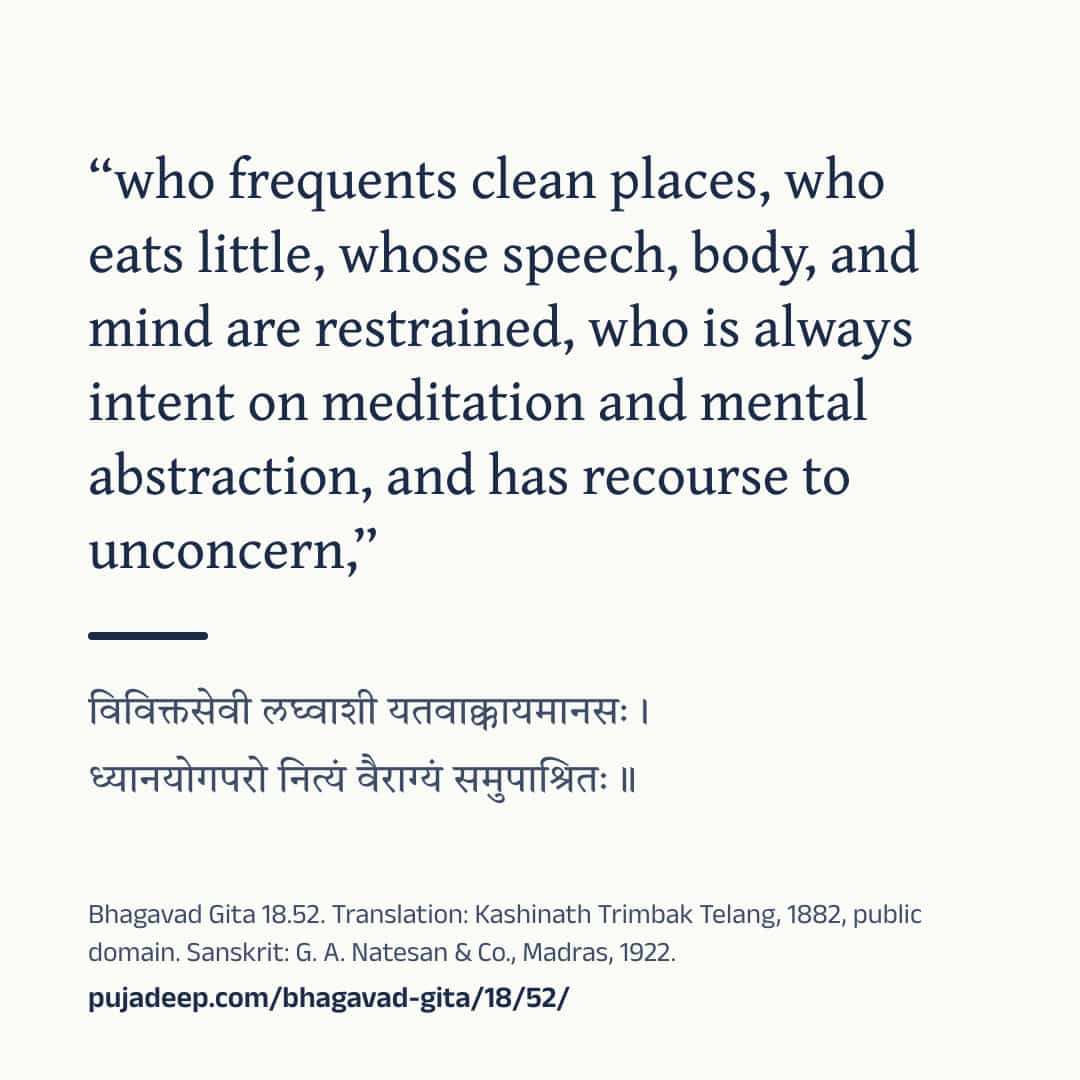
who frequents clean places, who eats little, whose speech, body, and mind are restrained, who is always intent on meditation and mental abstraction1, and has recourse to unconcern,
This sentence begins in 18.51. This sentence goes on in 18.53.
Footnotes (the translator’s own) - Abstraction is concentrated and exclusive meditation, Saṅkara. The other commentators take dhyânayoga as meditation simply,—as treated of in chapter VI, says Nîlakantha. ↩
Compare 3 translations
Kashinath Trimbak Telang, 1882. Public domain. Page 128.
who frequents clean places, who eats little, whose speech, body, and mind are restrained, who is always intent on meditation and mental abstraction1, and has recourse to unconcern,
This sentence begins in 18.51. This sentence goes on in 18.53.
Footnotes (the translator’s own) - Abstraction is concentrated and exclusive meditation, Saṅkara. The other commentators take dhyânayoga as meditation simply,—as treated of in chapter VI, says Nîlakantha. ↩
You are reading this one
Annie Besant, 1895. Public domain. Page 162.
Frequenting a sequestered place, abstemious (in food), speech, body and mind1 subdued, fixed in meditation and Yoga,2 taking refuge in dispassion,
This sentence begins in 18.51. This sentence goes on in 18.53.
Footnotes (the translator’s own) You are reading this one
Swami Swarupananda, 1909 (first printed 1907). Public domain. Page 342.
Resorting to a sequestered spot; eating but little; body, speech and mind controlled; ever engaged in meditation and concentration; possessed with dispassion;
This sentence begins in 18.51. This sentence goes on in 18.53.
You are reading this one
Cite this verse
The translation: K. T. Telang, The Bhagavadgîtâ (The Sacred Books of the East, vol. VIII, Oxford: Clarendon Press, 1882), p. 128. Bhagavad Gita 18.52.
The translation: Annie Besant, The Bhagavad Gîtâ, or The Lord's Song (London: Theosophical Publishing Society, 1895), p. 162. Bhagavad Gita 18.52.
The translation: Swami Swarupananda, Srimad-Bhagavad-Gita (Mayavati: Prabuddha Bharata Press, 1909; first printed in Prabuddha Bharata, 1907–1909), p. 342. Bhagavad Gita 18.52.
Our explanation: “Bhagavad Gita 18.52: meaning and translation.” Pujadeep. Updated October 25, 2026. https://pujadeep.com/bhagavad-gita/18/52/
Pujadeep’s explanations are free to quote with credit: name Pujadeep and link to the page. How to credit
Classical readings, by school
No readings by school on this verse yet.
Share
Show the ways to share
Send one picture or the text to one chat. The picture names its source and the address of this page.
Drawing the picture
See the words
Bhagavad Gita 18.52

विविक्तसेवी लघ्वाशी यतवाक्कायमानसः ।
ध्यानयोगपरो नित्यं वैराग्यं समुपाश्रितः ॥

“who frequents clean places, who eats little, whose speech, body, and mind are restrained, who is always intent on meditation and mental abstraction, and has recourse to unconcern,”
(K. T. Telang, The Bhagavadgîtâ (The Sacred Books of the East, vol. VIII, Oxford: Clarendon Press, 1882), p. 128, public domain)
This sentence begins in 18.51. This sentence goes on in 18.53.

“Frequenting a sequestered place, abstemious (in food), speech, body and mind subdued, fixed in meditation and Yoga, taking refuge in dispassion,”
(Annie Besant, The Bhagavad Gîtâ, or The Lord's Song (London: Theosophical Publishing Society, 1895), p. 162, public domain)
This sentence begins in 18.51. This sentence goes on in 18.53.

“Resorting to a sequestered spot; eating but little; body, speech and mind controlled; ever engaged in meditation and concentration; possessed with dispassion;”
(Swami Swarupananda, Srimad-Bhagavad-Gita (Mayavati: Prabuddha Bharata Press, 1909; first printed in Prabuddha Bharata, 1907–1909), p. 342, public domain)
This sentence begins in 18.51. This sentence goes on in 18.53.

Sanskrit: G. A. Natesan & Co., Madras, 1922.
https://pujadeep.com/bhagavad-gita/18/52/ Nothing is sent from this site. Your own app sends it, to the chat you choose. The picture quotes the translation you chose on this page, with its name and year.
Sanskrit text: The Bhagavad-Gita, or The Lord's Song, with the text in Devanagari and an English translation, 1922. Meanings: written for Pujadeep and checked against the cited edition. Source and changes
Questions families ask
Who speaks Bhagavad Gita 18.52?
Krishna speaks this verse, in chapter 18 (Moksha Sannyasa Yoga).
Where does the Sanskrit text come from?
Sanskrit text: The Bhagavad-Gita, or The Lord's Song, with the text in Devanagari and an English translation, 1922. Meanings: written for Pujadeep and checked against the cited edition. See the source
Is the meaning on this page a translation?
Explanation written for this site from the sources listed here, and checked against the cited edition. It is not a translation and not the only way to read the text. Free to quote with credit.
Source and licence
- Sanskrit text
- The Bhagavad-Gita, or The Lord's Song, with the text in Devanagari and an English translation (Annie Besant, G. A. Natesan & Co., Madras, 1922). Public domain. The Sanskrit on these pages was read from this printing’s page images.
- Translation
- The Bhagavadgîtâ with the Sanatsugâtîya and the Anugîtâ, translated by Kâshinâth Trimbak Telang (The Sacred Books of the East, vol. VIII, ed. F. Max Müller) (Kashinath Trimbak Telang, F. Max Müller, Clarendon Press, Oxford, 1882). Public domain. Shown verbatim, as printed.
- Translation
- The Bhagavad Gîtâ, or The Lord's Song, translated by Annie Besant (Annie Besant, Theosophical Publishing Society, London, 1895). Public domain. Shown verbatim, as printed.
- Translation
- Srimad-Bhagavad-Gita, with Sanskrit Text; Paraphrase with Word-by-word Literal Translation; English Rendering and Comments, Index, &c., by the Swami Swarupananda (Himalayan Series, No. XX) (Swami Swarupananda, The Editors and Publishers, Advaita Ashrama, Mayavati, Prabuddha Bharata Press, Mayavati, Almora, Himalayas, 1909). Public domain. Shown verbatim, as printed.
- Common wording
- In this text, 32 words follow today's common wording, checked against sanskritdocuments.org; Sanskrit Wikisource; Gita Press, Gorakhpur; GRETIL, Göttingen and Bhaktivedanta Book Trust.
- Our explanation
- Explanation written for this site from the sources listed here, and checked against the cited edition. It is not a translation and not the only way to read the text. Free to quote with credit.
- Checked
- Checked against the cited edition, October 15, 2026.
- Updated
- October 25, 2026