Bhagavad Gita 18.54: meaning and translation
Chapter 18: Moksha Sannyasa Yoga. Krishna says
Krishna says that one who has become Brahman, calm within, neither grieves nor longs; being the same towards all beings, such a person gains the highest devotion (bhakti) to him.
Click or tap a word for its meaning and its dictionary page.
Text and layers
Text and layers
These choices stay in this browser.
Bhagavad Gita 18.54
ब्रह्मभूतः प्रसन्नात्मा न शोचति न काङ्क्षति ।समः सर्वेषु भूतेषु मद्भक्तिं लभते पराम् ॥
Brahmabhutah prasannatma na shochati na kankshatiSamah sarveshu bhuteshu madbhaktim labhate param
brahmabhūtaḥ prasannātmā na śocati na kāṅkṣati |samaḥ sarveṣu bhūteṣu madbhaktiṃ labhate parām ||
Our explanation Krishna says that one who has become Brahman, calm within, neither grieves nor longs; being the same towards all beings, such a person gains the highest devotion (bhakti) to him.
हिंदी अर्थ कृष्ण कहते हैं कि ब्रह्मभूत (ब्रह्म में स्थित) व्यक्ति प्रसन्नचित्त रहता है, न शोक करता है, न कामना; सब प्राणियों में समभाव रखते हुए वह उनकी परा भक्ति पाता है।
Word by word
Every word, with its dictionary page
Word by word
- ब्रह्मभूतः brahmabhūtaḥ · become Brahman (compound (masculine), nominative singular) Dictionary: brahma-bhūta, Monier-Williams 1899, p. 739, col. 2 “become i.e. absorbed in Brahmă”
- प्रसन्नात्मा prasannātmā · serene in mind (compound (masculine), nominative singular) Dictionary: pra-sannātman, Monier-Williams 1899, p. 696, col. 3 “gracious-minded, propitious”
- न na · not (indeclinable) Dictionary: 2. na, Monier-Williams 1899, p. 523, col. 1 “not, no, nor, neither”
- शोचति śocati · grieves (present, 3rd person singular) Dictionary: 1. śuc, Monier-Williams 1899, p. 1081, col. 1 “be sorrowful or afflicted, grieve, mourn at or for”
- न na · not (indeclinable) Dictionary: 2. na, Monier-Williams 1899, p. 523, col. 1 “not, no, nor, neither”
- काङ्क्षति kāṅkṣati · longs (present, 3rd person singular) Dictionary: kāṅkṣ, Monier-Williams 1899, p. 268, col. 1 “to wish, desire, long for, hope for”
- समः samaḥ · the same (adjective (masculine), nominative singular) Dictionary: 2. sama, Monier-Williams 1899, p. 1152, col. 1 “same, equal, similar, like, equivalent”
- सर्वेषु sarveṣu · to all (adjective (neuter), locative plural) Dictionary: sarva, Monier-Williams 1899, p. 1184, col. 3 “whole, entire, all, every”
- भूतेषु bhūteṣu · beings (noun (neuter), locative plural) Dictionary: bhūta, Monier-Williams 1899, p. 761, col. 3 “that which is or exists, any living being (divine, human, animal, and even vegetable)”
- मद्भक्तिम् madbhaktim · devotion to "me" (Krishna) (compound (feminine), accusative singular) Dictionary: 1. mad, Monier-Williams 1899, p. 777, col. 2 “base of the first pers. pron. in the sg. number (esp. in comp.)”; bhakti, Monier-Williams 1899, p. 743, col. 2 “attachment, devotion, fondness for, devotion to”
- लभते labhate · gains (present, 3rd person singular) Dictionary: labh, Monier-Williams 1899, p. 896, col. 2 “to gain possession of, obtain, receive, conceive, get”
- पराम् parām · highest (adjective (feminine), accusative singular) Dictionary: 1. para, Monier-Williams 1899, p. 586, col. 1 “best or worst, highest, supreme, chief”
Old translations
Kashinath Trimbak Telang, 1882. Public domain. Page 128.
Thus reaching the Brahman1, and with a tranquil self, he grieves not, wishes not; but being alike to all beings, obtains the highest devotion to me.
Footnotes (the translator’s own) - I. e. comprehending his identity with the Brahman. ↩
Compare 3 translations
Kashinath Trimbak Telang, 1882. Public domain. Page 128.
Thus reaching the Brahman1, and with a tranquil self, he grieves not, wishes not; but being alike to all beings, obtains the highest devotion to me.
Footnotes (the translator’s own) - I. e. comprehending his identity with the Brahman. ↩
You are reading this one
Annie Besant, 1895. Public domain. Page 163.
Becoming Brahman, serene in the SELF, he neither grieveth nor desireth; balanced among all beings, he obtaineth supreme devotion unto Me.
You are reading this one
Swami Swarupananda, 1909 (first printed 1907). Public domain. Page 343.
Brahman-become, tranquil-minded, he neither grieves nor desires; the same to all beings; he attains to supreme devotion unto Me.
You are reading this one
Cite this verse
The translation: K. T. Telang, The Bhagavadgîtâ (The Sacred Books of the East, vol. VIII, Oxford: Clarendon Press, 1882), p. 128. Bhagavad Gita 18.54.
The translation: Annie Besant, The Bhagavad Gîtâ, or The Lord's Song (London: Theosophical Publishing Society, 1895), p. 163. Bhagavad Gita 18.54.
The translation: Swami Swarupananda, Srimad-Bhagavad-Gita (Mayavati: Prabuddha Bharata Press, 1909; first printed in Prabuddha Bharata, 1907–1909), p. 343. Bhagavad Gita 18.54.
Our explanation: “Bhagavad Gita 18.54: meaning and translation.” Pujadeep. Updated October 25, 2026. https://pujadeep.com/bhagavad-gita/18/54/
Pujadeep’s explanations are free to quote with credit: name Pujadeep and link to the page. How to credit
Classical readings, by school
No readings by school on this verse yet.
Share
Show the ways to share
Send one picture or the text to one chat. The picture names its source and the address of this page.
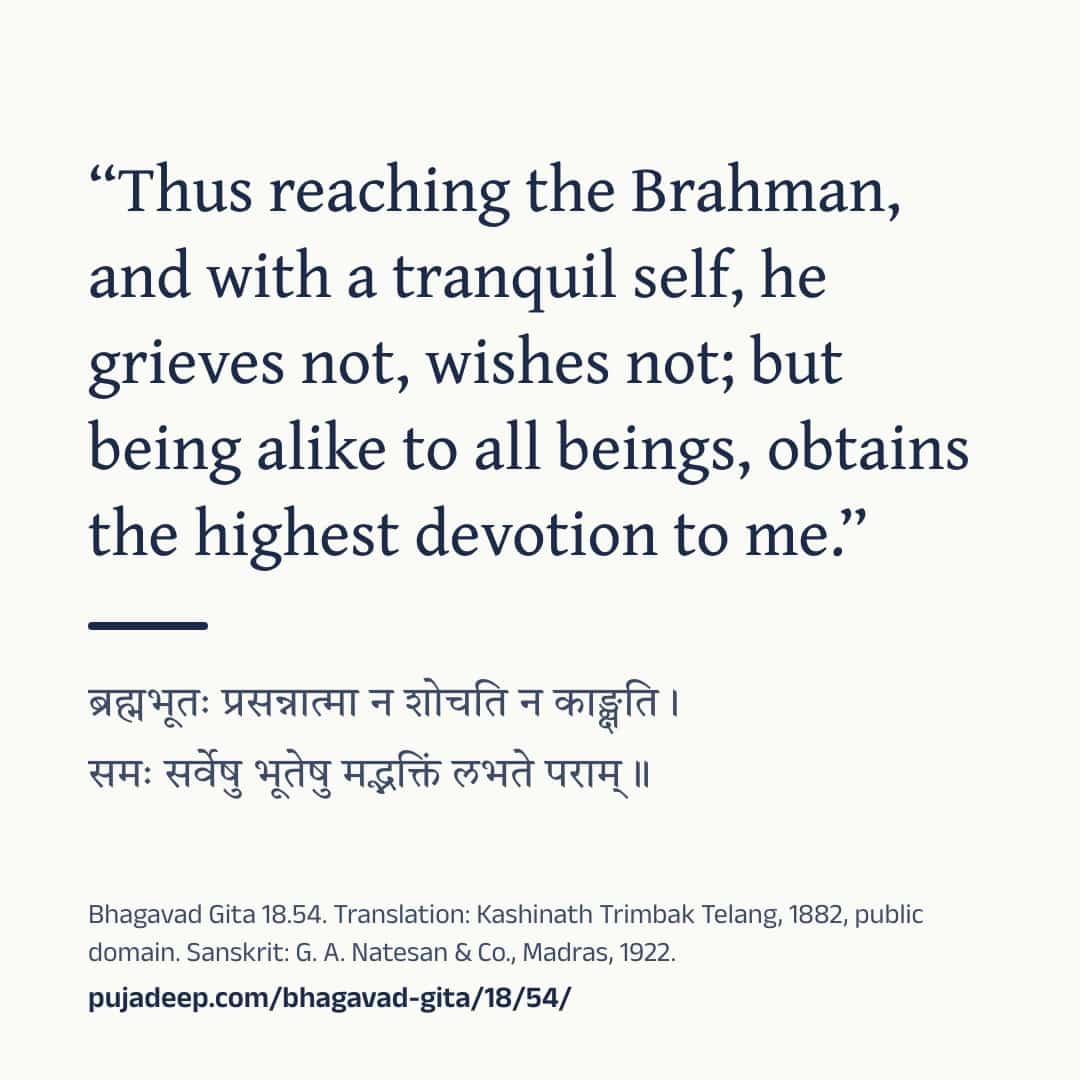
Drawing the picture
See the words
Bhagavad Gita 18.54

ब्रह्मभूतः प्रसन्नात्मा न शोचति न काङ्क्षति ।
समः सर्वेषु भूतेषु मद्भक्तिं लभते पराम् ॥

“Thus reaching the Brahman, and with a tranquil self, he grieves not, wishes not; but being alike to all beings, obtains the highest devotion to me.”
(K. T. Telang, The Bhagavadgîtâ (The Sacred Books of the East, vol. VIII, Oxford: Clarendon Press, 1882), p. 128, public domain)

“Becoming Brahman, serene in the SELF, he neither grieveth nor desireth; balanced among all beings, he obtaineth supreme devotion unto Me.”
(Annie Besant, The Bhagavad Gîtâ, or The Lord's Song (London: Theosophical Publishing Society, 1895), p. 163, public domain)

“Brahman-become, tranquil-minded, he neither grieves nor desires; the same to all beings; he attains to supreme devotion unto Me.”
(Swami Swarupananda, Srimad-Bhagavad-Gita (Mayavati: Prabuddha Bharata Press, 1909; first printed in Prabuddha Bharata, 1907–1909), p. 343, public domain)

Sanskrit: G. A. Natesan & Co., Madras, 1922.
https://pujadeep.com/bhagavad-gita/18/54/ Nothing is sent from this site. Your own app sends it, to the chat you choose. The picture quotes the translation you chose on this page, with its name and year.
Sanskrit text: The Bhagavad-Gita, or The Lord's Song, with the text in Devanagari and an English translation, 1922. Meanings: written for Pujadeep and checked against the cited edition. Source and changes
Questions families ask
Who speaks Bhagavad Gita 18.54?
Krishna speaks this verse, in chapter 18 (Moksha Sannyasa Yoga).
Where does the Sanskrit text come from?
Sanskrit text: The Bhagavad-Gita, or The Lord's Song, with the text in Devanagari and an English translation, 1922. Meanings: written for Pujadeep and checked against the cited edition. See the source
Is the meaning on this page a translation?
Explanation written for this site from the sources listed here, and checked against the cited edition. It is not a translation and not the only way to read the text. Free to quote with credit.
Source and licence
- Sanskrit text
- The Bhagavad-Gita, or The Lord's Song, with the text in Devanagari and an English translation (Annie Besant, G. A. Natesan & Co., Madras, 1922). Public domain. The Sanskrit on these pages was read from this printing’s page images.
- Translation
- The Bhagavadgîtâ with the Sanatsugâtîya and the Anugîtâ, translated by Kâshinâth Trimbak Telang (The Sacred Books of the East, vol. VIII, ed. F. Max Müller) (Kashinath Trimbak Telang, F. Max Müller, Clarendon Press, Oxford, 1882). Public domain. Shown verbatim, as printed.
- Translation
- The Bhagavad Gîtâ, or The Lord's Song, translated by Annie Besant (Annie Besant, Theosophical Publishing Society, London, 1895). Public domain. Shown verbatim, as printed.
- Translation
- Srimad-Bhagavad-Gita, with Sanskrit Text; Paraphrase with Word-by-word Literal Translation; English Rendering and Comments, Index, &c., by the Swami Swarupananda (Himalayan Series, No. XX) (Swami Swarupananda, The Editors and Publishers, Advaita Ashrama, Mayavati, Prabuddha Bharata Press, Mayavati, Almora, Himalayas, 1909). Public domain. Shown verbatim, as printed.
- Common wording
- In this text, 32 words follow today's common wording, checked against sanskritdocuments.org; Sanskrit Wikisource; Gita Press, Gorakhpur; GRETIL, Göttingen and Bhaktivedanta Book Trust.
- Our explanation
- Explanation written for this site from the sources listed here, and checked against the cited edition. It is not a translation and not the only way to read the text. Free to quote with credit.
- Checked
- Checked against the cited edition, October 15, 2026.
- Updated
- October 25, 2026