Bhagavad Gita 18.58: meaning and translation
Chapter 18: Moksha Sannyasa Yoga. Krishna says
Krishna tells Arjuna that with his mind on him he will cross all difficulties by his grace; but if out of pride he will not listen, he will be lost.
Click or tap a word for its meaning and its dictionary page.
Text and layers
Text and layers
These choices stay in this browser.
Bhagavad Gita 18.58
मच्चित्तः सर्वदुर्गाणि मत्प्रसादात्तरिष्यसि ।अथ चेत्त्वमहङ्कारान्न श्रोष्यसि विनङ्क्ष्यसि ॥
Machchittah sarvadurgani matprasadattarishyasiAtha chettvamahankaranna shroshyasi vinankshyasi
maccittaḥ sarvadurgāṇi matprasādāttariṣyasi |atha cettvamahaṅkārānna śroṣyasi vinaṅkṣyasi ||
Our explanation Krishna tells Arjuna that with his mind on him he will cross all difficulties by his grace; but if out of pride he will not listen, he will be lost. These are Krishna's words to Arjuna at the moment of decision.
हिंदी अर्थ कृष्ण अर्जुन से कहते हैं कि उनमें चित्त लगाकर वे उनकी कृपा से सब कठिनाइयाँ पार कर लेंगे; पर यदि अहंकार के कारण नहीं सुनेंगे, तो नष्ट हो जाएँगे। ये निर्णय की घड़ी में अर्जुन से कहे गए कृष्ण के वचन हैं।
Word by word
Every word, with its dictionary page
Word by word
- मच्चित्तः maccittaḥ · with mind on "me" (Krishna) (compound (masculine), nominative singular) Dictionary: mac-citta, Monier-Williams 1899, p. 777, col. 2 “having the mind (fixed) on me, thinking of me”
- सर्वदुर्गाणि sarvadurgāṇi · all difficulties (compound (neuter), accusative plural) Dictionary: sarva, Monier-Williams 1899, p. 1184, col. 3 “whole, entire, all, every”; durga, Monier-Williams 1899, p. 487, col. 2 “difficulty, danger, distress”
- मत्प्रसादात् matprasādāt · by "my" (Krishna's) grace (compound (masculine), ablative singular) Dictionary: 1. mad, Monier-Williams 1899, p. 777, col. 2 “base of the first pers. pron. in the sg. number (esp. in comp.)”; pra-sāda, Monier-Williams 1899, p. 697, col. 1 “graciousness, kindness, kind behaviour, favour, aid”
- तरिष्यसि tariṣyasi · you will cross (future, 2nd person singular) Dictionary: tṝ, Monier-Williams 1899, p. 454, col. 2 “to pass across or over, cross over (a river), sail across”
- अथ atha · but (indeclinable) Dictionary: atha, Monier-Williams 1899, p. 17, col. 3 “now; then; moreover; rather; certainly; but”
- चेत् cet · if (indeclinable) Dictionary: ced, Monier-Williams 1899, p. 401, col. 3 “‘if’”
- त्वम् tvam · you (pronoun, nominative singular) Dictionary: 2. tva, Monier-Williams 1899, p. 463, col. 2 “base of the 2nd personal pron.”
- अहङ्कारात् ahaṅkārāt · out of ego (noun (masculine), ablative singular) Dictionary: ahaṃ-kāra, Monier-Williams 1899, p. 124, col. 2 “conception of one's individuality, self-consciousness”
- न na · not (indeclinable) Dictionary: 2. na, Monier-Williams 1899, p. 523, col. 1 “not, no, nor, neither”
- श्रोष्यसि śroṣyasi · you will listen (future, 2nd person singular) Dictionary: 1. śru, Monier-Williams 1899, p. 1100, col. 3 “to hear, listen or attend to anything”
- विनङ्क्ष्यसि vinaṅkṣyasi · you will be lost (future, 2nd person singular) Dictionary: vi-naś, Monier-Williams 1899, p. 969, col. 2 “to be utterly lost, perish, disappear, vanish”
Old translations
Kashinath Trimbak Telang, 1882. Public domain. Page 128.
(Placing) your thoughts on me, you will cross over all difficulties by my favour. But if you will not listen through egotism1, you will be ruined.
Footnotes (the translator’s own) - Pride of learning and cleverness, or of piety. See p. 124, note 5. ↩
Compare 3 translations
Kashinath Trimbak Telang, 1882. Public domain. Page 128.
(Placing) your thoughts on me, you will cross over all difficulties by my favour. But if you will not listen through egotism1, you will be ruined.
Footnotes (the translator’s own) - Pride of learning and cleverness, or of piety. See p. 124, note 5. ↩
You are reading this one
Annie Besant, 1895. Public domain. Page 163.
Thinking on Me, thou shalt conquer all obstacles by My grace; but if from egoism thou wilt not give ear, thou wilt be destroyed utterly.
You are reading this one
Swami Swarupananda, 1909 (first printed 1907). Public domain. Page 345.
Fixing thy mind on Me, thou shalt by My grace, overcome all obstacles; but if from self-conceit thou wilt not hear Me, thou shalt perish.
You are reading this one
Cite this verse
The translation: K. T. Telang, The Bhagavadgîtâ (The Sacred Books of the East, vol. VIII, Oxford: Clarendon Press, 1882), p. 128. Bhagavad Gita 18.58.
The translation: Annie Besant, The Bhagavad Gîtâ, or The Lord's Song (London: Theosophical Publishing Society, 1895), p. 163. Bhagavad Gita 18.58.
The translation: Swami Swarupananda, Srimad-Bhagavad-Gita (Mayavati: Prabuddha Bharata Press, 1909; first printed in Prabuddha Bharata, 1907–1909), p. 345. Bhagavad Gita 18.58.
Our explanation: “Bhagavad Gita 18.58: meaning and translation.” Pujadeep. Updated October 25, 2026. https://pujadeep.com/bhagavad-gita/18/58/
Pujadeep’s explanations are free to quote with credit: name Pujadeep and link to the page. How to credit
Classical readings, by school
No readings by school on this verse yet.
Share
Show the ways to share
Send one picture or the text to one chat. The picture names its source and the address of this page.
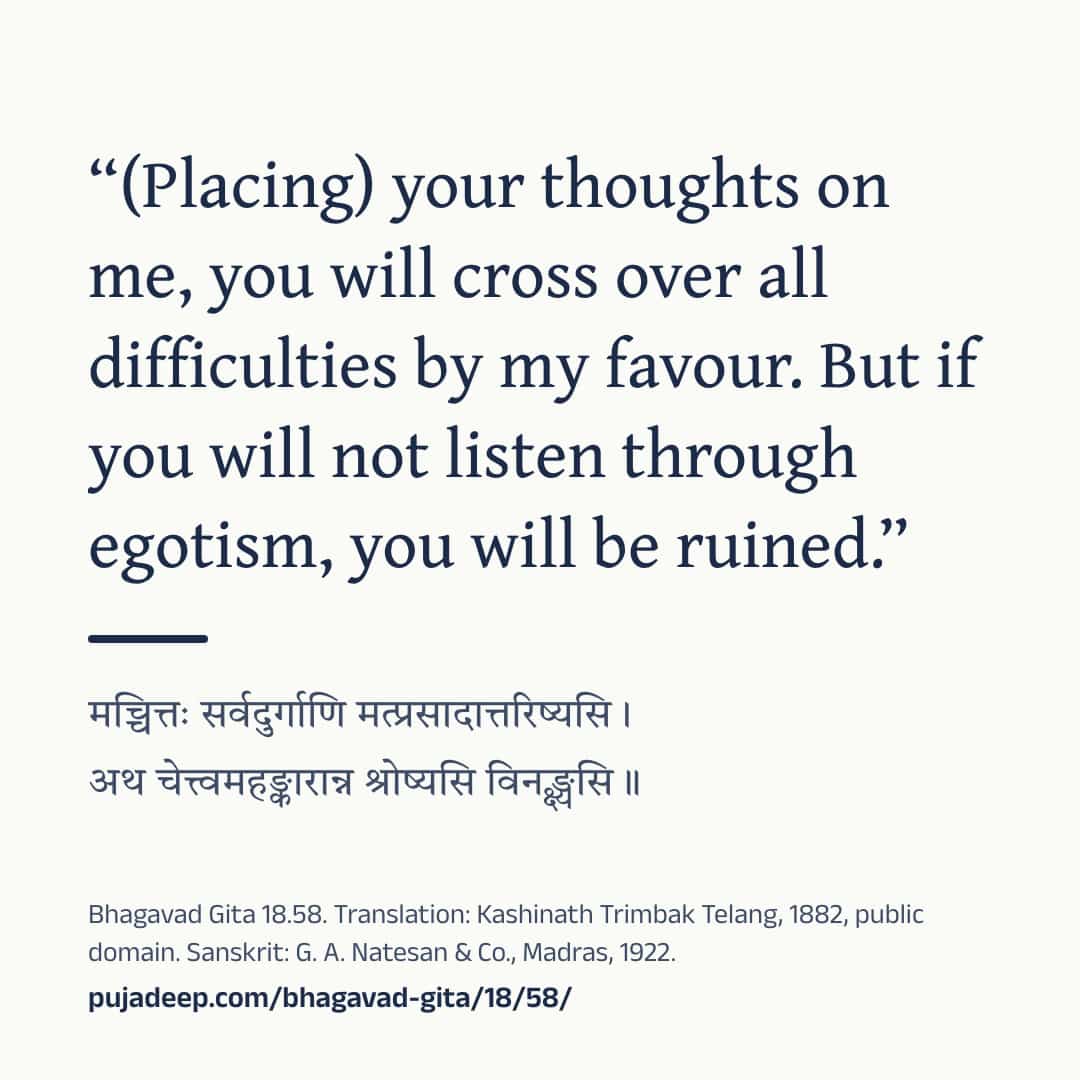
Drawing the picture
See the words
Bhagavad Gita 18.58

मच्चित्तः सर्वदुर्गाणि मत्प्रसादात्तरिष्यसि ।
अथ चेत्त्वमहङ्कारान्न श्रोष्यसि विनङ्क्ष्यसि ॥

“(Placing) your thoughts on me, you will cross over all difficulties by my favour. But if you will not listen through egotism, you will be ruined.”
(K. T. Telang, The Bhagavadgîtâ (The Sacred Books of the East, vol. VIII, Oxford: Clarendon Press, 1882), p. 128, public domain)

“Thinking on Me, thou shalt conquer all obstacles by My grace; but if from egoism thou wilt not give ear, thou wilt be destroyed utterly.”
(Annie Besant, The Bhagavad Gîtâ, or The Lord's Song (London: Theosophical Publishing Society, 1895), p. 163, public domain)

“Fixing thy mind on Me, thou shalt by My grace, overcome all obstacles; but if from self-conceit thou wilt not hear Me, thou shalt perish.”
(Swami Swarupananda, Srimad-Bhagavad-Gita (Mayavati: Prabuddha Bharata Press, 1909; first printed in Prabuddha Bharata, 1907–1909), p. 345, public domain)

Sanskrit: G. A. Natesan & Co., Madras, 1922.
https://pujadeep.com/bhagavad-gita/18/58/ Nothing is sent from this site. Your own app sends it, to the chat you choose. The picture quotes the translation you chose on this page, with its name and year.
Sanskrit text: The Bhagavad-Gita, or The Lord's Song, with the text in Devanagari and an English translation, 1922. Meanings: written for Pujadeep and checked against the cited edition. Source and changes
Questions families ask
Who speaks Bhagavad Gita 18.58?
Krishna speaks this verse, in chapter 18 (Moksha Sannyasa Yoga).
Where does the Sanskrit text come from?
Sanskrit text: The Bhagavad-Gita, or The Lord's Song, with the text in Devanagari and an English translation, 1922. Meanings: written for Pujadeep and checked against the cited edition. See the source
Is the meaning on this page a translation?
Explanation written for this site from the sources listed here, and checked against the cited edition. It is not a translation and not the only way to read the text. Free to quote with credit.
Source and licence
- Sanskrit text
- The Bhagavad-Gita, or The Lord's Song, with the text in Devanagari and an English translation (Annie Besant, G. A. Natesan & Co., Madras, 1922). Public domain. The Sanskrit on these pages was read from this printing’s page images.
- Translation
- The Bhagavadgîtâ with the Sanatsugâtîya and the Anugîtâ, translated by Kâshinâth Trimbak Telang (The Sacred Books of the East, vol. VIII, ed. F. Max Müller) (Kashinath Trimbak Telang, F. Max Müller, Clarendon Press, Oxford, 1882). Public domain. Shown verbatim, as printed.
- Translation
- The Bhagavad Gîtâ, or The Lord's Song, translated by Annie Besant (Annie Besant, Theosophical Publishing Society, London, 1895). Public domain. Shown verbatim, as printed.
- Translation
- Srimad-Bhagavad-Gita, with Sanskrit Text; Paraphrase with Word-by-word Literal Translation; English Rendering and Comments, Index, &c., by the Swami Swarupananda (Himalayan Series, No. XX) (Swami Swarupananda, The Editors and Publishers, Advaita Ashrama, Mayavati, Prabuddha Bharata Press, Mayavati, Almora, Himalayas, 1909). Public domain. Shown verbatim, as printed.
- Common wording
- In this text, 32 words follow today's common wording, checked against sanskritdocuments.org; Sanskrit Wikisource; Gita Press, Gorakhpur; GRETIL, Göttingen and Bhaktivedanta Book Trust.
- Our explanation
- Explanation written for this site from the sources listed here, and checked against the cited edition. It is not a translation and not the only way to read the text. Free to quote with credit.
- Checked
- Checked against the cited edition, October 15, 2026.
- Updated
- October 25, 2026