Bhagavad Gita 18.70: meaning and translation
Chapter 18: Moksha Sannyasa Yoga. Krishna says
The text says, in Krishna's words, that whoever studies this sacred dialogue between the two of them will have worshipped him with the sacrifice of knowledge (jñāna-yajña); Krishna calls this his view.
Click or tap a word for its meaning and its dictionary page.
Text and layers
Text and layers
These choices stay in this browser.
Bhagavad Gita 18.70
अध्येष्यते च य इमं धर्म्यं संवादमावयोः ।ज्ञानयज्ञेन तेनाहमिष्टः स्यामिति मे मतिः ॥
Adhyeshyate cha ya imam dharmyam sanvadamavayohJnanayajnena tenahamishtah syamiti me matih
adhyeṣyate ca ya imaṃ dharmyaṃ saṃvādamāvayoḥ |jñānayajñena tenāhamiṣṭaḥ syāmiti me matiḥ ||
Our explanation The text says, in Krishna's words, that whoever studies this sacred dialogue between the two of them will have worshipped him with the sacrifice of knowledge (jñāna-yajña); Krishna calls this his view. It is the Gita's own claim about studying it.
हिंदी अर्थ यह श्लोक कृष्ण के शब्दों में कहता है कि जो उन दोनों के इस धर्ममय संवाद का अध्ययन करेगा, उसने ज्ञानयज्ञ से उनकी पूजा की होगी; कृष्ण इसे अपना मत कहते हैं। यह गीता के अध्ययन के बारे में गीता का अपना कथन है।
The text’s own words about its benefits, not a promise from Pujadeep.
Word by word
Every word, with its dictionary page
Word by word
- अध्येष्यते adhyeṣyate · will study (future, 3rd person singular) Dictionary: adhī, Monier-Williams 1899, p. 22, col. 3 “to study, learn by heart, read, recite”
- च ca · and (indeclinable) Dictionary: 2. ca, Monier-Williams 1899, p. 380, col. 1 “and, both, also, moreover, as well as”
- यः yaḥ · who (pronoun (masculine), nominative singular) Dictionary: yad, Monier-Williams 1899, p. 844, col. 2 “who, which, what, whichever, whatever, that”
- इमम् imam · this (pronoun (masculine), accusative singular) Dictionary: 1. idam, Monier-Williams 1899, p. 165, col. 2 “this, this here, referring to something near the speaker”
- धर्म्यम् dharmyam · sacred, in keeping with dharma (adjective (masculine), accusative singular) Dictionary: dharmya, Monier-Williams 1899, p. 513, col. 1 “just, virtuous, righteous”
- संवादम् saṃvādam · dialogue (noun (masculine), accusative singular) Dictionary: saṃ-vāda, Monier-Williams 1899, p. 1114, col. 2 “speaking together, conversation, colloquy with”
- आवयोः āvayoḥ · of us two (pronoun, genitive dual) Dictionary: asmad, Monier-Williams 1899, p. 123, col. 2 “base of the first person plur., as used in comp.”
- ज्ञानयज्ञेन jñānayajñena · by the sacrifice of knowledge (compound (masculine), instrumental singular) Dictionary: jñāna, Monier-Williams 1899, p. 426, col. 1 “knowing, becoming acquainted with, knowledge”; yajña, Monier-Williams 1899, p. 839, col. 2 “worship, devotion, prayer, praise; act of worship or devotion, offering, oblation, sacrifice”
- तेन tena · by him (pronoun (masculine), instrumental singular) Dictionary: tad, Monier-Williams 1899, p. 434, col. 1 “m. he, f. she, n. it, that, this”
- अहम् aham · "I" (Krishna) (pronoun, nominative singular) Dictionary: aham, Monier-Williams 1899, p. 124, col. 2 “nom. sg. ‘I,’”
- इष्टः iṣṭaḥ · worshipped (past participle (masculine), nominative singular) Dictionary: 2. iṣṭa, Monier-Williams 1899, p. 169, col. 3 “sacrificed, worshipped with sacrifices”
- स्याम् syām · would be (optative, 1st person singular) Dictionary: 1. as, Monier-Williams 1899, p. 117, col. 2 “to be, live, exist, be present”
- इति iti · thus (indeclinable) Dictionary: 2. iti, Monier-Williams 1899, p. 165, col. 1 “in this manner, thus”
- मे me · "my" (Krishna's) (pronoun, genitive singular) Dictionary: 1. mad, Monier-Williams 1899, p. 777, col. 2 “base of the first pers. pron. in the sg. number (esp. in comp.)”
- मतिः matiḥ · view (noun (feminine), nominative singular) Dictionary: mati, Monier-Williams 1899, p. 783, col. 2 “opinion, notion, idea, belief, conviction, view, creed”
Old translations
Kashinath Trimbak Telang, 1882. Public domain. Page 130.
And he who will study this holy dialogue of ours, will, such is my opinion, have offered to me the sacrifice of knowledge1.
Footnotes (the translator’s own) - Which is the best of sacrifices; see p. 62. ↩
Compare 3 translations
Kashinath Trimbak Telang, 1882. Public domain. Page 130.
And he who will study this holy dialogue of ours, will, such is my opinion, have offered to me the sacrifice of knowledge1.
Footnotes (the translator’s own) - Which is the best of sacrifices; see p. 62. ↩
You are reading this one
Annie Besant, 1895. Public domain. Page 166.
And he who shall study this sacred dialogue of ours, by him will have been offered to Me the sacrifice of wisdom. Such is My Mind.
You are reading this one
Swami Swarupananda, 1909 (first printed 1907). Public domain. Page 351.
And he who shall study this sacred dialogue of ours, by him shall I have been worshipped by the Yajna of knowledge; such is my conviction.
You are reading this one
Cite this verse
The translation: K. T. Telang, The Bhagavadgîtâ (The Sacred Books of the East, vol. VIII, Oxford: Clarendon Press, 1882), p. 130. Bhagavad Gita 18.70.
The translation: Annie Besant, The Bhagavad Gîtâ, or The Lord's Song (London: Theosophical Publishing Society, 1895), p. 166. Bhagavad Gita 18.70.
The translation: Swami Swarupananda, Srimad-Bhagavad-Gita (Mayavati: Prabuddha Bharata Press, 1909; first printed in Prabuddha Bharata, 1907–1909), p. 351. Bhagavad Gita 18.70.
Our explanation: “Bhagavad Gita 18.70: meaning and translation.” Pujadeep. Updated October 25, 2026. https://pujadeep.com/bhagavad-gita/18/70/
Pujadeep’s explanations are free to quote with credit: name Pujadeep and link to the page. How to credit
Classical readings, by school
No readings by school on this verse yet.
Share
Show the ways to share
Send one picture or the text to one chat. The picture names its source and the address of this page.
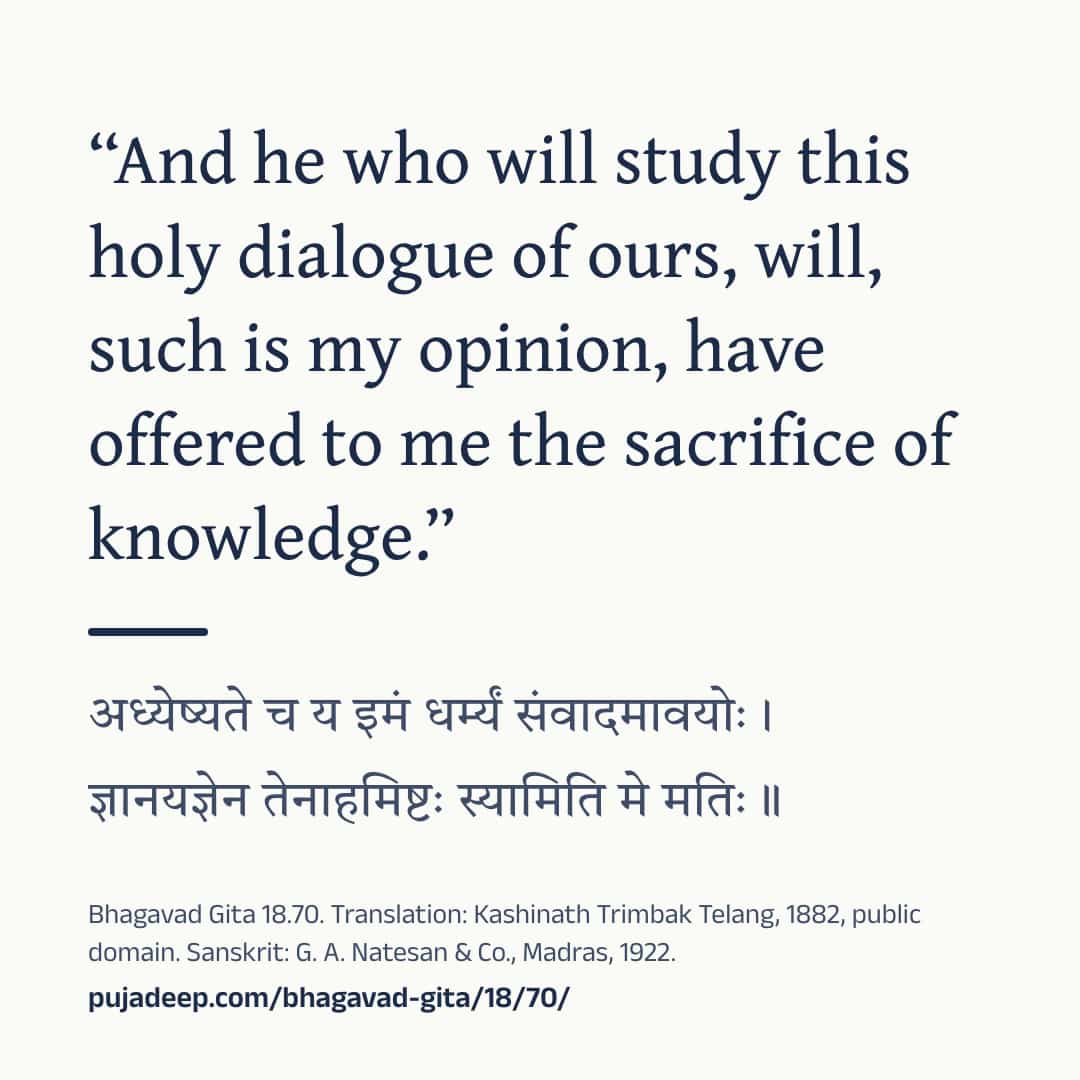
Drawing the picture
See the words
Bhagavad Gita 18.70

अध्येष्यते च य इमं धर्म्यं संवादमावयोः ।
ज्ञानयज्ञेन तेनाहमिष्टः स्यामिति मे मतिः ॥

“And he who will study this holy dialogue of ours, will, such is my opinion, have offered to me the sacrifice of knowledge.”
(K. T. Telang, The Bhagavadgîtâ (The Sacred Books of the East, vol. VIII, Oxford: Clarendon Press, 1882), p. 130, public domain)

“And he who shall study this sacred dialogue of ours, by him will have been offered to Me the sacrifice of wisdom. Such is My Mind.”
(Annie Besant, The Bhagavad Gîtâ, or The Lord's Song (London: Theosophical Publishing Society, 1895), p. 166, public domain)

“And he who shall study this sacred dialogue of ours, by him shall I have been worshipped by the Yajna of knowledge; such is my conviction.”
(Swami Swarupananda, Srimad-Bhagavad-Gita (Mayavati: Prabuddha Bharata Press, 1909; first printed in Prabuddha Bharata, 1907–1909), p. 351, public domain)

Sanskrit: G. A. Natesan & Co., Madras, 1922.
https://pujadeep.com/bhagavad-gita/18/70/ Nothing is sent from this site. Your own app sends it, to the chat you choose. The picture quotes the translation you chose on this page, with its name and year.
Sanskrit text: The Bhagavad-Gita, or The Lord's Song, with the text in Devanagari and an English translation, 1922. Meanings: written for Pujadeep and checked against the cited edition. Source and changes
Questions families ask
Who speaks Bhagavad Gita 18.70?
Krishna speaks this verse, in chapter 18 (Moksha Sannyasa Yoga).
Where does the Sanskrit text come from?
Sanskrit text: The Bhagavad-Gita, or The Lord's Song, with the text in Devanagari and an English translation, 1922. Meanings: written for Pujadeep and checked against the cited edition. See the source
Is the meaning on this page a translation?
Explanation written for this site from the sources listed here, and checked against the cited edition. It is not a translation and not the only way to read the text. Free to quote with credit.
Source and licence
- Sanskrit text
- The Bhagavad-Gita, or The Lord's Song, with the text in Devanagari and an English translation (Annie Besant, G. A. Natesan & Co., Madras, 1922). Public domain. The Sanskrit on these pages was read from this printing’s page images.
- Translation
- The Bhagavadgîtâ with the Sanatsugâtîya and the Anugîtâ, translated by Kâshinâth Trimbak Telang (The Sacred Books of the East, vol. VIII, ed. F. Max Müller) (Kashinath Trimbak Telang, F. Max Müller, Clarendon Press, Oxford, 1882). Public domain. Shown verbatim, as printed.
- Translation
- The Bhagavad Gîtâ, or The Lord's Song, translated by Annie Besant (Annie Besant, Theosophical Publishing Society, London, 1895). Public domain. Shown verbatim, as printed.
- Translation
- Srimad-Bhagavad-Gita, with Sanskrit Text; Paraphrase with Word-by-word Literal Translation; English Rendering and Comments, Index, &c., by the Swami Swarupananda (Himalayan Series, No. XX) (Swami Swarupananda, The Editors and Publishers, Advaita Ashrama, Mayavati, Prabuddha Bharata Press, Mayavati, Almora, Himalayas, 1909). Public domain. Shown verbatim, as printed.
- Common wording
- In this text, 32 words follow today's common wording, checked against sanskritdocuments.org; Sanskrit Wikisource; Gita Press, Gorakhpur; GRETIL, Göttingen and Bhaktivedanta Book Trust.
- Our explanation
- Explanation written for this site from the sources listed here, and checked against the cited edition. It is not a translation and not the only way to read the text. Free to quote with credit.
- Checked
- Checked against the cited edition, October 15, 2026.
- Updated
- October 25, 2026