Bhagavad Gita 18.73: meaning and translation
Chapter 18: Moksha Sannyasa Yoga. Arjuna says
Arjuna answers.
Click or tap a word for its meaning and its dictionary page.
Text and layers
Text and layers
These choices stay in this browser.
Bhagavad Gita 18.73
अर्जुन उवाच ।
नष्टो मोहः स्मृतिर्लब्धा त्वत्प्रसादान्मयाऽच्युत ।स्थितोऽस्मि गतसन्देहः करिष्ये वचनं तव ॥
Nashto mohah smritirlabdha tvatprasadanmayachyutaSthitosmi gatasandehah karishye vachanam tava
naṣṭo mohaḥ smṛtirlabdhā tvatprasādānmayā’cyuta |sthito’smi gatasandehaḥ kariṣye vacanaṃ tava ||
Our explanation Arjuna answers. He says his confusion is gone and that, by Krishna's grace, he has regained his memory (smṛti), his true understanding. He stands firm, his doubts gone, and says he will do as Krishna says. This answers the grief of chapter 1 and his refusal in 2.9.
हिंदी अर्थ अर्जुन उत्तर देते हैं। वे कहते हैं कि उनका मोह नष्ट हो गया है और कृष्ण की कृपा से उन्हें स्मृति (अपनी सही समझ) फिर मिल गई है। वे स्थिर हैं, उनके संदेह दूर हो गए हैं, और वे कहते हैं कि वे कृष्ण का वचन मानेंगे। यह अध्याय 1 के विषाद और 2.9 में उनके इनकार का उत्तर है।
Word by word
Every word, with its dictionary page
Word by word
- नष्टः naṣṭaḥ · is destroyed (past participle (masculine), nominative singular) Dictionary: naṣṭa, Monier-Williams 1899, p. 532, col. 1 “lost, disappeared, perished, destroyed”
- मोहः mohaḥ · delusion (noun (masculine), nominative singular) Dictionary: moha, Monier-Williams 1899, p. 836, col. 1 “loss of consciousness, bewilderment, perplexity, distraction, infatuation, delusion, error, folly”
- स्मृतिः smṛtiḥ · memory, right understanding (noun (feminine), nominative singular) Dictionary: smṛti, Monier-Williams 1899, p. 1272, col. 2 “remembrance, reminiscence”
- लब्धा labdhā · is gained (past participle (feminine), nominative singular) Dictionary: labdha, Monier-Williams 1899, p. 896, col. 2 “taken, seized, caught, met with, found &c.”
- त्वत्प्रसादात् tvatprasādāt · by your grace (compound (masculine), ablative singular) Dictionary: 2. tva, Monier-Williams 1899, p. 463, col. 2 “base of the 2nd personal pron.”; pra-sāda, Monier-Williams 1899, p. 697, col. 1 “graciousness, kindness, kind behaviour, favour, aid”
- मया mayā · by "me" (Arjuna) (pronoun, instrumental singular) Dictionary: 1. mad, Monier-Williams 1899, p. 777, col. 2 “base of the first pers. pron. in the sg. number (esp. in comp.)”
- अच्युत acyuta · O Achyuta (Krishna) (noun (masculine), vocative singular) Dictionary: a-cyuta, Monier-Williams 1899, p. 9, col. 2 “not fallen; firm, solid; imperishable, permanent”
- स्थितः sthitaḥ · firm (past participle (masculine), nominative singular) Dictionary: sthita, Monier-Williams 1899, p. 1264, col. 1 “standing, staying, situated, resting or abiding or remaining in”
- अस्मि asmi · "I am" (present, 1st person singular) Dictionary: 1. as, Monier-Williams 1899, p. 117, col. 2 “to be, live, exist, be present”
- गतसन्देहः gatasandehaḥ · with doubts gone (compound (masculine), nominative singular) Dictionary: gata, Monier-Williams 1899, p. 347, col. 1 “gone, gone away, departed”; saṃ-deha, Monier-Williams 1899, p. 1143, col. 3 “doubt, uncertainty about”
- करिष्ये kariṣye · "I will do" (future, 1st person singular) Dictionary: 1. kṛ, Monier-Williams 1899, p. 301, col. 1 “to do, make, perform, accomplish, cause, effect, prepare, undertake”
- वचनम् vacanam · word (noun (neuter), accusative singular) Dictionary: vacana, Monier-Williams 1899, p. 912, col. 3 “advice, instruction, direction, order, command”
- तव tava · your (pronoun, genitive singular) Dictionary: 2. tva, Monier-Williams 1899, p. 463, col. 2 “base of the 2nd personal pron.”
1 printing differs
Edition differences. Another printing or text reads this place differently.
- Spelling A digital text reads Same words. The 1922 edition marks the merged vowel with an avagraha (मयाऽच्युत); this e-text does not.
Old translations
Kashinath Trimbak Telang, 1882. Public domain. Page 130.
Arguna said:
Destroyed is my delusion; by your favour, O undegraded one! I (now) recollect1 myself. I stand freed from doubts2. I will do your bidding.
Footnotes (the translator’s own) Compare 3 translations
Kashinath Trimbak Telang, 1882. Public domain. Page 130.
Arguna said:
Destroyed is my delusion; by your favour, O undegraded one! I (now) recollect1 myself. I stand freed from doubts2. I will do your bidding.
Footnotes (the translator’s own) You are reading this one
Annie Besant, 1895. Public domain. Page 166–167.
Arjuna said:
Destroyed my delusion. I have gained the knowledge1 of the truth through Thy grace, O Achyuta. I am firm, my doubts have fled away. I will do according to Thy word.
Footnotes (the translator’s own) - Literally "memory." ↩
You are reading this one
Swami Swarupananda, 1909 (first printed 1907). Public domain. Page 352.
Arjuna said:
Destroyed is my delusion, and I have gained my memory through Thy grace, O Achyuta. I am firm; my doubts are gone. I will do Thy word.
You are reading this one
Cite this verse
The translation: K. T. Telang, The Bhagavadgîtâ (The Sacred Books of the East, vol. VIII, Oxford: Clarendon Press, 1882), p. 130. Bhagavad Gita 18.73.
The translation: Annie Besant, The Bhagavad Gîtâ, or The Lord's Song (London: Theosophical Publishing Society, 1895), pp. 166–167. Bhagavad Gita 18.73.
The translation: Swami Swarupananda, Srimad-Bhagavad-Gita (Mayavati: Prabuddha Bharata Press, 1909; first printed in Prabuddha Bharata, 1907–1909), p. 352. Bhagavad Gita 18.73.
Our explanation: “Bhagavad Gita 18.73: meaning and translation.” Pujadeep. Updated October 25, 2026. https://pujadeep.com/bhagavad-gita/18/73/
Pujadeep’s explanations are free to quote with credit: name Pujadeep and link to the page. How to credit
Classical readings, by school
Each reading is named by its school. None is presented as the only meaning.
What Advaita, Vishishtadvaita and Dvaita teach, in short
Shankara Advaita
Shankara takes smṛti as recognition of the true nature of the Self. The exchange shows, he says, that the purpose of the whole teaching is the end of delusion and the knowledge of the Self; Arjuna means that he has reached the goal of life.
Source: The Bhagavad-Gita, with the commentary of Sri Sankaracharya, translated by A. Mahadeva Sastri (2nd ed., Mysore: G. T. A. Printing Works, 1901), commentary on 18.73, p. 477. Summarised in our own words; none of its text is reproduced.
Ramanuja Vishishtadvaita
Ramanuja takes smṛti as true knowledge of reality: that the self is distinct from matter and belongs to the Lord, and that Krishna is the Supreme Person, reached by bhakti. Arjuna's doubts about fighting his kin are gone, and he will go to war at once, as the Lord wills.
Source: Sri Bhagavad-Gita with Sri Ramanujacharya's Visishtadvaita commentary, translated by A. Govindacharya (Madras, 1898), commentary on 18.73, pp. 568–569. Summarised in our own words; none of its text is reproduced.
Share
Show the ways to share
Send one picture or the text to one chat. The picture names its source and the address of this page.
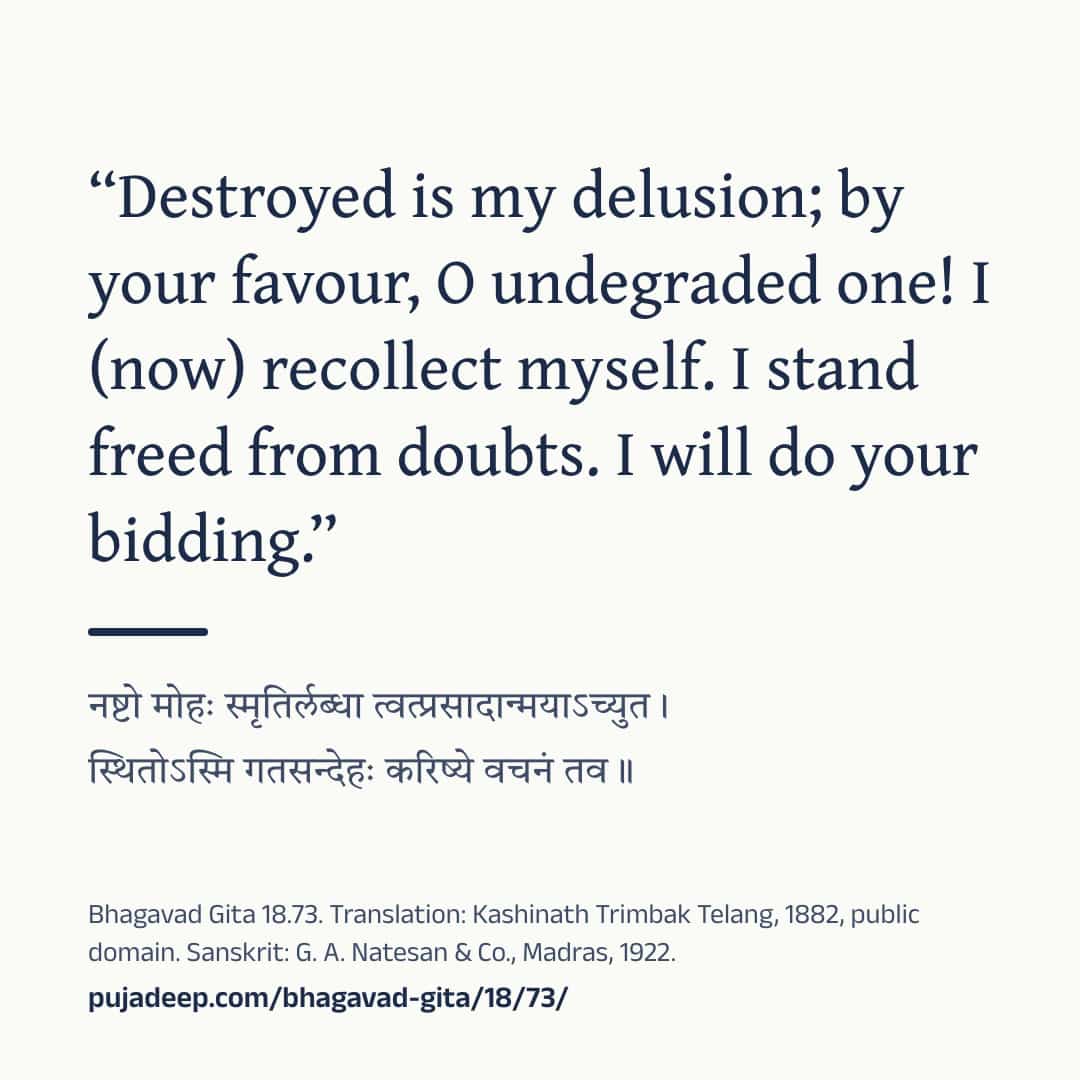
Drawing the picture
See the words
Bhagavad Gita 18.73

नष्टो मोहः स्मृतिर्लब्धा त्वत्प्रसादान्मयाऽच्युत ।
स्थितोऽस्मि गतसन्देहः करिष्ये वचनं तव ॥

“Destroyed is my delusion; by your favour, O undegraded one! I (now) recollect myself. I stand freed from doubts. I will do your bidding.”
(K. T. Telang, The Bhagavadgîtâ (The Sacred Books of the East, vol. VIII, Oxford: Clarendon Press, 1882), p. 130, public domain)

“Destroyed my delusion. I have gained the knowledge of the truth through Thy grace, O Achyuta. I am firm, my doubts have fled away. I will do according to Thy word.”
(Annie Besant, The Bhagavad Gîtâ, or The Lord's Song (London: Theosophical Publishing Society, 1895), pp. 166–167, public domain)

“Destroyed is my delusion, and I have gained my memory through Thy grace, O Achyuta. I am firm; my doubts are gone. I will do Thy word.”
(Swami Swarupananda, Srimad-Bhagavad-Gita (Mayavati: Prabuddha Bharata Press, 1909; first printed in Prabuddha Bharata, 1907–1909), p. 352, public domain)

Sanskrit: G. A. Natesan & Co., Madras, 1922.
https://pujadeep.com/bhagavad-gita/18/73/ Nothing is sent from this site. Your own app sends it, to the chat you choose. The picture quotes the translation you chose on this page, with its name and year.
Sanskrit text: The Bhagavad-Gita, or The Lord's Song, with the text in Devanagari and an English translation, 1922. Meanings: written for Pujadeep and checked against the cited edition. Source and changes
Questions families ask
Who speaks Bhagavad Gita 18.73?
Arjuna speaks this verse, in chapter 18 (Moksha Sannyasa Yoga).
Where does the Sanskrit text come from?
Sanskrit text: The Bhagavad-Gita, or The Lord's Song, with the text in Devanagari and an English translation, 1922. Meanings: written for Pujadeep and checked against the cited edition. See the source
Is the meaning on this page a translation?
Explanation written for this site from the sources listed here, and checked against the cited edition. It is not a translation and not the only way to read the text. Free to quote with credit.
Source and licence
- Sanskrit text
- The Bhagavad-Gita, or The Lord's Song, with the text in Devanagari and an English translation (Annie Besant, G. A. Natesan & Co., Madras, 1922). Public domain. The Sanskrit on these pages was read from this printing’s page images.
- Translation
- The Bhagavadgîtâ with the Sanatsugâtîya and the Anugîtâ, translated by Kâshinâth Trimbak Telang (The Sacred Books of the East, vol. VIII, ed. F. Max Müller) (Kashinath Trimbak Telang, F. Max Müller, Clarendon Press, Oxford, 1882). Public domain. Shown verbatim, as printed.
- Translation
- The Bhagavad Gîtâ, or The Lord's Song, translated by Annie Besant (Annie Besant, Theosophical Publishing Society, London, 1895). Public domain. Shown verbatim, as printed.
- Translation
- Srimad-Bhagavad-Gita, with Sanskrit Text; Paraphrase with Word-by-word Literal Translation; English Rendering and Comments, Index, &c., by the Swami Swarupananda (Himalayan Series, No. XX) (Swami Swarupananda, The Editors and Publishers, Advaita Ashrama, Mayavati, Prabuddha Bharata Press, Mayavati, Almora, Himalayas, 1909). Public domain. Shown verbatim, as printed.
- Commentary
- The Bhagavad-Gita, with the commentary of Sri Sankaracharya, translated by A. Mahadeva Sastri (2nd ed., Mysore: G. T. A. Printing Works, 1901) (Public-domain scan, University of California Libraries). Summarised in our own words; none of its text is reproduced.
- Commentary
- Sri Bhagavad-Gita with Sri Ramanujacharya's Visishtadvaita commentary, translated by A. Govindacharya (Madras, 1898) (Scan uploaded to archive.org (folkscanomy collection)). Summarised in our own words; none of its text is reproduced.
- Common wording
- In this text, 32 words follow today's common wording, checked against sanskritdocuments.org; Sanskrit Wikisource; Gita Press, Gorakhpur; GRETIL, Göttingen and Bhaktivedanta Book Trust.
- Our explanation
- Explanation written for this site from the sources listed here, and checked against the cited edition. It is not a translation and not the only way to read the text. Free to quote with credit.
- Checked
- Checked against the cited edition, October 15, 2026.
- Updated
- October 25, 2026