Bhagavad Gita 18.78: meaning and translation
Chapter 18: Moksha Sannyasa Yoga. Sanjaya says
Sanjaya ends the Gita with his own view.
Click or tap a word for its meaning and its dictionary page.
Text and layers
Text and layers
These choices stay in this browser.
Bhagavad Gita 18.78
यत्र योगेश्वरः कृष्णो यत्र पार्थो धनुर्धरः ।तत्र श्रीर्विजयो भूतिर्ध्रुवा नीतिर्मतिर्मम ॥
Yatra yogeshvarah krishno yatra partho dhanurdharahTatra shrirvijayo bhutirdhruva nitirmatirmama
yatra yogeśvaraḥ kṛṣṇo yatra pārtho dhanurdharaḥ |tatra śrīrvijayo bhūtirdhruvā nītirmatirmama ||
Our explanation Sanjaya ends the Gita with his own view. Wherever Krishna, the lord of yoga, is, and wherever Partha the archer is, there, he says, are fortune, victory, prosperity and lasting right conduct (nīti). Shankara takes 'there' to mean the side of the Pandavas. Besant's note gives Shankara's reading of the last words. The colophon then names the chapter.
हिंदी अर्थ संजय अपने मत के साथ गीता समाप्त करते हैं। वे कहते हैं कि जहाँ योगेश्वर कृष्ण हैं और जहाँ धनुर्धर पार्थ हैं, वहाँ श्री, विजय, भूति (समृद्धि) और ध्रुव नीति है। शंकराचार्य “वहाँ” का अर्थ पांडवों का पक्ष लेते हैं। बेसेंट की टिप्पणी अंतिम शब्दों का शंकराचार्य वाला अर्थ देती है। इसके बाद पुष्पिका अध्याय का नाम बताती है।
Word by word
Every word, with its dictionary page
Word by word
- यत्र yatra · where (indeclinable) Dictionary: yatra, Monier-Williams 1899, p. 841, col. 2 “in or to which place, where, wherein, wherever”
- योगेश्वरः yogeśvaraḥ · the lord of yoga (compound (masculine), nominative singular) Dictionary: yogeśvara, Monier-Williams 1899, p. 857, col. 3 “a master or adept in the Yoga”
- कृष्णः kṛṣṇaḥ · Krishna (noun (masculine), nominative singular) Dictionary: 1. kṛṣṇa, Monier-Williams 1899, p. 306, col. 2 “N. of a celebrated Avatār of the god Vishṇu, or sometimes identified with Vishṇu himself”
- यत्र yatra · where (indeclinable) Dictionary: yatra, Monier-Williams 1899, p. 841, col. 2 “in or to which place, where, wherein, wherever”
- पार्थः pārthaḥ · the son of Pritha (Arjuna) (noun (masculine), nominative singular) Dictionary: 2. pārtha, Monier-Williams 1899, p. 621, col. 3 “metron. of Yudhi-shṭhira or Bhīma-sena or Arjuna”
- धनुर्धरः dhanurdharaḥ · the bowman (compound (masculine), nominative singular) Dictionary: dhanur-dhara, Monier-Williams 1899, p. 509, col. 2
- तत्र tatra · there (indeclinable) Dictionary: tatra, Monier-Williams 1899, p. 433, col. 2 “in that, therein, in that case”
- श्रीः śrīḥ · fortune (noun (feminine), nominative singular) Dictionary: 3. śrī, Monier-Williams 1899, p. 1098, col. 3 “prosperity, welfare, good fortune, success, auspiciousness, wealth, treasure, riches”
- विजयः vijayaḥ · victory (noun (masculine), nominative singular) Dictionary: vi-jaya, Monier-Williams 1899, p. 960, col. 1 “contest for victory, victory, conquest, triumph, superiority”
- भूतिः bhūtiḥ · prosperity (noun (feminine), nominative singular) Dictionary: bhūti, Monier-Williams 1899, p. 762, col. 3 “well-being, thriving, prosperity, might, power, wealth, fortune”
- ध्रुवा dhruvā · sure, lasting (adjective (feminine), nominative singular) Dictionary: dhruva, Monier-Williams 1899, p. 521, col. 2 “fixed, firm, immovable, unchangeable, constant, lasting, permanent, eternal”
- नीतिः nītiḥ · right conduct, sound policy (noun (feminine), nominative singular) Dictionary: nīti, Monier-Williams 1899, p. 565, col. 1 “conduct, (esp.) right or wise or moral c° or behaviour, prudence, policy”
- मतिः matiḥ · view (noun (feminine), nominative singular) Dictionary: mati, Monier-Williams 1899, p. 783, col. 2 “opinion, notion, idea, belief, conviction, view, creed”
- मम mama · "my" (Sanjaya's) (pronoun, genitive singular) Dictionary: 1. mad, Monier-Williams 1899, p. 777, col. 2 “base of the first pers. pron. in the sg. number (esp. in comp.)”
2 printings differ
Edition differences. Another printing or text reads this place differently.
- The printed edition reads: यत्र योगेश्वरः कृष्णो यत्र पार्थो धनुर्धरः ।
तत्र श्रीर्विजयो भूंतिर्ध्रुवा नीतिर्मतिर्मम ॥ The print shows an anusvara over भू (भूंतिर्ध्रुवा, leaf n272); read as a stray sort and not shown, because bhūtiḥ has no nasal and both proofreading references read भूतिर्ध्रुवा. Same kind of flaw as 14.26. - Spelling The 1922 Madras printing reads: तत्र श्रीर्विजयो भूंतिर्ध्रुवा नीतिर्मतिर्मम The 1922 base printing (leaf n272) shows a stray anusvara over भू; see normalisations.
Old translations
Kashinath Trimbak Telang, 1882. Public domain. Page 131.
Wherever (is) Krishna, the lord of the possessors of mystic power, wherever (is) the (great) archer, the son of Prithâ, there in my opinion (are) fortune, victory, prosperity1, and eternal justice.
Footnotes (the translator’s own) - Prosperity is the greater development of fortune. ↩
Compare 3 translations
Kashinath Trimbak Telang, 1882. Public domain. Page 131.
Wherever (is) Krishna, the lord of the possessors of mystic power, wherever (is) the (great) archer, the son of Prithâ, there in my opinion (are) fortune, victory, prosperity1, and eternal justice.
Footnotes (the translator’s own) - Prosperity is the greater development of fortune. ↩
You are reading this one
Annie Besant, 1895. Public domain. Page 167–168.
Wherever is Yoga's Lord, Krishna, or wherever is Pârtha, the archer, there are firmly established prosperity, victory and happiness. So I think.1
Footnotes (the translator’s own) - Shri Shânkarâchârya's reading would run, translated: "there is prosperity, victory, happiness, and firm morality." ↩
You are reading this one
Swami Swarupananda, 1909 (first printed 1907). Public domain. Page 355.
Wherever is Krishna, the Lord of Yoga, wherever is Pârtha, the wielder of the bow, there are prosperity, victory, expansion, and sound polity: such is my conviction.
You are reading this one
Cite this verse
The translation: K. T. Telang, The Bhagavadgîtâ (The Sacred Books of the East, vol. VIII, Oxford: Clarendon Press, 1882), p. 131. Bhagavad Gita 18.78.
The translation: Annie Besant, The Bhagavad Gîtâ, or The Lord's Song (London: Theosophical Publishing Society, 1895), pp. 167–168. Bhagavad Gita 18.78.
The translation: Swami Swarupananda, Srimad-Bhagavad-Gita (Mayavati: Prabuddha Bharata Press, 1909; first printed in Prabuddha Bharata, 1907–1909), p. 355. Bhagavad Gita 18.78.
Our explanation: “Bhagavad Gita 18.78: meaning and translation.” Pujadeep. Updated October 25, 2026. https://pujadeep.com/bhagavad-gita/18/78/
Pujadeep’s explanations are free to quote with credit: name Pujadeep and link to the page. How to credit
Classical readings, by school
No readings by school on this verse yet.
Share
Show the ways to share
Send one picture or the text to one chat. The picture names its source and the address of this page.
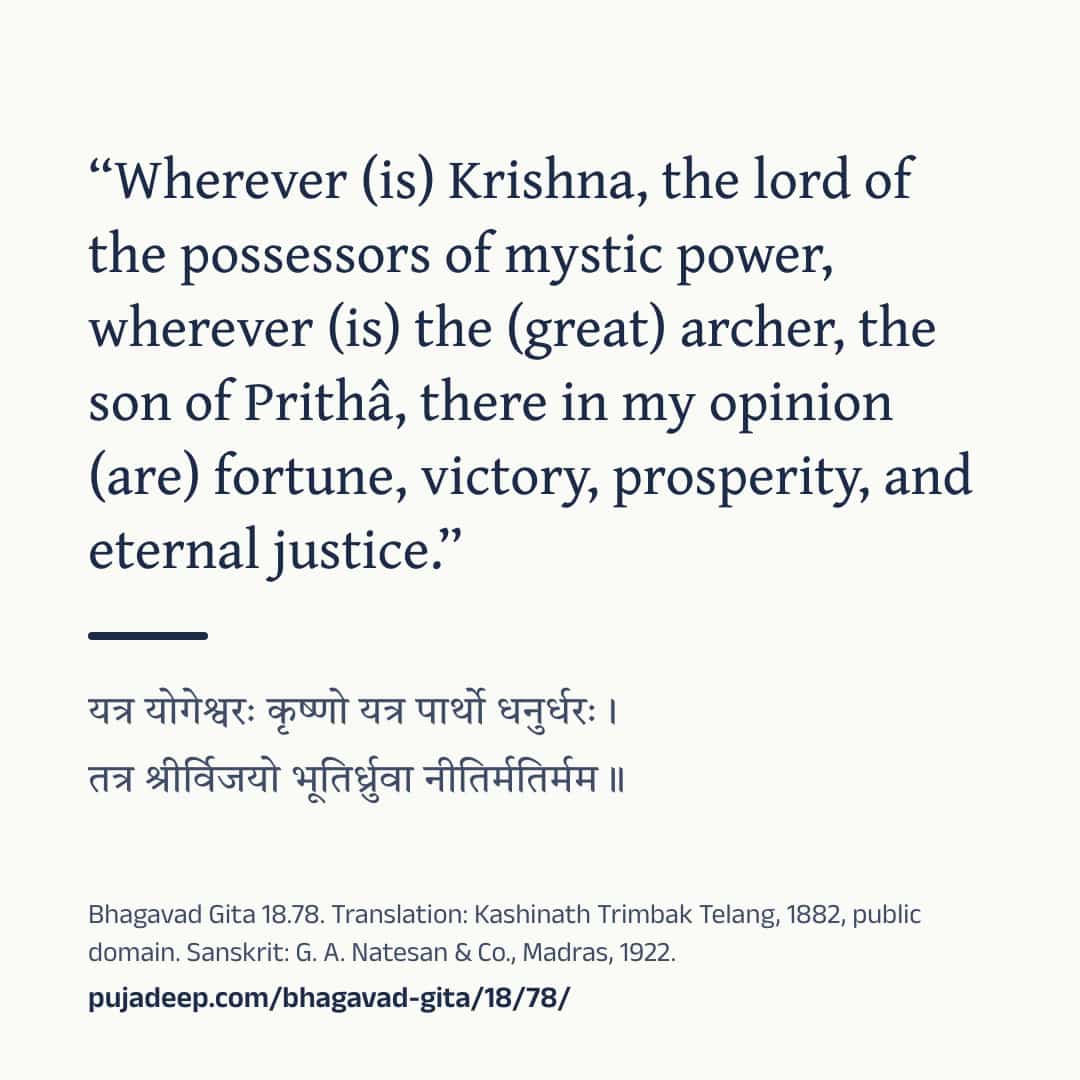
Drawing the picture
See the words
Bhagavad Gita 18.78

यत्र योगेश्वरः कृष्णो यत्र पार्थो धनुर्धरः ।
तत्र श्रीर्विजयो भूतिर्ध्रुवा नीतिर्मतिर्मम ॥

“Wherever (is) Krishna, the lord of the possessors of mystic power, wherever (is) the (great) archer, the son of Prithâ, there in my opinion (are) fortune, victory, prosperity, and eternal justice.”
(K. T. Telang, The Bhagavadgîtâ (The Sacred Books of the East, vol. VIII, Oxford: Clarendon Press, 1882), p. 131, public domain)

“Wherever is Yoga's Lord, Krishna, or wherever is Pârtha, the archer, there are firmly established prosperity, victory and happiness. So I think.”
(Annie Besant, The Bhagavad Gîtâ, or The Lord's Song (London: Theosophical Publishing Society, 1895), pp. 167–168, public domain)

“Wherever is Krishna, the Lord of Yoga, wherever is Pârtha, the wielder of the bow, there are prosperity, victory, expansion, and sound polity: such is my conviction.”
(Swami Swarupananda, Srimad-Bhagavad-Gita (Mayavati: Prabuddha Bharata Press, 1909; first printed in Prabuddha Bharata, 1907–1909), p. 355, public domain)

Sanskrit: G. A. Natesan & Co., Madras, 1922.
https://pujadeep.com/bhagavad-gita/18/78/ Nothing is sent from this site. Your own app sends it, to the chat you choose. The picture quotes the translation you chose on this page, with its name and year.
Sanskrit text: The Bhagavad-Gita, or The Lord's Song, with the text in Devanagari and an English translation, 1922. Meanings: written for Pujadeep and checked against the cited edition. Source and changes
Questions families ask
Who speaks Bhagavad Gita 18.78?
Sanjaya speaks this verse, in chapter 18 (Moksha Sannyasa Yoga).
Where does the Sanskrit text come from?
Sanskrit text: The Bhagavad-Gita, or The Lord's Song, with the text in Devanagari and an English translation, 1922. Meanings: written for Pujadeep and checked against the cited edition. See the source
Is the meaning on this page a translation?
Explanation written for this site from the sources listed here, and checked against the cited edition. It is not a translation and not the only way to read the text. Free to quote with credit.
Source and licence
- Sanskrit text
- The Bhagavad-Gita, or The Lord's Song, with the text in Devanagari and an English translation (Annie Besant, G. A. Natesan & Co., Madras, 1922). Public domain. The Sanskrit on these pages was read from this printing’s page images.
- Translation
- The Bhagavadgîtâ with the Sanatsugâtîya and the Anugîtâ, translated by Kâshinâth Trimbak Telang (The Sacred Books of the East, vol. VIII, ed. F. Max Müller) (Kashinath Trimbak Telang, F. Max Müller, Clarendon Press, Oxford, 1882). Public domain. Shown verbatim, as printed.
- Translation
- The Bhagavad Gîtâ, or The Lord's Song, translated by Annie Besant (Annie Besant, Theosophical Publishing Society, London, 1895). Public domain. Shown verbatim, as printed.
- Translation
- Srimad-Bhagavad-Gita, with Sanskrit Text; Paraphrase with Word-by-word Literal Translation; English Rendering and Comments, Index, &c., by the Swami Swarupananda (Himalayan Series, No. XX) (Swami Swarupananda, The Editors and Publishers, Advaita Ashrama, Mayavati, Prabuddha Bharata Press, Mayavati, Almora, Himalayas, 1909). Public domain. Shown verbatim, as printed.
- Common wording
- In this text, 32 words follow today's common wording, checked against sanskritdocuments.org; Sanskrit Wikisource; Gita Press, Gorakhpur; GRETIL, Göttingen and Bhaktivedanta Book Trust.
- Our explanation
- Explanation written for this site from the sources listed here, and checked against the cited edition. It is not a translation and not the only way to read the text. Free to quote with credit.
- Checked
- Checked against the cited edition, October 15, 2026.
- Updated
- October 25, 2026