Bhagavad Gita 18.63: meaning and translation
Chapter 18: Moksha Sannyasa Yoga. Krishna says
Krishna says he has now told Arjuna knowledge more secret than any secret.
Click or tap a word for its meaning and its dictionary page.
Text and layers
Text and layers
These choices stay in this browser.
Bhagavad Gita 18.63
इति ते ज्ञानमाख्यातं गुह्याद्गुह्यतरं मया ।विमृश्यैतदशेषेण यथेच्छसि तथा कुरु ॥
Iti te jnanamakhyatam guhyadguhyataram mayaVimrishyaitadasheshena yathechchhasi tatha kuru
iti te jñānamākhyātaṃ guhyādguhyataraṃ mayā |vimṛśyaitadaśeṣeṇa yathecchasi tathā kuru ||
Our explanation Krishna says he has now told Arjuna knowledge more secret than any secret. He asks him to reflect on it fully and then to do as he chooses. The choice is left to Arjuna.
हिंदी अर्थ कृष्ण कहते हैं कि उन्होंने अर्जुन को सब रहस्यों से भी अधिक रहस्यमय ज्ञान बता दिया है। वे अर्जुन से कहते हैं कि इस पर पूरा विचार करें और फिर जैसा चाहें वैसा करें। निर्णय अर्जुन पर छोड़ा गया है।
Word by word
Every word, with its dictionary page
Word by word
- इति iti · thus (indeclinable) Dictionary: 2. iti, Monier-Williams 1899, p. 165, col. 1 “in this manner, thus”
- ते te · to you (pronoun, dative singular) Dictionary: 2. tva, Monier-Williams 1899, p. 463, col. 2 “base of the 2nd personal pron.”
- ज्ञानम् jñānam · knowledge (noun (neuter), nominative singular) Dictionary: jñāna, Monier-Williams 1899, p. 426, col. 1 “knowing, becoming acquainted with, knowledge”
- आख्यातम् ākhyātam · has been told (past participle (neuter), nominative singular) Dictionary: ā-khyāta, Monier-Williams 1899, p. 129, col. 2 “said, told, declared, made known”
- गुह्यात् guhyāt · than any secret (adjective (neuter), ablative singular) Dictionary: guhya, Monier-Williams 1899, p. 360, col. 3 “a secret, mystery”
- गुह्यतरम् guhyataram · more secret (adjective (neuter), nominative singular) Dictionary: guhya, Monier-Williams 1899, p. 360, col. 3 “a secret, mystery”; 1. tara, Monier-Williams 1899, p. 438, col. 3 “an affix forming the compar. degree of adjectives”
- मया mayā · by "me" (Krishna) (pronoun, instrumental singular) Dictionary: 1. mad, Monier-Williams 1899, p. 777, col. 2 “base of the first pers. pron. in the sg. number (esp. in comp.)”
- विमृश्य vimṛśya · having reflected on (absolutive (having done)) Dictionary: vi-mṛś, Monier-Williams 1899, p. 981, col. 1 “having deliberated or considered”
- एतत् etat · this (pronoun (neuter), accusative singular) Dictionary: etad, Monier-Williams 1899, p. 231, col. 2 “this, this here, here”
- अशेषेण aśeṣeṇa · fully (noun (masculine), instrumental singular) Dictionary: a-śeṣa, Monier-Williams 1899, p. 113, col. 3 “without remainder, entire, perfect, all”
- यथा yathā · as (indeclinable) Dictionary: yathā, Monier-Williams 1899, p. 841, col. 2 “in which manner or way, according as, as, like”
- इच्छसि icchasi · you wish (present, 2nd person singular) Dictionary: 3. iṣ, Monier-Williams 1899, p. 169, col. 1 “to desire, wish, long for, request”
- तथा tathā · so (indeclinable) Dictionary: tathā, Monier-Williams 1899, p. 433, col. 3 “in that manner, so, thus”
- कुरु kuru · do (imperative, 2nd person singular) Dictionary: 1. kṛ, Monier-Williams 1899, p. 301, col. 1 “to do, make, perform, accomplish, cause, effect, prepare, undertake”
Old translations
Kashinath Trimbak Telang, 1882. Public domain. Page 129.
Thus have I declared to you the knowledge more mysterious than any mystery. Ponder over it thoroughly, and then act as you like.
Compare 3 translations
Kashinath Trimbak Telang, 1882. Public domain. Page 129.
Thus have I declared to you the knowledge more mysterious than any mystery. Ponder over it thoroughly, and then act as you like.
You are reading this one
Annie Besant, 1895. Public domain. Page 164.
Thus hath wisdom, most secret of all secrets, been declared unto thee by Me; having reflected over it fully, then act thou as thou desirest.
You are reading this one
Swami Swarupananda, 1909 (first printed 1907). Public domain. Page 347.
Thus has wisdom more profound than all profundities, been declared to thee by Me; reflecting over it fully, act as thou likest.
You are reading this one
Cite this verse
The translation: K. T. Telang, The Bhagavadgîtâ (The Sacred Books of the East, vol. VIII, Oxford: Clarendon Press, 1882), p. 129. Bhagavad Gita 18.63.
The translation: Annie Besant, The Bhagavad Gîtâ, or The Lord's Song (London: Theosophical Publishing Society, 1895), p. 164. Bhagavad Gita 18.63.
The translation: Swami Swarupananda, Srimad-Bhagavad-Gita (Mayavati: Prabuddha Bharata Press, 1909; first printed in Prabuddha Bharata, 1907–1909), p. 347. Bhagavad Gita 18.63.
Our explanation: “Bhagavad Gita 18.63: meaning and translation.” Pujadeep. Updated October 25, 2026. https://pujadeep.com/bhagavad-gita/18/63/
Pujadeep’s explanations are free to quote with credit: name Pujadeep and link to the page. How to credit
Classical readings, by school
No readings by school on this verse yet.
Share
Show the ways to share
Send one picture or the text to one chat. The picture names its source and the address of this page.
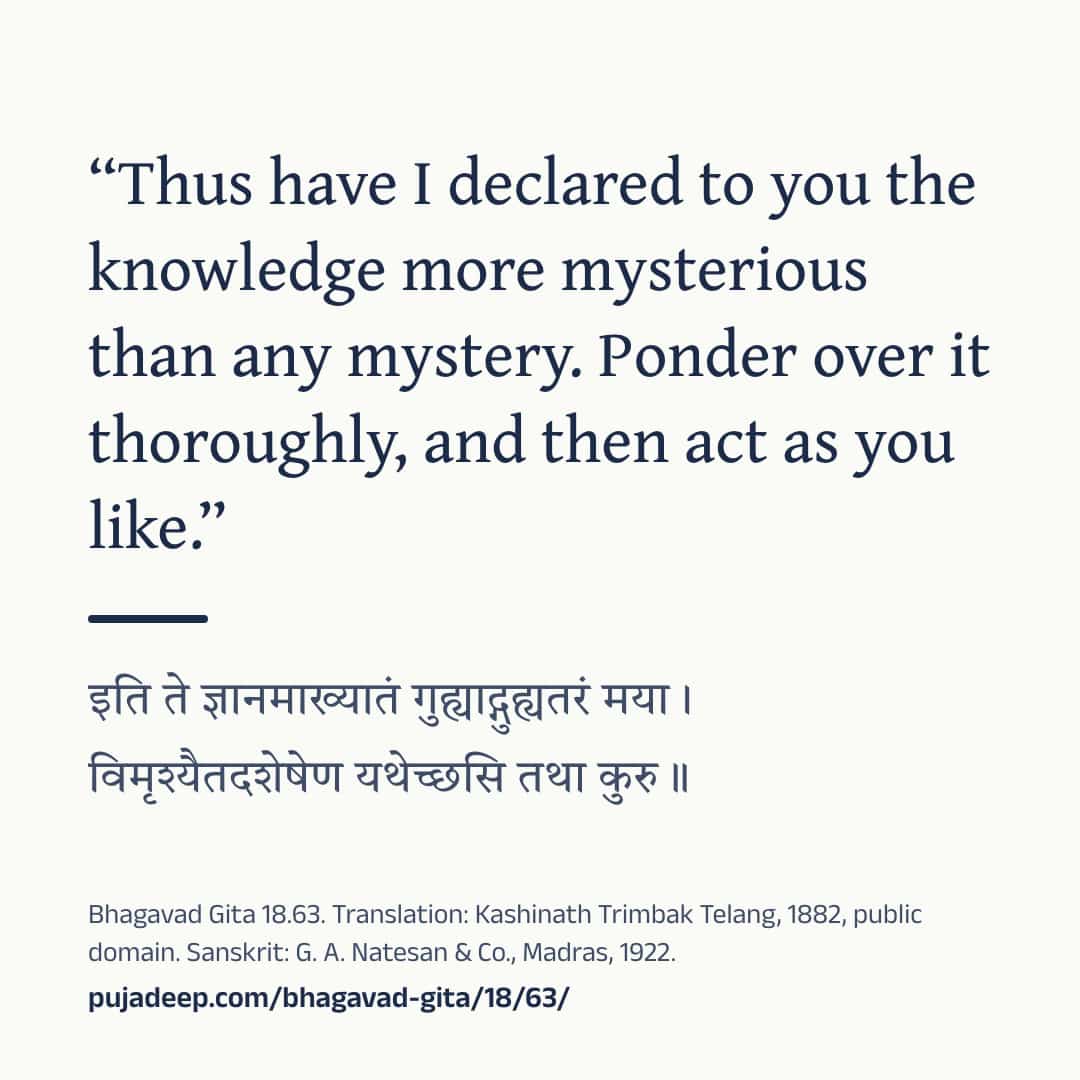
Drawing the picture
See the words
Bhagavad Gita 18.63

इति ते ज्ञानमाख्यातं गुह्याद्गुह्यतरं मया ।
विमृश्यैतदशेषेण यथेच्छसि तथा कुरु ॥

“Thus have I declared to you the knowledge more mysterious than any mystery. Ponder over it thoroughly, and then act as you like.”
(K. T. Telang, The Bhagavadgîtâ (The Sacred Books of the East, vol. VIII, Oxford: Clarendon Press, 1882), p. 129, public domain)

“Thus hath wisdom, most secret of all secrets, been declared unto thee by Me; having reflected over it fully, then act thou as thou desirest.”
(Annie Besant, The Bhagavad Gîtâ, or The Lord's Song (London: Theosophical Publishing Society, 1895), p. 164, public domain)

“Thus has wisdom more profound than all profundities, been declared to thee by Me; reflecting over it fully, act as thou likest.”
(Swami Swarupananda, Srimad-Bhagavad-Gita (Mayavati: Prabuddha Bharata Press, 1909; first printed in Prabuddha Bharata, 1907–1909), p. 347, public domain)

Sanskrit: G. A. Natesan & Co., Madras, 1922.
https://pujadeep.com/bhagavad-gita/18/63/ Nothing is sent from this site. Your own app sends it, to the chat you choose. The picture quotes the translation you chose on this page, with its name and year.
Sanskrit text: The Bhagavad-Gita, or The Lord's Song, with the text in Devanagari and an English translation, 1922. Meanings: written for Pujadeep and checked against the cited edition. Source and changes
Questions families ask
Who speaks Bhagavad Gita 18.63?
Krishna speaks this verse, in chapter 18 (Moksha Sannyasa Yoga).
Where does the Sanskrit text come from?
Sanskrit text: The Bhagavad-Gita, or The Lord's Song, with the text in Devanagari and an English translation, 1922. Meanings: written for Pujadeep and checked against the cited edition. See the source
Is the meaning on this page a translation?
Explanation written for this site from the sources listed here, and checked against the cited edition. It is not a translation and not the only way to read the text. Free to quote with credit.
Source and licence
- Sanskrit text
- The Bhagavad-Gita, or The Lord's Song, with the text in Devanagari and an English translation (Annie Besant, G. A. Natesan & Co., Madras, 1922). Public domain. The Sanskrit on these pages was read from this printing’s page images.
- Translation
- The Bhagavadgîtâ with the Sanatsugâtîya and the Anugîtâ, translated by Kâshinâth Trimbak Telang (The Sacred Books of the East, vol. VIII, ed. F. Max Müller) (Kashinath Trimbak Telang, F. Max Müller, Clarendon Press, Oxford, 1882). Public domain. Shown verbatim, as printed.
- Translation
- The Bhagavad Gîtâ, or The Lord's Song, translated by Annie Besant (Annie Besant, Theosophical Publishing Society, London, 1895). Public domain. Shown verbatim, as printed.
- Translation
- Srimad-Bhagavad-Gita, with Sanskrit Text; Paraphrase with Word-by-word Literal Translation; English Rendering and Comments, Index, &c., by the Swami Swarupananda (Himalayan Series, No. XX) (Swami Swarupananda, The Editors and Publishers, Advaita Ashrama, Mayavati, Prabuddha Bharata Press, Mayavati, Almora, Himalayas, 1909). Public domain. Shown verbatim, as printed.
- Common wording
- In this text, 32 words follow today's common wording, checked against sanskritdocuments.org; Sanskrit Wikisource; Gita Press, Gorakhpur; GRETIL, Göttingen and Bhaktivedanta Book Trust.
- Our explanation
- Explanation written for this site from the sources listed here, and checked against the cited edition. It is not a translation and not the only way to read the text. Free to quote with credit.
- Checked
- Checked against the cited edition, October 15, 2026.
- Updated
- October 25, 2026