Bhagavad Gita 18.62: meaning and translation
Chapter 18: Moksha Sannyasa Yoga. Krishna says
Krishna tells Arjuna to go for refuge with his whole being to that Lord alone, who dwells in every heart (18.61); by his grace, Krishna says, he will reach the highest peace and the eternal abode.
Click or tap a word for its meaning and its dictionary page.
Text and layers
Text and layers
These choices stay in this browser.
Bhagavad Gita 18.62
तमेव शरणं गच्छ सर्वभावेन भारत ।तत्प्रसादात्परां शान्तिं स्थानं प्राप्स्यसि शाश्वतम् ॥
Tameva sharanam gachchha sarvabhavena bharataTatprasadatparam shantim sthanam prapsyasi shashvatam
tameva śaraṇaṃ gaccha sarvabhāvena bhārata |tatprasādātparāṃ śāntiṃ sthānaṃ prāpsyasi śāśvatam ||
Our explanation Krishna tells Arjuna to go for refuge with his whole being to that Lord alone, who dwells in every heart (18.61); by his grace, Krishna says, he will reach the highest peace and the eternal abode.
हिंदी अर्थ कृष्ण अर्जुन से कहते हैं कि वे पूरे भाव से उसी ईश्वर की शरण में जाएँ, जो सबके हृदय में रहते हैं (18.61); कृष्ण कहते हैं कि उनकी कृपा से वे परम शांति और शाश्वत स्थान पाएँगे।
Word by word
Every word, with its dictionary page
Word by word
- तम् tam · to him (pronoun (masculine), accusative singular) Dictionary: tad, Monier-Williams 1899, p. 434, col. 1 “m. he, f. she, n. it, that, this”
- एव eva · alone (indeclinable) Dictionary: 1. eva, Monier-Williams 1899, p. 232, col. 2 “just, exactly, very, same, only, even, alone, merely”
- शरणम् śaraṇam · refuge (noun (neuter), accusative singular) Dictionary: 2. śaraṇa, Monier-Williams 1899, p. 1057, col. 1 “refuge, protection”
- गच्छ gaccha · go (imperative, 2nd person singular) Dictionary: 1. gam, Monier-Williams 1899, p. 347, col. 1 “to go, move, go away, set out, come”
- सर्वभावेन sarvabhāvena · with all your being (compound (masculine), instrumental singular) Dictionary: sarva-bhāva, Monier-Williams 1899, p. 1186, col. 2 “with all one's thoughts, with one's whole soul”
- भारत bhārata · O Bharata (Arjuna) (noun (masculine), vocative singular) Dictionary: bhārata, Monier-Williams 1899, p. 753, col. 1 “descended from Bharata or the Bharatas”
- तत्प्रसादात् tatprasādāt · by his grace (compound (masculine), ablative singular) Dictionary: tad, Monier-Williams 1899, p. 434, col. 1 “m. he, f. she, n. it, that, this”; pra-sāda, Monier-Williams 1899, p. 697, col. 1 “graciousness, kindness, kind behaviour, favour, aid”
- पराम् parām · highest (adjective (feminine), accusative singular) Dictionary: 1. para, Monier-Williams 1899, p. 586, col. 1 “best or worst, highest, supreme, chief”
- शान्तिम् śāntim · peace (noun (feminine), accusative singular) Dictionary: śānti, Monier-Williams 1899, p. 1064, col. 3 “tranquillity, peace, quiet, peace or calmness of mind, absence of passion”
- स्थानम् sthānam · abode (noun (neuter), accusative singular) Dictionary: sthāna, Monier-Williams 1899, p. 1263, col. 1 “place of standing or staying, any place, spot, locality, abode, dwelling, house, site”
- प्राप्स्यसि prāpsyasi · you will reach (future, 2nd person singular) Dictionary: prāp, Monier-Williams 1899, p. 707, col. 2 “to attain to, reach, arrive at, meet with, find”
- शाश्वतम् śāśvatam · eternal (adjective (neuter), accusative singular) Dictionary: śāśvata, Monier-Williams 1899, p. 1068, col. 3 “eternal, constant, perpetual, all”
Old translations
Kashinath Trimbak Telang, 1882. Public domain. Page 129.
With him, O descendant of Bharata! seek shelter in every way1; by his favour you will obtain the highest tranquillity, the eternal seat.
Footnotes (the translator’s own) - Cf. p. 114; by thought, word, and deed. ↩
Compare 3 translations
Kashinath Trimbak Telang, 1882. Public domain. Page 129.
With him, O descendant of Bharata! seek shelter in every way1; by his favour you will obtain the highest tranquillity, the eternal seat.
Footnotes (the translator’s own) - Cf. p. 114; by thought, word, and deed. ↩
You are reading this one
Annie Besant, 1895. Public domain. Page 164.
Flee unto Him for shelter with all thy being, O Bhârata; by His grace thou shalt obtain supreme Peace, the everlasting Dwelling-place.
You are reading this one
Swami Swarupananda, 1909 (first printed 1907). Public domain. Page 347.
Take refuge in Him with all thy heart, O Bhárata; by His grace shalt thou attain supreme peace (and) the eternal abode.
You are reading this one
Cite this verse
The translation: K. T. Telang, The Bhagavadgîtâ (The Sacred Books of the East, vol. VIII, Oxford: Clarendon Press, 1882), p. 129. Bhagavad Gita 18.62.
The translation: Annie Besant, The Bhagavad Gîtâ, or The Lord's Song (London: Theosophical Publishing Society, 1895), p. 164. Bhagavad Gita 18.62.
The translation: Swami Swarupananda, Srimad-Bhagavad-Gita (Mayavati: Prabuddha Bharata Press, 1909; first printed in Prabuddha Bharata, 1907–1909), p. 347. Bhagavad Gita 18.62.
Our explanation: “Bhagavad Gita 18.62: meaning and translation.” Pujadeep. Updated October 25, 2026. https://pujadeep.com/bhagavad-gita/18/62/
Pujadeep’s explanations are free to quote with credit: name Pujadeep and link to the page. How to credit
Classical readings, by school
No readings by school on this verse yet.
Share
Show the ways to share
Send one picture or the text to one chat. The picture names its source and the address of this page.
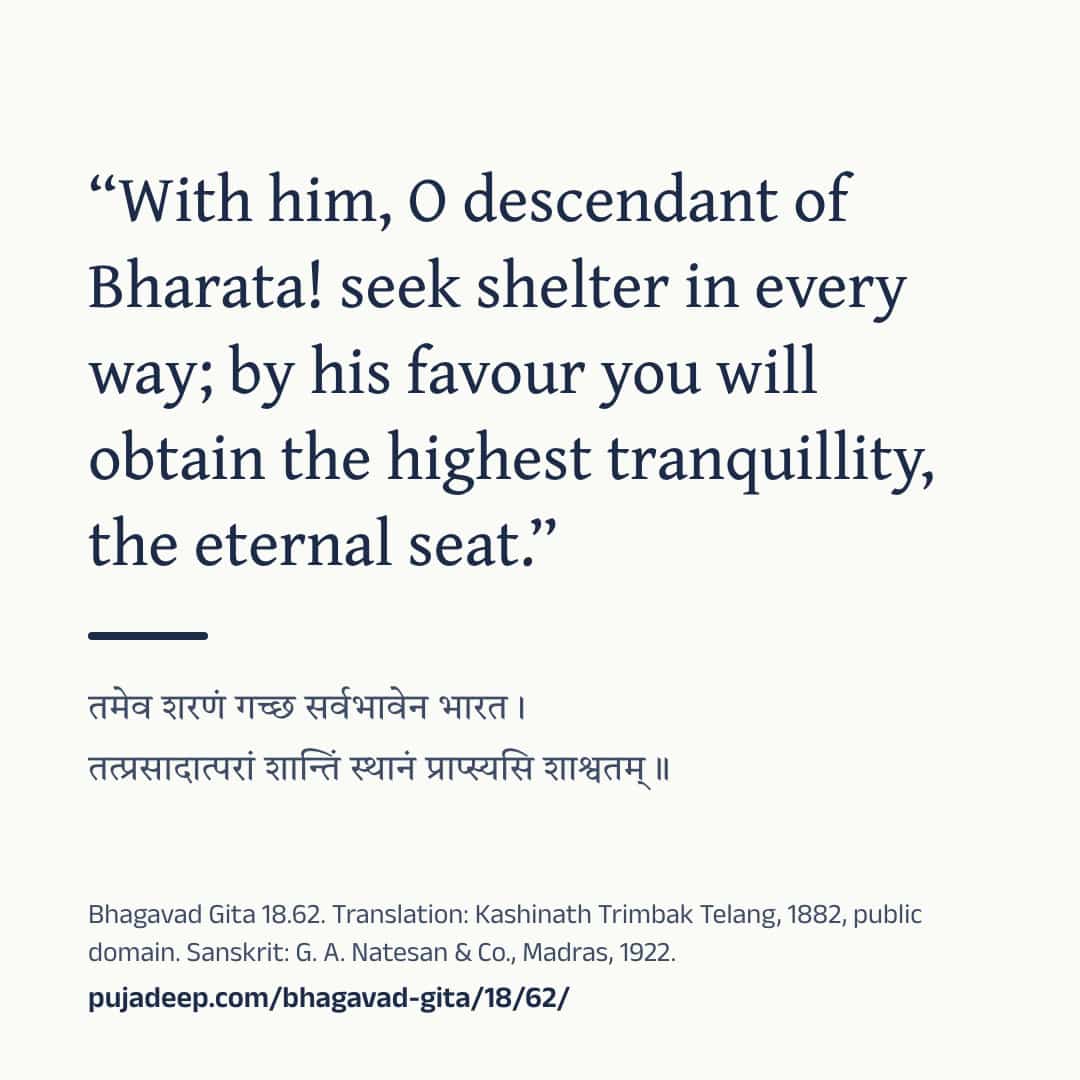
Drawing the picture
See the words
Bhagavad Gita 18.62

तमेव शरणं गच्छ सर्वभावेन भारत ।
तत्प्रसादात्परां शान्तिं स्थानं प्राप्स्यसि शाश्वतम् ॥

“With him, O descendant of Bharata! seek shelter in every way; by his favour you will obtain the highest tranquillity, the eternal seat.”
(K. T. Telang, The Bhagavadgîtâ (The Sacred Books of the East, vol. VIII, Oxford: Clarendon Press, 1882), p. 129, public domain)

“Flee unto Him for shelter with all thy being, O Bhârata; by His grace thou shalt obtain supreme Peace, the everlasting Dwelling-place.”
(Annie Besant, The Bhagavad Gîtâ, or The Lord's Song (London: Theosophical Publishing Society, 1895), p. 164, public domain)

“Take refuge in Him with all thy heart, O Bhárata; by His grace shalt thou attain supreme peace (and) the eternal abode.”
(Swami Swarupananda, Srimad-Bhagavad-Gita (Mayavati: Prabuddha Bharata Press, 1909; first printed in Prabuddha Bharata, 1907–1909), p. 347, public domain)

Sanskrit: G. A. Natesan & Co., Madras, 1922.
https://pujadeep.com/bhagavad-gita/18/62/ Nothing is sent from this site. Your own app sends it, to the chat you choose. The picture quotes the translation you chose on this page, with its name and year.
Sanskrit text: The Bhagavad-Gita, or The Lord's Song, with the text in Devanagari and an English translation, 1922. Meanings: written for Pujadeep and checked against the cited edition. Source and changes
Questions families ask
Who speaks Bhagavad Gita 18.62?
Krishna speaks this verse, in chapter 18 (Moksha Sannyasa Yoga).
Where does the Sanskrit text come from?
Sanskrit text: The Bhagavad-Gita, or The Lord's Song, with the text in Devanagari and an English translation, 1922. Meanings: written for Pujadeep and checked against the cited edition. See the source
Is the meaning on this page a translation?
Explanation written for this site from the sources listed here, and checked against the cited edition. It is not a translation and not the only way to read the text. Free to quote with credit.
Source and licence
- Sanskrit text
- The Bhagavad-Gita, or The Lord's Song, with the text in Devanagari and an English translation (Annie Besant, G. A. Natesan & Co., Madras, 1922). Public domain. The Sanskrit on these pages was read from this printing’s page images.
- Translation
- The Bhagavadgîtâ with the Sanatsugâtîya and the Anugîtâ, translated by Kâshinâth Trimbak Telang (The Sacred Books of the East, vol. VIII, ed. F. Max Müller) (Kashinath Trimbak Telang, F. Max Müller, Clarendon Press, Oxford, 1882). Public domain. Shown verbatim, as printed.
- Translation
- The Bhagavad Gîtâ, or The Lord's Song, translated by Annie Besant (Annie Besant, Theosophical Publishing Society, London, 1895). Public domain. Shown verbatim, as printed.
- Translation
- Srimad-Bhagavad-Gita, with Sanskrit Text; Paraphrase with Word-by-word Literal Translation; English Rendering and Comments, Index, &c., by the Swami Swarupananda (Himalayan Series, No. XX) (Swami Swarupananda, The Editors and Publishers, Advaita Ashrama, Mayavati, Prabuddha Bharata Press, Mayavati, Almora, Himalayas, 1909). Public domain. Shown verbatim, as printed.
- Common wording
- In this text, 32 words follow today's common wording, checked against sanskritdocuments.org; Sanskrit Wikisource; Gita Press, Gorakhpur; GRETIL, Göttingen and Bhaktivedanta Book Trust.
- Our explanation
- Explanation written for this site from the sources listed here, and checked against the cited edition. It is not a translation and not the only way to read the text. Free to quote with credit.
- Checked
- Checked against the cited edition, October 15, 2026.
- Updated
- October 25, 2026