Bhagavad Gita 18.56: meaning and translation
Chapter 18: Moksha Sannyasa Yoga. Krishna says
Krishna says that even while always doing all actions, one who takes refuge in him reaches, by his grace, the eternal, unchanging state.
Click or tap a word for its meaning and its dictionary page.
Text and layers
Text and layers
These choices stay in this browser.
Bhagavad Gita 18.56
सर्वकर्माण्यपि सदा कुर्वाणो मद्व्यपाश्रयः ।मत्प्रसादादवाप्नोति शाश्वतं पदमव्ययम् ॥
Sarvakarmanyapi sada kurvano madvyapashrayahMatprasadadavapnoti shashvatam padamavyayam
sarvakarmāṇyapi sadā kurvāṇo madvyapāśrayaḥ |matprasādādavāpnoti śāśvataṃ padamavyayam ||
Our explanation Krishna says that even while always doing all actions, one who takes refuge in him reaches, by his grace, the eternal, unchanging state.
हिंदी अर्थ कृष्ण कहते हैं कि सदा सब कर्म करते हुए भी जो उनका आश्रय लेता है, वह उनकी कृपा से शाश्वत, अविनाशी पद पाता है।
Word by word
Every word, with its dictionary page
Word by word
- सर्वकर्माणि sarvakarmāṇi · all actions (compound (neuter), accusative plural) Dictionary: sarva, Monier-Williams 1899, p. 1184, col. 3 “whole, entire, all, every”; karman, Monier-Williams 1899, p. 258, col. 2 “act, action, performance, business”
- अपि api · even (indeclinable) Dictionary: api, Monier-Williams 1899, p. 55, col. 1 “in the sense of even, also, very”
- सदा sadā · always (indeclinable) Dictionary: sadā, Monier-Williams 1899, p. 1139, col. 2 “always, ever, every time, continually, perpetually”
- कुर्वाणः kurvāṇaḥ · doing (present participle (masculine), nominative singular) Dictionary: 1. kṛ, Monier-Williams 1899, p. 301, col. 1 “to do, make, perform, accomplish, cause, effect, prepare, undertake”
- मद्व्यपाश्रयः madvyapāśrayaḥ · taking refuge in "me" (Krishna) (compound (masculine), nominative singular) Dictionary: 1. mad, Monier-Williams 1899, p. 777, col. 2 “base of the first pers. pron. in the sg. number (esp. in comp.)”; 2. vyapāśraya, Monier-Williams 1899, p. 1032, col. 1 “place of refuge, shelter, support”
- मत्प्रसादात् matprasādāt · by "my" (Krishna's) grace (compound (masculine), ablative singular) Dictionary: 1. mad, Monier-Williams 1899, p. 777, col. 2 “base of the first pers. pron. in the sg. number (esp. in comp.)”; pra-sāda, Monier-Williams 1899, p. 697, col. 1 “graciousness, kindness, kind behaviour, favour, aid”
- अवाप्नोति avāpnoti · reaches (present, 3rd person singular) Dictionary: avāp, Monier-Williams 1899, p. 107, col. 1 “to reach, attain, obtain, gain, get”
- शाश्वतम् śāśvatam · eternal (adjective (neuter), accusative singular) Dictionary: śāśvata, Monier-Williams 1899, p. 1068, col. 3 “eternal, constant, perpetual, all”
- पदम् padam · state, abode (noun (neuter), accusative singular) Dictionary: pada, Monier-Williams 1899, p. 583, col. 1 “a footing, standpoint; position, rank, station, site, abode, home”
- अव्ययम् avyayam · imperishable (adjective (neuter), accusative singular) Dictionary: 2. a-vyaya, Monier-Williams 1899, p. 111, col. 3 “not liable to change, imperishable, undecaying”
Old translations
Kashinath Trimbak Telang, 1882. Public domain. Page 128.
Even performing all actions, always depending on me, he, through my favour, obtains the imperishable and eternal seat.
Compare 3 translations
Kashinath Trimbak Telang, 1882. Public domain. Page 128.
Even performing all actions, always depending on me, he, through my favour, obtains the imperishable and eternal seat.
You are reading this one
Annie Besant, 1895. Public domain. Page 163.
Even performing all actions continually, taking refuge in Me, by My grace he obtaineth the eternal indestructible Abode.
You are reading this one
Swami Swarupananda, 1909 (first printed 1907). Public domain. Page 344.
Even doing all actions always, taking refuge in Me,—by My grace he attains to the Eternal Immutable State.
You are reading this one
Cite this verse
The translation: K. T. Telang, The Bhagavadgîtâ (The Sacred Books of the East, vol. VIII, Oxford: Clarendon Press, 1882), p. 128. Bhagavad Gita 18.56.
The translation: Annie Besant, The Bhagavad Gîtâ, or The Lord's Song (London: Theosophical Publishing Society, 1895), p. 163. Bhagavad Gita 18.56.
The translation: Swami Swarupananda, Srimad-Bhagavad-Gita (Mayavati: Prabuddha Bharata Press, 1909; first printed in Prabuddha Bharata, 1907–1909), p. 344. Bhagavad Gita 18.56.
Our explanation: “Bhagavad Gita 18.56: meaning and translation.” Pujadeep. Updated October 25, 2026. https://pujadeep.com/bhagavad-gita/18/56/
Pujadeep’s explanations are free to quote with credit: name Pujadeep and link to the page. How to credit
Classical readings, by school
No readings by school on this verse yet.
Share
Show the ways to share
Send one picture or the text to one chat. The picture names its source and the address of this page.
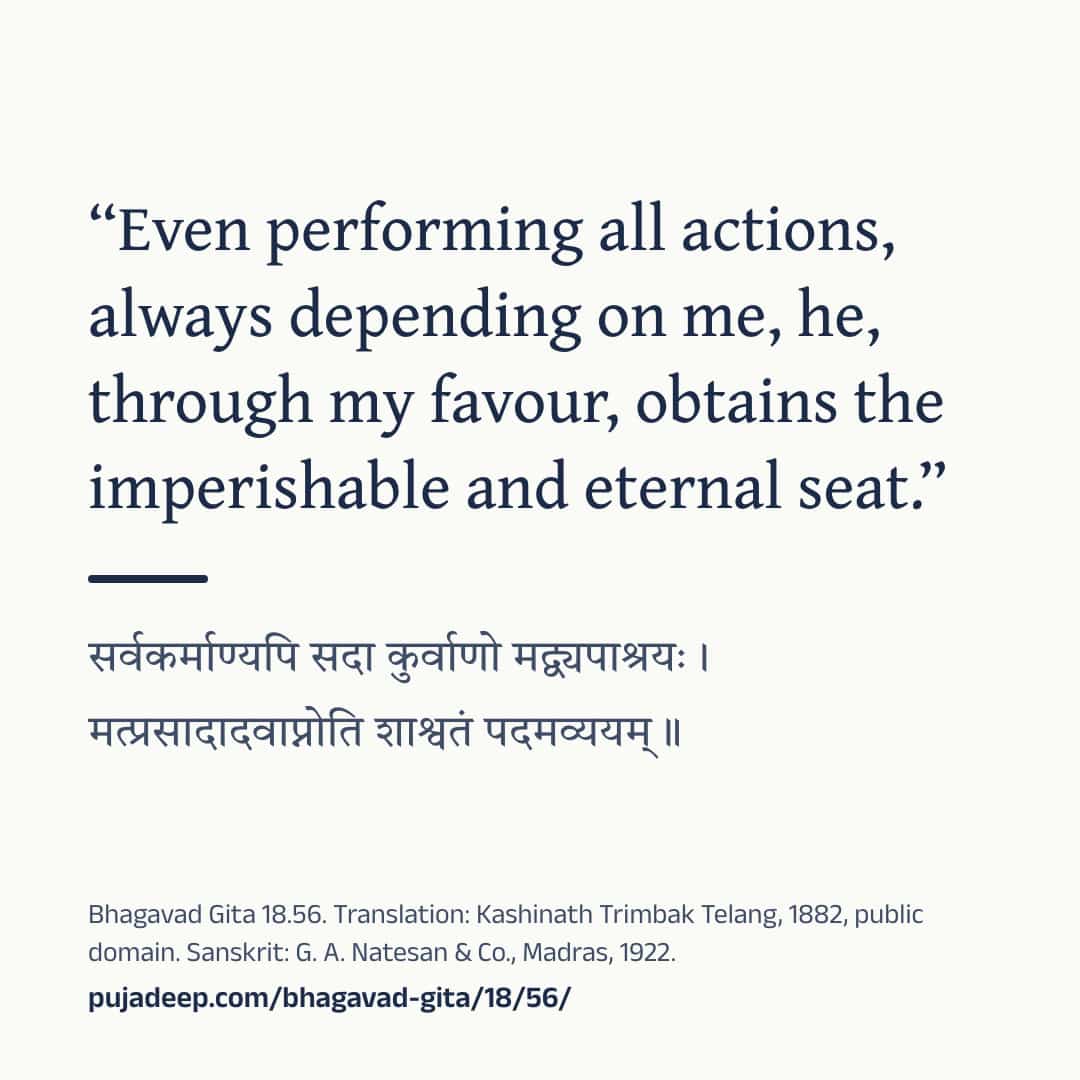
Drawing the picture
See the words
Bhagavad Gita 18.56

सर्वकर्माण्यपि सदा कुर्वाणो मद्व्यपाश्रयः ।
मत्प्रसादादवाप्नोति शाश्वतं पदमव्ययम् ॥

“Even performing all actions, always depending on me, he, through my favour, obtains the imperishable and eternal seat.”
(K. T. Telang, The Bhagavadgîtâ (The Sacred Books of the East, vol. VIII, Oxford: Clarendon Press, 1882), p. 128, public domain)

“Even performing all actions continually, taking refuge in Me, by My grace he obtaineth the eternal indestructible Abode.”
(Annie Besant, The Bhagavad Gîtâ, or The Lord's Song (London: Theosophical Publishing Society, 1895), p. 163, public domain)

“Even doing all actions always, taking refuge in Me,—by My grace he attains to the Eternal Immutable State.”
(Swami Swarupananda, Srimad-Bhagavad-Gita (Mayavati: Prabuddha Bharata Press, 1909; first printed in Prabuddha Bharata, 1907–1909), p. 344, public domain)

Sanskrit: G. A. Natesan & Co., Madras, 1922.
https://pujadeep.com/bhagavad-gita/18/56/ Nothing is sent from this site. Your own app sends it, to the chat you choose. The picture quotes the translation you chose on this page, with its name and year.
Sanskrit text: The Bhagavad-Gita, or The Lord's Song, with the text in Devanagari and an English translation, 1922. Meanings: written for Pujadeep and checked against the cited edition. Source and changes
Questions families ask
Who speaks Bhagavad Gita 18.56?
Krishna speaks this verse, in chapter 18 (Moksha Sannyasa Yoga).
Where does the Sanskrit text come from?
Sanskrit text: The Bhagavad-Gita, or The Lord's Song, with the text in Devanagari and an English translation, 1922. Meanings: written for Pujadeep and checked against the cited edition. See the source
Is the meaning on this page a translation?
Explanation written for this site from the sources listed here, and checked against the cited edition. It is not a translation and not the only way to read the text. Free to quote with credit.
Source and licence
- Sanskrit text
- The Bhagavad-Gita, or The Lord's Song, with the text in Devanagari and an English translation (Annie Besant, G. A. Natesan & Co., Madras, 1922). Public domain. The Sanskrit on these pages was read from this printing’s page images.
- Translation
- The Bhagavadgîtâ with the Sanatsugâtîya and the Anugîtâ, translated by Kâshinâth Trimbak Telang (The Sacred Books of the East, vol. VIII, ed. F. Max Müller) (Kashinath Trimbak Telang, F. Max Müller, Clarendon Press, Oxford, 1882). Public domain. Shown verbatim, as printed.
- Translation
- The Bhagavad Gîtâ, or The Lord's Song, translated by Annie Besant (Annie Besant, Theosophical Publishing Society, London, 1895). Public domain. Shown verbatim, as printed.
- Translation
- Srimad-Bhagavad-Gita, with Sanskrit Text; Paraphrase with Word-by-word Literal Translation; English Rendering and Comments, Index, &c., by the Swami Swarupananda (Himalayan Series, No. XX) (Swami Swarupananda, The Editors and Publishers, Advaita Ashrama, Mayavati, Prabuddha Bharata Press, Mayavati, Almora, Himalayas, 1909). Public domain. Shown verbatim, as printed.
- Common wording
- In this text, 32 words follow today's common wording, checked against sanskritdocuments.org; Sanskrit Wikisource; Gita Press, Gorakhpur; GRETIL, Göttingen and Bhaktivedanta Book Trust.
- Our explanation
- Explanation written for this site from the sources listed here, and checked against the cited edition. It is not a translation and not the only way to read the text. Free to quote with credit.
- Checked
- Checked against the cited edition, October 15, 2026.
- Updated
- October 25, 2026