Bhagavad Gita 18.59: meaning and translation
Chapter 18: Moksha Sannyasa Yoga. Krishna says
Krishna tells Arjuna that if, relying on his pride, he thinks "I will not fight", his resolve is empty: his own nature will make him act.
Click or tap a word for its meaning and its dictionary page.
Text and layers
Text and layers
These choices stay in this browser.
Bhagavad Gita 18.59
यदहङ्कारमाश्रित्य न योत्स्य इति मन्यसे ।मिथ्यैष व्यवसायस्ते प्रकृतिस्त्वां नियोक्ष्यति ॥
Yadahankaramashritya na yotsya iti manyaseMithyaisha vyavasayaste prakritistvam niyokshyati
yadahaṅkāramāśritya na yotsya iti manyase |mithyaiṣa vyavasāyaste prakṛtistvāṃ niyokṣyati ||
Our explanation Krishna tells Arjuna that if, relying on his pride, he thinks "I will not fight", his resolve is empty: his own nature will make him act. Shankara, in Telang's note, takes 'nature' to mean the nature of a Kṣatriya.
हिंदी अर्थ कृष्ण अर्जुन से कहते हैं कि यदि वे अहंकार के सहारे सोचते हैं कि “मैं नहीं लड़ूँगा”, तो उनका यह निश्चय व्यर्थ है: उनकी प्रकृति उन्हें कर्म में लगा देगी। तेलंग की टिप्पणी के अनुसार शंकराचार्य “प्रकृति” का अर्थ क्षत्रिय-स्वभाव लेते हैं।
Word by word
Every word, with its dictionary page
Word by word
- यत् yat · that, if (indeclinable) Dictionary: yad, Monier-Williams 1899, p. 844, col. 2 “who, which, what, whichever, whatever, that”
- अहङ्कारम् ahaṅkāram · ego (noun (masculine), accusative singular) Dictionary: ahaṃ-kāra, Monier-Williams 1899, p. 124, col. 2 “conception of one's individuality, self-consciousness”
- आश्रित्य āśritya · taking refuge in (absolutive (having done)) Dictionary: 1. ā-śri, Monier-Williams 1899, p. 158, col. 2 “to seek refuge in”
- न na · not (indeclinable) Dictionary: 2. na, Monier-Williams 1899, p. 523, col. 1 “not, no, nor, neither”
- योत्स्ये yotsye · "I will fight" (Arjuna) (future, 1st person singular) Dictionary: 1. yudh, Monier-Williams 1899, p. 854, col. 3 “to fight with (instr., also with saha, samam) or for (loc.) or against (acc.)”
- इति iti · thus (indeclinable) Dictionary: 2. iti, Monier-Williams 1899, p. 165, col. 1 “in this manner, thus”
- मन्यसे manyase · you think (present, 2nd person singular) Dictionary: man, Monier-Williams 1899, p. 783, col. 1 “to think, believe, imagine, suppose, conjecture”
- मिथ्या mithyā · false, in vain (indeclinable) Dictionary: mithyā, Monier-Williams 1899, p. 817, col. 1 “to no purpose, fruitlessly, in vain”
- एषः eṣaḥ · this (pronoun (masculine), nominative singular) Dictionary: etad, Monier-Williams 1899, p. 231, col. 2 “this, this here, here”
- व्यवसायः vyavasāyaḥ · resolve (noun (masculine), nominative singular) Dictionary: vy-avasāya, Monier-Williams 1899, p. 1033, col. 1 “settled determination, resolve, purpose, intention”
- ते te · your (pronoun, genitive singular) Dictionary: 2. tva, Monier-Williams 1899, p. 463, col. 2 “base of the 2nd personal pron.”
- प्रकृतिः prakṛtiḥ · nature (noun (feminine), nominative singular) Dictionary: pra-kṛti, Monier-Williams 1899, p. 654, col. 1 “nature, character, constitution, temper, disposition”
- त्वाम् tvām · you (pronoun, accusative singular) Dictionary: 2. tva, Monier-Williams 1899, p. 463, col. 2 “base of the 2nd personal pron.”
- नियोक्ष्यति niyokṣyati · will compel (future, 3rd person singular) Dictionary: ni-yuj, Monier-Williams 1899, p. 552, col. 2 “to enjoin, order, command, coerce, impel, appoint”
Old translations
Kashinath Trimbak Telang, 1882. Public domain. Page 128.
If entertaining egotism, you think that you may not fight, vain, indeed, is that resolution of yours. Nature1 will constrain you.
Footnotes (the translator’s own) - The nature of a Kshatriya, Saṅkara. ↩
Compare 3 translations
Kashinath Trimbak Telang, 1882. Public domain. Page 128.
If entertaining egotism, you think that you may not fight, vain, indeed, is that resolution of yours. Nature1 will constrain you.
Footnotes (the translator’s own) - The nature of a Kshatriya, Saṅkara. ↩
You are reading this one
Annie Besant, 1895. Public domain. Page 163–164.
If, taking refuge in egoism, thou thinkest, "I will not fight," to no purpose thy determination: nature will constrain thee.
You are reading this one
Swami Swarupananda, 1909 (first printed 1907). Public domain. Page 345.
If, filled with self-conceit, thou thinkest, "I will not fight," vain is this thy resolve; thy Prakriti will constrain thee.
You are reading this one
Cite this verse
The translation: K. T. Telang, The Bhagavadgîtâ (The Sacred Books of the East, vol. VIII, Oxford: Clarendon Press, 1882), p. 128. Bhagavad Gita 18.59.
The translation: Annie Besant, The Bhagavad Gîtâ, or The Lord's Song (London: Theosophical Publishing Society, 1895), pp. 163–164. Bhagavad Gita 18.59.
The translation: Swami Swarupananda, Srimad-Bhagavad-Gita (Mayavati: Prabuddha Bharata Press, 1909; first printed in Prabuddha Bharata, 1907–1909), p. 345. Bhagavad Gita 18.59.
Our explanation: “Bhagavad Gita 18.59: meaning and translation.” Pujadeep. Updated October 25, 2026. https://pujadeep.com/bhagavad-gita/18/59/
Pujadeep’s explanations are free to quote with credit: name Pujadeep and link to the page. How to credit
Classical readings, by school
No readings by school on this verse yet.
Share
Show the ways to share
Send one picture or the text to one chat. The picture names its source and the address of this page.
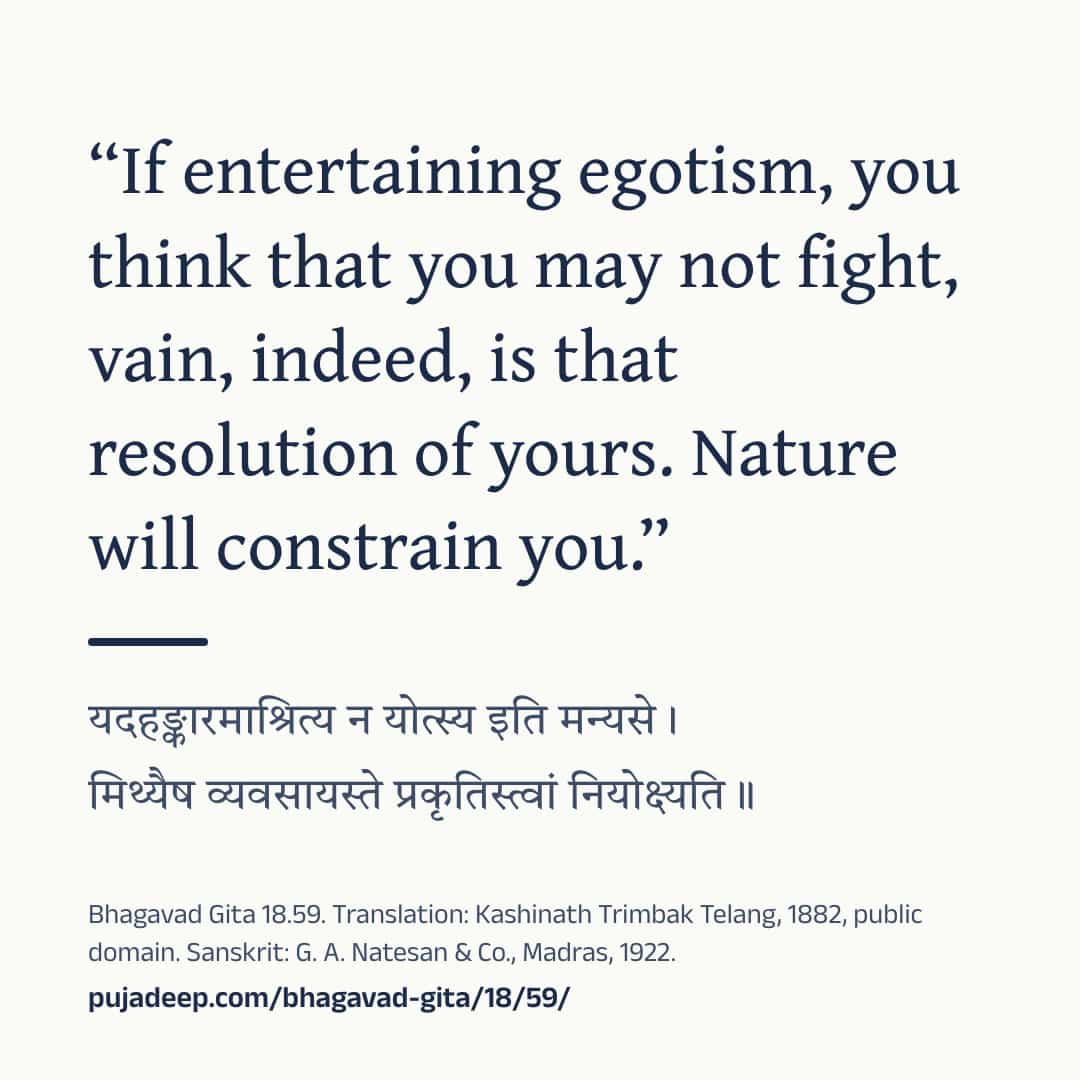
Drawing the picture
See the words
Bhagavad Gita 18.59

यदहङ्कारमाश्रित्य न योत्स्य इति मन्यसे ।
मिथ्यैष व्यवसायस्ते प्रकृतिस्त्वां नियोक्ष्यति ॥

“If entertaining egotism, you think that you may not fight, vain, indeed, is that resolution of yours. Nature will constrain you.”
(K. T. Telang, The Bhagavadgîtâ (The Sacred Books of the East, vol. VIII, Oxford: Clarendon Press, 1882), p. 128, public domain)

“If, taking refuge in egoism, thou thinkest, "I will not fight," to no purpose thy determination: nature will constrain thee.”
(Annie Besant, The Bhagavad Gîtâ, or The Lord's Song (London: Theosophical Publishing Society, 1895), pp. 163–164, public domain)

“If, filled with self-conceit, thou thinkest, "I will not fight," vain is this thy resolve; thy Prakriti will constrain thee.”
(Swami Swarupananda, Srimad-Bhagavad-Gita (Mayavati: Prabuddha Bharata Press, 1909; first printed in Prabuddha Bharata, 1907–1909), p. 345, public domain)

Sanskrit: G. A. Natesan & Co., Madras, 1922.
https://pujadeep.com/bhagavad-gita/18/59/ Nothing is sent from this site. Your own app sends it, to the chat you choose. The picture quotes the translation you chose on this page, with its name and year.
Sanskrit text: The Bhagavad-Gita, or The Lord's Song, with the text in Devanagari and an English translation, 1922. Meanings: written for Pujadeep and checked against the cited edition. Source and changes
Questions families ask
Who speaks Bhagavad Gita 18.59?
Krishna speaks this verse, in chapter 18 (Moksha Sannyasa Yoga).
Where does the Sanskrit text come from?
Sanskrit text: The Bhagavad-Gita, or The Lord's Song, with the text in Devanagari and an English translation, 1922. Meanings: written for Pujadeep and checked against the cited edition. See the source
Is the meaning on this page a translation?
Explanation written for this site from the sources listed here, and checked against the cited edition. It is not a translation and not the only way to read the text. Free to quote with credit.
Source and licence
- Sanskrit text
- The Bhagavad-Gita, or The Lord's Song, with the text in Devanagari and an English translation (Annie Besant, G. A. Natesan & Co., Madras, 1922). Public domain. The Sanskrit on these pages was read from this printing’s page images.
- Translation
- The Bhagavadgîtâ with the Sanatsugâtîya and the Anugîtâ, translated by Kâshinâth Trimbak Telang (The Sacred Books of the East, vol. VIII, ed. F. Max Müller) (Kashinath Trimbak Telang, F. Max Müller, Clarendon Press, Oxford, 1882). Public domain. Shown verbatim, as printed.
- Translation
- The Bhagavad Gîtâ, or The Lord's Song, translated by Annie Besant (Annie Besant, Theosophical Publishing Society, London, 1895). Public domain. Shown verbatim, as printed.
- Translation
- Srimad-Bhagavad-Gita, with Sanskrit Text; Paraphrase with Word-by-word Literal Translation; English Rendering and Comments, Index, &c., by the Swami Swarupananda (Himalayan Series, No. XX) (Swami Swarupananda, The Editors and Publishers, Advaita Ashrama, Mayavati, Prabuddha Bharata Press, Mayavati, Almora, Himalayas, 1909). Public domain. Shown verbatim, as printed.
- Common wording
- In this text, 32 words follow today's common wording, checked against sanskritdocuments.org; Sanskrit Wikisource; Gita Press, Gorakhpur; GRETIL, Göttingen and Bhaktivedanta Book Trust.
- Our explanation
- Explanation written for this site from the sources listed here, and checked against the cited edition. It is not a translation and not the only way to read the text. Free to quote with credit.
- Checked
- Checked against the cited edition, October 15, 2026.
- Updated
- October 25, 2026