Bhagavad Gita 18.55: meaning and translation
Chapter 18: Moksha Sannyasa Yoga. Krishna says
By devotion, Krishna says, one comes to know him truly, how great he is and who he is; and knowing him truly, one then enters into him.
Click or tap a word for its meaning and its dictionary page.
Text and layers
Text and layers
These choices stay in this browser.
Bhagavad Gita 18.55
भक्त्या मामभिजानाति यावान्यश्चास्मि तत्त्वतः ।ततो मां तत्त्वतो ज्ञात्वा विशते तदनन्तरम् ॥
Bhaktya mamabhijanati yavanyashchasmi tattvatahTato mam tattvato jnatva vishate tadanantaram
bhaktyā māmabhijānāti yāvānyaścāsmi tattvataḥ |tato māṃ tattvato jñātvā viśate tadanantaram ||
Our explanation By devotion, Krishna says, one comes to know him truly, how great he is and who he is; and knowing him truly, one then enters into him. The schools read 'enters into him' very differently (see the views).
हिंदी अर्थ कृष्ण कहते हैं कि भक्ति से व्यक्ति उन्हें तत्त्व से जानता है कि वे कितने हैं और कौन हैं; और उन्हें तत्त्व से जानकर फिर उनमें प्रवेश करता है। “उनमें प्रवेश” को परंपराएँ बहुत अलग ढंग से पढ़ती हैं।
Word by word
Every word, with its dictionary page
Word by word
- भक्त्या bhaktyā · by devotion (noun (feminine), instrumental singular) Dictionary: bhakti, Monier-Williams 1899, p. 743, col. 2 “attachment, devotion, fondness for, devotion to”
- माम् mām · "me" (Krishna) (pronoun, accusative singular) Dictionary: 1. mad, Monier-Williams 1899, p. 777, col. 2 “base of the first pers. pron. in the sg. number (esp. in comp.)”
- अभिजानाति abhijānāti · knows fully (present, 3rd person singular) Dictionary: abhi-jñā, Monier-Williams 1899, p. 62, col. 2 “to recognize, perceive, know, be or become aware of”
- यावान् yāvān · how great (adjective (masculine), nominative singular) Dictionary: yāvat, Monier-Williams 1899, p. 852, col. 1 “as great, as large, as much, as many”
- यः yaḥ · who (pronoun (masculine), nominative singular) Dictionary: yad, Monier-Williams 1899, p. 844, col. 2 “who, which, what, whichever, whatever, that”
- च ca · and (indeclinable) Dictionary: 2. ca, Monier-Williams 1899, p. 380, col. 1 “and, both, also, moreover, as well as”
- अस्मि asmi · "I am" (present, 1st person singular) Dictionary: 1. as, Monier-Williams 1899, p. 117, col. 2 “to be, live, exist, be present”
- तत्त्वतः tattvataḥ · in truth (indeclinable) Dictionary: tat-tva-tas, Monier-Williams 1899, p. 433, col. 1
- ततः tataḥ · then (indeclinable) Dictionary: tatas, Monier-Williams 1899, p. 432, col. 2 “thereupon, then, after that, afterwards”
- माम् mām · "me" (Krishna) (pronoun, accusative singular) Dictionary: 1. mad, Monier-Williams 1899, p. 777, col. 2 “base of the first pers. pron. in the sg. number (esp. in comp.)”
- तत्त्वतः tattvataḥ · in truth (indeclinable) Dictionary: tat-tva-tas, Monier-Williams 1899, p. 433, col. 1
- ज्ञात्वा jñātvā · having known (absolutive (having done)) Dictionary: 1. jñā, Monier-Williams 1899, p. 425, col. 3 “to know, have knowledge, become acquainted with”
- विशते viśate · enters (present, 3rd person singular) Dictionary: 1. viś, Monier-Williams 1899, p. 989, col. 2 “to enter, enter in or settle down on, go into”
- तदनन्तरम् tadanantaram · right after that (indeclinable) Dictionary: tad, Monier-Williams 1899, p. 434, col. 1 “m. he, f. she, n. it, that, this”; an-antara, Monier-Williams 1899, p. 25, col. 1 “immediately after; after; afterwards”
Old translations
Kashinath Trimbak Telang, 1882. Public domain. Page 128.
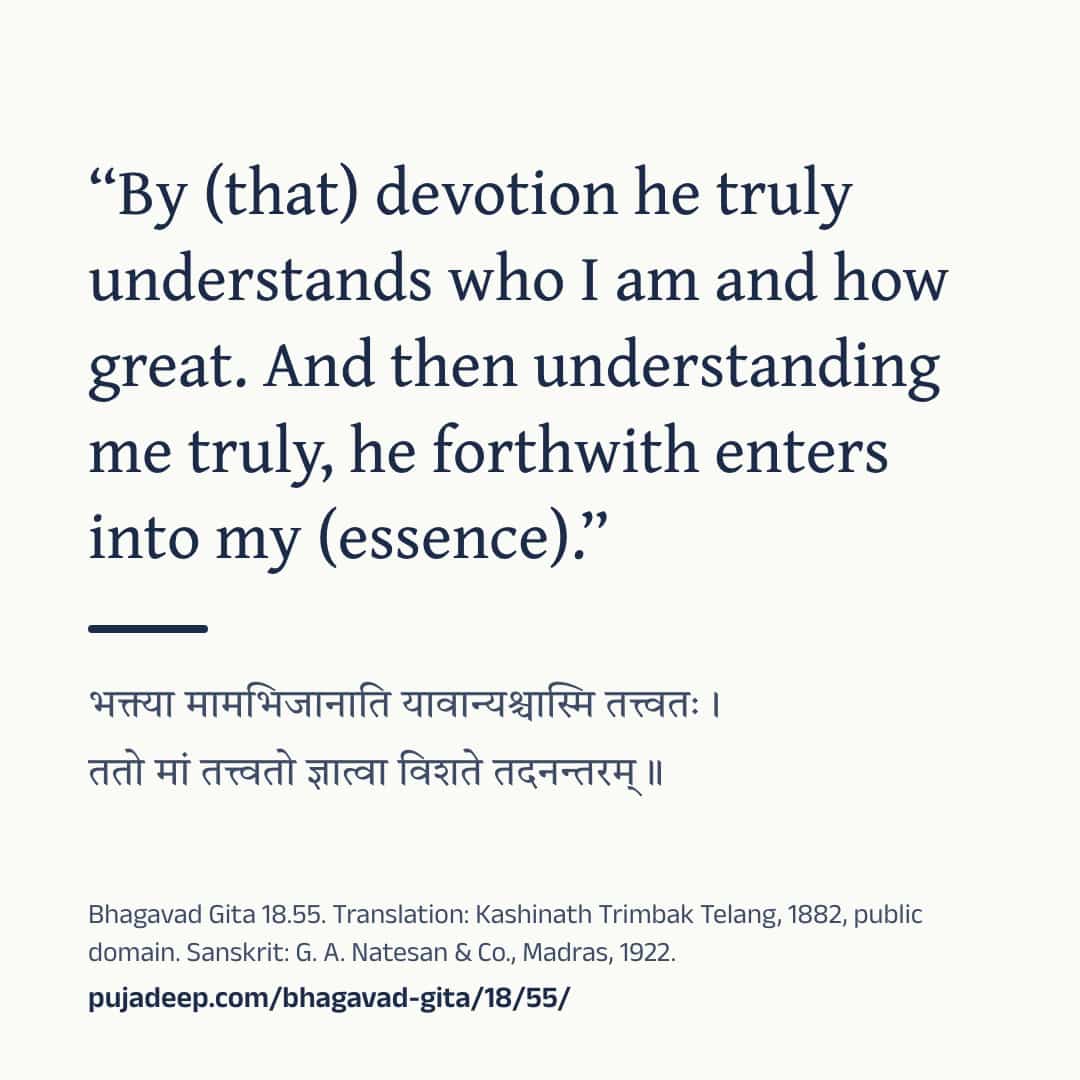
By (that) devotion he truly understands who I am and how great. And then understanding me truly, he forthwith enters into my (essence).
Compare 3 translations
Kashinath Trimbak Telang, 1882. Public domain. Page 128.
By (that) devotion he truly understands who I am and how great. And then understanding me truly, he forthwith enters into my (essence).
You are reading this one
Annie Besant, 1895. Public domain. Page 163.
By devotion he knoweth Me fully, what I am and what My Essence; having thus known My Essence, he forthwith entereth into Me.
You are reading this one
Swami Swarupananda, 1909 (first printed 1907). Public domain. Page 344.
By devotion he knows Me in reality, what and who I am; then having known Me in reality, he forthwith enters into Me.
You are reading this one
Cite this verse
The translation: K. T. Telang, The Bhagavadgîtâ (The Sacred Books of the East, vol. VIII, Oxford: Clarendon Press, 1882), p. 128. Bhagavad Gita 18.55.
The translation: Annie Besant, The Bhagavad Gîtâ, or The Lord's Song (London: Theosophical Publishing Society, 1895), p. 163. Bhagavad Gita 18.55.
The translation: Swami Swarupananda, Srimad-Bhagavad-Gita (Mayavati: Prabuddha Bharata Press, 1909; first printed in Prabuddha Bharata, 1907–1909), p. 344. Bhagavad Gita 18.55.
Our explanation: “Bhagavad Gita 18.55: meaning and translation.” Pujadeep. Updated October 25, 2026. https://pujadeep.com/bhagavad-gita/18/55/
Pujadeep’s explanations are free to quote with credit: name Pujadeep and link to the page. How to credit
Classical readings, by school
Each reading is named by its school. None is presented as the only meaning.
What Advaita, Vishishtadvaita and Dvaita teach, in short
Shankara Advaita
Shankara says the devotion here is the devotion of knowledge, the highest of the four kinds named in 7.16–17. Knowing and entering are not two acts: entering is the knowledge itself, in which every sense of difference between the Lord and the knower of the field disappears.
Source: The Bhagavad-Gita, with the commentary of Sri Sankaracharya, translated by A. Mahadeva Sastri (2nd ed., Mysore: G. T. A. Printing Works, 1901), commentary on 18.55, pp. 447–448. Summarised in our own words; none of its text is reproduced.
Ramanuja Vishishtadvaita
Ramanuja says that through loving devotion one gains a vision of the Lord as he is, in his nature, qualities and glories, and then, carried by the same love, 'enters' him, that is, comes to be with him. Bhakti is the means of that entry, as 11.54 says.
Source: Sri Bhagavad-Gita with Sri Ramanujacharya's Visishtadvaita commentary, translated by A. Govindacharya (Madras, 1898), commentary on 18.55, pp. 556–557. Summarised in our own words; none of its text is reproduced.
Share
Show the ways to share
Send one picture or the text to one chat. The picture names its source and the address of this page.
Drawing the picture
See the words
Bhagavad Gita 18.55

भक्त्या मामभिजानाति यावान्यश्चास्मि तत्त्वतः ।
ततो मां तत्त्वतो ज्ञात्वा विशते तदनन्तरम् ॥

“By (that) devotion he truly understands who I am and how great. And then understanding me truly, he forthwith enters into my (essence).”
(K. T. Telang, The Bhagavadgîtâ (The Sacred Books of the East, vol. VIII, Oxford: Clarendon Press, 1882), p. 128, public domain)

“By devotion he knoweth Me fully, what I am and what My Essence; having thus known My Essence, he forthwith entereth into Me.”
(Annie Besant, The Bhagavad Gîtâ, or The Lord's Song (London: Theosophical Publishing Society, 1895), p. 163, public domain)

“By devotion he knows Me in reality, what and who I am; then having known Me in reality, he forthwith enters into Me.”
(Swami Swarupananda, Srimad-Bhagavad-Gita (Mayavati: Prabuddha Bharata Press, 1909; first printed in Prabuddha Bharata, 1907–1909), p. 344, public domain)

Sanskrit: G. A. Natesan & Co., Madras, 1922.
https://pujadeep.com/bhagavad-gita/18/55/ Nothing is sent from this site. Your own app sends it, to the chat you choose. The picture quotes the translation you chose on this page, with its name and year.
Sanskrit text: The Bhagavad-Gita, or The Lord's Song, with the text in Devanagari and an English translation, 1922. Meanings: written for Pujadeep and checked against the cited edition. Source and changes
Questions families ask
Who speaks Bhagavad Gita 18.55?
Krishna speaks this verse, in chapter 18 (Moksha Sannyasa Yoga).
Where does the Sanskrit text come from?
Sanskrit text: The Bhagavad-Gita, or The Lord's Song, with the text in Devanagari and an English translation, 1922. Meanings: written for Pujadeep and checked against the cited edition. See the source
Is the meaning on this page a translation?
Explanation written for this site from the sources listed here, and checked against the cited edition. It is not a translation and not the only way to read the text. Free to quote with credit.
Source and licence
- Sanskrit text
- The Bhagavad-Gita, or The Lord's Song, with the text in Devanagari and an English translation (Annie Besant, G. A. Natesan & Co., Madras, 1922). Public domain. The Sanskrit on these pages was read from this printing’s page images.
- Translation
- The Bhagavadgîtâ with the Sanatsugâtîya and the Anugîtâ, translated by Kâshinâth Trimbak Telang (The Sacred Books of the East, vol. VIII, ed. F. Max Müller) (Kashinath Trimbak Telang, F. Max Müller, Clarendon Press, Oxford, 1882). Public domain. Shown verbatim, as printed.
- Translation
- The Bhagavad Gîtâ, or The Lord's Song, translated by Annie Besant (Annie Besant, Theosophical Publishing Society, London, 1895). Public domain. Shown verbatim, as printed.
- Translation
- Srimad-Bhagavad-Gita, with Sanskrit Text; Paraphrase with Word-by-word Literal Translation; English Rendering and Comments, Index, &c., by the Swami Swarupananda (Himalayan Series, No. XX) (Swami Swarupananda, The Editors and Publishers, Advaita Ashrama, Mayavati, Prabuddha Bharata Press, Mayavati, Almora, Himalayas, 1909). Public domain. Shown verbatim, as printed.
- Commentary
- The Bhagavad-Gita, with the commentary of Sri Sankaracharya, translated by A. Mahadeva Sastri (2nd ed., Mysore: G. T. A. Printing Works, 1901) (Public-domain scan, University of California Libraries). Summarised in our own words; none of its text is reproduced.
- Commentary
- Sri Bhagavad-Gita with Sri Ramanujacharya's Visishtadvaita commentary, translated by A. Govindacharya (Madras, 1898) (Scan uploaded to archive.org (folkscanomy collection)). Summarised in our own words; none of its text is reproduced.
- Common wording
- In this text, 32 words follow today's common wording, checked against sanskritdocuments.org; Sanskrit Wikisource; Gita Press, Gorakhpur; GRETIL, Göttingen and Bhaktivedanta Book Trust.
- Our explanation
- Explanation written for this site from the sources listed here, and checked against the cited edition. It is not a translation and not the only way to read the text. Free to quote with credit.
- Checked
- Checked against the cited edition, October 15, 2026.
- Updated
- October 25, 2026