Bhagavad Gita 18.43: meaning and translation
Chapter 18: Moksha Sannyasa Yoga. Krishna says
Krishna lists the work born of the nature of a Kṣatriya: courage, vigour, steadiness, skill, not fleeing from battle, generosity and the bearing of a ruler.
Click or tap a word for its meaning and its dictionary page.
Text and layers
Text and layers
These choices stay in this browser.
Bhagavad Gita 18.43
शौर्यं तेजो धृतिर्दाक्ष्यं युद्धे चाप्यपलायनम् ।दानमीश्वरभावश्च क्षात्रं कर्म स्वभावजम् ॥
Shauryam tejo dhritirdakshyam yuddhe chapyapalayanamDanamishvarabhavashcha kshatram karma svabhavajam
śauryaṃ tejo dhṛtirdākṣyaṃ yuddhe cāpyapalāyanam |dānamīśvarabhāvaśca kṣātraṃ karma svabhāvajam ||
Our explanation Krishna lists the work born of the nature of a Kṣatriya: courage, vigour, steadiness, skill, not fleeing from battle, generosity and the bearing of a ruler. Readings of these verses differ between schools and teachers, and the wording is the text's, not the view of this library.
हिंदी अर्थ कृष्ण क्षत्रिय के स्वभाव से उत्पन्न कर्म गिनाते हैं: शौर्य, तेज, धृति, दक्षता, युद्ध से न भागना, दान और शासन करने का भाव (ईश्वरभाव)। इन श्लोकों को अलग-अलग परंपराएँ और आचार्य अलग ढंग से पढ़ते हैं, और ये शब्द पाठ के हैं, इस पुस्तकालय का मत नहीं।
Word by word
Every word, with its dictionary page
Word by word
- शौर्यम् śauryam · valour (noun (neuter), nominative singular) Dictionary: śaurya, Monier-Williams 1899, p. 1093, col. 2 “heroism, valour, prowess, might”
- तेजः tejaḥ · vigour, boldness (noun (neuter), nominative singular) Dictionary: tejas, Monier-Williams 1899, p. 454, col. 3 “fiery energy, ardour, vital power, spirit, efficacy, essence”
- धृतिः dhṛtiḥ · steadiness (noun (feminine), nominative singular) Dictionary: dhṛti, Monier-Williams 1899, p. 519, col. 3 “firmness, constancy, resolution, will, command”
- दाक्ष्यम् dākṣyam · skill (noun (neuter), nominative singular) Dictionary: dākṣya, Monier-Williams 1899, p. 475, col. 1 “cleverness, skill, fitness, capability, industry”
- युद्धे yuddhe · in battle (noun (neuter), locative singular) Dictionary: yuddha, Monier-Williams 1899, p. 854, col. 3 “battle, fight, war”
- च ca · and (indeclinable) Dictionary: 2. ca, Monier-Williams 1899, p. 380, col. 1 “and, both, also, moreover, as well as”
- अपि api · also (indeclinable) Dictionary: api, Monier-Williams 1899, p. 55, col. 1 “in the sense of even, also, very”
- अपलायनम् apalāyanam · not fleeing (noun (neuter), nominative singular) Dictionary: 3. a, Monier-Williams 1899, p. 1, col. 1 “having a negative or privative or contrary sense”; palāyana, Monier-Williams 1899, p. 610, col. 1 “fleeing, flight, escape”
- दानम् dānam · giving (noun (neuter), nominative singular) Dictionary: 1. dāna, Monier-Williams 1899, p. 474, col. 1 “the act of giving”
- ईश्वरभावः īśvarabhāvaḥ · the bearing of a ruler (compound (masculine), nominative singular) Dictionary: īśvara, Monier-Williams 1899, p. 171, col. 1 “master, lord, prince, king”; bhāva, Monier-Williams 1899, p. 754, col. 2 “manner of being, nature, temperament, character”
- च ca · and (indeclinable) Dictionary: 2. ca, Monier-Williams 1899, p. 380, col. 1 “and, both, also, moreover, as well as”
- क्षात्रम् kṣātram · of a Kshatriya (adjective (neuter), nominative singular) Dictionary: kṣātra, Monier-Williams 1899, p. 325, col. 3 “belonging or relating or peculiar to the second caste”
- कर्म karma · work (noun (neuter), nominative singular) Dictionary: karman, Monier-Williams 1899, p. 258, col. 2 “act, action, performance, business”
- स्वभावजम् svabhāvajam · born of nature (compound (neuter), nominative singular) Dictionary: sva-bhāva, Monier-Williams 1899, p. 1276, col. 1 “innate or inherent disposition, nature”; 2. ja, Monier-Williams 1899, p. 407, col. 3 “ifc. born or descended from, produced or caused by”
Old translations
Kashinath Trimbak Telang, 1882. Public domain. Page 126–127.
Valour, glory, courage, dexterity1, not slinking away from battle, gifts, exercise of lordly power2, this is the natural duty of Kshatriyas.
Footnotes (the translator’s own) Compare 3 translations
Kashinath Trimbak Telang, 1882. Public domain. Page 126–127.
Valour, glory, courage, dexterity1, not slinking away from battle, gifts, exercise of lordly power2, this is the natural duty of Kshatriyas.
Footnotes (the translator’s own) You are reading this one
Annie Besant, 1895. Public domain. Page 160.
Prowess, boldness, firmness, dexterity, and also not flying from battle, generosity, the nature of a ruler, are the Kshattriya-Karma, born of his own nature.
You are reading this one
Swami Swarupananda, 1909 (first printed 1907). Public domain. Page 337–338.
Prowess, boldness, fortitude, dexterity, and also not flying from battle, generosity and sovereignty are the duties of Kshatriyas, born of (their own) nature.
You are reading this one
Cite this verse
The translation: K. T. Telang, The Bhagavadgîtâ (The Sacred Books of the East, vol. VIII, Oxford: Clarendon Press, 1882), pp. 126–127. Bhagavad Gita 18.43.
The translation: Annie Besant, The Bhagavad Gîtâ, or The Lord's Song (London: Theosophical Publishing Society, 1895), p. 160. Bhagavad Gita 18.43.
The translation: Swami Swarupananda, Srimad-Bhagavad-Gita (Mayavati: Prabuddha Bharata Press, 1909; first printed in Prabuddha Bharata, 1907–1909), pp. 337–338. Bhagavad Gita 18.43.
Our explanation: “Bhagavad Gita 18.43: meaning and translation.” Pujadeep. Updated October 25, 2026. https://pujadeep.com/bhagavad-gita/18/43/
Pujadeep’s explanations are free to quote with credit: name Pujadeep and link to the page. How to credit
Classical readings, by school
No readings by school on this verse yet.
Share
Show the ways to share
Send one picture or the text to one chat. The picture names its source and the address of this page.
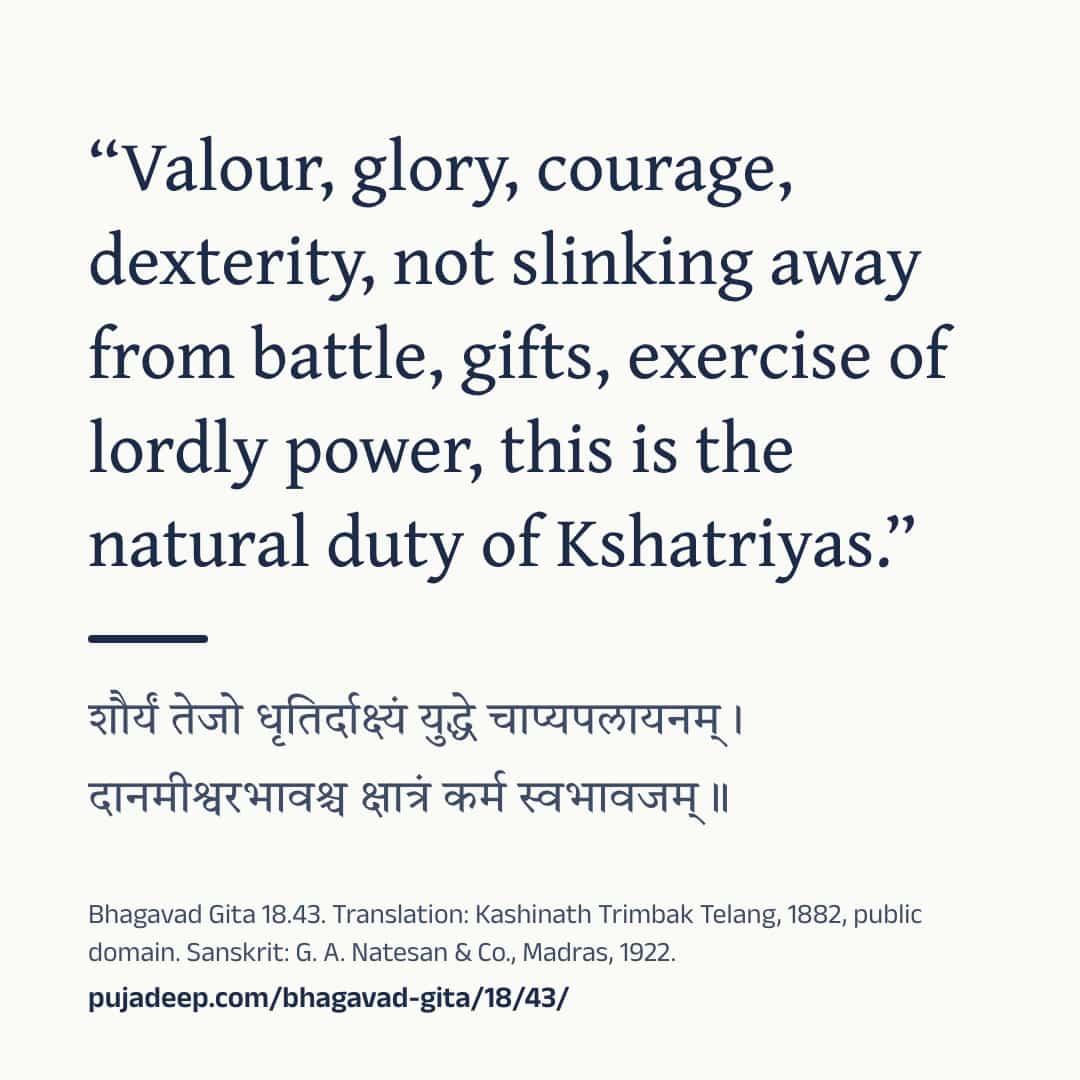
Drawing the picture
See the words
Bhagavad Gita 18.43

शौर्यं तेजो धृतिर्दाक्ष्यं युद्धे चाप्यपलायनम् ।
दानमीश्वरभावश्च क्षात्रं कर्म स्वभावजम् ॥

“Valour, glory, courage, dexterity, not slinking away from battle, gifts, exercise of lordly power, this is the natural duty of Kshatriyas.”
(K. T. Telang, The Bhagavadgîtâ (The Sacred Books of the East, vol. VIII, Oxford: Clarendon Press, 1882), pp. 126–127, public domain)

“Prowess, boldness, firmness, dexterity, and also not flying from battle, generosity, the nature of a ruler, are the Kshattriya-Karma, born of his own nature.”
(Annie Besant, The Bhagavad Gîtâ, or The Lord's Song (London: Theosophical Publishing Society, 1895), p. 160, public domain)

“Prowess, boldness, fortitude, dexterity, and also not flying from battle, generosity and sovereignty are the duties of Kshatriyas, born of (their own) nature.”
(Swami Swarupananda, Srimad-Bhagavad-Gita (Mayavati: Prabuddha Bharata Press, 1909; first printed in Prabuddha Bharata, 1907–1909), pp. 337–338, public domain)

Sanskrit: G. A. Natesan & Co., Madras, 1922.
https://pujadeep.com/bhagavad-gita/18/43/ Nothing is sent from this site. Your own app sends it, to the chat you choose. The picture quotes the translation you chose on this page, with its name and year.
Sanskrit text: The Bhagavad-Gita, or The Lord's Song, with the text in Devanagari and an English translation, 1922. Meanings: written for Pujadeep and checked against the cited edition. Source and changes
Questions families ask
Who speaks Bhagavad Gita 18.43?
Krishna speaks this verse, in chapter 18 (Moksha Sannyasa Yoga).
Where does the Sanskrit text come from?
Sanskrit text: The Bhagavad-Gita, or The Lord's Song, with the text in Devanagari and an English translation, 1922. Meanings: written for Pujadeep and checked against the cited edition. See the source
Is the meaning on this page a translation?
Explanation written for this site from the sources listed here, and checked against the cited edition. It is not a translation and not the only way to read the text. Free to quote with credit.
Source and licence
- Sanskrit text
- The Bhagavad-Gita, or The Lord's Song, with the text in Devanagari and an English translation (Annie Besant, G. A. Natesan & Co., Madras, 1922). Public domain. The Sanskrit on these pages was read from this printing’s page images.
- Translation
- The Bhagavadgîtâ with the Sanatsugâtîya and the Anugîtâ, translated by Kâshinâth Trimbak Telang (The Sacred Books of the East, vol. VIII, ed. F. Max Müller) (Kashinath Trimbak Telang, F. Max Müller, Clarendon Press, Oxford, 1882). Public domain. Shown verbatim, as printed.
- Translation
- The Bhagavad Gîtâ, or The Lord's Song, translated by Annie Besant (Annie Besant, Theosophical Publishing Society, London, 1895). Public domain. Shown verbatim, as printed.
- Translation
- Srimad-Bhagavad-Gita, with Sanskrit Text; Paraphrase with Word-by-word Literal Translation; English Rendering and Comments, Index, &c., by the Swami Swarupananda (Himalayan Series, No. XX) (Swami Swarupananda, The Editors and Publishers, Advaita Ashrama, Mayavati, Prabuddha Bharata Press, Mayavati, Almora, Himalayas, 1909). Public domain. Shown verbatim, as printed.
- Common wording
- In this text, 32 words follow today's common wording, checked against sanskritdocuments.org; Sanskrit Wikisource; Gita Press, Gorakhpur; GRETIL, Göttingen and Bhaktivedanta Book Trust.
- Our explanation
- Explanation written for this site from the sources listed here, and checked against the cited edition. It is not a translation and not the only way to read the text. Free to quote with credit.
- Checked
- Checked against the cited edition, October 15, 2026.
- Updated
- October 25, 2026