Bhagavad Gita 18.28: meaning and translation
Chapter 18: Moksha Sannyasa Yoga. Krishna says
Krishna says that a doer who is unsteady, coarse, stubborn, deceitful, spiteful, lazy, gloomy and slow to act is called a doer of the nature of tamas.
Click or tap a word for its meaning and its dictionary page.
Text and layers
Text and layers
These choices stay in this browser.
Bhagavad Gita 18.28
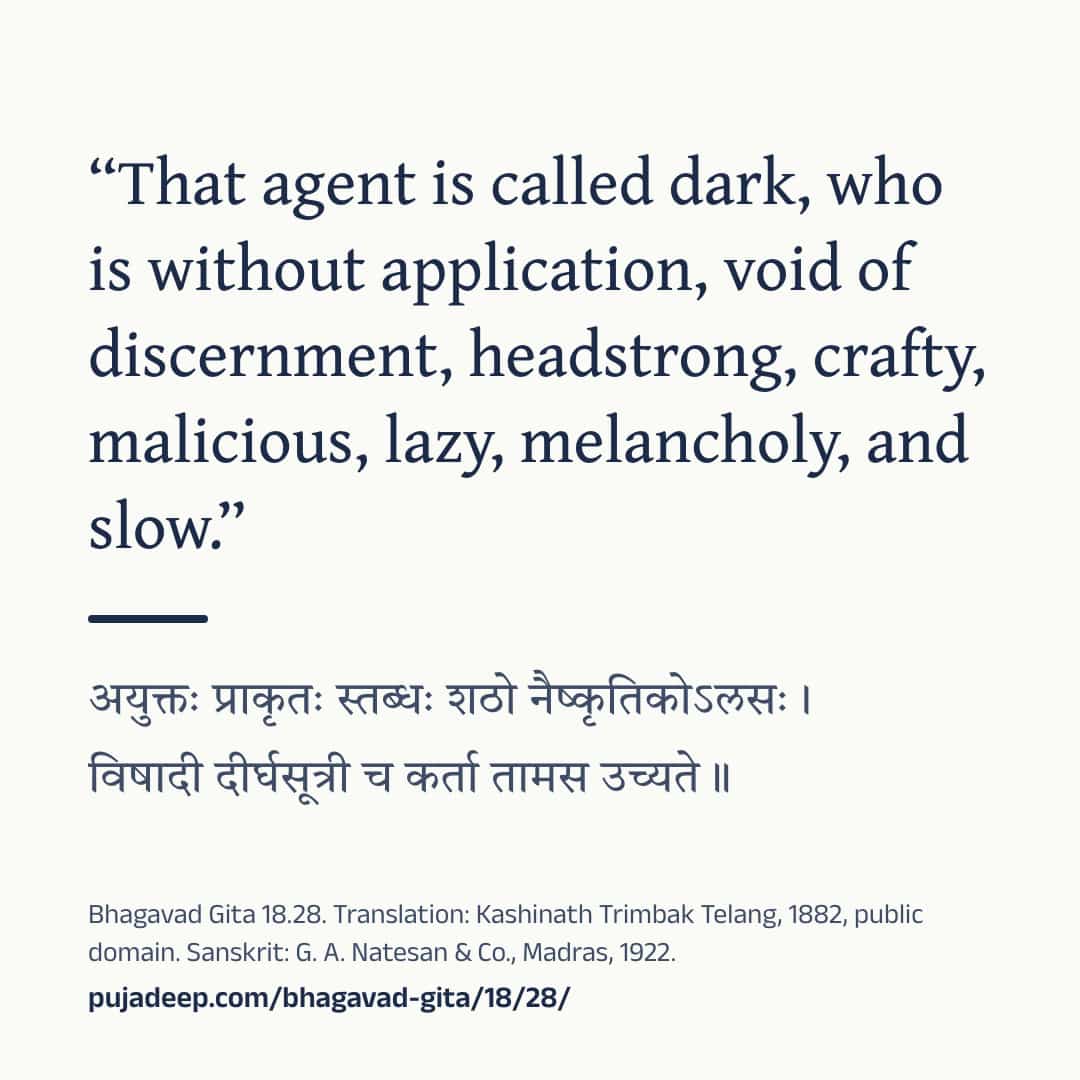
अयुक्तः प्राकृतः स्तब्धः शठो नैष्कृतिकोऽलसः ।विषादी दीर्घसूत्री च कर्ता तामस उच्यते ॥
Ayuktah prakritah stabdhah shatho naishkritikolasahVishadi dirghasutri cha karta tamasa uchyate
ayuktaḥ prākṛtaḥ stabdhaḥ śaṭho naiṣkṛtiko’lasaḥ |viṣādī dīrghasūtrī ca kartā tāmasa ucyate ||
Our explanation Krishna says that a doer who is unsteady, coarse, stubborn, deceitful, spiteful, lazy, gloomy and slow to act is called a doer of the nature of tamas.
हिंदी अर्थ कृष्ण कहते हैं कि जो कर्ता अस्थिर, असंस्कृत, हठी, धूर्त, दूसरों को हानि पहुँचाने वाला, आलसी, विषाद से भरा और काम को टालने वाला है, वह तामस कर्ता कहलाता है।
Word by word
Every word, with its dictionary page
Word by word
- अयुक्तः ayuktaḥ · unsteady, undisciplined (past participle (masculine), nominative singular) Dictionary: a-yukta, Monier-Williams 1899, p. 85, col. 3 “not attentive, not devout”
- प्राकृतः prākṛtaḥ · crude, unrefined (adjective (masculine), nominative singular) Dictionary: prākṛta, Monier-Williams 1899, p. 703, col. 1 “low, vulgar, unrefined”
- स्तब्धः stabdhaḥ · stubborn, arrogant (past participle (masculine), nominative singular) Dictionary: stabdha, Monier-Williams 1899, p. 1258, col. 1 “puffed up, proud, arrogant”
- शठः śaṭhaḥ · deceitful (adjective (masculine), nominative singular) Dictionary: śaṭha, Monier-Williams 1899, p. 1048, col. 2 “false, deceitful, fraudulent, malignant, wicked”
- नैष्कृतिकः naiṣkṛtikaḥ · malicious (adjective (masculine), nominative singular) Dictionary: naiṣkṛtika, Monier-Williams 1899, p. 570, col. 2; naikṛtika, Monier-Williams 1899, p. 569, col. 3 “dishonest, fallacious, low, vile”
- अलसः alasaḥ · lazy (adjective (masculine), nominative singular) Dictionary: a-lasa, Monier-Williams 1899, p. 94, col. 3 “inactive, without energy, lazy, idle, indolent”
- विषादी viṣādī · despondent (adjective (masculine), nominative singular) Dictionary: 2. vi-ṣādin, Monier-Williams 1899, p. 996, col. 3 “dejected, dismayed, disconsolate, sad”
- दीर्घसूत्री dīrghasūtrī · slow, putting things off (compound (masculine), nominative singular) Dictionary: dīrgha-sūtrin, Monier-Williams 1899, p. 482, col. 3; dīrgha-sūtra, Monier-Williams 1899, p. 482, col. 3 “slow, dilatory, procrastinating”
- च ca · and (indeclinable) Dictionary: 2. ca, Monier-Williams 1899, p. 380, col. 1 “and, both, also, moreover, as well as”
- कर्ता kartā · doer (noun (masculine), nominative singular) Dictionary: kartṛ, Monier-Williams 1899, p. 257, col. 3 “one who makes or does or acts or effects, a doer, maker, agent, author”
- तामसः tāmasaḥ · of tamas (adjective (masculine), nominative singular) Dictionary: tāmasa, Monier-Williams 1899, p. 442, col. 3 “appertaining to or affected by the quality tamas”
- उच्यते ucyate · is called (present passive, 3rd person singular) Dictionary: vac, Monier-Williams 1899, p. 912, col. 1 “to be called or accounted, be regarded as, pass for”
Old translations
Kashinath Trimbak Telang, 1882. Public domain. Page 125.
That agent is called dark, who is without application1, void of discernment, headstrong, crafty, malicious, lazy, melancholy, and slow.
Footnotes (the translator’s own) - I. e. attention to work; melancholy=always desponding and wanting in energy. ↩
Compare 3 translations
Kashinath Trimbak Telang, 1882. Public domain. Page 125.
That agent is called dark, who is without application1, void of discernment, headstrong, crafty, malicious, lazy, melancholy, and slow.
Footnotes (the translator’s own) - I. e. attention to work; melancholy=always desponding and wanting in energy. ↩
You are reading this one
Annie Besant, 1895. Public domain. Page 157.
Listless, vulgar, stubborn, cheating, malicious, indolent, despairful, procrastinating, that actor is called tâmasic.
You are reading this one
Swami Swarupananda, 1909 (first printed 1907). Public domain. Page 331.
Unsteady, vulgar, arrogant, dishonest, malicious, indolent, desponding and procrastinating, such an agent is called Támasic.
You are reading this one
Cite this verse
The translation: K. T. Telang, The Bhagavadgîtâ (The Sacred Books of the East, vol. VIII, Oxford: Clarendon Press, 1882), p. 125. Bhagavad Gita 18.28.
The translation: Annie Besant, The Bhagavad Gîtâ, or The Lord's Song (London: Theosophical Publishing Society, 1895), p. 157. Bhagavad Gita 18.28.
The translation: Swami Swarupananda, Srimad-Bhagavad-Gita (Mayavati: Prabuddha Bharata Press, 1909; first printed in Prabuddha Bharata, 1907–1909), p. 331. Bhagavad Gita 18.28.
Our explanation: “Bhagavad Gita 18.28: meaning and translation.” Pujadeep. Updated October 25, 2026. https://pujadeep.com/bhagavad-gita/18/28/
Pujadeep’s explanations are free to quote with credit: name Pujadeep and link to the page. How to credit
Classical readings, by school
No readings by school on this verse yet.
Share
Show the ways to share
Send one picture or the text to one chat. The picture names its source and the address of this page.
Drawing the picture
See the words
Bhagavad Gita 18.28

अयुक्तः प्राकृतः स्तब्धः शठो नैष्कृतिकोऽलसः ।
विषादी दीर्घसूत्री च कर्ता तामस उच्यते ॥

“That agent is called dark, who is without application, void of discernment, headstrong, crafty, malicious, lazy, melancholy, and slow.”
(K. T. Telang, The Bhagavadgîtâ (The Sacred Books of the East, vol. VIII, Oxford: Clarendon Press, 1882), p. 125, public domain)

“Listless, vulgar, stubborn, cheating, malicious, indolent, despairful, procrastinating, that actor is called tâmasic.”
(Annie Besant, The Bhagavad Gîtâ, or The Lord's Song (London: Theosophical Publishing Society, 1895), p. 157, public domain)

“Unsteady, vulgar, arrogant, dishonest, malicious, indolent, desponding and procrastinating, such an agent is called Támasic.”
(Swami Swarupananda, Srimad-Bhagavad-Gita (Mayavati: Prabuddha Bharata Press, 1909; first printed in Prabuddha Bharata, 1907–1909), p. 331, public domain)

Sanskrit: G. A. Natesan & Co., Madras, 1922.
https://pujadeep.com/bhagavad-gita/18/28/ Nothing is sent from this site. Your own app sends it, to the chat you choose. The picture quotes the translation you chose on this page, with its name and year.
Sanskrit text: The Bhagavad-Gita, or The Lord's Song, with the text in Devanagari and an English translation, 1922. Meanings: written for Pujadeep and checked against the cited edition. Source and changes
Questions families ask
Who speaks Bhagavad Gita 18.28?
Krishna speaks this verse, in chapter 18 (Moksha Sannyasa Yoga).
Where does the Sanskrit text come from?
Sanskrit text: The Bhagavad-Gita, or The Lord's Song, with the text in Devanagari and an English translation, 1922. Meanings: written for Pujadeep and checked against the cited edition. See the source
Is the meaning on this page a translation?
Explanation written for this site from the sources listed here, and checked against the cited edition. It is not a translation and not the only way to read the text. Free to quote with credit.
Source and licence
- Sanskrit text
- The Bhagavad-Gita, or The Lord's Song, with the text in Devanagari and an English translation (Annie Besant, G. A. Natesan & Co., Madras, 1922). Public domain. The Sanskrit on these pages was read from this printing’s page images.
- Translation
- The Bhagavadgîtâ with the Sanatsugâtîya and the Anugîtâ, translated by Kâshinâth Trimbak Telang (The Sacred Books of the East, vol. VIII, ed. F. Max Müller) (Kashinath Trimbak Telang, F. Max Müller, Clarendon Press, Oxford, 1882). Public domain. Shown verbatim, as printed.
- Translation
- The Bhagavad Gîtâ, or The Lord's Song, translated by Annie Besant (Annie Besant, Theosophical Publishing Society, London, 1895). Public domain. Shown verbatim, as printed.
- Translation
- Srimad-Bhagavad-Gita, with Sanskrit Text; Paraphrase with Word-by-word Literal Translation; English Rendering and Comments, Index, &c., by the Swami Swarupananda (Himalayan Series, No. XX) (Swami Swarupananda, The Editors and Publishers, Advaita Ashrama, Mayavati, Prabuddha Bharata Press, Mayavati, Almora, Himalayas, 1909). Public domain. Shown verbatim, as printed.
- Common wording
- In this text, 32 words follow today's common wording, checked against sanskritdocuments.org; Sanskrit Wikisource; Gita Press, Gorakhpur; GRETIL, Göttingen and Bhaktivedanta Book Trust.
- Our explanation
- Explanation written for this site from the sources listed here, and checked against the cited edition. It is not a translation and not the only way to read the text. Free to quote with credit.
- Checked
- Checked against the cited edition, October 15, 2026.
- Updated
- October 25, 2026