Bhagavad Gita 18.25: meaning and translation
Chapter 18: Moksha Sannyasa Yoga. Krishna says
Krishna says that an action begun out of confusion, without thinking of what follows from it, of loss, of harm to others, or of one's own strength, is called action of the nature of tamas.
Click or tap a word for its meaning and its dictionary page.
Text and layers
Text and layers
These choices stay in this browser.
Bhagavad Gita 18.25
अनुबन्धं क्षयं हिंसामनपेक्ष्य च पौरुषम् ।मोहादारभ्यते कर्म यत्तत्तामसमुच्यते ॥
Anubandham kshayam hinsamanapekshya cha paurushamMohadarabhyate karma yattattamasamuchyate
anubandhaṃ kṣayaṃ hiṃsāmanapekṣya ca pauruṣam |mohādārabhyate karma yattattāmasamucyate ||
Our explanation Krishna says that an action begun out of confusion, without thinking of what follows from it, of loss, of harm to others, or of one's own strength, is called action of the nature of tamas.
हिंदी अर्थ कृष्ण कहते हैं कि जो कर्म मोह के कारण आरंभ किया जाता है, उसके परिणाम, हानि, दूसरों की हिंसा और अपने सामर्थ्य का विचार किए बिना, वह तामस कहलाता है।
Word by word
Every word, with its dictionary page
Word by word
- अनुबन्धम् anubandham · the consequence (noun (masculine), accusative singular) Dictionary: anu-bandha, Monier-Williams 1899, p. 36, col. 2 “sequence, consequence, result”
- क्षयम् kṣayam · loss (noun (masculine), accusative singular) Dictionary: 3. kṣaya, Monier-Williams 1899, p. 328, col. 1 “loss, waste, wane, diminution, destruction, decay”
- हिंसाम् hiṃsām · harm (noun (feminine), accusative singular) Dictionary: hiṃsā, Monier-Williams 1899, p. 1297, col. 3 “injury, harm (to life or property), hurt, mischief, wrong”
- अनपेक्ष्य anapekṣya · without regard to (absolutive (having done)) Dictionary: an-apekṣya, Monier-Williams 1899, p. 25, col. 3 “disregarding, irrespective of”
- च ca · and (indeclinable) Dictionary: 2. ca, Monier-Williams 1899, p. 380, col. 1 “and, both, also, moreover, as well as”
- पौरुषम् pauruṣam · one's own strength (noun (neuter), accusative singular) Dictionary: 1. pauruṣa, Monier-Williams 1899, p. 651, col. 2 “manliness, manly strength or courage or deed, valour, heroism”
- मोहात् mohāt · out of delusion (noun (masculine), ablative singular) Dictionary: moha, Monier-Williams 1899, p. 836, col. 1 “loss of consciousness, bewilderment, perplexity, distraction, infatuation, delusion, error, folly”
- आरभ्यते ārabhyate · is undertaken (present passive, 3rd person singular) Dictionary: ā-rabh, Monier-Williams 1899, p. 150, col. 1 “to undertake, commence, begin”
- कर्म karma · action (noun (neuter), nominative singular) Dictionary: karman, Monier-Williams 1899, p. 258, col. 2 “act, action, performance, business”
- यत् yat · which (pronoun (neuter), nominative singular) Dictionary: yad, Monier-Williams 1899, p. 844, col. 2 “who, which, what, whichever, whatever, that”
- तत् tat · that (pronoun (neuter), nominative singular) Dictionary: tad, Monier-Williams 1899, p. 434, col. 1 “m. he, f. she, n. it, that, this”
- तामसम् tāmasam · of tamas (adjective (neuter), nominative singular) Dictionary: tāmasa, Monier-Williams 1899, p. 442, col. 3 “appertaining to or affected by the quality tamas”
- उच्यते ucyate · is called (present passive, 3rd person singular) Dictionary: vac, Monier-Williams 1899, p. 912, col. 1 “to be called or accounted, be regarded as, pass for”
2 printings differ
Edition differences. Another printing or text reads this place differently.
- Word Today's text from Gita Press, Gorakhpur reads: अनुबन्धं क्षयं हिंसामनवेक्ष्य च पौरुषम् Today's text from Gita Press (p. 191) reads अनवेक्ष्य ('without looking at'); sanskritdocuments.org and GRETIL read अनपेक्ष्य ('without regard to') with the 1922 edition. The popular texts disagree, so the printing's reading stays (decision 14). The sense is the same.
- Word Today's text from Sanskrit Wikisource reads: अनुबन्धं क्षयं हिंसामनवेक्ष्य च पौरुषम् Sanskrit Wikisource (the Gita Supersite's text) reads अनवेक्ष्य, like Gita Press.
Old translations
Kashinath Trimbak Telang, 1882. Public domain. Page 124.
The action is called dark, which is commenced through delusion, without regard to consequences, loss, injury, or strength1.
Footnotes (the translator’s own) - Consequences=good or evil resulting; loss=of wealth or strength; injury=to others; strength=one's own capacity. ↩
Compare 3 translations
Kashinath Trimbak Telang, 1882. Public domain. Page 124.
The action is called dark, which is commenced through delusion, without regard to consequences, loss, injury, or strength1.
Footnotes (the translator’s own) - Consequences=good or evil resulting; loss=of wealth or strength; injury=to others; strength=one's own capacity. ↩
You are reading this one
Annie Besant, 1895. Public domain. Page 157.
The action undertaken from delusion, without regarding the consequences—loss and injury (to others)—and personal strength, that is declared to be tâmasic.
You are reading this one
Swami Swarupananda, 1909 (first printed 1907). Public domain. Page 330.
That action is declared to be Támasic which is undertaken through delusion, without heed to the consequence, loss (of power and wealth), injury (to others) and (one's own) ability.
You are reading this one
Cite this verse
The translation: K. T. Telang, The Bhagavadgîtâ (The Sacred Books of the East, vol. VIII, Oxford: Clarendon Press, 1882), p. 124. Bhagavad Gita 18.25.
The translation: Annie Besant, The Bhagavad Gîtâ, or The Lord's Song (London: Theosophical Publishing Society, 1895), p. 157. Bhagavad Gita 18.25.
The translation: Swami Swarupananda, Srimad-Bhagavad-Gita (Mayavati: Prabuddha Bharata Press, 1909; first printed in Prabuddha Bharata, 1907–1909), p. 330. Bhagavad Gita 18.25.
Our explanation: “Bhagavad Gita 18.25: meaning and translation.” Pujadeep. Updated October 25, 2026. https://pujadeep.com/bhagavad-gita/18/25/
Pujadeep’s explanations are free to quote with credit: name Pujadeep and link to the page. How to credit
Classical readings, by school
No readings by school on this verse yet.
Share
Show the ways to share
Send one picture or the text to one chat. The picture names its source and the address of this page.
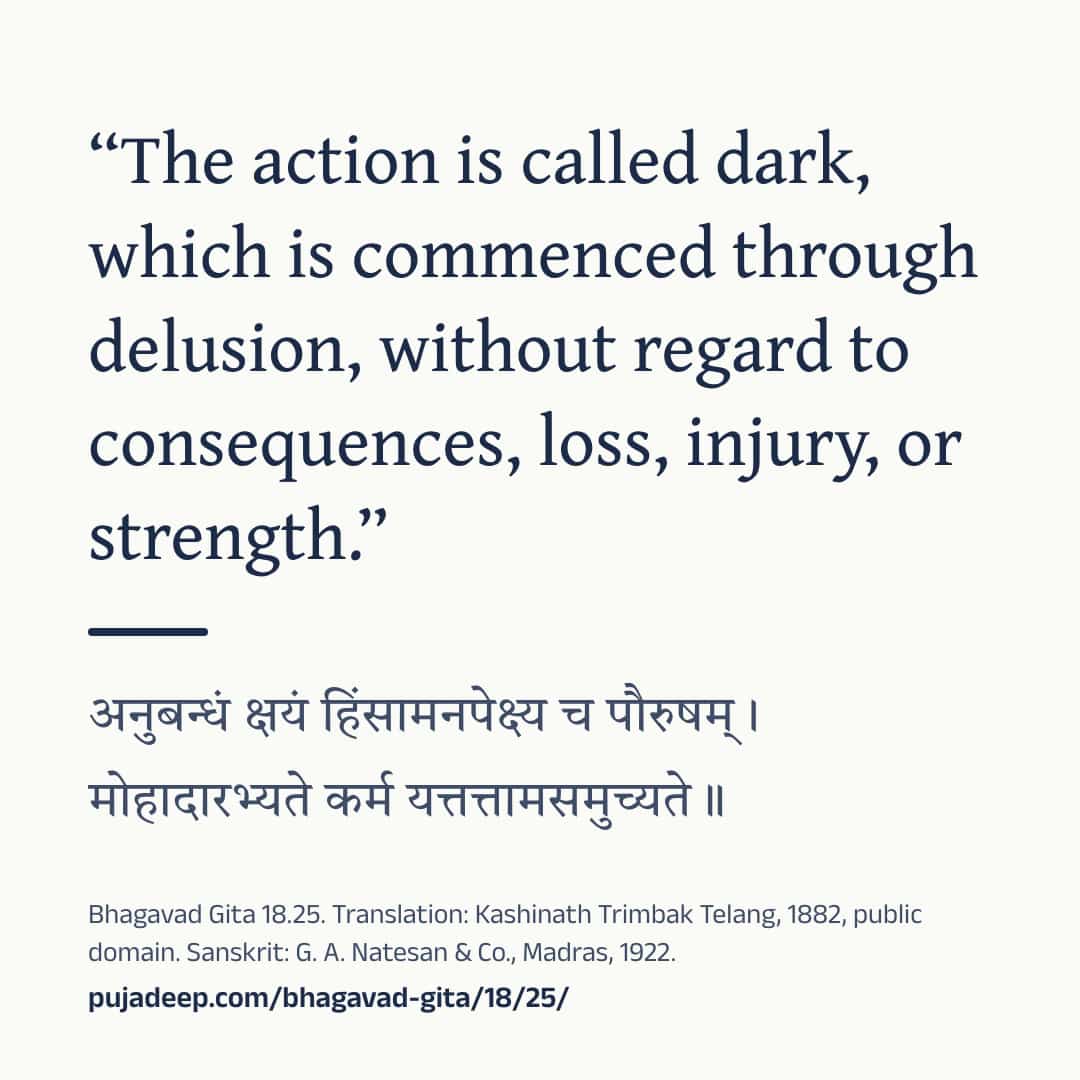
Drawing the picture
See the words
Bhagavad Gita 18.25

अनुबन्धं क्षयं हिंसामनपेक्ष्य च पौरुषम् ।
मोहादारभ्यते कर्म यत्तत्तामसमुच्यते ॥

“The action is called dark, which is commenced through delusion, without regard to consequences, loss, injury, or strength.”
(K. T. Telang, The Bhagavadgîtâ (The Sacred Books of the East, vol. VIII, Oxford: Clarendon Press, 1882), p. 124, public domain)

“The action undertaken from delusion, without regarding the consequences—loss and injury (to others)—and personal strength, that is declared to be tâmasic.”
(Annie Besant, The Bhagavad Gîtâ, or The Lord's Song (London: Theosophical Publishing Society, 1895), p. 157, public domain)

“That action is declared to be Támasic which is undertaken through delusion, without heed to the consequence, loss (of power and wealth), injury (to others) and (one's own) ability.”
(Swami Swarupananda, Srimad-Bhagavad-Gita (Mayavati: Prabuddha Bharata Press, 1909; first printed in Prabuddha Bharata, 1907–1909), p. 330, public domain)

Sanskrit: G. A. Natesan & Co., Madras, 1922.
https://pujadeep.com/bhagavad-gita/18/25/ Nothing is sent from this site. Your own app sends it, to the chat you choose. The picture quotes the translation you chose on this page, with its name and year.
Sanskrit text: The Bhagavad-Gita, or The Lord's Song, with the text in Devanagari and an English translation, 1922. Meanings: written for Pujadeep and checked against the cited edition. Source and changes
Questions families ask
Who speaks Bhagavad Gita 18.25?
Krishna speaks this verse, in chapter 18 (Moksha Sannyasa Yoga).
Where does the Sanskrit text come from?
Sanskrit text: The Bhagavad-Gita, or The Lord's Song, with the text in Devanagari and an English translation, 1922. Meanings: written for Pujadeep and checked against the cited edition. See the source
Is the meaning on this page a translation?
Explanation written for this site from the sources listed here, and checked against the cited edition. It is not a translation and not the only way to read the text. Free to quote with credit.
Source and licence
- Sanskrit text
- The Bhagavad-Gita, or The Lord's Song, with the text in Devanagari and an English translation (Annie Besant, G. A. Natesan & Co., Madras, 1922). Public domain. The Sanskrit on these pages was read from this printing’s page images.
- Translation
- The Bhagavadgîtâ with the Sanatsugâtîya and the Anugîtâ, translated by Kâshinâth Trimbak Telang (The Sacred Books of the East, vol. VIII, ed. F. Max Müller) (Kashinath Trimbak Telang, F. Max Müller, Clarendon Press, Oxford, 1882). Public domain. Shown verbatim, as printed.
- Translation
- The Bhagavad Gîtâ, or The Lord's Song, translated by Annie Besant (Annie Besant, Theosophical Publishing Society, London, 1895). Public domain. Shown verbatim, as printed.
- Translation
- Srimad-Bhagavad-Gita, with Sanskrit Text; Paraphrase with Word-by-word Literal Translation; English Rendering and Comments, Index, &c., by the Swami Swarupananda (Himalayan Series, No. XX) (Swami Swarupananda, The Editors and Publishers, Advaita Ashrama, Mayavati, Prabuddha Bharata Press, Mayavati, Almora, Himalayas, 1909). Public domain. Shown verbatim, as printed.
- Common wording
- In this text, 32 words follow today's common wording, checked against sanskritdocuments.org; Sanskrit Wikisource; Gita Press, Gorakhpur; GRETIL, Göttingen and Bhaktivedanta Book Trust.
- Our explanation
- Explanation written for this site from the sources listed here, and checked against the cited edition. It is not a translation and not the only way to read the text. Free to quote with credit.
- Checked
- Checked against the cited edition, October 15, 2026.
- Updated
- October 25, 2026