Bhagavad Gita 18.16: meaning and translation
Chapter 18: Moksha Sannyasa Yoga. Krishna says
This being so, Krishna says, whoever sees the self alone as the doer, because his understanding is untrained, does not see; his thinking is wrong.
Click or tap a word for its meaning and its dictionary page.
Text and layers
Text and layers
These choices stay in this browser.
Bhagavad Gita 18.16
तत्रैवं सति कर्तारमात्मानं केवलं तु यः ।पश्यत्यकृतबुद्धित्वान्न स पश्यति दुर्मतिः ॥
Tatraivam sati kartaramatmanam kevalam tu yahPashyatyakritabuddhitvanna sa pashyati durmatih
tatraivaṃ sati kartāramātmānaṃ kevalaṃ tu yaḥ |paśyatyakṛtabuddhitvānna sa paśyati durmatiḥ ||
Our explanation This being so, Krishna says, whoever sees the self alone as the doer, because his understanding is untrained, does not see; his thinking is wrong. The schools differ on whether the self acts at all (see the views).
हिंदी अर्थ कृष्ण कहते हैं कि ऐसा होने पर भी जो अप्रशिक्षित बुद्धि के कारण केवल आत्मा को कर्ता देखता है, वह दुर्मति है और ठीक नहीं देखता। आत्मा कर्ता है या नहीं, इस पर परंपराओं में मतभेद है।
Word by word
Every word, with its dictionary page
Word by word
- तत्र tatra · there, that being so (indeclinable) Dictionary: tatra, Monier-Williams 1899, p. 433, col. 2 “in that, therein, in that case”
- एवम् evam · thus (indeclinable) Dictionary: evam, Monier-Williams 1899, p. 232, col. 2 “thus, in this way, in such a manner, such”
- सति sati · being (present participle (neuter), locative singular) Dictionary: sat, Monier-Williams 1899, p. 1134, col. 2 “being, existing, occurring, happening, being present”
- कर्तारम् kartāram · as the doer (noun (masculine), accusative singular) Dictionary: kartṛ, Monier-Williams 1899, p. 257, col. 3 “one who makes or does or acts or effects, a doer, maker, agent, author”
- आत्मानम् ātmānam · the self (noun (masculine), accusative singular) Dictionary: ātman, Monier-Williams 1899, p. 135, col. 1 “the individual soul, self, abstract individual”
- केवलम् kevalam · alone (adjective (masculine), accusative singular) Dictionary: kevala, Monier-Williams 1899, p. 309, col. 3 “alone, only, mere, sole”
- तु tu · but (indeclinable) Dictionary: 2. tu, Monier-Williams 1899, p. 449, col. 3 “but”
- यः yaḥ · who (pronoun (masculine), nominative singular) Dictionary: yad, Monier-Williams 1899, p. 844, col. 2 “who, which, what, whichever, whatever, that”
- पश्यति paśyati · sees (present, 3rd person singular) Dictionary: 1. paś, Monier-Williams 1899, p. 611, col. 2 “to see”
- अकृतबुद्धित्वात् akṛtabuddhitvāt · from an untrained understanding (compound (neuter), ablative singular) Dictionary: a-kṛta-buddhi, Monier-Williams 1899, p. 2, col. 2 “having an unformed mind”; a-kṛta-buddhi-tva, Monier-Williams 1899, p. 2, col. 2 “ignorance”
- न na · not (indeclinable) Dictionary: 2. na, Monier-Williams 1899, p. 523, col. 1 “not, no, nor, neither”
- सः saḥ · he (pronoun (masculine), nominative singular) Dictionary: tad, Monier-Williams 1899, p. 434, col. 1 “m. he, f. she, n. it, that, this”
- पश्यति paśyati · sees (present, 3rd person singular) Dictionary: 1. paś, Monier-Williams 1899, p. 611, col. 2 “to see”
- दुर्मतिः durmatiḥ · of poor understanding (compound (masculine), nominative singular) Dictionary: dur-mati, Monier-Williams 1899, p. 486, col. 2 “weak-minded, silly, ignorant”
Old translations
Kashinath Trimbak Telang, 1882. Public domain. Page 123.
That being so, the undiscerning man, who being of an unrefined understanding, sees the agent in the immaculate self, sees not (rightly)1.
Footnotes (the translator’s own) - Cf. p. 106. ↩
Compare 3 translations
Kashinath Trimbak Telang, 1882. Public domain. Page 123.
That being so, the undiscerning man, who being of an unrefined understanding, sees the agent in the immaculate self, sees not (rightly)1.
Footnotes (the translator’s own) - Cf. p. 106. ↩
You are reading this one
Annie Besant, 1895. Public domain. Page 155.
That being so, he verily who looketh on his SELF, which is isolated, as the actor, owing to untrained discriminative faculty, he,1 of perverted intelligence, seeth not.
Footnotes (the translator’s own) - Buddhi. ↩
You are reading this one
Swami Swarupananda, 1909 (first printed 1907). Public domain. Page 326.
Such being the case, he who, through a non-purified understanding, looks upon his Self, the Absolute, as the agent,—he of perverted mind sees not.
You are reading this one
Cite this verse
The translation: K. T. Telang, The Bhagavadgîtâ (The Sacred Books of the East, vol. VIII, Oxford: Clarendon Press, 1882), p. 123. Bhagavad Gita 18.16.
The translation: Annie Besant, The Bhagavad Gîtâ, or The Lord's Song (London: Theosophical Publishing Society, 1895), p. 155. Bhagavad Gita 18.16.
The translation: Swami Swarupananda, Srimad-Bhagavad-Gita (Mayavati: Prabuddha Bharata Press, 1909; first printed in Prabuddha Bharata, 1907–1909), p. 326. Bhagavad Gita 18.16.
Our explanation: “Bhagavad Gita 18.16: meaning and translation.” Pujadeep. Updated October 25, 2026. https://pujadeep.com/bhagavad-gita/18/16/
Pujadeep’s explanations are free to quote with credit: name Pujadeep and link to the page. How to credit
Classical readings, by school
Each reading is named by its school. None is presented as the only meaning.
What Advaita, Vishishtadvaita and Dvaita teach, in short
Shankara Advaita
Shankara says the pure Self is never the doer; action is done by the five causes. A person whose understanding has not been trained by the Vedānta, a teacher and reasoning takes the pure Self to be the doer, like someone who thinks the moon moves when the clouds move.
Source: The Bhagavad-Gita, with the commentary of Sri Sankaracharya, translated by A. Mahadeva Sastri (2nd ed., Mysore: G. T. A. Printing Works, 1901), commentary on 18.16, pp. 411–412. Summarised in our own words; none of its text is reproduced.
Ramanuja Vishishtadvaita
Ramanuja says the soul is truly a doer, but only with the sanction of the Supreme Self within it. The one who sees wrongly is the one who thinks his own self acts entirely on its own.
Source: Sri Bhagavad-Gita with Sri Ramanujacharya's Visishtadvaita commentary, translated by A. Govindacharya (Madras, 1898), commentary on 18.16, p. 534. Summarised in our own words; none of its text is reproduced.
Share
Show the ways to share
Send one picture or the text to one chat. The picture names its source and the address of this page.
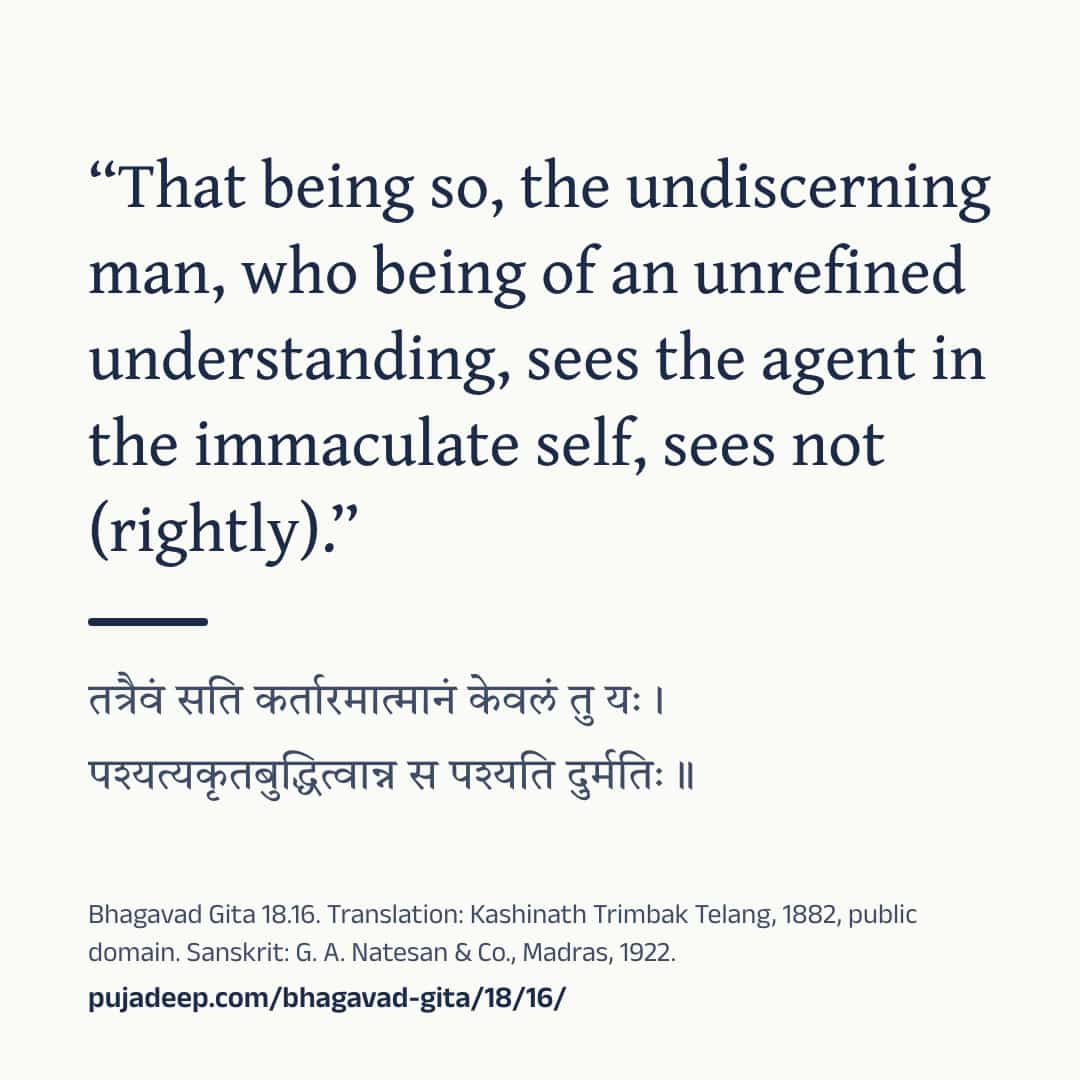
Drawing the picture
See the words
Bhagavad Gita 18.16

तत्रैवं सति कर्तारमात्मानं केवलं तु यः ।
पश्यत्यकृतबुद्धित्वान्न स पश्यति दुर्मतिः ॥

“That being so, the undiscerning man, who being of an unrefined understanding, sees the agent in the immaculate self, sees not (rightly).”
(K. T. Telang, The Bhagavadgîtâ (The Sacred Books of the East, vol. VIII, Oxford: Clarendon Press, 1882), p. 123, public domain)

“That being so, he verily who looketh on his SELF, which is isolated, as the actor, owing to untrained discriminative faculty, he, of perverted intelligence, seeth not.”
(Annie Besant, The Bhagavad Gîtâ, or The Lord's Song (London: Theosophical Publishing Society, 1895), p. 155, public domain)

“Such being the case, he who, through a non-purified understanding, looks upon his Self, the Absolute, as the agent,—he of perverted mind sees not.”
(Swami Swarupananda, Srimad-Bhagavad-Gita (Mayavati: Prabuddha Bharata Press, 1909; first printed in Prabuddha Bharata, 1907–1909), p. 326, public domain)

Sanskrit: G. A. Natesan & Co., Madras, 1922.
https://pujadeep.com/bhagavad-gita/18/16/ Nothing is sent from this site. Your own app sends it, to the chat you choose. The picture quotes the translation you chose on this page, with its name and year.
Sanskrit text: The Bhagavad-Gita, or The Lord's Song, with the text in Devanagari and an English translation, 1922. Meanings: written for Pujadeep and checked against the cited edition. Source and changes
Questions families ask
Who speaks Bhagavad Gita 18.16?
Krishna speaks this verse, in chapter 18 (Moksha Sannyasa Yoga).
Where does the Sanskrit text come from?
Sanskrit text: The Bhagavad-Gita, or The Lord's Song, with the text in Devanagari and an English translation, 1922. Meanings: written for Pujadeep and checked against the cited edition. See the source
Is the meaning on this page a translation?
Explanation written for this site from the sources listed here, and checked against the cited edition. It is not a translation and not the only way to read the text. Free to quote with credit.
Source and licence
- Sanskrit text
- The Bhagavad-Gita, or The Lord's Song, with the text in Devanagari and an English translation (Annie Besant, G. A. Natesan & Co., Madras, 1922). Public domain. The Sanskrit on these pages was read from this printing’s page images.
- Translation
- The Bhagavadgîtâ with the Sanatsugâtîya and the Anugîtâ, translated by Kâshinâth Trimbak Telang (The Sacred Books of the East, vol. VIII, ed. F. Max Müller) (Kashinath Trimbak Telang, F. Max Müller, Clarendon Press, Oxford, 1882). Public domain. Shown verbatim, as printed.
- Translation
- The Bhagavad Gîtâ, or The Lord's Song, translated by Annie Besant (Annie Besant, Theosophical Publishing Society, London, 1895). Public domain. Shown verbatim, as printed.
- Translation
- Srimad-Bhagavad-Gita, with Sanskrit Text; Paraphrase with Word-by-word Literal Translation; English Rendering and Comments, Index, &c., by the Swami Swarupananda (Himalayan Series, No. XX) (Swami Swarupananda, The Editors and Publishers, Advaita Ashrama, Mayavati, Prabuddha Bharata Press, Mayavati, Almora, Himalayas, 1909). Public domain. Shown verbatim, as printed.
- Commentary
- The Bhagavad-Gita, with the commentary of Sri Sankaracharya, translated by A. Mahadeva Sastri (2nd ed., Mysore: G. T. A. Printing Works, 1901) (Public-domain scan, University of California Libraries). Summarised in our own words; none of its text is reproduced.
- Commentary
- Sri Bhagavad-Gita with Sri Ramanujacharya's Visishtadvaita commentary, translated by A. Govindacharya (Madras, 1898) (Scan uploaded to archive.org (folkscanomy collection)). Summarised in our own words; none of its text is reproduced.
- Common wording
- In this text, 32 words follow today's common wording, checked against sanskritdocuments.org; Sanskrit Wikisource; Gita Press, Gorakhpur; GRETIL, Göttingen and Bhaktivedanta Book Trust.
- Our explanation
- Explanation written for this site from the sources listed here, and checked against the cited edition. It is not a translation and not the only way to read the text. Free to quote with credit.
- Checked
- Checked against the cited edition, October 15, 2026.
- Updated
- October 25, 2026