Bhagavad Gita 18.6: meaning and translation
Chapter 18: Moksha Sannyasa Yoga. Krishna says
Even these acts, Krishna says, should be done without attachment and without wanting their fruit.
Click or tap a word for its meaning and its dictionary page.
Text and layers
Text and layers
These choices stay in this browser.
Bhagavad Gita 18.6
एतान्यपि तु कर्माणि सङ्गं त्यक्त्वा फलानि च ।कर्तव्यानीति मे पार्थ निश्चितं मतमुत्तमम् ॥
Etanyapi tu karmani sangam tyaktva phalani chaKartavyaniti me partha nishchitam matamuttamam
etānyapi tu karmāṇi saṅgaṃ tyaktvā phalāni ca |kartavyānīti me pārtha niścitaṃ matamuttamam ||
Our explanation Even these acts, Krishna says, should be done without attachment and without wanting their fruit. He calls this his firm and highest view.
हिंदी अर्थ कृष्ण कहते हैं कि ये कर्म भी आसक्ति और फल की इच्छा छोड़कर करने चाहिए। वे इसे अपना निश्चित और उत्तम मत बताते हैं।
Word by word
Every word, with its dictionary page
Word by word
- एतानि etāni · these (pronoun (neuter), nominative plural) Dictionary: etad, Monier-Williams 1899, p. 231, col. 2 “this, this here, here”
- अपि api · even (indeclinable) Dictionary: api, Monier-Williams 1899, p. 55, col. 1 “in the sense of even, also, very”
- तु tu · but (indeclinable) Dictionary: 2. tu, Monier-Williams 1899, p. 449, col. 3 “but”
- कर्माणि karmāṇi · actions (noun (neuter), nominative plural) Dictionary: karman, Monier-Williams 1899, p. 258, col. 2 “act, action, performance, business”
- सङ्गम् saṅgam · attachment (noun (masculine), accusative singular) Dictionary: saṅga, Monier-Williams 1899, p. 1132, col. 3 “(esp.) worldly or selfish attachment or affection, desire, wish, cupidity”
- त्यक्त्वा tyaktvā · having given up (absolutive (having done)) Dictionary: 1. tyaj, Monier-Williams 1899, p. 456, col. 3 “to leave, abandon, quit”
- फलानि phalāni · the fruits (noun (neuter), accusative plural) Dictionary: phala, Monier-Williams 1899, p. 716, col. 2 “fruit (met.), consequence, effect, result, retribution (good or bad)”
- च ca · and (indeclinable) Dictionary: 2. ca, Monier-Williams 1899, p. 380, col. 1 “and, both, also, moreover, as well as”
- कर्तव्यानि kartavyāni · should be done (gerundive (to be done) (neuter), nominative plural) Dictionary: kartavya, Monier-Williams 1899, p. 257, col. 3 “to be done or made or accomplished”
- इति iti · thus (indeclinable) Dictionary: 2. iti, Monier-Williams 1899, p. 165, col. 1 “in this manner, thus”
- मे me · "my" (Krishna's) (pronoun, genitive singular) Dictionary: 1. mad, Monier-Williams 1899, p. 777, col. 2 “base of the first pers. pron. in the sg. number (esp. in comp.)”
- पार्थ pārtha · O son of Pritha (noun (masculine), vocative singular) Dictionary: 2. pārtha, Monier-Williams 1899, p. 621, col. 3 “metron. of Yudhi-shṭhira or Bhīma-sena or Arjuna”
- निश्चितम् niścitam · settled, firm (past participle (neuter), nominative singular) Dictionary: niś-cita, Monier-Williams 1899, p. 561, col. 2 “ascertained, determined, settled, decided”
- मतम् matam · view (noun (neuter), nominative singular) Dictionary: mata, Monier-Williams 1899, p. 783, col. 1 “a thought, idea, opinion, sentiment, view, belief, doctrine”
- उत्तमम् uttamam · best, highest (adjective (neuter), nominative singular) Dictionary: ut-tama, Monier-Williams 1899, p. 177, col. 3 “uppermost, highest, chief; most elevated, principal; best, excellent”
Old translations
Kashinath Trimbak Telang, 1882. Public domain. Page 122.
But even these actions, O son of Prithâ! should be performed, abandoning attachment and fruit; such is my excellent and decided opinion.
Compare 3 translations
Kashinath Trimbak Telang, 1882. Public domain. Page 122.
But even these actions, O son of Prithâ! should be performed, abandoning attachment and fruit; such is my excellent and decided opinion.
You are reading this one
Annie Besant, 1895. Public domain. Page 153.
But even these actions should be done leaving aside attachment and fruit, O Pârtha; that is my certain and best belief.
You are reading this one
Swami Swarupananda, 1909 (first printed 1907). Public domain. Page 321.
But even these works, O Pártha, should be performed, leaving attachment and the fruits;—such is My best and certain conviction.
You are reading this one
Cite this verse
The translation: K. T. Telang, The Bhagavadgîtâ (The Sacred Books of the East, vol. VIII, Oxford: Clarendon Press, 1882), p. 122. Bhagavad Gita 18.6.
The translation: Annie Besant, The Bhagavad Gîtâ, or The Lord's Song (London: Theosophical Publishing Society, 1895), p. 153. Bhagavad Gita 18.6.
The translation: Swami Swarupananda, Srimad-Bhagavad-Gita (Mayavati: Prabuddha Bharata Press, 1909; first printed in Prabuddha Bharata, 1907–1909), p. 321. Bhagavad Gita 18.6.
Our explanation: “Bhagavad Gita 18.6: meaning and translation.” Pujadeep. Updated October 25, 2026. https://pujadeep.com/bhagavad-gita/18/6/
Pujadeep’s explanations are free to quote with credit: name Pujadeep and link to the page. How to credit
Classical readings, by school
No readings by school on this verse yet.
Share
Show the ways to share
Send one picture or the text to one chat. The picture names its source and the address of this page.
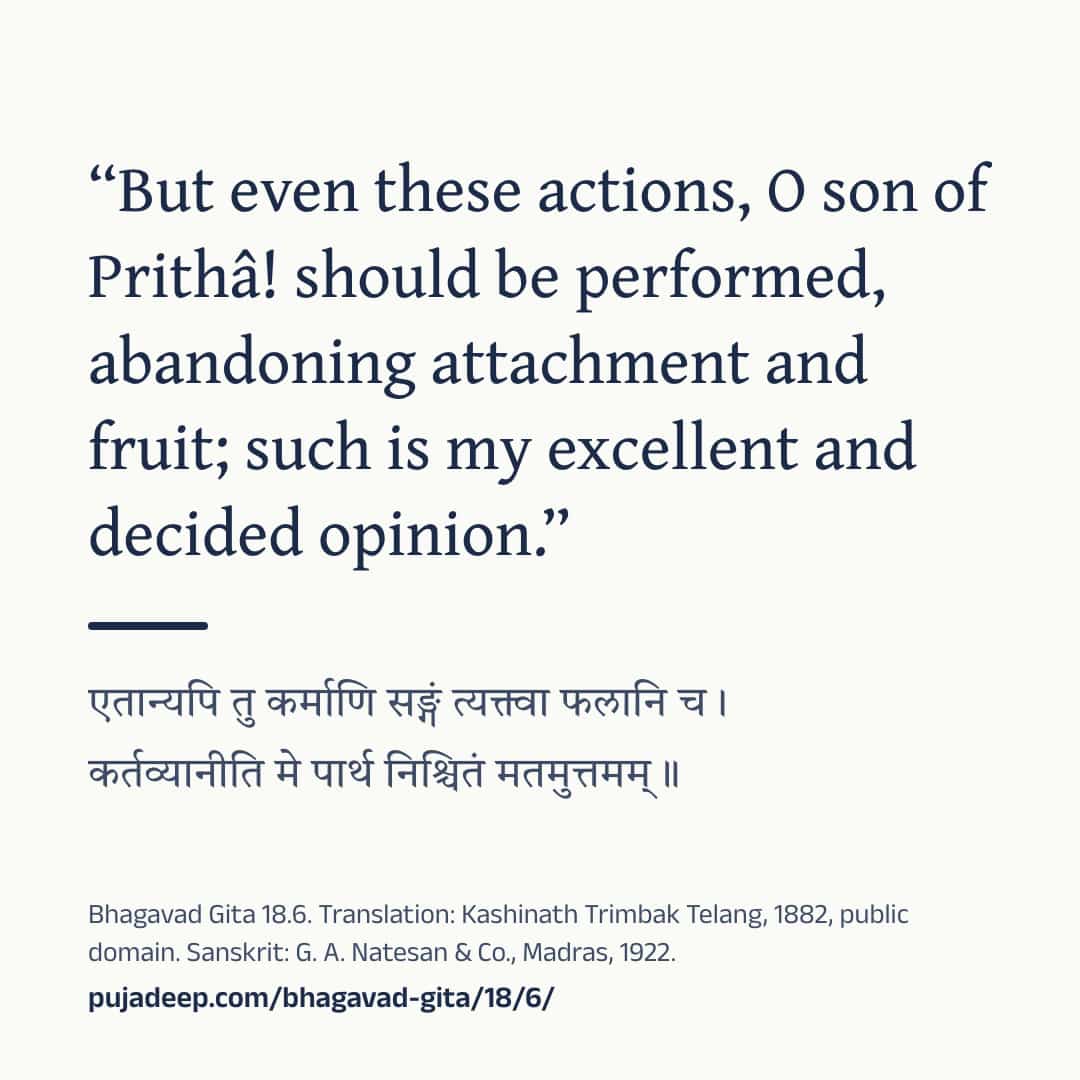
Drawing the picture
See the words
Bhagavad Gita 18.6

एतान्यपि तु कर्माणि सङ्गं त्यक्त्वा फलानि च ।
कर्तव्यानीति मे पार्थ निश्चितं मतमुत्तमम् ॥

“But even these actions, O son of Prithâ! should be performed, abandoning attachment and fruit; such is my excellent and decided opinion.”
(K. T. Telang, The Bhagavadgîtâ (The Sacred Books of the East, vol. VIII, Oxford: Clarendon Press, 1882), p. 122, public domain)

“But even these actions should be done leaving aside attachment and fruit, O Pârtha; that is my certain and best belief.”
(Annie Besant, The Bhagavad Gîtâ, or The Lord's Song (London: Theosophical Publishing Society, 1895), p. 153, public domain)

“But even these works, O Pártha, should be performed, leaving attachment and the fruits;—such is My best and certain conviction.”
(Swami Swarupananda, Srimad-Bhagavad-Gita (Mayavati: Prabuddha Bharata Press, 1909; first printed in Prabuddha Bharata, 1907–1909), p. 321, public domain)

Sanskrit: G. A. Natesan & Co., Madras, 1922.
https://pujadeep.com/bhagavad-gita/18/6/ Nothing is sent from this site. Your own app sends it, to the chat you choose. The picture quotes the translation you chose on this page, with its name and year.
Sanskrit text: The Bhagavad-Gita, or The Lord's Song, with the text in Devanagari and an English translation, 1922. Meanings: written for Pujadeep and checked against the cited edition. Source and changes
Questions families ask
Who speaks Bhagavad Gita 18.6?
Krishna speaks this verse, in chapter 18 (Moksha Sannyasa Yoga).
Where does the Sanskrit text come from?
Sanskrit text: The Bhagavad-Gita, or The Lord's Song, with the text in Devanagari and an English translation, 1922. Meanings: written for Pujadeep and checked against the cited edition. See the source
Is the meaning on this page a translation?
Explanation written for this site from the sources listed here, and checked against the cited edition. It is not a translation and not the only way to read the text. Free to quote with credit.
Source and licence
- Sanskrit text
- The Bhagavad-Gita, or The Lord's Song, with the text in Devanagari and an English translation (Annie Besant, G. A. Natesan & Co., Madras, 1922). Public domain. The Sanskrit on these pages was read from this printing’s page images.
- Translation
- The Bhagavadgîtâ with the Sanatsugâtîya and the Anugîtâ, translated by Kâshinâth Trimbak Telang (The Sacred Books of the East, vol. VIII, ed. F. Max Müller) (Kashinath Trimbak Telang, F. Max Müller, Clarendon Press, Oxford, 1882). Public domain. Shown verbatim, as printed.
- Translation
- The Bhagavad Gîtâ, or The Lord's Song, translated by Annie Besant (Annie Besant, Theosophical Publishing Society, London, 1895). Public domain. Shown verbatim, as printed.
- Translation
- Srimad-Bhagavad-Gita, with Sanskrit Text; Paraphrase with Word-by-word Literal Translation; English Rendering and Comments, Index, &c., by the Swami Swarupananda (Himalayan Series, No. XX) (Swami Swarupananda, The Editors and Publishers, Advaita Ashrama, Mayavati, Prabuddha Bharata Press, Mayavati, Almora, Himalayas, 1909). Public domain. Shown verbatim, as printed.
- Common wording
- In this text, 32 words follow today's common wording, checked against sanskritdocuments.org; Sanskrit Wikisource; Gita Press, Gorakhpur; GRETIL, Göttingen and Bhaktivedanta Book Trust.
- Our explanation
- Explanation written for this site from the sources listed here, and checked against the cited edition. It is not a translation and not the only way to read the text. Free to quote with credit.
- Checked
- Checked against the cited edition, October 15, 2026.
- Updated
- October 25, 2026