Bhagavad Gita 18.4: meaning and translation
Chapter 18: Moksha Sannyasa Yoga. Krishna says
Krishna tells Arjuna, best of the Bharatas, to hear his own conclusion on tyāga.
Click or tap a word for its meaning and its dictionary page.
Text and layers
Text and layers
These choices stay in this browser.
Bhagavad Gita 18.4
निश्चयं शृणु मे तत्र त्यागे भरतसत्तम ।त्यागो हि पुरुषव्याघ्र त्रिविधः सम्प्रकीर्तितः ॥
Nishchayam shrinu me tatra tyage bharatasattamaTyago hi purushavyaghra trividhah samprakirtitah
niścayaṃ śṛṇu me tatra tyāge bharatasattama |tyāgo hi puruṣavyāghra trividhaḥ samprakīrtitaḥ ||
Our explanation Krishna tells Arjuna, best of the Bharatas, to hear his own conclusion on tyāga. Tyāga, he says, is declared to be of three kinds.
हिंदी अर्थ कृष्ण अर्जुन (भरतश्रेष्ठ) से कहते हैं कि त्याग के विषय में उनका निश्चय सुनें। वे कहते हैं कि त्याग तीन प्रकार का बताया गया है।
Word by word
Every word, with its dictionary page
Word by word
- निश्चयम् niścayam · the settled view (noun (masculine), accusative singular) Dictionary: niś-caya, Monier-Williams 1899, p. 561, col. 2 “inquiry, ascertainment, fixed opinion, conviction, certainty”
- शृणु śṛṇu · hear (imperative, 2nd person singular) Dictionary: 1. śru, Monier-Williams 1899, p. 1100, col. 3 “to hear, listen or attend to anything”
- मे me · "my" (Krishna's) (pronoun, genitive singular) Dictionary: 1. mad, Monier-Williams 1899, p. 777, col. 2 “base of the first pers. pron. in the sg. number (esp. in comp.)”
- तत्र tatra · about that (indeclinable) Dictionary: tatra, Monier-Williams 1899, p. 433, col. 2 “in that, therein, in that case”
- त्यागे tyāge · on giving up (noun (masculine), locative singular) Dictionary: tyāga, Monier-Williams 1899, p. 456, col. 3 “leaving, abandoning, forsaking”
- भरतसत्तम bharatasattama · O best of the Bharatas (compound (masculine), vocative singular) Dictionary: bharata, Monier-Williams 1899, p. 747, col. 2 “a celebrated hero and monarch of India”; sat-tama, Monier-Williams 1899, p. 1134, col. 3 “very good or right, the best, first, chief of (gen. or comp.)”
- त्यागः tyāgaḥ · giving up (noun (masculine), nominative singular) Dictionary: tyāga, Monier-Williams 1899, p. 456, col. 3 “leaving, abandoning, forsaking”
- हि hi · for (indeclinable) Dictionary: 2. hi, Monier-Williams 1899, p. 1297, col. 3 “for, because, on account of”
- पुरुषव्याघ्र puruṣavyāghra · O tiger among men (compound (masculine), vocative singular) Dictionary: puruṣa, Monier-Williams 1899, p. 637, col. 1 “a man, male, human being (pl. people, mankind)”; vyāghra, Monier-Williams 1899, p. 1036, col. 2 “any pre-eminently strong or noble person, ‘a tiger among men’”
- त्रिविधः trividhaḥ · of three kinds (adjective (masculine), nominative singular) Dictionary: tri-vidha, Monier-Williams 1899, p. 460, col. 2 “of 3 kinds, triple, threefold”
- सम्प्रकीर्तितः samprakīrtitaḥ · is declared (past participle (masculine), nominative singular) Dictionary: sam-pra-kīrtita, Monier-Williams 1899, p. 1173, col. 3 “designated, called”
Old translations
Kashinath Trimbak Telang, 1882. Public domain. Page 122.
As to that abandonment, O best of the descendants of Bharata! listen to my decision; for abandonment, O bravest of men! is described (to be) threefold.
Compare 3 translations
Kashinath Trimbak Telang, 1882. Public domain. Page 122.
As to that abandonment, O best of the descendants of Bharata! listen to my decision; for abandonment, O bravest of men! is described (to be) threefold.
You are reading this one
Annie Besant, 1895. Public domain. Page 153.
Hear my conclusions as to that abandonment, O best of the Bhâratas; since Abandonment, O tiger of men, has been explained as threefold.
You are reading this one
Swami Swarupananda, 1909 (first printed 1907). Public domain. Page 321.
Hear from Me the final truth about relinquishment, O best of the Bharatas. For relinquishment has been declared to be of three kinds, O tiger of men.
You are reading this one
Cite this verse
The translation: K. T. Telang, The Bhagavadgîtâ (The Sacred Books of the East, vol. VIII, Oxford: Clarendon Press, 1882), p. 122. Bhagavad Gita 18.4.
The translation: Annie Besant, The Bhagavad Gîtâ, or The Lord's Song (London: Theosophical Publishing Society, 1895), p. 153. Bhagavad Gita 18.4.
The translation: Swami Swarupananda, Srimad-Bhagavad-Gita (Mayavati: Prabuddha Bharata Press, 1909; first printed in Prabuddha Bharata, 1907–1909), p. 321. Bhagavad Gita 18.4.
Our explanation: “Bhagavad Gita 18.4: meaning and translation.” Pujadeep. Updated October 25, 2026. https://pujadeep.com/bhagavad-gita/18/4/
Pujadeep’s explanations are free to quote with credit: name Pujadeep and link to the page. How to credit
Classical readings, by school
No readings by school on this verse yet.
Share
Show the ways to share
Send one picture or the text to one chat. The picture names its source and the address of this page.
Drawing the picture
See the words
Bhagavad Gita 18.4

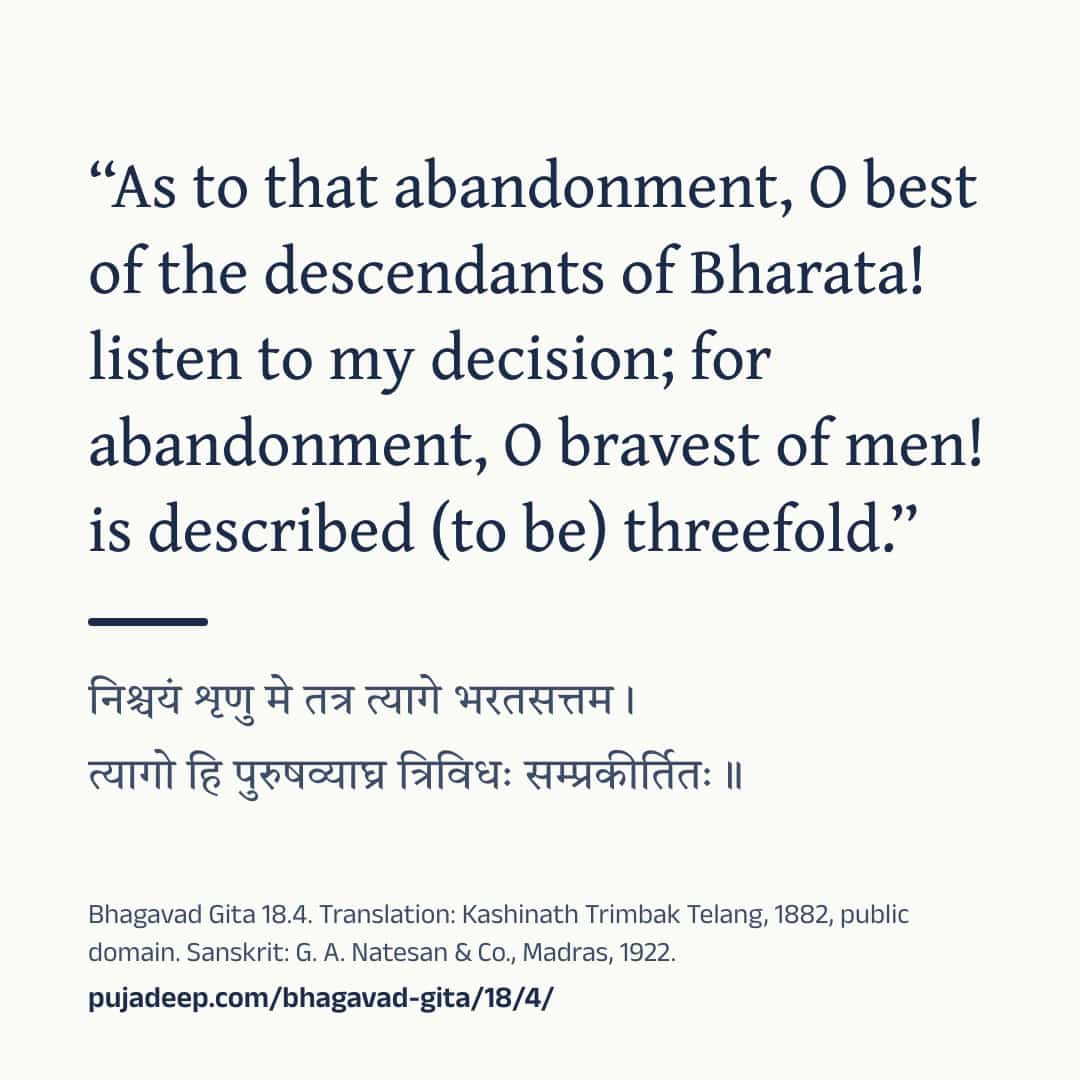
निश्चयं शृणु मे तत्र त्यागे भरतसत्तम ।
त्यागो हि पुरुषव्याघ्र त्रिविधः सम्प्रकीर्तितः ॥

“As to that abandonment, O best of the descendants of Bharata! listen to my decision; for abandonment, O bravest of men! is described (to be) threefold.”
(K. T. Telang, The Bhagavadgîtâ (The Sacred Books of the East, vol. VIII, Oxford: Clarendon Press, 1882), p. 122, public domain)

“Hear my conclusions as to that abandonment, O best of the Bhâratas; since Abandonment, O tiger of men, has been explained as threefold.”
(Annie Besant, The Bhagavad Gîtâ, or The Lord's Song (London: Theosophical Publishing Society, 1895), p. 153, public domain)

“Hear from Me the final truth about relinquishment, O best of the Bharatas. For relinquishment has been declared to be of three kinds, O tiger of men.”
(Swami Swarupananda, Srimad-Bhagavad-Gita (Mayavati: Prabuddha Bharata Press, 1909; first printed in Prabuddha Bharata, 1907–1909), p. 321, public domain)

Sanskrit: G. A. Natesan & Co., Madras, 1922.
https://pujadeep.com/bhagavad-gita/18/4/ Nothing is sent from this site. Your own app sends it, to the chat you choose. The picture quotes the translation you chose on this page, with its name and year.
Sanskrit text: The Bhagavad-Gita, or The Lord's Song, with the text in Devanagari and an English translation, 1922. Meanings: written for Pujadeep and checked against the cited edition. Source and changes
Questions families ask
Who speaks Bhagavad Gita 18.4?
Krishna speaks this verse, in chapter 18 (Moksha Sannyasa Yoga).
Where does the Sanskrit text come from?
Sanskrit text: The Bhagavad-Gita, or The Lord's Song, with the text in Devanagari and an English translation, 1922. Meanings: written for Pujadeep and checked against the cited edition. See the source
Is the meaning on this page a translation?
Explanation written for this site from the sources listed here, and checked against the cited edition. It is not a translation and not the only way to read the text. Free to quote with credit.
Source and licence
- Sanskrit text
- The Bhagavad-Gita, or The Lord's Song, with the text in Devanagari and an English translation (Annie Besant, G. A. Natesan & Co., Madras, 1922). Public domain. The Sanskrit on these pages was read from this printing’s page images.
- Translation
- The Bhagavadgîtâ with the Sanatsugâtîya and the Anugîtâ, translated by Kâshinâth Trimbak Telang (The Sacred Books of the East, vol. VIII, ed. F. Max Müller) (Kashinath Trimbak Telang, F. Max Müller, Clarendon Press, Oxford, 1882). Public domain. Shown verbatim, as printed.
- Translation
- The Bhagavad Gîtâ, or The Lord's Song, translated by Annie Besant (Annie Besant, Theosophical Publishing Society, London, 1895). Public domain. Shown verbatim, as printed.
- Translation
- Srimad-Bhagavad-Gita, with Sanskrit Text; Paraphrase with Word-by-word Literal Translation; English Rendering and Comments, Index, &c., by the Swami Swarupananda (Himalayan Series, No. XX) (Swami Swarupananda, The Editors and Publishers, Advaita Ashrama, Mayavati, Prabuddha Bharata Press, Mayavati, Almora, Himalayas, 1909). Public domain. Shown verbatim, as printed.
- Common wording
- In this text, 32 words follow today's common wording, checked against sanskritdocuments.org; Sanskrit Wikisource; Gita Press, Gorakhpur; GRETIL, Göttingen and Bhaktivedanta Book Trust.
- Our explanation
- Explanation written for this site from the sources listed here, and checked against the cited edition. It is not a translation and not the only way to read the text. Free to quote with credit.
- Checked
- Checked against the cited edition, October 15, 2026.
- Updated
- October 25, 2026