Bhagavad Gita 18.10: meaning and translation
Chapter 18: Moksha Sannyasa Yoga. Krishna says
Krishna describes the one who gives up in this way.
Click or tap a word for its meaning and its dictionary page.
Text and layers
Text and layers
These choices stay in this browser.
Bhagavad Gita 18.10
न द्वेष्ट्यकुशलं कर्म कुशले नानुषज्जते ।त्यागी सत्त्वसमाविष्टो मेधावी छिन्नसंशयः ॥
Na dveshtyakushalam karma kushale nanushajjateTyagi sattvasamavishto medhavi chhinnasanshayah
na dveṣṭyakuśalaṃ karma kuśale nānuṣajjate |tyāgī sattvasamāviṣṭo medhāvī chinnasaṃśayaḥ ||
Our explanation Krishna describes the one who gives up in this way. Filled with sattva, wise and free of doubt, such a person does not dislike unpleasant work and is not attached to pleasant work.
हिंदी अर्थ कृष्ण ऐसे त्यागी का वर्णन करते हैं। सत्त्व से भरा, मेधावी और संशय से मुक्त ऐसा व्यक्ति अप्रिय कर्म से द्वेष नहीं करता और प्रिय कर्म में आसक्त नहीं होता।
Word by word
Every word, with its dictionary page
Word by word
- न na · not (indeclinable) Dictionary: 2. na, Monier-Williams 1899, p. 523, col. 1 “not, no, nor, neither”
- द्वेष्टि dveṣṭi · hates (present, 3rd person singular) Dictionary: 2. dviṣ, Monier-Williams 1899, p. 506, col. 3 “to hate, show hatred against”
- अकुशलम् akuśalam · unpleasant, not good (adjective (neuter), accusative singular) Dictionary: a-kuśala, Monier-Williams 1899, p. 2, col. 2 “inauspicious, evil”
- कर्म karma · action (noun (neuter), accusative singular) Dictionary: karman, Monier-Williams 1899, p. 258, col. 2 “act, action, performance, business”
- कुशले kuśale · to the pleasant, good (adjective (neuter), locative singular) Dictionary: kuśala, Monier-Williams 1899, p. 297, col. 2 “right, proper, suitable, good”
- न na · not (indeclinable) Dictionary: 2. na, Monier-Williams 1899, p. 523, col. 1 “not, no, nor, neither”
- अनुषज्जते anuṣajjate · is attached (present, 3rd person singular) Dictionary: anu-ṣañj, Monier-Williams 1899, p. 39, col. 3 “to cling to, adhere, be attached to”
- त्यागी tyāgī · the one who gives up (noun (masculine), nominative singular) Dictionary: tyāgin, Monier-Williams 1899, p. 456, col. 3 “giving up, resigning (ifc.)”
- सत्त्वसमाविष्टः sattvasamāviṣṭaḥ · filled with sattva (compound (masculine), nominative singular) Dictionary: sat-tva, Monier-Williams 1899, p. 1135, col. 2 “the quality of purity or goodness”; sam-ā-viṣṭa, Monier-Williams 1899, p. 1162, col. 3 “entered together or at once, seized, occupied, possessed by or filled with (instr. or comp.)”
- मेधावी medhāvī · wise (adjective (masculine), nominative singular) Dictionary: medhā-vin, Monier-Williams 1899, p. 833, col. 1; medhā-vat, Monier-Williams 1899, p. 833, col. 1 “possessing wisdom, intelligent, wise”
- छिन्नसंशयः chinnasaṃśayaḥ · whose doubts are cut away (compound (masculine), nominative singular) Dictionary: chinna-saṃśaya, Monier-Williams 1899, p. 406, col. 3 “one whose doubts are dispelled, confident”
2 printings differ
Edition differences. Another printing or text reads this place differently.
- The printed edition reads: न द्वेष्ट्यकुशलं कर्म कुशलं नानुषज्जते ।
त्यागी सत्त्वसमाविष्टो मेधावी छिन्नसंशयः ॥ The print shows कुशलं (an anusvara and no e-sign over श, leaf n250). Read as a printing flaw and corrected to कुशले: the verb anuṣajjate ('is attached to') takes the locative, the line contrasts akuśalaṃ karma with kuśale, and both proofreading references read कुशले. Same kind of flaw as 12.18 and 14.26 (GOAL.md, 12 Oct 2026). Review 2 re-read leaf n250 enlarged: the print is plainly कुशलं. It is kept as a flaw, not logged as a variant, because the accusative would leave anuṣajjate without the locative it takes and would break the contrast with akuśalaṃ karma; neither e-text nor any edition used here reads it. - Spelling The 1922 Madras printing reads: न द्वेष्ट्यकुशलं कर्म कुशलं नानुषज्जते The 1922 base printing (leaf n250) reads कुशलं, a printing flaw corrected to कुशले; see normalisations.
Old translations
Kashinath Trimbak Telang, 1882. Public domain. Page 122.
He who is possessed of abandonment1, being full of goodness, and talented, and having his doubts destroyed, is not averse from unpleasant actions, is not attached to pleasant2 (ones).
Footnotes (the translator’s own) Compare 3 translations
Kashinath Trimbak Telang, 1882. Public domain. Page 122.
He who is possessed of abandonment1, being full of goodness, and talented, and having his doubts destroyed, is not averse from unpleasant actions, is not attached to pleasant2 (ones).
Footnotes (the translator’s own) You are reading this one
Annie Besant, 1895. Public domain. Page 154.
The abandoner pervaded by Sattva, intelligent and with doubts cut away, hateth not unpleasurable action nor is attached to pleasurable.
You are reading this one
Swami Swarupananda, 1909 (first printed 1907). Public domain. Page 323.
The relinquisher endued with Satva and a steady understanding and with his doubts dispelled, hates not a disagreeable work nor is attached to an agreeable one.
You are reading this one
Cite this verse
The translation: K. T. Telang, The Bhagavadgîtâ (The Sacred Books of the East, vol. VIII, Oxford: Clarendon Press, 1882), p. 122. Bhagavad Gita 18.10.
The translation: Annie Besant, The Bhagavad Gîtâ, or The Lord's Song (London: Theosophical Publishing Society, 1895), p. 154. Bhagavad Gita 18.10.
The translation: Swami Swarupananda, Srimad-Bhagavad-Gita (Mayavati: Prabuddha Bharata Press, 1909; first printed in Prabuddha Bharata, 1907–1909), p. 323. Bhagavad Gita 18.10.
Our explanation: “Bhagavad Gita 18.10: meaning and translation.” Pujadeep. Updated October 25, 2026. https://pujadeep.com/bhagavad-gita/18/10/
Pujadeep’s explanations are free to quote with credit: name Pujadeep and link to the page. How to credit
Classical readings, by school
No readings by school on this verse yet.
Share
Show the ways to share
Send one picture or the text to one chat. The picture names its source and the address of this page.
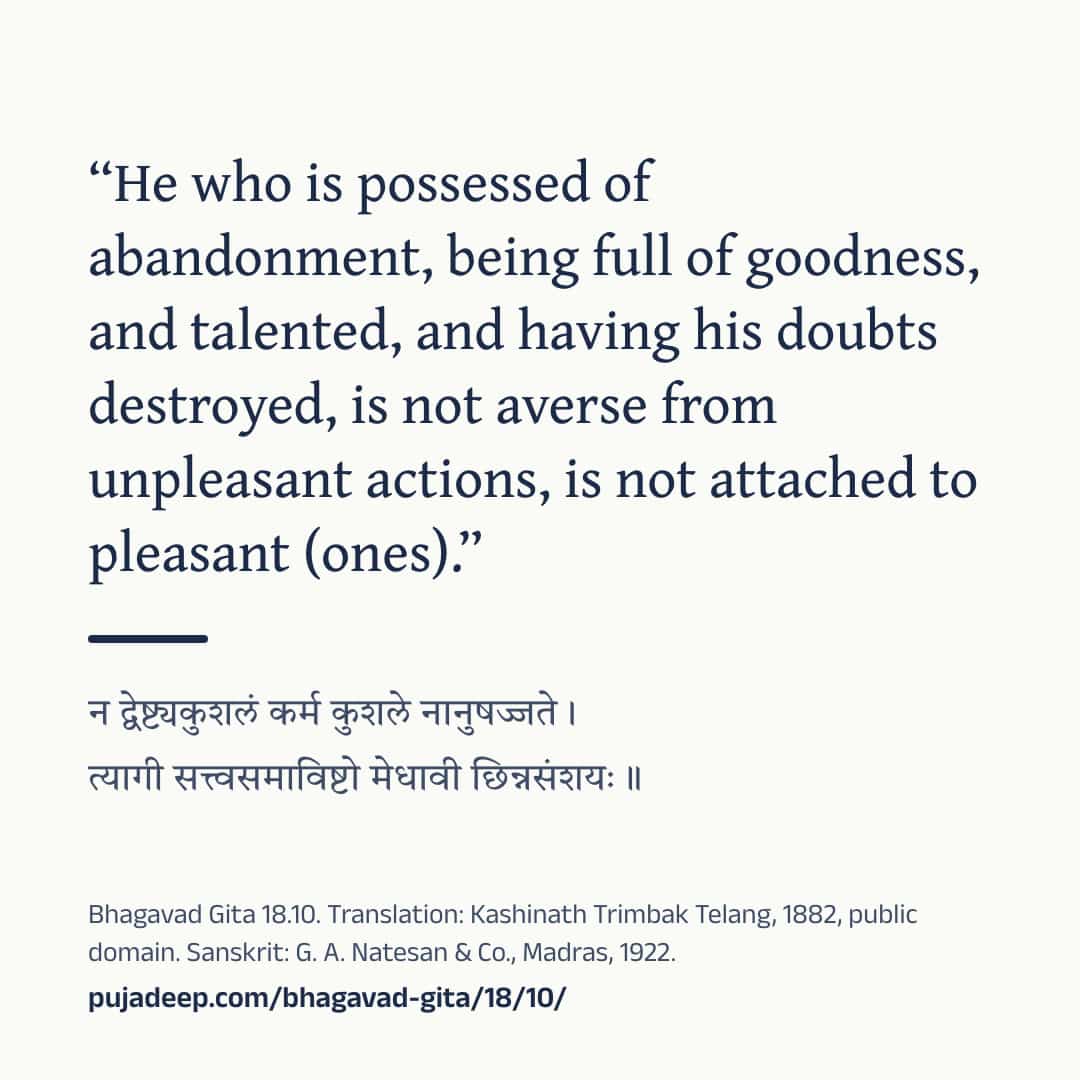
Drawing the picture
See the words
Bhagavad Gita 18.10

न द्वेष्ट्यकुशलं कर्म कुशले नानुषज्जते ।
त्यागी सत्त्वसमाविष्टो मेधावी छिन्नसंशयः ॥

“He who is possessed of abandonment, being full of goodness, and talented, and having his doubts destroyed, is not averse from unpleasant actions, is not attached to pleasant (ones).”
(K. T. Telang, The Bhagavadgîtâ (The Sacred Books of the East, vol. VIII, Oxford: Clarendon Press, 1882), p. 122, public domain)

“The abandoner pervaded by Sattva, intelligent and with doubts cut away, hateth not unpleasurable action nor is attached to pleasurable.”
(Annie Besant, The Bhagavad Gîtâ, or The Lord's Song (London: Theosophical Publishing Society, 1895), p. 154, public domain)

“The relinquisher endued with Satva and a steady understanding and with his doubts dispelled, hates not a disagreeable work nor is attached to an agreeable one.”
(Swami Swarupananda, Srimad-Bhagavad-Gita (Mayavati: Prabuddha Bharata Press, 1909; first printed in Prabuddha Bharata, 1907–1909), p. 323, public domain)

Sanskrit: G. A. Natesan & Co., Madras, 1922.
https://pujadeep.com/bhagavad-gita/18/10/ Nothing is sent from this site. Your own app sends it, to the chat you choose. The picture quotes the translation you chose on this page, with its name and year.
Sanskrit text: The Bhagavad-Gita, or The Lord's Song, with the text in Devanagari and an English translation, 1922. Meanings: written for Pujadeep and checked against the cited edition. Source and changes
Questions families ask
Who speaks Bhagavad Gita 18.10?
Krishna speaks this verse, in chapter 18 (Moksha Sannyasa Yoga).
Where does the Sanskrit text come from?
Sanskrit text: The Bhagavad-Gita, or The Lord's Song, with the text in Devanagari and an English translation, 1922. Meanings: written for Pujadeep and checked against the cited edition. See the source
Is the meaning on this page a translation?
Explanation written for this site from the sources listed here, and checked against the cited edition. It is not a translation and not the only way to read the text. Free to quote with credit.
Source and licence
- Sanskrit text
- The Bhagavad-Gita, or The Lord's Song, with the text in Devanagari and an English translation (Annie Besant, G. A. Natesan & Co., Madras, 1922). Public domain. The Sanskrit on these pages was read from this printing’s page images.
- Translation
- The Bhagavadgîtâ with the Sanatsugâtîya and the Anugîtâ, translated by Kâshinâth Trimbak Telang (The Sacred Books of the East, vol. VIII, ed. F. Max Müller) (Kashinath Trimbak Telang, F. Max Müller, Clarendon Press, Oxford, 1882). Public domain. Shown verbatim, as printed.
- Translation
- The Bhagavad Gîtâ, or The Lord's Song, translated by Annie Besant (Annie Besant, Theosophical Publishing Society, London, 1895). Public domain. Shown verbatim, as printed.
- Translation
- Srimad-Bhagavad-Gita, with Sanskrit Text; Paraphrase with Word-by-word Literal Translation; English Rendering and Comments, Index, &c., by the Swami Swarupananda (Himalayan Series, No. XX) (Swami Swarupananda, The Editors and Publishers, Advaita Ashrama, Mayavati, Prabuddha Bharata Press, Mayavati, Almora, Himalayas, 1909). Public domain. Shown verbatim, as printed.
- Common wording
- In this text, 32 words follow today's common wording, checked against sanskritdocuments.org; Sanskrit Wikisource; Gita Press, Gorakhpur; GRETIL, Göttingen and Bhaktivedanta Book Trust.
- Our explanation
- Explanation written for this site from the sources listed here, and checked against the cited edition. It is not a translation and not the only way to read the text. Free to quote with credit.
- Checked
- Checked against the cited edition, October 15, 2026.
- Updated
- October 25, 2026