Bhagavad Gita 18.17: meaning and translation
Chapter 18: Moksha Sannyasa Yoga. Krishna says
Krishna says that one who has no sense of "I am the doer", and whose understanding is not stained, does not kill even if he kills these people, and is not bound.
Click or tap a word for its meaning and its dictionary page.
Text and layers
Text and layers
These choices stay in this browser.
Bhagavad Gita 18.17
यस्य नाहंकृतो भावो बुद्धिर्यस्य न लिप्यते ।हत्वाऽपि स इमाँल्लोकान्न हन्ति न निबध्यते ॥
Yasya nahankrito bhavo buddhiryasya na lipyateHatvapi sa imanllokanna hanti na nibadhyate
yasya nāhaṃkṛto bhāvo buddhiryasya na lipyate |hatvā’pi sa imām̐llokānna hanti na nibadhyate ||
Our explanation Krishna says that one who has no sense of "I am the doer", and whose understanding is not stained, does not kill even if he kills these people, and is not bound. The verse speaks to Arjuna on the eve of battle; it is the Gita's teaching on agency, as Krishna gives it.
हिंदी अर्थ कृष्ण कहते हैं कि जिसमें “मैं कर्ता हूँ” का भाव नहीं है और जिसकी बुद्धि लिप्त नहीं होती, वह इन लोगों को मारकर भी नहीं मारता और न बँधता है। यह श्लोक युद्ध से ठीक पहले अर्जुन से कहा गया है; यह कर्तापन पर गीता की शिक्षा है, जैसी कृष्ण देते हैं।
Word by word
Every word, with its dictionary page
Word by word
- यस्य yasya · whose (pronoun (masculine), genitive singular) Dictionary: yad, Monier-Williams 1899, p. 844, col. 2 “who, which, what, whichever, whatever, that”
- न na · not (indeclinable) Dictionary: 2. na, Monier-Williams 1899, p. 523, col. 1 “not, no, nor, neither”
- अहंकृतः ahaṃkṛtaḥ · made by the ego, egoistic (past participle (masculine), nominative singular) Dictionary: ahaṃ-kṛta, Monier-Williams 1899, p. 124, col. 2 “egotistic”
- भावः bhāvaḥ · state of mind (noun (masculine), nominative singular) Dictionary: bhāva, Monier-Williams 1899, p. 754, col. 2 “any state of mind or body, way of thinking or feeling, sentiment”
- बुद्धिः buddhiḥ · understanding (noun (feminine), nominative singular) Dictionary: buddhi, Monier-Williams 1899, p. 733, col. 3 “intelligence, reason, intellect, mind, discernment, judgment”
- यस्य yasya · whose (pronoun (masculine), genitive singular) Dictionary: yad, Monier-Williams 1899, p. 844, col. 2 “who, which, what, whichever, whatever, that”
- न na · not (indeclinable) Dictionary: 2. na, Monier-Williams 1899, p. 523, col. 1 “not, no, nor, neither”
- लिप्यते lipyate · is stained (present passive, 3rd person singular) Dictionary: lip, Monier-Williams 1899, p. 902, col. 2 “to smear, besmear, anoint with (instr.), stain, soil, taint, pollute, defile”
- हत्वा hatvā · having killed (absolutive (having done)) Dictionary: 1. han, Monier-Williams 1899, p. 1287, col. 2 “to smite, slay, hit, kill, mar, destroy”
- अपि api · even (indeclinable) Dictionary: api, Monier-Williams 1899, p. 55, col. 1 “in the sense of even, also, very”
- सः saḥ · he (pronoun (masculine), nominative singular) Dictionary: tad, Monier-Williams 1899, p. 434, col. 1 “m. he, f. she, n. it, that, this”
- इमान् imān · these (pronoun (masculine), accusative plural) Dictionary: 1. idam, Monier-Williams 1899, p. 165, col. 2 “this, this here, referring to something near the speaker”
- लोकान् lokān · people, worlds (noun (masculine), accusative plural) Dictionary: loka, Monier-Williams 1899, p. 906, col. 2 “the inhabitants of the world, mankind, folk, people”
- न na · not (indeclinable) Dictionary: 2. na, Monier-Williams 1899, p. 523, col. 1 “not, no, nor, neither”
- हन्ति hanti · kills (present, 3rd person singular) Dictionary: 1. han, Monier-Williams 1899, p. 1287, col. 2 “to smite, slay, hit, kill, mar, destroy”
- न na · not (indeclinable) Dictionary: 2. na, Monier-Williams 1899, p. 523, col. 1 “not, no, nor, neither”
- निबध्यते nibadhyate · is bound (present passive, 3rd person singular) Dictionary: ni-bandh, Monier-Williams 1899, p. 550, col. 1 “to enchain, fetter (lit. and fig.)”
1 printing differs
Edition differences. Another printing or text reads this place differently.
- Spelling A digital text reads Same word. The e-text writes the class nasal (नाहङ्कृतो); the 1922 edition writes anusvara (नाहंकृतो). The edition also marks the merged vowel of हत्वाऽपि with an avagraha; the e-text writes हत्वापि.
Old translations
Kashinath Trimbak Telang, 1882. Public domain. Page 123.
He who has no feeling of egoism1, and whose mind is not tainted, even though he kills (all) these people, kills not, is not fettered2 (by the action).
Footnotes (the translator’s own) Compare 3 translations
Kashinath Trimbak Telang, 1882. Public domain. Page 123.
He who has no feeling of egoism1, and whose mind is not tainted, even though he kills (all) these people, kills not, is not fettered2 (by the action).
Footnotes (the translator’s own) You are reading this one
Annie Besant, 1895. Public domain. Page 155.
He who is free from the egoistic notion, whose discriminative faculty is pure, though he slay these peoples, he slayeth not, nor is bound.
You are reading this one
Swami Swarupananda, 1909 (first printed 1907). Public domain. Page 326.
He who is free from the notion of egoism, whose intelligence is not affected (by good or evil), though he kill these peoples, he kills not, nor is bound (by the action).
You are reading this one
Cite this verse
The translation: K. T. Telang, The Bhagavadgîtâ (The Sacred Books of the East, vol. VIII, Oxford: Clarendon Press, 1882), p. 123. Bhagavad Gita 18.17.
The translation: Annie Besant, The Bhagavad Gîtâ, or The Lord's Song (London: Theosophical Publishing Society, 1895), p. 155. Bhagavad Gita 18.17.
The translation: Swami Swarupananda, Srimad-Bhagavad-Gita (Mayavati: Prabuddha Bharata Press, 1909; first printed in Prabuddha Bharata, 1907–1909), p. 326. Bhagavad Gita 18.17.
Our explanation: “Bhagavad Gita 18.17: meaning and translation.” Pujadeep. Updated October 25, 2026. https://pujadeep.com/bhagavad-gita/18/17/
Pujadeep’s explanations are free to quote with credit: name Pujadeep and link to the page. How to credit
Classical readings, by school
No readings by school on this verse yet.
Share
Show the ways to share
Send one picture or the text to one chat. The picture names its source and the address of this page.
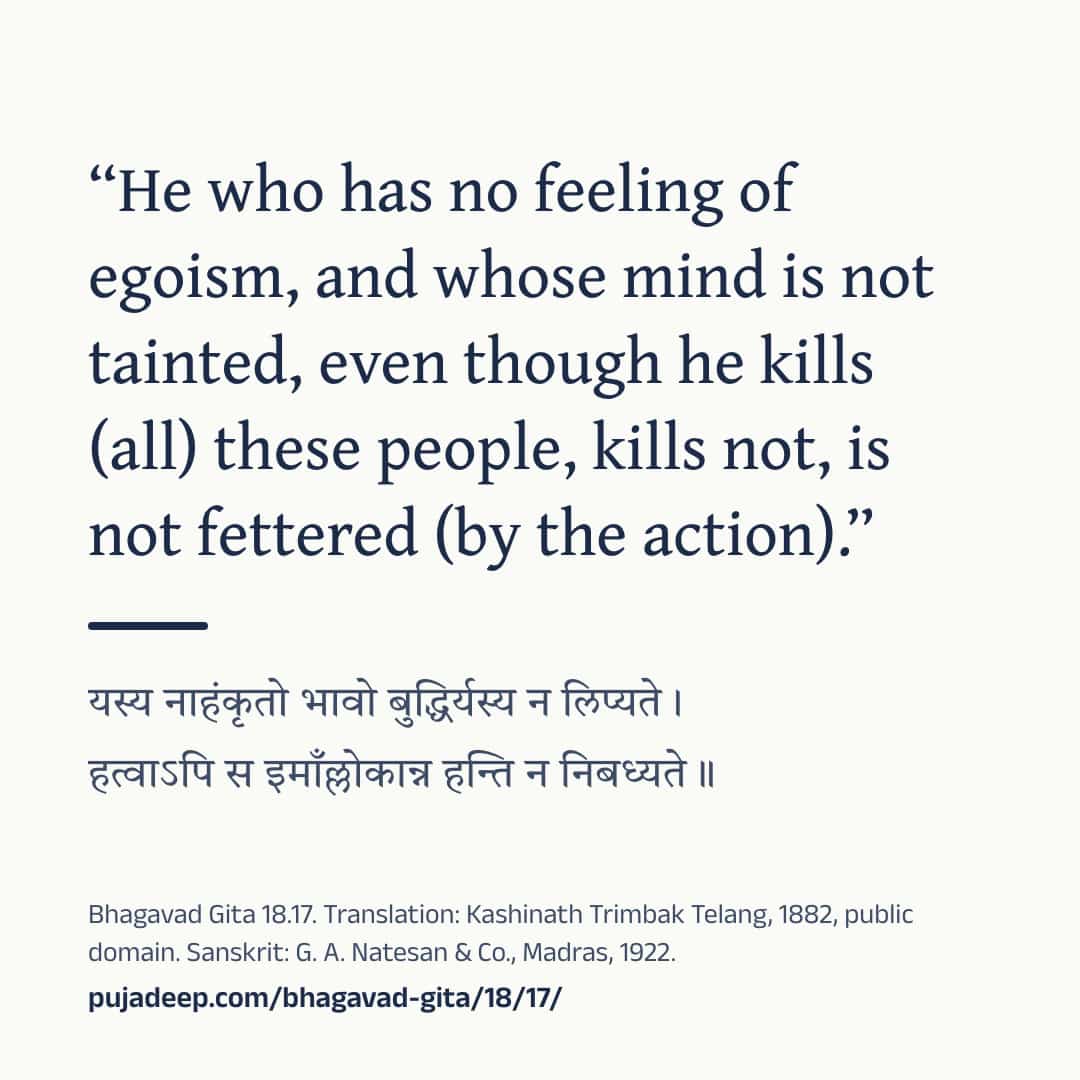
Drawing the picture
See the words
Bhagavad Gita 18.17

यस्य नाहंकृतो भावो बुद्धिर्यस्य न लिप्यते ।
हत्वाऽपि स इमाँल्लोकान्न हन्ति न निबध्यते ॥

“He who has no feeling of egoism, and whose mind is not tainted, even though he kills (all) these people, kills not, is not fettered (by the action).”
(K. T. Telang, The Bhagavadgîtâ (The Sacred Books of the East, vol. VIII, Oxford: Clarendon Press, 1882), p. 123, public domain)

“He who is free from the egoistic notion, whose discriminative faculty is pure, though he slay these peoples, he slayeth not, nor is bound.”
(Annie Besant, The Bhagavad Gîtâ, or The Lord's Song (London: Theosophical Publishing Society, 1895), p. 155, public domain)

“He who is free from the notion of egoism, whose intelligence is not affected (by good or evil), though he kill these peoples, he kills not, nor is bound (by the action).”
(Swami Swarupananda, Srimad-Bhagavad-Gita (Mayavati: Prabuddha Bharata Press, 1909; first printed in Prabuddha Bharata, 1907–1909), p. 326, public domain)

Sanskrit: G. A. Natesan & Co., Madras, 1922.
https://pujadeep.com/bhagavad-gita/18/17/ Nothing is sent from this site. Your own app sends it, to the chat you choose. The picture quotes the translation you chose on this page, with its name and year.
Sanskrit text: The Bhagavad-Gita, or The Lord's Song, with the text in Devanagari and an English translation, 1922. Meanings: written for Pujadeep and checked against the cited edition. Source and changes
Questions families ask
Who speaks Bhagavad Gita 18.17?
Krishna speaks this verse, in chapter 18 (Moksha Sannyasa Yoga).
Where does the Sanskrit text come from?
Sanskrit text: The Bhagavad-Gita, or The Lord's Song, with the text in Devanagari and an English translation, 1922. Meanings: written for Pujadeep and checked against the cited edition. See the source
Is the meaning on this page a translation?
Explanation written for this site from the sources listed here, and checked against the cited edition. It is not a translation and not the only way to read the text. Free to quote with credit.
Source and licence
- Sanskrit text
- The Bhagavad-Gita, or The Lord's Song, with the text in Devanagari and an English translation (Annie Besant, G. A. Natesan & Co., Madras, 1922). Public domain. The Sanskrit on these pages was read from this printing’s page images.
- Translation
- The Bhagavadgîtâ with the Sanatsugâtîya and the Anugîtâ, translated by Kâshinâth Trimbak Telang (The Sacred Books of the East, vol. VIII, ed. F. Max Müller) (Kashinath Trimbak Telang, F. Max Müller, Clarendon Press, Oxford, 1882). Public domain. Shown verbatim, as printed.
- Translation
- The Bhagavad Gîtâ, or The Lord's Song, translated by Annie Besant (Annie Besant, Theosophical Publishing Society, London, 1895). Public domain. Shown verbatim, as printed.
- Translation
- Srimad-Bhagavad-Gita, with Sanskrit Text; Paraphrase with Word-by-word Literal Translation; English Rendering and Comments, Index, &c., by the Swami Swarupananda (Himalayan Series, No. XX) (Swami Swarupananda, The Editors and Publishers, Advaita Ashrama, Mayavati, Prabuddha Bharata Press, Mayavati, Almora, Himalayas, 1909). Public domain. Shown verbatim, as printed.
- Common wording
- In this text, 32 words follow today's common wording, checked against sanskritdocuments.org; Sanskrit Wikisource; Gita Press, Gorakhpur; GRETIL, Göttingen and Bhaktivedanta Book Trust.
- Our explanation
- Explanation written for this site from the sources listed here, and checked against the cited edition. It is not a translation and not the only way to read the text. Free to quote with credit.
- Checked
- Checked against the cited edition, October 15, 2026.
- Updated
- October 25, 2026