Bhagavad Gita 18.26: meaning and translation
Chapter 18: Moksha Sannyasa Yoga. Krishna says
Krishna says a doer is called sāttvika, of the nature of sattva, when he has let go of attachment, does not talk proudly about himself, has firmness and zeal, and is not shaken by success or failure.
Click or tap a word for its meaning and its dictionary page.
Text and layers
Text and layers
These choices stay in this browser.
Bhagavad Gita 18.26
मुक्तसङ्गोऽनहंवादी धृत्युत्साहसमन्वितः ।सिद्ध्यसिद्ध्योर्निर्विकारः कर्त्ता सात्त्विक उच्यते ॥
Muktasangonahanvadi dhrityutsahasamanvitahSiddhyasiddhyornirvikarah kartta sattvika uchyate
muktasaṅgo’nahaṃvādī dhṛtyutsāhasamanvitaḥ |siddhyasiddhyornirvikāraḥ karttā sāttvika ucyate ||
Our explanation Krishna says a doer is called sāttvika, of the nature of sattva, when he has let go of attachment, does not talk proudly about himself, has firmness and zeal, and is not shaken by success or failure.
हिंदी अर्थ कृष्ण कहते हैं कि जो कर्ता आसक्ति से मुक्त है, अहंकार की बातें नहीं करता, धैर्य और उत्साह से युक्त है, और सफलता-असफलता में एक-सा रहता है, वह सात्त्विक कर्ता कहलाता है।
Word by word
Every word, with its dictionary page
Word by word
- मुक्तसङ्गः muktasaṅgaḥ · free from attachment (compound (masculine), nominative singular) Dictionary: mukta, Monier-Williams 1899, p. 820, col. 3 “liberated, delivered, emancipated (esp. from sin or worldly existence)”; saṅga, Monier-Williams 1899, p. 1132, col. 3 “(esp.) worldly or selfish attachment or affection, desire, wish, cupidity”
- अनहंवादी anahaṃvādī · not speaking of "I" (compound (masculine), nominative singular) Dictionary: 3. a, Monier-Williams 1899, p. 1, col. 1 “having a negative or privative or contrary sense”; aham, Monier-Williams 1899, p. 124, col. 2 “nom. sg. ‘I,’”; vādin, Monier-Williams 1899, p. 940, col. 1 “saying, discoursing, speaking, talking, speaking or talking about”
- धृत्युत्साहसमन्वितः dhṛtyutsāhasamanvitaḥ · with steadiness and zeal (compound (masculine), nominative singular) Dictionary: dhṛti, Monier-Williams 1899, p. 519, col. 3 “firmness, constancy, resolution, will, command”; ut-sāha, Monier-Williams 1899, p. 182, col. 1 “strength of will, resolution; effort, perseverance”; sam-anvita, Monier-Williams 1899, p. 1155, col. 2 “connected or associated with, completely possessed of, fully endowed with”
- सिद्ध्यसिद्ध्योः siddhyasiddhyoḥ · in success and failure (compound (feminine), locative dual) Dictionary: 2. siddhi, Monier-Williams 1899, p. 1216, col. 2 “accomplishment, performance, fulfilment, complete attainment (of any object), success”; a-siddhi, Monier-Williams 1899, p. 120, col. 3 “imperfect accomplishment, failure”
- निर्विकारः nirvikāraḥ · unchanged (compound (masculine), nominative singular) Dictionary: nir-vikāra, Monier-Williams 1899, p. 542, col. 1 “unchanged, unchangeable, uniform, normal”
- कर्त्ता karttā · doer (noun (masculine), nominative singular) Dictionary: kartṛ, Monier-Williams 1899, p. 257, col. 3 “one who makes or does or acts or effects, a doer, maker, agent, author”
- सात्त्विकः sāttvikaḥ · of sattva (adjective (masculine), nominative singular) Dictionary: sāttvika, Monier-Williams 1899, p. 1200, col. 1 “relating to or endowed with the quality Sattva (i.e. ‘purity’ or ‘goodness’)”
- उच्यते ucyate · is called (present passive, 3rd person singular) Dictionary: vac, Monier-Williams 1899, p. 912, col. 1 “to be called or accounted, be regarded as, pass for”
1 printing differs
Edition differences. Another printing or text reads this place differently.
- Spelling A digital text reads Same word. The 1922 edition prints कर्त्ता with a doubled t here (leaf n255), as some printings of the period do; elsewhere in the chapter it prints कर्ता. Another digital text also reads kartā.
Old translations
Kashinath Trimbak Telang, 1882. Public domain. Page 124.
That agent is called good, who has cast off attachment, who is free from egotistic talk, who is possessed of courage and energy, and unaffected by success or ill-success.
Compare 3 translations
Kashinath Trimbak Telang, 1882. Public domain. Page 124.
That agent is called good, who has cast off attachment, who is free from egotistic talk, who is possessed of courage and energy, and unaffected by success or ill-success.
You are reading this one
Annie Besant, 1895. Public domain. Page 157.
Liberated from attachment and not being an egoist, endued with firmness and vigour, unturned by success or failure, that actor is called sâttvic.
You are reading this one
Swami Swarupananda, 1909 (first printed 1907). Public domain. Page 330.
An agent who is free from attachment, non-egotistic, endued with fortitude and enthusiasm, and unaffected in success or failure, is called Sâtvic.
You are reading this one
Cite this verse
The translation: K. T. Telang, The Bhagavadgîtâ (The Sacred Books of the East, vol. VIII, Oxford: Clarendon Press, 1882), p. 124. Bhagavad Gita 18.26.
The translation: Annie Besant, The Bhagavad Gîtâ, or The Lord's Song (London: Theosophical Publishing Society, 1895), p. 157. Bhagavad Gita 18.26.
The translation: Swami Swarupananda, Srimad-Bhagavad-Gita (Mayavati: Prabuddha Bharata Press, 1909; first printed in Prabuddha Bharata, 1907–1909), p. 330. Bhagavad Gita 18.26.
Our explanation: “Bhagavad Gita 18.26: meaning and translation.” Pujadeep. Updated October 25, 2026. https://pujadeep.com/bhagavad-gita/18/26/
Pujadeep’s explanations are free to quote with credit: name Pujadeep and link to the page. How to credit
Classical readings, by school
No readings by school on this verse yet.
Share
Show the ways to share
Send one picture or the text to one chat. The picture names its source and the address of this page.
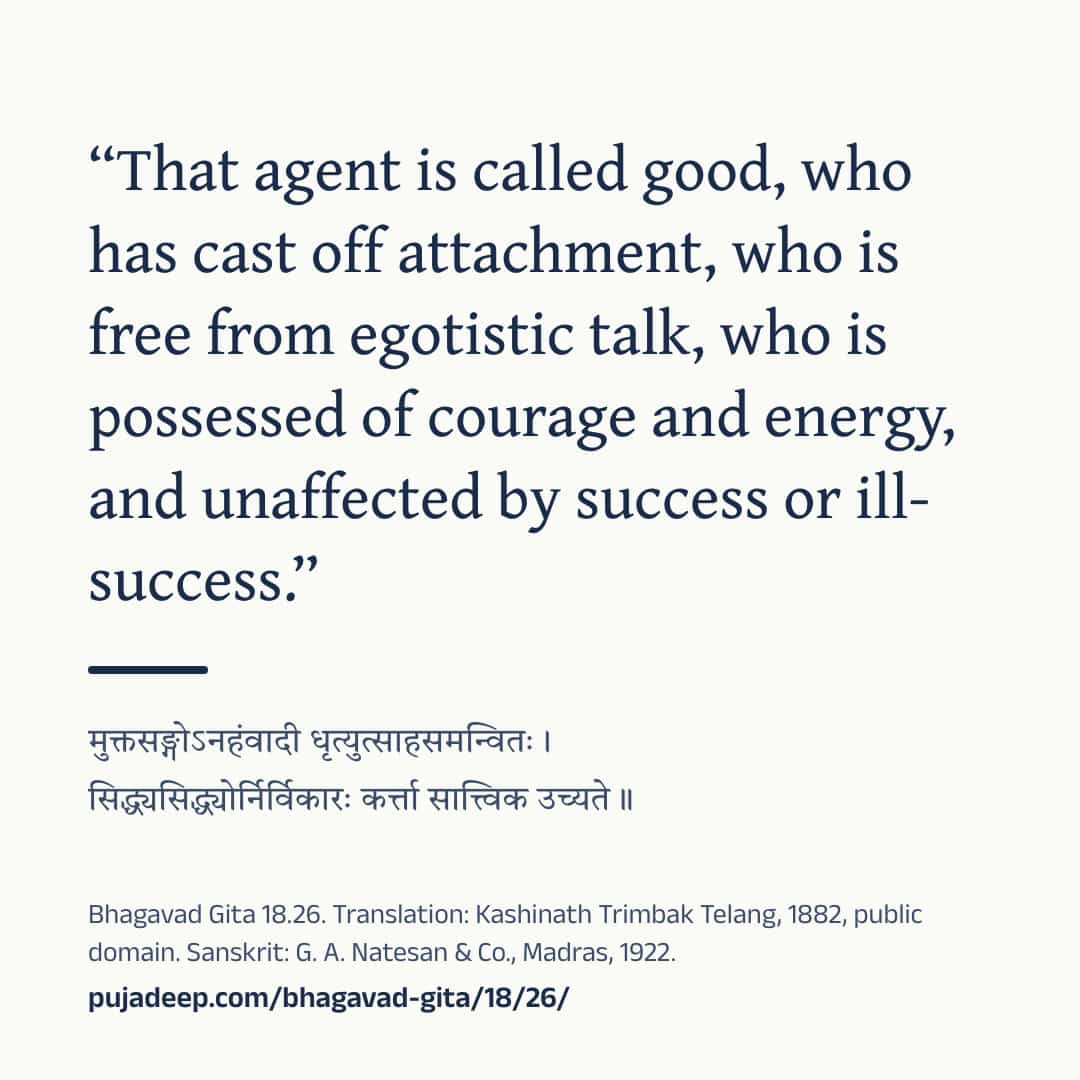
Drawing the picture
See the words
Bhagavad Gita 18.26

मुक्तसङ्गोऽनहंवादी धृत्युत्साहसमन्वितः ।
सिद्ध्यसिद्ध्योर्निर्विकारः कर्त्ता सात्त्विक उच्यते ॥

“That agent is called good, who has cast off attachment, who is free from egotistic talk, who is possessed of courage and energy, and unaffected by success or ill-success.”
(K. T. Telang, The Bhagavadgîtâ (The Sacred Books of the East, vol. VIII, Oxford: Clarendon Press, 1882), p. 124, public domain)

“Liberated from attachment and not being an egoist, endued with firmness and vigour, unturned by success or failure, that actor is called sâttvic.”
(Annie Besant, The Bhagavad Gîtâ, or The Lord's Song (London: Theosophical Publishing Society, 1895), p. 157, public domain)

“An agent who is free from attachment, non-egotistic, endued with fortitude and enthusiasm, and unaffected in success or failure, is called Sâtvic.”
(Swami Swarupananda, Srimad-Bhagavad-Gita (Mayavati: Prabuddha Bharata Press, 1909; first printed in Prabuddha Bharata, 1907–1909), p. 330, public domain)

Sanskrit: G. A. Natesan & Co., Madras, 1922.
https://pujadeep.com/bhagavad-gita/18/26/ Nothing is sent from this site. Your own app sends it, to the chat you choose. The picture quotes the translation you chose on this page, with its name and year.
Sanskrit text: The Bhagavad-Gita, or The Lord's Song, with the text in Devanagari and an English translation, 1922. Meanings: written for Pujadeep and checked against the cited edition. Source and changes
Questions families ask
Who speaks Bhagavad Gita 18.26?
Krishna speaks this verse, in chapter 18 (Moksha Sannyasa Yoga).
Where does the Sanskrit text come from?
Sanskrit text: The Bhagavad-Gita, or The Lord's Song, with the text in Devanagari and an English translation, 1922. Meanings: written for Pujadeep and checked against the cited edition. See the source
Is the meaning on this page a translation?
Explanation written for this site from the sources listed here, and checked against the cited edition. It is not a translation and not the only way to read the text. Free to quote with credit.
Source and licence
- Sanskrit text
- The Bhagavad-Gita, or The Lord's Song, with the text in Devanagari and an English translation (Annie Besant, G. A. Natesan & Co., Madras, 1922). Public domain. The Sanskrit on these pages was read from this printing’s page images.
- Translation
- The Bhagavadgîtâ with the Sanatsugâtîya and the Anugîtâ, translated by Kâshinâth Trimbak Telang (The Sacred Books of the East, vol. VIII, ed. F. Max Müller) (Kashinath Trimbak Telang, F. Max Müller, Clarendon Press, Oxford, 1882). Public domain. Shown verbatim, as printed.
- Translation
- The Bhagavad Gîtâ, or The Lord's Song, translated by Annie Besant (Annie Besant, Theosophical Publishing Society, London, 1895). Public domain. Shown verbatim, as printed.
- Translation
- Srimad-Bhagavad-Gita, with Sanskrit Text; Paraphrase with Word-by-word Literal Translation; English Rendering and Comments, Index, &c., by the Swami Swarupananda (Himalayan Series, No. XX) (Swami Swarupananda, The Editors and Publishers, Advaita Ashrama, Mayavati, Prabuddha Bharata Press, Mayavati, Almora, Himalayas, 1909). Public domain. Shown verbatim, as printed.
- Common wording
- In this text, 32 words follow today's common wording, checked against sanskritdocuments.org; Sanskrit Wikisource; Gita Press, Gorakhpur; GRETIL, Göttingen and Bhaktivedanta Book Trust.
- Our explanation
- Explanation written for this site from the sources listed here, and checked against the cited edition. It is not a translation and not the only way to read the text. Free to quote with credit.
- Checked
- Checked against the cited edition, October 15, 2026.
- Updated
- October 25, 2026