Bhagavad Gita 18.22: meaning and translation
Chapter 18: Moksha Sannyasa Yoga. Krishna says
Krishna says that the knowledge which clings to one single thing as if it were the whole, without reason, without grasping the truth, and narrow, is called knowledge of the nature of tamas.
Click or tap a word for its meaning and its dictionary page.
Text and layers
Text and layers
These choices stay in this browser.
Bhagavad Gita 18.22
यत्तु कृत्स्नवदेकस्मिन् कार्ये सक्तमहैतुकम् ।अतत्त्वार्थवदल्पं च तत्तामसमुदाहृतम् ॥
Yattu kritsnavadekasmin karye saktamahaitukamAtattvarthavadalpam cha tattamasamudahritam
yattu kṛtsnavadekasmin kārye saktamahaitukam |atattvārthavadalpaṃ ca tattāmasamudāhṛtam ||
Our explanation Krishna says that the knowledge which clings to one single thing as if it were the whole, without reason, without grasping the truth, and narrow, is called knowledge of the nature of tamas.
हिंदी अर्थ कृष्ण कहते हैं कि जो ज्ञान किसी एक ही वस्तु में ऐसे चिपका रहता है मानो वही सब कुछ हो, बिना कारण के, तत्त्व को समझे बिना, और जो तुच्छ है, वह तामस कहा गया है।
Word by word
Every word, with its dictionary page
Word by word
- यत् yat · which (pronoun (neuter), nominative singular) Dictionary: yad, Monier-Williams 1899, p. 844, col. 2 “who, which, what, whichever, whatever, that”
- तु tu · but (indeclinable) Dictionary: 2. tu, Monier-Williams 1899, p. 449, col. 3 “but”
- कृत्स्नवत् kṛtsnavat · as if it were the whole (indeclinable) Dictionary: kṛtsna, Monier-Williams 1899, p. 304, col. 3 “all, whole, entire”; 1. vat, Monier-Williams 1899, p. 915, col. 2 “added to words to imply likeness or resemblance, and generally translatable by ‘as,’ ‘like’”
- एकस्मिन् ekasmin · to one (adjective (neuter), locative singular) Dictionary: eka, Monier-Williams 1899, p. 227, col. 3 “one”
- कार्ये kārye · thing to be done, effect (noun (neuter), locative singular) Dictionary: kārya, Monier-Williams 1899, p. 276, col. 1 “an effect, result”
- सक्तम् saktam · clinging (past participle (neuter), nominative singular) Dictionary: sakta, Monier-Williams 1899, p. 1132, col. 3 “clinging or adhering to, sticking in”
- अहैतुकम् ahaitukam · without reason (adjective (neuter), nominative singular) Dictionary: a-haituka, Monier-Williams 1899, p. 125, col. 3 “causeless”
- अतत्त्वार्थवत् atattvārthavat · without grasp of the truth (adjective (neuter), nominative singular) Dictionary: 3. a, Monier-Williams 1899, p. 1, col. 1 “having a negative or privative or contrary sense”; tat-tva, Monier-Williams 1899, p. 432, col. 3 “true or real state, truth, reality”; artha, Monier-Williams 1899, p. 90, col. 3 “thing, object”; 1. vat, Monier-Williams 1899, p. 915, col. 2 “added to words to imply likeness or resemblance, and generally translatable by ‘as,’ ‘like’”
- अल्पम् alpam · small, narrow (adjective (neuter), nominative singular) Dictionary: alpa, Monier-Williams 1899, p. 95, col. 2 “small, minute, trifling, little”
- च ca · and (indeclinable) Dictionary: 2. ca, Monier-Williams 1899, p. 380, col. 1 “and, both, also, moreover, as well as”
- तत् tat · that (pronoun (neuter), nominative singular) Dictionary: tad, Monier-Williams 1899, p. 434, col. 1 “m. he, f. she, n. it, that, this”
- तामसम् tāmasam · of tamas (adjective (neuter), nominative singular) Dictionary: tāmasa, Monier-Williams 1899, p. 442, col. 3 “appertaining to or affected by the quality tamas”
- उदाहृतम् udāhṛtam · is called (past participle (neuter), nominative singular) Dictionary: ud-āhṛta, Monier-Williams 1899, p. 185, col. 3 “said, declared, illustrated; called, named, entitled”
2 printings differ
Edition differences. Another printing or text reads this place differently.
- Spelling A digital text reads Same letters. The 1922 edition prints एकस्मिन् कार्ये as two words.
- Word A digital text reads Another digital text reads ahetukam; the edition and another digital text read अहैतुकम् (ahaitukam). The sense is the same, 'without reason'.
Old translations
Kashinath Trimbak Telang, 1882. Public domain. Page 124.
And that is described as dark, which clings to one created (thing) only as everything, which is devoid of reason, devoid of real principle, and insignificant1.
Footnotes (the translator’s own) - Reason=argument in support; real principle=truth, view of things as they are; insignificant, i. e. in comprehensiveness. ↩
Compare 3 translations
Kashinath Trimbak Telang, 1882. Public domain. Page 124.
And that is described as dark, which clings to one created (thing) only as everything, which is devoid of reason, devoid of real principle, and insignificant1.
Footnotes (the translator’s own) - Reason=argument in support; real principle=truth, view of things as they are; insignificant, i. e. in comprehensiveness. ↩
You are reading this one
Annie Besant, 1895. Public domain. Page 156.
And that which clingeth to each one thing as if it were the whole, without reason, without grasping the reality, narrow, that is declared to be tâmasic.
You are reading this one
Swami Swarupananda, 1909 (first printed 1907). Public domain. Page 329.
Whilst that which is confined to one single effect as if it were the whole, without reason, without foundation in truth, and trivial,—that is declared to be Támasic.
You are reading this one
Cite this verse
The translation: K. T. Telang, The Bhagavadgîtâ (The Sacred Books of the East, vol. VIII, Oxford: Clarendon Press, 1882), p. 124. Bhagavad Gita 18.22.
The translation: Annie Besant, The Bhagavad Gîtâ, or The Lord's Song (London: Theosophical Publishing Society, 1895), p. 156. Bhagavad Gita 18.22.
The translation: Swami Swarupananda, Srimad-Bhagavad-Gita (Mayavati: Prabuddha Bharata Press, 1909; first printed in Prabuddha Bharata, 1907–1909), p. 329. Bhagavad Gita 18.22.
Our explanation: “Bhagavad Gita 18.22: meaning and translation.” Pujadeep. Updated October 25, 2026. https://pujadeep.com/bhagavad-gita/18/22/
Pujadeep’s explanations are free to quote with credit: name Pujadeep and link to the page. How to credit
Classical readings, by school
No readings by school on this verse yet.
Share
Show the ways to share
Send one picture or the text to one chat. The picture names its source and the address of this page.
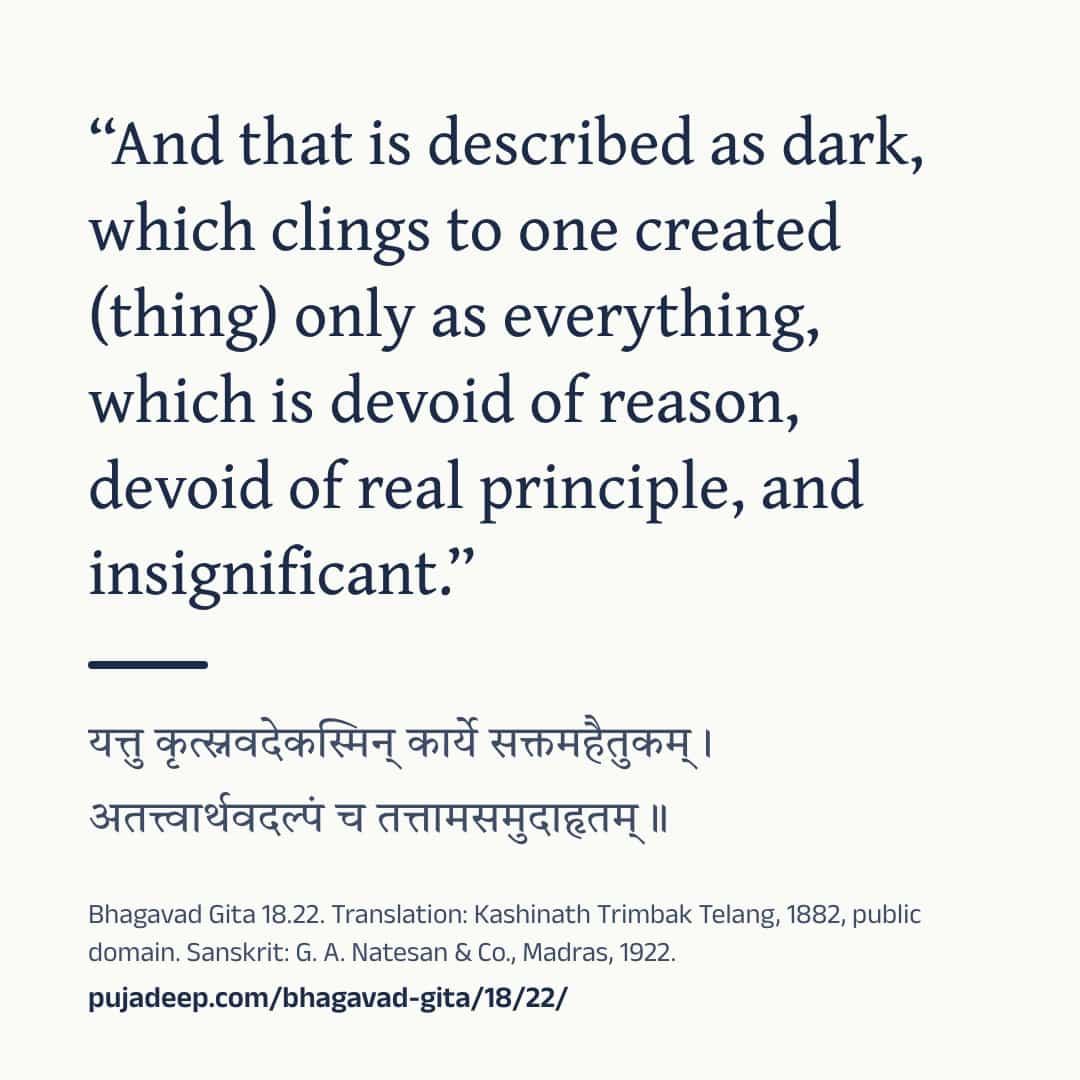
Drawing the picture
See the words
Bhagavad Gita 18.22

यत्तु कृत्स्नवदेकस्मिन् कार्ये सक्तमहैतुकम् ।
अतत्त्वार्थवदल्पं च तत्तामसमुदाहृतम् ॥

“And that is described as dark, which clings to one created (thing) only as everything, which is devoid of reason, devoid of real principle, and insignificant.”
(K. T. Telang, The Bhagavadgîtâ (The Sacred Books of the East, vol. VIII, Oxford: Clarendon Press, 1882), p. 124, public domain)

“And that which clingeth to each one thing as if it were the whole, without reason, without grasping the reality, narrow, that is declared to be tâmasic.”
(Annie Besant, The Bhagavad Gîtâ, or The Lord's Song (London: Theosophical Publishing Society, 1895), p. 156, public domain)

“Whilst that which is confined to one single effect as if it were the whole, without reason, without foundation in truth, and trivial,—that is declared to be Támasic.”
(Swami Swarupananda, Srimad-Bhagavad-Gita (Mayavati: Prabuddha Bharata Press, 1909; first printed in Prabuddha Bharata, 1907–1909), p. 329, public domain)

Sanskrit: G. A. Natesan & Co., Madras, 1922.
https://pujadeep.com/bhagavad-gita/18/22/ Nothing is sent from this site. Your own app sends it, to the chat you choose. The picture quotes the translation you chose on this page, with its name and year.
Sanskrit text: The Bhagavad-Gita, or The Lord's Song, with the text in Devanagari and an English translation, 1922. Meanings: written for Pujadeep and checked against the cited edition. Source and changes
Questions families ask
Who speaks Bhagavad Gita 18.22?
Krishna speaks this verse, in chapter 18 (Moksha Sannyasa Yoga).
Where does the Sanskrit text come from?
Sanskrit text: The Bhagavad-Gita, or The Lord's Song, with the text in Devanagari and an English translation, 1922. Meanings: written for Pujadeep and checked against the cited edition. See the source
Is the meaning on this page a translation?
Explanation written for this site from the sources listed here, and checked against the cited edition. It is not a translation and not the only way to read the text. Free to quote with credit.
Source and licence
- Sanskrit text
- The Bhagavad-Gita, or The Lord's Song, with the text in Devanagari and an English translation (Annie Besant, G. A. Natesan & Co., Madras, 1922). Public domain. The Sanskrit on these pages was read from this printing’s page images.
- Translation
- The Bhagavadgîtâ with the Sanatsugâtîya and the Anugîtâ, translated by Kâshinâth Trimbak Telang (The Sacred Books of the East, vol. VIII, ed. F. Max Müller) (Kashinath Trimbak Telang, F. Max Müller, Clarendon Press, Oxford, 1882). Public domain. Shown verbatim, as printed.
- Translation
- The Bhagavad Gîtâ, or The Lord's Song, translated by Annie Besant (Annie Besant, Theosophical Publishing Society, London, 1895). Public domain. Shown verbatim, as printed.
- Translation
- Srimad-Bhagavad-Gita, with Sanskrit Text; Paraphrase with Word-by-word Literal Translation; English Rendering and Comments, Index, &c., by the Swami Swarupananda (Himalayan Series, No. XX) (Swami Swarupananda, The Editors and Publishers, Advaita Ashrama, Mayavati, Prabuddha Bharata Press, Mayavati, Almora, Himalayas, 1909). Public domain. Shown verbatim, as printed.
- Common wording
- In this text, 32 words follow today's common wording, checked against sanskritdocuments.org; Sanskrit Wikisource; Gita Press, Gorakhpur; GRETIL, Göttingen and Bhaktivedanta Book Trust.
- Our explanation
- Explanation written for this site from the sources listed here, and checked against the cited edition. It is not a translation and not the only way to read the text. Free to quote with credit.
- Checked
- Checked against the cited edition, October 15, 2026.
- Updated
- October 25, 2026