Bhagavad Gita 18.12: meaning and translation
Chapter 18: Moksha Sannyasa Yoga. Krishna says
Krishna says that the fruit of action is of three kinds: unwanted, wanted and mixed.
Click or tap a word for its meaning and its dictionary page.
Text and layers
Text and layers
These choices stay in this browser.
Bhagavad Gita 18.12
अनिष्टमिष्टं मिश्रं च त्रिविधं कर्मणः फलम् ।भवत्यत्यागिनां प्रेत्य न तु संन्यासिनां क्वचित् ॥
Anishtamishtam mishram cha trividham karmanah phalamBhavatyatyaginam pretya na tu sannyasinam kvachit
aniṣṭamiṣṭaṃ miśraṃ ca trividhaṃ karmaṇaḥ phalam |bhavatyatyāgināṃ pretya na tu saṃnyāsināṃ kvacit ||
Our explanation Krishna says that the fruit of action is of three kinds: unwanted, wanted and mixed. It comes after death to those who have not given up, he says, but never to those who have renounced (sannyāsī). The two schools read 'those who have renounced' differently (see the views).
हिंदी अर्थ कृष्ण कहते हैं कि कर्म का फल तीन प्रकार का है: अनिष्ट, इष्ट और मिश्रित। वे कहते हैं कि यह फल मृत्यु के बाद उन्हें मिलता है जिन्होंने त्याग नहीं किया, पर संन्यासियों को कभी नहीं। “संन्यासी” से क्या अभिप्राय है, इसे दोनों परंपराएँ अलग ढंग से पढ़ती हैं।
Word by word
Every word, with its dictionary page
Word by word
- अनिष्टम् aniṣṭam · unwanted (past participle (neuter), nominative singular) Dictionary: 1. an-iṣṭa, Monier-Williams 1899, p. 30, col. 2 “unwished, undesirable”
- इष्टम् iṣṭam · wanted (past participle (neuter), nominative singular) Dictionary: 1. iṣṭa, Monier-Williams 1899, p. 169, col. 2 “wished, desired; liked, beloved”
- मिश्रम् miśram · mixed (adjective (neuter), nominative singular) Dictionary: miśra, Monier-Williams 1899, p. 817, col. 3 “mixed, mingled, blended, combined”
- च ca · and (indeclinable) Dictionary: 2. ca, Monier-Williams 1899, p. 380, col. 1 “and, both, also, moreover, as well as”
- त्रिविधम् trividham · of three kinds (adjective (neuter), nominative singular) Dictionary: tri-vidha, Monier-Williams 1899, p. 460, col. 2 “of 3 kinds, triple, threefold”
- कर्मणः karmaṇaḥ · of action (noun (neuter), genitive singular) Dictionary: karman, Monier-Williams 1899, p. 258, col. 2 “act, action, performance, business”
- फलम् phalam · fruit (noun (neuter), nominative singular) Dictionary: phala, Monier-Williams 1899, p. 716, col. 2 “fruit (met.), consequence, effect, result, retribution (good or bad)”
- भवति bhavati · comes (present, 3rd person singular) Dictionary: 1. bhū, Monier-Williams 1899, p. 760, col. 2 “to become, be”
- अत्यागिनाम् atyāginām · to those who have not given up (noun (masculine), genitive plural) Dictionary: 3. a, Monier-Williams 1899, p. 1, col. 1 “having a negative or privative or contrary sense”; tyāgin, Monier-Williams 1899, p. 456, col. 3 “giving up, resigning (ifc.)”
- प्रेत्य pretya · after death (indeclinable) Dictionary: pretya, Monier-Williams 1899, p. 712, col. 1 “having died, after death, in the next world”
- न na · not (indeclinable) Dictionary: 2. na, Monier-Williams 1899, p. 523, col. 1 “not, no, nor, neither”
- तु tu · but (indeclinable) Dictionary: 2. tu, Monier-Williams 1899, p. 449, col. 3 “but”
- संन्यासिनाम् saṃnyāsinām · to those who have renounced (noun (masculine), genitive plural) Dictionary: saṃ-nyāsin, Monier-Williams 1899, p. 1148, col. 1 “laying aside, giving up, abandoning, renouncing”
- क्वचित् kvacit · ever, at any time (indeclinable) Dictionary: kva, Monier-Williams 1899, p. 324, col. 2 “na kvacid, nowhere, never, by no means”
Old translations
Kashinath Trimbak Telang, 1882. Public domain. Page 122–123.
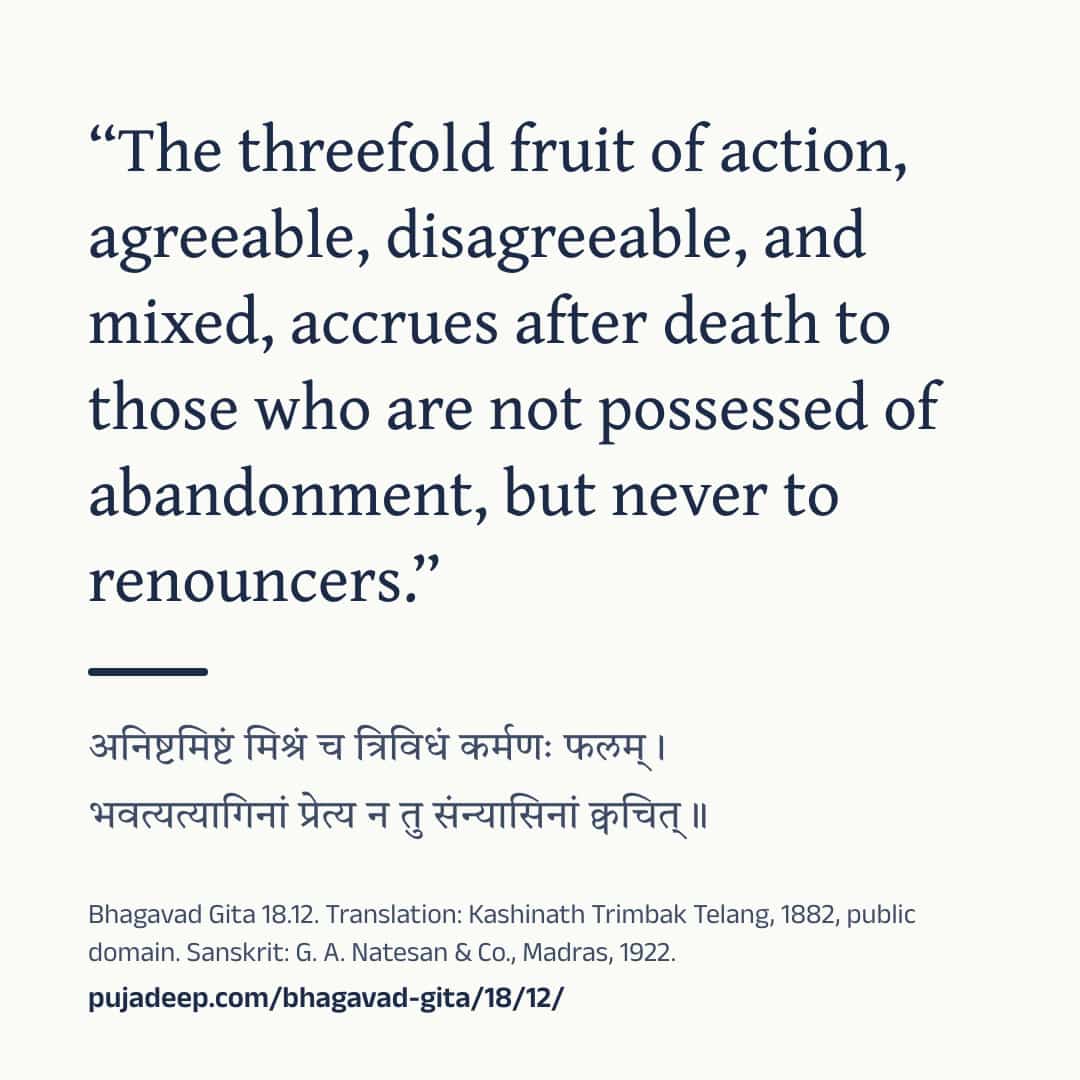
The threefold fruit of action, agreeable, disagreeable, and mixed, accrues after death to those who are not possessed of abandonment, but never to renouncers1.
Footnotes (the translator’s own) - The original is sannyâsî, but Srîdhara is probably right in taking it to mean one who has command of 'abandonment.' Saṅkara and Madhusûdana, however, take the word in its ordinary sense of 'ascetic.' What follows explains, says Srîdhara, why 'the fruit does not accrue to renouncers.' ↩
Compare 3 translations
Kashinath Trimbak Telang, 1882. Public domain. Page 122–123.
The threefold fruit of action, agreeable, disagreeable, and mixed, accrues after death to those who are not possessed of abandonment, but never to renouncers1.
Footnotes (the translator’s own) - The original is sannyâsî, but Srîdhara is probably right in taking it to mean one who has command of 'abandonment.' Saṅkara and Madhusûdana, however, take the word in its ordinary sense of 'ascetic.' What follows explains, says Srîdhara, why 'the fruit does not accrue to renouncers.' ↩
You are reading this one
Annie Besant, 1895. Public domain. Page 154.
Good, evil and mixed—threefold is the fruit of action hereafter for the non-Abandoner; but there is none ever for the Renouncer.
You are reading this one
Swami Swarupananda, 1909 (first printed 1907). Public domain. Page 324.
The threefold fruit of action—disagreeable, agreeable and mixed,—accrues to non-relinquishers after death, but never to relinquishers.
You are reading this one
Cite this verse
The translation: K. T. Telang, The Bhagavadgîtâ (The Sacred Books of the East, vol. VIII, Oxford: Clarendon Press, 1882), pp. 122–123. Bhagavad Gita 18.12.
The translation: Annie Besant, The Bhagavad Gîtâ, or The Lord's Song (London: Theosophical Publishing Society, 1895), p. 154. Bhagavad Gita 18.12.
The translation: Swami Swarupananda, Srimad-Bhagavad-Gita (Mayavati: Prabuddha Bharata Press, 1909; first printed in Prabuddha Bharata, 1907–1909), p. 324. Bhagavad Gita 18.12.
Our explanation: “Bhagavad Gita 18.12: meaning and translation.” Pujadeep. Updated October 25, 2026. https://pujadeep.com/bhagavad-gita/18/12/
Pujadeep’s explanations are free to quote with credit: name Pujadeep and link to the page. How to credit
Classical readings, by school
Each reading is named by its school. None is presented as the only meaning.
What Advaita, Vishishtadvaita and Dvaita teach, in short
Shankara Advaita
Shankara says the threefold fruit (hell and animal births, birth among the gods, and human birth) comes to all who have not renounced, including those who follow karma-yoga. It never comes to true renunciants: those of the highest order of sannyāsa who are devoted only to knowledge. Only one who has right knowledge, he says, can give up all works.
Source: The Bhagavad-Gita, with the commentary of Sri Sankaracharya, translated by A. Mahadeva Sastri (2nd ed., Mysore: G. T. A. Printing Works, 1901), commentary on 18.12, pp. 408–409. Summarised in our own words; none of its text is reproduced.
Ramanuja Vishishtadvaita
Ramanuja says the renouncers here are those who give up the sense of being the doer, and the fruit, while they go on doing their duties. Sannyāsa and tyāga mean the same thing; renunciation does not mean stopping work altogether.
Source: Sri Bhagavad-Gita with Sri Ramanujacharya's Visishtadvaita commentary, translated by A. Govindacharya (Madras, 1898), commentary on 18.12, pp. 530–531. Summarised in our own words; none of its text is reproduced.
Share
Show the ways to share
Send one picture or the text to one chat. The picture names its source and the address of this page.
Drawing the picture
See the words
Bhagavad Gita 18.12

अनिष्टमिष्टं मिश्रं च त्रिविधं कर्मणः फलम् ।
भवत्यत्यागिनां प्रेत्य न तु संन्यासिनां क्वचित् ॥

“The threefold fruit of action, agreeable, disagreeable, and mixed, accrues after death to those who are not possessed of abandonment, but never to renouncers.”
(K. T. Telang, The Bhagavadgîtâ (The Sacred Books of the East, vol. VIII, Oxford: Clarendon Press, 1882), pp. 122–123, public domain)

“Good, evil and mixed—threefold is the fruit of action hereafter for the non-Abandoner; but there is none ever for the Renouncer.”
(Annie Besant, The Bhagavad Gîtâ, or The Lord's Song (London: Theosophical Publishing Society, 1895), p. 154, public domain)

“The threefold fruit of action—disagreeable, agreeable and mixed,—accrues to non-relinquishers after death, but never to relinquishers.”
(Swami Swarupananda, Srimad-Bhagavad-Gita (Mayavati: Prabuddha Bharata Press, 1909; first printed in Prabuddha Bharata, 1907–1909), p. 324, public domain)

Sanskrit: G. A. Natesan & Co., Madras, 1922.
https://pujadeep.com/bhagavad-gita/18/12/ Nothing is sent from this site. Your own app sends it, to the chat you choose. The picture quotes the translation you chose on this page, with its name and year.
Sanskrit text: The Bhagavad-Gita, or The Lord's Song, with the text in Devanagari and an English translation, 1922. Meanings: written for Pujadeep and checked against the cited edition. Source and changes
Questions families ask
Who speaks Bhagavad Gita 18.12?
Krishna speaks this verse, in chapter 18 (Moksha Sannyasa Yoga).
Where does the Sanskrit text come from?
Sanskrit text: The Bhagavad-Gita, or The Lord's Song, with the text in Devanagari and an English translation, 1922. Meanings: written for Pujadeep and checked against the cited edition. See the source
Is the meaning on this page a translation?
Explanation written for this site from the sources listed here, and checked against the cited edition. It is not a translation and not the only way to read the text. Free to quote with credit.
Source and licence
- Sanskrit text
- The Bhagavad-Gita, or The Lord's Song, with the text in Devanagari and an English translation (Annie Besant, G. A. Natesan & Co., Madras, 1922). Public domain. The Sanskrit on these pages was read from this printing’s page images.
- Translation
- The Bhagavadgîtâ with the Sanatsugâtîya and the Anugîtâ, translated by Kâshinâth Trimbak Telang (The Sacred Books of the East, vol. VIII, ed. F. Max Müller) (Kashinath Trimbak Telang, F. Max Müller, Clarendon Press, Oxford, 1882). Public domain. Shown verbatim, as printed.
- Translation
- The Bhagavad Gîtâ, or The Lord's Song, translated by Annie Besant (Annie Besant, Theosophical Publishing Society, London, 1895). Public domain. Shown verbatim, as printed.
- Translation
- Srimad-Bhagavad-Gita, with Sanskrit Text; Paraphrase with Word-by-word Literal Translation; English Rendering and Comments, Index, &c., by the Swami Swarupananda (Himalayan Series, No. XX) (Swami Swarupananda, The Editors and Publishers, Advaita Ashrama, Mayavati, Prabuddha Bharata Press, Mayavati, Almora, Himalayas, 1909). Public domain. Shown verbatim, as printed.
- Commentary
- The Bhagavad-Gita, with the commentary of Sri Sankaracharya, translated by A. Mahadeva Sastri (2nd ed., Mysore: G. T. A. Printing Works, 1901) (Public-domain scan, University of California Libraries). Summarised in our own words; none of its text is reproduced.
- Commentary
- Sri Bhagavad-Gita with Sri Ramanujacharya's Visishtadvaita commentary, translated by A. Govindacharya (Madras, 1898) (Scan uploaded to archive.org (folkscanomy collection)). Summarised in our own words; none of its text is reproduced.
- Common wording
- In this text, 32 words follow today's common wording, checked against sanskritdocuments.org; Sanskrit Wikisource; Gita Press, Gorakhpur; GRETIL, Göttingen and Bhaktivedanta Book Trust.
- Our explanation
- Explanation written for this site from the sources listed here, and checked against the cited edition. It is not a translation and not the only way to read the text. Free to quote with credit.
- Checked
- Checked against the cited edition, October 15, 2026.
- Updated
- October 25, 2026