Bhagavad Gita 18.5: meaning and translation
Chapter 18: Moksha Sannyasa Yoga. Krishna says
Krishna says that sacrifice, giving and austerity should not be given up; they should be done.
Click or tap a word for its meaning and its dictionary page.
Text and layers
Text and layers
These choices stay in this browser.
Bhagavad Gita 18.5
यज्ञदानतपः कर्म न त्याज्यं कार्यमेव तत् ।यज्ञो दानं तपश्चैव पावनानि मनीषिणाम् ॥
Yajnadanatapah karma na tyajyam karyameva tatYajno danam tapashchaiva pavanani manishinam
yajñadānatapaḥ karma na tyājyaṃ kāryameva tat |yajño dānaṃ tapaścaiva pāvanāni manīṣiṇām ||
Our explanation Krishna says that sacrifice, giving and austerity should not be given up; they should be done. In his words, they purify the wise.
हिंदी अर्थ कृष्ण कहते हैं कि यज्ञ, दान और तप नहीं छोड़ने चाहिए; इन्हें करना ही चाहिए। उनके शब्दों में, ये विचारशील लोगों को पवित्र करते हैं।
Word by word
Every word, with its dictionary page
Word by word
- यज्ञदानतपःकर्म yajñadānatapaḥkarma · the work of sacrifice, giving and austerity (compound (neuter), nominative singular) Dictionary: yajña, Monier-Williams 1899, p. 839, col. 2 “worship, devotion, prayer, praise; act of worship or devotion, offering, oblation, sacrifice”; 1. dāna, Monier-Williams 1899, p. 474, col. 1 “the act of giving”; tapas, Monier-Williams 1899, p. 437, col. 1 “religious austerity, bodily mortification, penance, severe meditation”; karman, Monier-Williams 1899, p. 258, col. 2 “act, action, performance, business”
- न na · not (indeclinable) Dictionary: 2. na, Monier-Williams 1899, p. 523, col. 1 “not, no, nor, neither”
- त्याज्यम् tyājyam · to be given up (gerundive (to be done) (neuter), nominative singular) Dictionary: tyājya, Monier-Williams 1899, p. 457, col. 1 “to be given up”
- कार्यम् kāryam · to be done (gerundive (to be done) (neuter), nominative singular) Dictionary: kārya, Monier-Williams 1899, p. 276, col. 1 “to be made or done or practised or performed”
- एव eva · indeed (indeclinable) Dictionary: 1. eva, Monier-Williams 1899, p. 232, col. 2 “just, exactly, very, same, only, even, alone, merely”
- तत् tat · that (pronoun (neuter), nominative singular) Dictionary: tad, Monier-Williams 1899, p. 434, col. 1 “m. he, f. she, n. it, that, this”
- यज्ञः yajñaḥ · sacrifice (noun (masculine), nominative singular) Dictionary: yajña, Monier-Williams 1899, p. 839, col. 2 “worship, devotion, prayer, praise; act of worship or devotion, offering, oblation, sacrifice”
- दानम् dānam · giving (noun (neuter), nominative singular) Dictionary: 1. dāna, Monier-Williams 1899, p. 474, col. 1 “the act of giving”
- तपः tapaḥ · austerity (noun (neuter), nominative singular) Dictionary: tapas, Monier-Williams 1899, p. 437, col. 1 “religious austerity, bodily mortification, penance, severe meditation”
- च ca · and (indeclinable) Dictionary: 2. ca, Monier-Williams 1899, p. 380, col. 1 “and, both, also, moreover, as well as”
- एव eva · indeed (indeclinable) Dictionary: 1. eva, Monier-Williams 1899, p. 232, col. 2 “just, exactly, very, same, only, even, alone, merely”
- पावनानि pāvanāni · purifying (adjective (neuter), nominative plural) Dictionary: pāvana, Monier-Williams 1899, p. 623, col. 2 “purifying, purificatory; pure, holy”
- मनीषिणाम् manīṣiṇām · for the wise (noun (masculine), genitive plural) Dictionary: manīṣin, Monier-Williams 1899, p. 784, col. 2 “thoughtful, intelligent, wise, sage, prudent”
1 printing differs
Edition differences. Another printing or text reads this place differently.
- Spelling A digital text reads Same letters. The e-text joins यज्ञदानतपःकर्म; the 1922 edition prints यज्ञदानतपः कर्म with a space.
Old translations
Kashinath Trimbak Telang, 1882. Public domain. Page 122.
The actions of sacrifice, gift, and penance should not be abandoned; they must needs be performed; for sacrifices, gifts, and penances are means of sanctification to the wise.
Compare 3 translations
Kashinath Trimbak Telang, 1882. Public domain. Page 122.
The actions of sacrifice, gift, and penance should not be abandoned; they must needs be performed; for sacrifices, gifts, and penances are means of sanctification to the wise.
You are reading this one
Annie Besant, 1895. Public domain. Page 153.
The action of sacrifice, gift and austerity should not be abandoned, but it should be indeed performed; sacrifice, gift and also austerity are the purifiers of the wise.
You are reading this one
Swami Swarupananda, 1909 (first printed 1907). Public domain. Page 321.
The work of Yajna, gift and austerity should not be relinquished, but it should indeed be performed; (for) Yajna, gift and austerity are purifying to the wise.
You are reading this one
Cite this verse
The translation: K. T. Telang, The Bhagavadgîtâ (The Sacred Books of the East, vol. VIII, Oxford: Clarendon Press, 1882), p. 122. Bhagavad Gita 18.5.
The translation: Annie Besant, The Bhagavad Gîtâ, or The Lord's Song (London: Theosophical Publishing Society, 1895), p. 153. Bhagavad Gita 18.5.
The translation: Swami Swarupananda, Srimad-Bhagavad-Gita (Mayavati: Prabuddha Bharata Press, 1909; first printed in Prabuddha Bharata, 1907–1909), p. 321. Bhagavad Gita 18.5.
Our explanation: “Bhagavad Gita 18.5: meaning and translation.” Pujadeep. Updated October 25, 2026. https://pujadeep.com/bhagavad-gita/18/5/
Pujadeep’s explanations are free to quote with credit: name Pujadeep and link to the page. How to credit
Classical readings, by school
No readings by school on this verse yet.
Share
Show the ways to share
Send one picture or the text to one chat. The picture names its source and the address of this page.
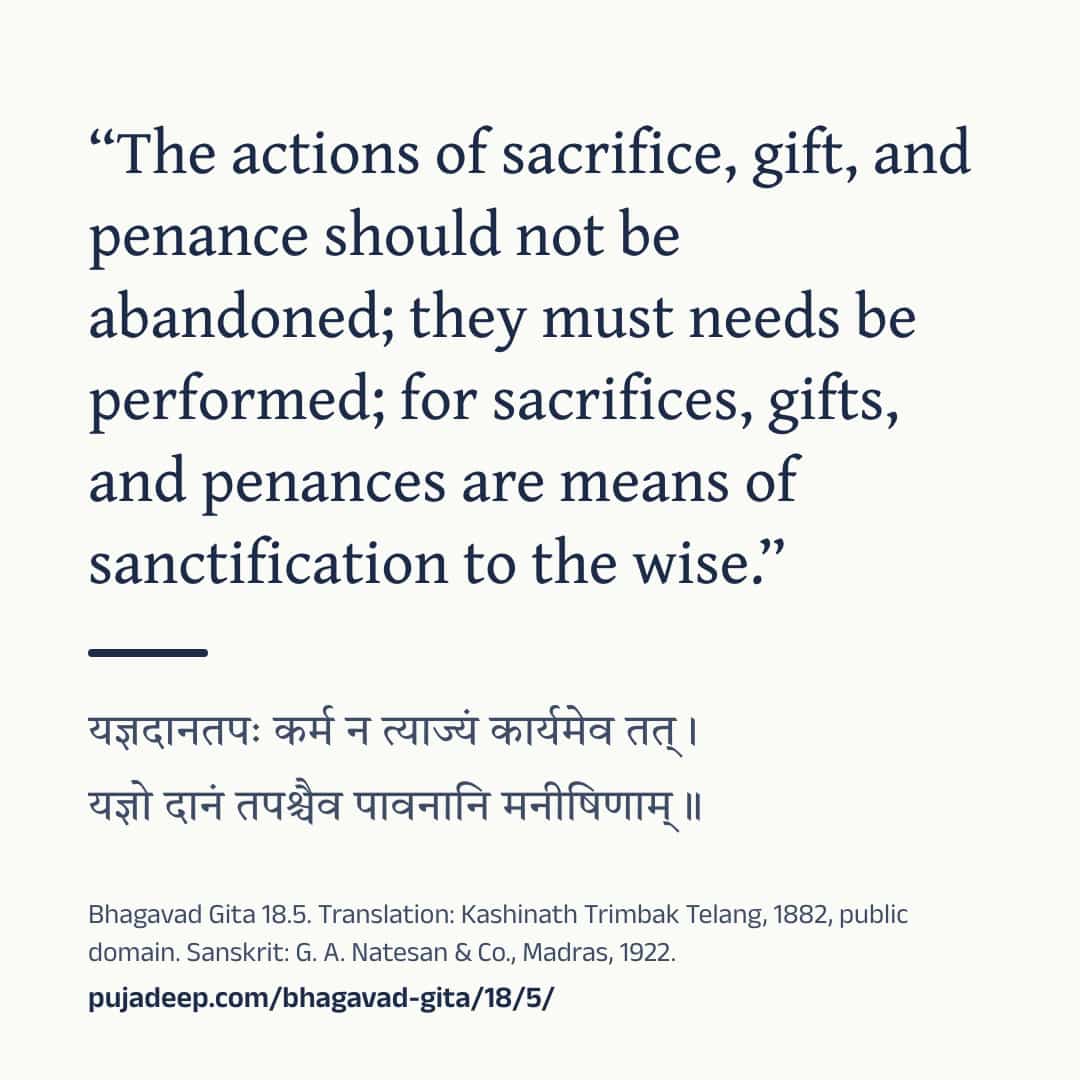
Drawing the picture
See the words
Bhagavad Gita 18.5

यज्ञदानतपः कर्म न त्याज्यं कार्यमेव तत् ।
यज्ञो दानं तपश्चैव पावनानि मनीषिणाम् ॥

“The actions of sacrifice, gift, and penance should not be abandoned; they must needs be performed; for sacrifices, gifts, and penances are means of sanctification to the wise.”
(K. T. Telang, The Bhagavadgîtâ (The Sacred Books of the East, vol. VIII, Oxford: Clarendon Press, 1882), p. 122, public domain)

“The action of sacrifice, gift and austerity should not be abandoned, but it should be indeed performed; sacrifice, gift and also austerity are the purifiers of the wise.”
(Annie Besant, The Bhagavad Gîtâ, or The Lord's Song (London: Theosophical Publishing Society, 1895), p. 153, public domain)

“The work of Yajna, gift and austerity should not be relinquished, but it should indeed be performed; (for) Yajna, gift and austerity are purifying to the wise.”
(Swami Swarupananda, Srimad-Bhagavad-Gita (Mayavati: Prabuddha Bharata Press, 1909; first printed in Prabuddha Bharata, 1907–1909), p. 321, public domain)

Sanskrit: G. A. Natesan & Co., Madras, 1922.
https://pujadeep.com/bhagavad-gita/18/5/ Nothing is sent from this site. Your own app sends it, to the chat you choose. The picture quotes the translation you chose on this page, with its name and year.
Sanskrit text: The Bhagavad-Gita, or The Lord's Song, with the text in Devanagari and an English translation, 1922. Meanings: written for Pujadeep and checked against the cited edition. Source and changes
Questions families ask
Who speaks Bhagavad Gita 18.5?
Krishna speaks this verse, in chapter 18 (Moksha Sannyasa Yoga).
Where does the Sanskrit text come from?
Sanskrit text: The Bhagavad-Gita, or The Lord's Song, with the text in Devanagari and an English translation, 1922. Meanings: written for Pujadeep and checked against the cited edition. See the source
Is the meaning on this page a translation?
Explanation written for this site from the sources listed here, and checked against the cited edition. It is not a translation and not the only way to read the text. Free to quote with credit.
Source and licence
- Sanskrit text
- The Bhagavad-Gita, or The Lord's Song, with the text in Devanagari and an English translation (Annie Besant, G. A. Natesan & Co., Madras, 1922). Public domain. The Sanskrit on these pages was read from this printing’s page images.
- Translation
- The Bhagavadgîtâ with the Sanatsugâtîya and the Anugîtâ, translated by Kâshinâth Trimbak Telang (The Sacred Books of the East, vol. VIII, ed. F. Max Müller) (Kashinath Trimbak Telang, F. Max Müller, Clarendon Press, Oxford, 1882). Public domain. Shown verbatim, as printed.
- Translation
- The Bhagavad Gîtâ, or The Lord's Song, translated by Annie Besant (Annie Besant, Theosophical Publishing Society, London, 1895). Public domain. Shown verbatim, as printed.
- Translation
- Srimad-Bhagavad-Gita, with Sanskrit Text; Paraphrase with Word-by-word Literal Translation; English Rendering and Comments, Index, &c., by the Swami Swarupananda (Himalayan Series, No. XX) (Swami Swarupananda, The Editors and Publishers, Advaita Ashrama, Mayavati, Prabuddha Bharata Press, Mayavati, Almora, Himalayas, 1909). Public domain. Shown verbatim, as printed.
- Common wording
- In this text, 32 words follow today's common wording, checked against sanskritdocuments.org; Sanskrit Wikisource; Gita Press, Gorakhpur; GRETIL, Göttingen and Bhaktivedanta Book Trust.
- Our explanation
- Explanation written for this site from the sources listed here, and checked against the cited edition. It is not a translation and not the only way to read the text. Free to quote with credit.
- Checked
- Checked against the cited edition, October 15, 2026.
- Updated
- October 25, 2026