Bhagavad Gita 18.8: meaning and translation
Chapter 18: Moksha Sannyasa Yoga. Krishna says
If a person gives up an action only because it is painful, from fear of bodily trouble, Krishna says, that is tyāga of the nature of rajas, and it does not bring the fruit of tyāga.
Click or tap a word for its meaning and its dictionary page.
Text and layers
Text and layers
These choices stay in this browser.
Bhagavad Gita 18.8
दुःखमित्येव यत्कर्म कायक्लेशभयात्त्यजेत् ।स कृत्वा राजसं त्यागं नैव त्यागफलं लभेत् ॥
Duhkhamityeva yatkarma kayakleshabhayattyajetSa kritva rajasam tyagam naiva tyagaphalam labhet
duḥkhamityeva yatkarma kāyakleśabhayāttyajet |sa kṛtvā rājasaṃ tyāgaṃ naiva tyāgaphalaṃ labhet ||
Our explanation If a person gives up an action only because it is painful, from fear of bodily trouble, Krishna says, that is tyāga of the nature of rajas, and it does not bring the fruit of tyāga.
हिंदी अर्थ कृष्ण कहते हैं कि जो व्यक्ति कोई कर्म केवल इसलिए छोड़ दे कि वह कष्ट देता है, शरीर के क्लेश के डर से, उसका त्याग राजस है, और उसे त्याग का फल नहीं मिलता।
Word by word
Every word, with its dictionary page
Word by word
- दुःखम् duḥkham · painful (noun (neuter), nominative singular) Dictionary: 1. duḥkha, Monier-Williams 1899, p. 483, col. 2 “uneasiness, pain, sorrow, trouble, difficulty”
- इति iti · thus (thinking) (indeclinable) Dictionary: 2. iti, Monier-Williams 1899, p. 165, col. 1 “in this manner, thus”
- एव eva · just (indeclinable) Dictionary: 1. eva, Monier-Williams 1899, p. 232, col. 2 “just, exactly, very, same, only, even, alone, merely”
- यत् yat · which (pronoun (neuter), accusative singular) Dictionary: yad, Monier-Williams 1899, p. 844, col. 2 “who, which, what, whichever, whatever, that”
- कर्म karma · action (noun (neuter), accusative singular) Dictionary: karman, Monier-Williams 1899, p. 258, col. 2 “act, action, performance, business”
- कायक्लेशभयात् kāyakleśabhayāt · from fear of bodily strain (compound (neuter), ablative singular) Dictionary: 2. kāya, Monier-Williams 1899, p. 274, col. 1 “the body”; kleśa, Monier-Williams 1899, p. 324, col. 1 “pain, affliction, distress, pain from disease, anguish”; bhaya, Monier-Williams 1899, p. 747, col. 1 “fear, alarm, dread, apprehension”
- त्यजेत् tyajet · gives up (optative, 3rd person singular) Dictionary: 1. tyaj, Monier-Williams 1899, p. 456, col. 3 “to leave, abandon, quit”
- सः saḥ · he (pronoun (masculine), nominative singular) Dictionary: tad, Monier-Williams 1899, p. 434, col. 1 “m. he, f. she, n. it, that, this”
- कृत्वा kṛtvā · having made (absolutive (having done)) Dictionary: 1. kṛ, Monier-Williams 1899, p. 301, col. 1 “to do, make, perform, accomplish, cause, effect, prepare, undertake”
- राजसम् rājasam · of rajas (adjective (masculine), accusative singular) Dictionary: rājasa, Monier-Williams 1899, p. 875, col. 2 “belonging or relating to the quality rajas”
- त्यागम् tyāgam · giving up (noun (masculine), accusative singular) Dictionary: tyāga, Monier-Williams 1899, p. 456, col. 3 “leaving, abandoning, forsaking”
- न na · not (indeclinable) Dictionary: 2. na, Monier-Williams 1899, p. 523, col. 1 “not, no, nor, neither”
- एव eva · at all (indeclinable) Dictionary: 1. eva, Monier-Williams 1899, p. 232, col. 2 “just, exactly, very, same, only, even, alone, merely”
- त्यागफलम् tyāgaphalam · the fruit of giving up (compound (neuter), accusative singular) Dictionary: tyāga, Monier-Williams 1899, p. 456, col. 3 “leaving, abandoning, forsaking”; phala, Monier-Williams 1899, p. 716, col. 2 “fruit (met.), consequence, effect, result, retribution (good or bad)”
- लभेत् labhet · would gain (optative, 3rd person singular) Dictionary: labh, Monier-Williams 1899, p. 896, col. 2 “to gain possession of, obtain, receive, conceive, get”
Old translations
Kashinath Trimbak Telang, 1882. Public domain. Page 122.
When a man abandons action, merely as being troublesome, through fear of bodily affliction, he does not obtain the fruit1 of abandonment by making (such) passionate abandonment.
Footnotes (the translator’s own) - Namely, final emancipation, by means of purity of heart. ↩
Compare 3 translations
Kashinath Trimbak Telang, 1882. Public domain. Page 122.
When a man abandons action, merely as being troublesome, through fear of bodily affliction, he does not obtain the fruit1 of abandonment by making (such) passionate abandonment.
Footnotes (the translator’s own) - Namely, final emancipation, by means of purity of heart. ↩
You are reading this one
Annie Besant, 1895. Public domain. Page 153.
He who abandoneth an action from fear of physical suffering, saying, "Painful," (thus) performing a râjasic abandonment, obtaineth not the fruit of Abandonment.
You are reading this one
Swami Swarupananda, 1909 (first printed 1907). Public domain. Page 322.
He who, from fear of bodily trouble, relinquishes action, because it is painful, thus performing a Râjasic relinquishment, he obtains not the fruit thereof.
You are reading this one
Cite this verse
The translation: K. T. Telang, The Bhagavadgîtâ (The Sacred Books of the East, vol. VIII, Oxford: Clarendon Press, 1882), p. 122. Bhagavad Gita 18.8.
The translation: Annie Besant, The Bhagavad Gîtâ, or The Lord's Song (London: Theosophical Publishing Society, 1895), p. 153. Bhagavad Gita 18.8.
The translation: Swami Swarupananda, Srimad-Bhagavad-Gita (Mayavati: Prabuddha Bharata Press, 1909; first printed in Prabuddha Bharata, 1907–1909), p. 322. Bhagavad Gita 18.8.
Our explanation: “Bhagavad Gita 18.8: meaning and translation.” Pujadeep. Updated October 25, 2026. https://pujadeep.com/bhagavad-gita/18/8/
Pujadeep’s explanations are free to quote with credit: name Pujadeep and link to the page. How to credit
Classical readings, by school
No readings by school on this verse yet.
Share
Show the ways to share
Send one picture or the text to one chat. The picture names its source and the address of this page.
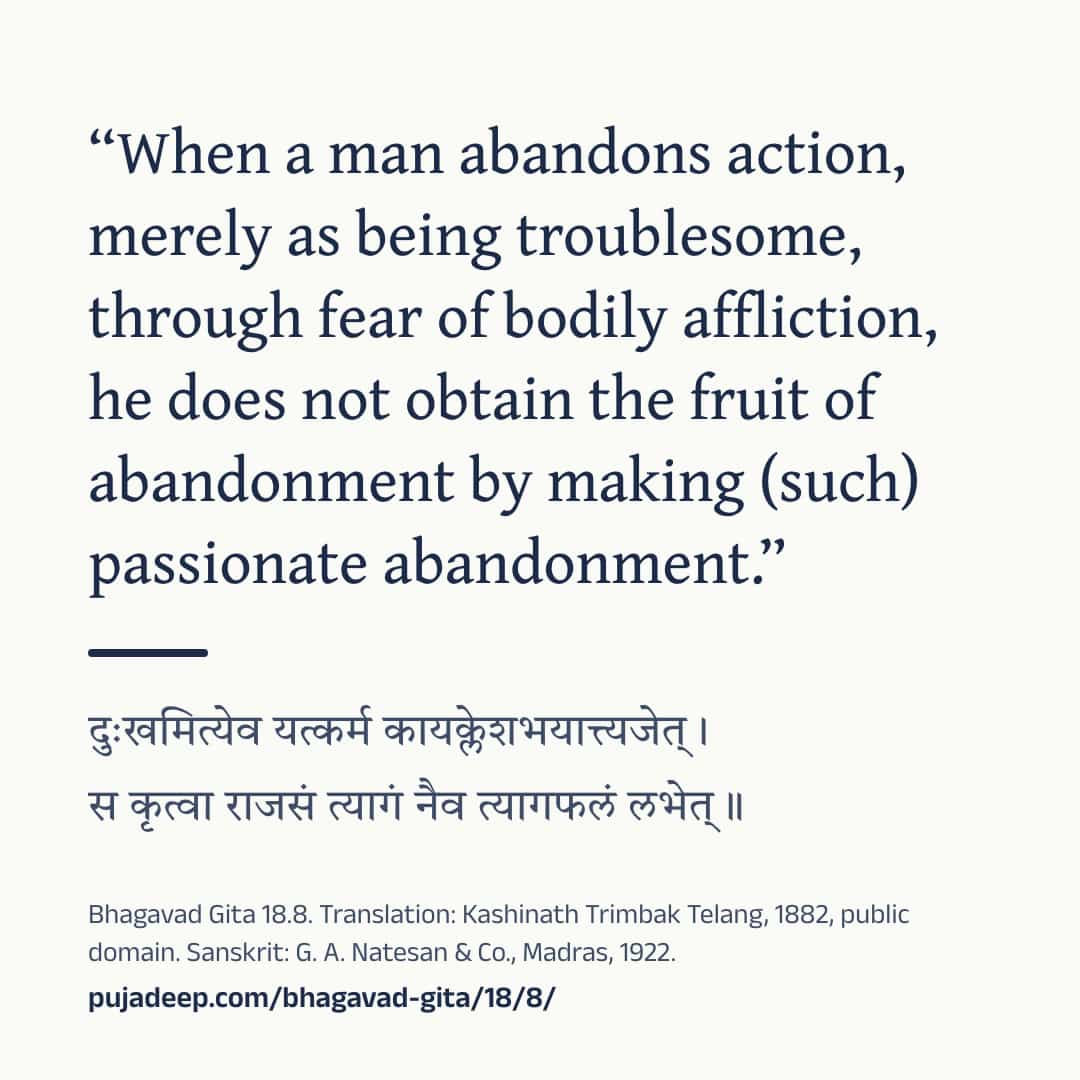
Drawing the picture
See the words
Bhagavad Gita 18.8

दुःखमित्येव यत्कर्म कायक्लेशभयात्त्यजेत् ।
स कृत्वा राजसं त्यागं नैव त्यागफलं लभेत् ॥

“When a man abandons action, merely as being troublesome, through fear of bodily affliction, he does not obtain the fruit of abandonment by making (such) passionate abandonment.”
(K. T. Telang, The Bhagavadgîtâ (The Sacred Books of the East, vol. VIII, Oxford: Clarendon Press, 1882), p. 122, public domain)

“He who abandoneth an action from fear of physical suffering, saying, "Painful," (thus) performing a râjasic abandonment, obtaineth not the fruit of Abandonment.”
(Annie Besant, The Bhagavad Gîtâ, or The Lord's Song (London: Theosophical Publishing Society, 1895), p. 153, public domain)

“He who, from fear of bodily trouble, relinquishes action, because it is painful, thus performing a Râjasic relinquishment, he obtains not the fruit thereof.”
(Swami Swarupananda, Srimad-Bhagavad-Gita (Mayavati: Prabuddha Bharata Press, 1909; first printed in Prabuddha Bharata, 1907–1909), p. 322, public domain)

Sanskrit: G. A. Natesan & Co., Madras, 1922.
https://pujadeep.com/bhagavad-gita/18/8/ Nothing is sent from this site. Your own app sends it, to the chat you choose. The picture quotes the translation you chose on this page, with its name and year.
Sanskrit text: The Bhagavad-Gita, or The Lord's Song, with the text in Devanagari and an English translation, 1922. Meanings: written for Pujadeep and checked against the cited edition. Source and changes
Questions families ask
Who speaks Bhagavad Gita 18.8?
Krishna speaks this verse, in chapter 18 (Moksha Sannyasa Yoga).
Where does the Sanskrit text come from?
Sanskrit text: The Bhagavad-Gita, or The Lord's Song, with the text in Devanagari and an English translation, 1922. Meanings: written for Pujadeep and checked against the cited edition. See the source
Is the meaning on this page a translation?
Explanation written for this site from the sources listed here, and checked against the cited edition. It is not a translation and not the only way to read the text. Free to quote with credit.
Source and licence
- Sanskrit text
- The Bhagavad-Gita, or The Lord's Song, with the text in Devanagari and an English translation (Annie Besant, G. A. Natesan & Co., Madras, 1922). Public domain. The Sanskrit on these pages was read from this printing’s page images.
- Translation
- The Bhagavadgîtâ with the Sanatsugâtîya and the Anugîtâ, translated by Kâshinâth Trimbak Telang (The Sacred Books of the East, vol. VIII, ed. F. Max Müller) (Kashinath Trimbak Telang, F. Max Müller, Clarendon Press, Oxford, 1882). Public domain. Shown verbatim, as printed.
- Translation
- The Bhagavad Gîtâ, or The Lord's Song, translated by Annie Besant (Annie Besant, Theosophical Publishing Society, London, 1895). Public domain. Shown verbatim, as printed.
- Translation
- Srimad-Bhagavad-Gita, with Sanskrit Text; Paraphrase with Word-by-word Literal Translation; English Rendering and Comments, Index, &c., by the Swami Swarupananda (Himalayan Series, No. XX) (Swami Swarupananda, The Editors and Publishers, Advaita Ashrama, Mayavati, Prabuddha Bharata Press, Mayavati, Almora, Himalayas, 1909). Public domain. Shown verbatim, as printed.
- Common wording
- In this text, 32 words follow today's common wording, checked against sanskritdocuments.org; Sanskrit Wikisource; Gita Press, Gorakhpur; GRETIL, Göttingen and Bhaktivedanta Book Trust.
- Our explanation
- Explanation written for this site from the sources listed here, and checked against the cited edition. It is not a translation and not the only way to read the text. Free to quote with credit.
- Checked
- Checked against the cited edition, October 15, 2026.
- Updated
- October 25, 2026