Bhagavad Gita 18.11: meaning and translation
Chapter 18: Moksha Sannyasa Yoga. Krishna says
Krishna says that no one who has a body can give up action completely.
Click or tap a word for its meaning and its dictionary page.
Text and layers
Text and layers
These choices stay in this browser.
Bhagavad Gita 18.11
न हि देहभृता शक्यं त्यक्तुं कर्माण्यशेषतः ।यस्तु कर्मफलत्यागी स त्यागीत्यभिधीयते ॥
Na hi dehabhrita shakyam tyaktum karmanyasheshatahYastu karmaphalatyagi sa tyagityabhidhiyate
na hi dehabhṛtā śakyaṃ tyaktuṃ karmāṇyaśeṣataḥ |yastu karmaphalatyāgī sa tyāgītyabhidhīyate ||
Our explanation Krishna says that no one who has a body can give up action completely. So the one who gives up the fruit of action, he says, is the one called a tyāgī.
हिंदी अर्थ कृष्ण कहते हैं कि देहधारी के लिए कर्मों को पूरी तरह छोड़ना संभव नहीं। इसलिए, वे कहते हैं, जो कर्मफल का त्याग करता है वही त्यागी कहलाता है।
Word by word
Every word, with its dictionary page
Word by word
- न na · not (indeclinable) Dictionary: 2. na, Monier-Williams 1899, p. 523, col. 1 “not, no, nor, neither”
- हि hi · for (indeclinable) Dictionary: 2. hi, Monier-Williams 1899, p. 1297, col. 3 “for, because, on account of”
- देहभृता dehabhṛtā · by one who bears a body (compound (masculine), instrumental singular) Dictionary: deha-bhṛt, Monier-Williams 1899, p. 497, col. 1 “‘carrying a b°,’ embodied, corporeal”
- शक्यम् śakyam · possible (adjective (neuter), nominative singular) Dictionary: śakya, Monier-Williams 1899, p. 1045, col. 1 “able, possible, practicable”
- त्यक्तुम् tyaktum · to give up (infinitive (to do)) Dictionary: 1. tyaj, Monier-Williams 1899, p. 456, col. 3 “to leave, abandon, quit”
- कर्माणि karmāṇi · actions (noun (neuter), accusative plural) Dictionary: karman, Monier-Williams 1899, p. 258, col. 2 “act, action, performance, business”
- अशेषतः aśeṣataḥ · entirely (indeclinable) Dictionary: a-śeṣa-tas, Monier-Williams 1899, p. 113, col. 3
- यः yaḥ · who (pronoun (masculine), nominative singular) Dictionary: yad, Monier-Williams 1899, p. 844, col. 2 “who, which, what, whichever, whatever, that”
- तु tu · but (indeclinable) Dictionary: 2. tu, Monier-Williams 1899, p. 449, col. 3 “but”
- कर्मफलत्यागी karmaphalatyāgī · who gives up the fruit of action (compound (masculine), nominative singular) Dictionary: karma-phala, Monier-Williams 1899, p. 259, col. 1 “the fruit or recompense of actions”; tyāgin, Monier-Williams 1899, p. 456, col. 3 “giving up, resigning (ifc.)”
- सः saḥ · he (pronoun (masculine), nominative singular) Dictionary: tad, Monier-Williams 1899, p. 434, col. 1 “m. he, f. she, n. it, that, this”
- त्यागी tyāgī · one who has given up (noun (masculine), nominative singular) Dictionary: tyāgin, Monier-Williams 1899, p. 456, col. 3 “giving up, resigning (ifc.)”
- इति iti · thus (indeclinable) Dictionary: 2. iti, Monier-Williams 1899, p. 165, col. 1 “in this manner, thus”
- अभिधीयते abhidhīyate · is called (present passive, 3rd person singular) Dictionary: 1. abhi-dhā, Monier-Williams 1899, p. 63, col. 2 “to set forth, explain, tell, speak to, address, say, name”
Old translations
Kashinath Trimbak Telang, 1882. Public domain. Page 122.
Since no embodied (being) can abandon actions without exception1, he is said to be possessed of abandonment, who abandons the fruit of action.
Footnotes (the translator’s own) - Cf. p. 53 supra. ↩
Compare 3 translations
Kashinath Trimbak Telang, 1882. Public domain. Page 122.
Since no embodied (being) can abandon actions without exception1, he is said to be possessed of abandonment, who abandons the fruit of action.
Footnotes (the translator’s own) - Cf. p. 53 supra. ↩
You are reading this one
Annie Besant, 1895. Public domain. Page 154.
An embodied being is unable completely to abandon actions; verily he who abandoneth the fruit of action he is said to be an Abandoner.
You are reading this one
Swami Swarupananda, 1909 (first printed 1907). Public domain. Page 323.
Actions cannot be entirely relinquished by an embodied being, but he who relinquishes the fruits of action is called a relinquisher.
You are reading this one
Cite this verse
The translation: K. T. Telang, The Bhagavadgîtâ (The Sacred Books of the East, vol. VIII, Oxford: Clarendon Press, 1882), p. 122. Bhagavad Gita 18.11.
The translation: Annie Besant, The Bhagavad Gîtâ, or The Lord's Song (London: Theosophical Publishing Society, 1895), p. 154. Bhagavad Gita 18.11.
The translation: Swami Swarupananda, Srimad-Bhagavad-Gita (Mayavati: Prabuddha Bharata Press, 1909; first printed in Prabuddha Bharata, 1907–1909), p. 323. Bhagavad Gita 18.11.
Our explanation: “Bhagavad Gita 18.11: meaning and translation.” Pujadeep. Updated October 25, 2026. https://pujadeep.com/bhagavad-gita/18/11/
Pujadeep’s explanations are free to quote with credit: name Pujadeep and link to the page. How to credit
Classical readings, by school
No readings by school on this verse yet.
Share
Show the ways to share
Send one picture or the text to one chat. The picture names its source and the address of this page.
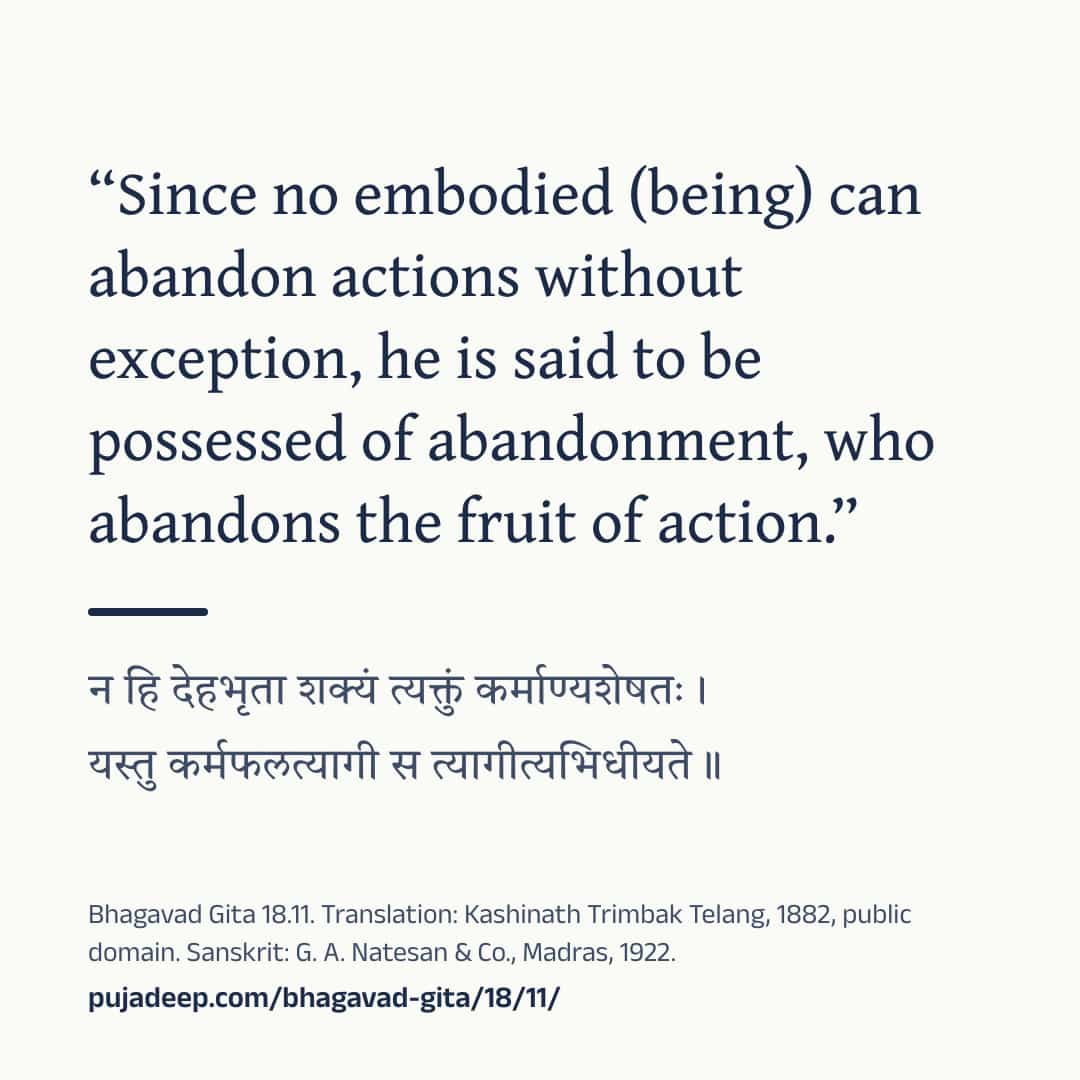
Drawing the picture
See the words
Bhagavad Gita 18.11

न हि देहभृता शक्यं त्यक्तुं कर्माण्यशेषतः ।
यस्तु कर्मफलत्यागी स त्यागीत्यभिधीयते ॥

“Since no embodied (being) can abandon actions without exception, he is said to be possessed of abandonment, who abandons the fruit of action.”
(K. T. Telang, The Bhagavadgîtâ (The Sacred Books of the East, vol. VIII, Oxford: Clarendon Press, 1882), p. 122, public domain)

“An embodied being is unable completely to abandon actions; verily he who abandoneth the fruit of action he is said to be an Abandoner.”
(Annie Besant, The Bhagavad Gîtâ, or The Lord's Song (London: Theosophical Publishing Society, 1895), p. 154, public domain)

“Actions cannot be entirely relinquished by an embodied being, but he who relinquishes the fruits of action is called a relinquisher.”
(Swami Swarupananda, Srimad-Bhagavad-Gita (Mayavati: Prabuddha Bharata Press, 1909; first printed in Prabuddha Bharata, 1907–1909), p. 323, public domain)

Sanskrit: G. A. Natesan & Co., Madras, 1922.
https://pujadeep.com/bhagavad-gita/18/11/ Nothing is sent from this site. Your own app sends it, to the chat you choose. The picture quotes the translation you chose on this page, with its name and year.
Sanskrit text: The Bhagavad-Gita, or The Lord's Song, with the text in Devanagari and an English translation, 1922. Meanings: written for Pujadeep and checked against the cited edition. Source and changes
Questions families ask
Who speaks Bhagavad Gita 18.11?
Krishna speaks this verse, in chapter 18 (Moksha Sannyasa Yoga).
Where does the Sanskrit text come from?
Sanskrit text: The Bhagavad-Gita, or The Lord's Song, with the text in Devanagari and an English translation, 1922. Meanings: written for Pujadeep and checked against the cited edition. See the source
Is the meaning on this page a translation?
Explanation written for this site from the sources listed here, and checked against the cited edition. It is not a translation and not the only way to read the text. Free to quote with credit.
Source and licence
- Sanskrit text
- The Bhagavad-Gita, or The Lord's Song, with the text in Devanagari and an English translation (Annie Besant, G. A. Natesan & Co., Madras, 1922). Public domain. The Sanskrit on these pages was read from this printing’s page images.
- Translation
- The Bhagavadgîtâ with the Sanatsugâtîya and the Anugîtâ, translated by Kâshinâth Trimbak Telang (The Sacred Books of the East, vol. VIII, ed. F. Max Müller) (Kashinath Trimbak Telang, F. Max Müller, Clarendon Press, Oxford, 1882). Public domain. Shown verbatim, as printed.
- Translation
- The Bhagavad Gîtâ, or The Lord's Song, translated by Annie Besant (Annie Besant, Theosophical Publishing Society, London, 1895). Public domain. Shown verbatim, as printed.
- Translation
- Srimad-Bhagavad-Gita, with Sanskrit Text; Paraphrase with Word-by-word Literal Translation; English Rendering and Comments, Index, &c., by the Swami Swarupananda (Himalayan Series, No. XX) (Swami Swarupananda, The Editors and Publishers, Advaita Ashrama, Mayavati, Prabuddha Bharata Press, Mayavati, Almora, Himalayas, 1909). Public domain. Shown verbatim, as printed.
- Common wording
- In this text, 32 words follow today's common wording, checked against sanskritdocuments.org; Sanskrit Wikisource; Gita Press, Gorakhpur; GRETIL, Göttingen and Bhaktivedanta Book Trust.
- Our explanation
- Explanation written for this site from the sources listed here, and checked against the cited edition. It is not a translation and not the only way to read the text. Free to quote with credit.
- Checked
- Checked against the cited edition, October 15, 2026.
- Updated
- October 25, 2026