Bhagavad Gita 18.30: meaning and translation
Chapter 18: Moksha Sannyasa Yoga. Krishna says
Krishna says that the understanding which knows when to act and when to hold back, what should and should not be done, what is to be feared and what is not, and what binds and what frees, is understanding of the nature of sattva.
Click or tap a word for its meaning and its dictionary page.
Text and layers
Text and layers
These choices stay in this browser.
Bhagavad Gita 18.30
प्रवृत्तिं च निवृत्तिं च कार्याकार्ये भयाभये ।बन्धं मोक्षं च या वेत्ति बुद्धिः सा पार्थ सात्त्विकी ॥
Pravrittim cha nivrittim cha karyakarye bhayabhayeBandham moksham cha ya vetti buddhih sa partha sattviki
pravṛttiṃ ca nivṛttiṃ ca kāryākārye bhayābhaye |bandhaṃ mokṣaṃ ca yā vetti buddhiḥ sā pārtha sāttvikī ||
Our explanation Krishna says that the understanding which knows when to act and when to hold back, what should and should not be done, what is to be feared and what is not, and what binds and what frees, is understanding of the nature of sattva. Telang's note says Shankara takes pravṛtti and nivṛtti as the paths of action and of knowledge; in Sastri's translation (p. 421) Shankara calls them the path of action and the path of renunciation (sannyāsa).
हिंदी अर्थ कृष्ण कहते हैं कि जो बुद्धि प्रवृत्ति और निवृत्ति, कर्तव्य और अकर्तव्य, भय और अभय, बंधन और मोक्ष को जानती है, वह सात्त्विक है। तेलंग की टिप्पणी कहती है कि शंकराचार्य प्रवृत्ति और निवृत्ति को कर्म का मार्ग और ज्ञान का मार्ग मानते हैं; शास्त्री के अनुवाद (पृ. 421) में शंकराचार्य इन्हें कर्म का मार्ग और संन्यास का मार्ग कहते हैं।
Word by word
Every word, with its dictionary page
Word by word
- प्रवृत्तिम् pravṛttim · going forth into action (noun (feminine), accusative singular) Dictionary: pra-vṛtti, Monier-Williams 1899, p. 694, col. 1 “activity, exertion, efficacy, function”
- च ca · and (indeclinable) Dictionary: 2. ca, Monier-Williams 1899, p. 380, col. 1 “and, both, also, moreover, as well as”
- निवृत्तिम् nivṛttim · turning back from action (noun (feminine), accusative singular) Dictionary: ni-vṛtti, Monier-Williams 1899, p. 560, col. 2 “ceasing from worldly acts, inactivity, rest, repose (opp. to pra-vṛitti)”
- च ca · and (indeclinable) Dictionary: 2. ca, Monier-Williams 1899, p. 380, col. 1 “and, both, also, moreover, as well as”
- कार्याकार्ये kāryākārye · what should and should not be done (compound (neuter), accusative dual) Dictionary: kārya, Monier-Williams 1899, p. 276, col. 1 “to be made or done or practised or performed”; a-kārya, Monier-Williams 1899, p. 2, col. 1 “not to be done, improper”
- भयाभये bhayābhaye · fear and fearlessness (compound (neuter), accusative dual) Dictionary: bhaya, Monier-Williams 1899, p. 747, col. 1 “fear, alarm, dread, apprehension”; a-bhaya, Monier-Williams 1899, p. 60, col. 3 “absence or removal of fear, peace, safety, security”
- बन्धम् bandham · bondage (noun (masculine), accusative singular) Dictionary: bandha, Monier-Williams 1899, p. 720, col. 3 “mundane bondage, attachment to this world”
- मोक्षम् mokṣam · release (noun (masculine), accusative singular) Dictionary: mokṣa, Monier-Williams 1899, p. 835, col. 1 “emancipation, liberation, release from (abl., rarely gen. or comp.)”
- च ca · and (indeclinable) Dictionary: 2. ca, Monier-Williams 1899, p. 380, col. 1 “and, both, also, moreover, as well as”
- या yā · which (pronoun (feminine), nominative singular) Dictionary: yad, Monier-Williams 1899, p. 844, col. 2 “who, which, what, whichever, whatever, that”
- वेत्ति vetti · knows (present, 3rd person singular) Dictionary: 1. vid, Monier-Williams 1899, p. 963, col. 2 “to know, understand, perceive, learn, become or be acquainted with”
- बुद्धिः buddhiḥ · understanding (noun (feminine), nominative singular) Dictionary: buddhi, Monier-Williams 1899, p. 733, col. 3 “intelligence, reason, intellect, mind, discernment, judgment”
- सा sā · that (pronoun (feminine), nominative singular) Dictionary: tad, Monier-Williams 1899, p. 434, col. 1 “m. he, f. she, n. it, that, this”
- पार्थ pārtha · O son of Pritha (noun (masculine), vocative singular) Dictionary: 2. pārtha, Monier-Williams 1899, p. 621, col. 3 “metron. of Yudhi-shṭhira or Bhīma-sena or Arjuna”
- सात्त्विकी sāttvikī · of sattva (adjective (feminine), nominative singular) Dictionary: sāttvika, Monier-Williams 1899, p. 1200, col. 1 “relating to or endowed with the quality Sattva (i.e. ‘purity’ or ‘goodness’)”
Old translations
Kashinath Trimbak Telang, 1882. Public domain. Page 125.
That intelligence, O son of Prithâ! is good which understands action and inaction1, what ought to be done and what ought not to be done, danger and the absence of danger, emancipation and bondage.
Footnotes (the translator’s own) - See p. 115. Saṅkara takes these to mean the 'paths' of action and knowledge, and Nîlakantha takes the next expression to mean that which is constant and that which is not constant—nitya, anitya. ↩
Compare 3 translations
Kashinath Trimbak Telang, 1882. Public domain. Page 125.
That intelligence, O son of Prithâ! is good which understands action and inaction1, what ought to be done and what ought not to be done, danger and the absence of danger, emancipation and bondage.
Footnotes (the translator’s own) - See p. 115. Saṅkara takes these to mean the 'paths' of action and knowledge, and Nîlakantha takes the next expression to mean that which is constant and that which is not constant—nitya, anitya. ↩
You are reading this one
Annie Besant, 1895. Public domain. Page 158.
That which knoweth action and inaction, what ought to be done and what ought not to done, fear and fearlessness, bondage and liberation, that Buddhi is sâttvic, O Pârtha.
You are reading this one
Swami Swarupananda, 1909 (first printed 1907). Public domain. Page 332.
That which knows the paths of work and renunciation, right and wrong action, fear and fearlessness, bondage and liberation, that intellect, O Pârtha, is Sátvic.
You are reading this one
Cite this verse
The translation: K. T. Telang, The Bhagavadgîtâ (The Sacred Books of the East, vol. VIII, Oxford: Clarendon Press, 1882), p. 125. Bhagavad Gita 18.30.
The translation: Annie Besant, The Bhagavad Gîtâ, or The Lord's Song (London: Theosophical Publishing Society, 1895), p. 158. Bhagavad Gita 18.30.
The translation: Swami Swarupananda, Srimad-Bhagavad-Gita (Mayavati: Prabuddha Bharata Press, 1909; first printed in Prabuddha Bharata, 1907–1909), p. 332. Bhagavad Gita 18.30.
Our explanation: “Bhagavad Gita 18.30: meaning and translation.” Pujadeep. Updated October 25, 2026. https://pujadeep.com/bhagavad-gita/18/30/
Pujadeep’s explanations are free to quote with credit: name Pujadeep and link to the page. How to credit
Classical readings, by school
No readings by school on this verse yet.
Share
Show the ways to share
Send one picture or the text to one chat. The picture names its source and the address of this page.
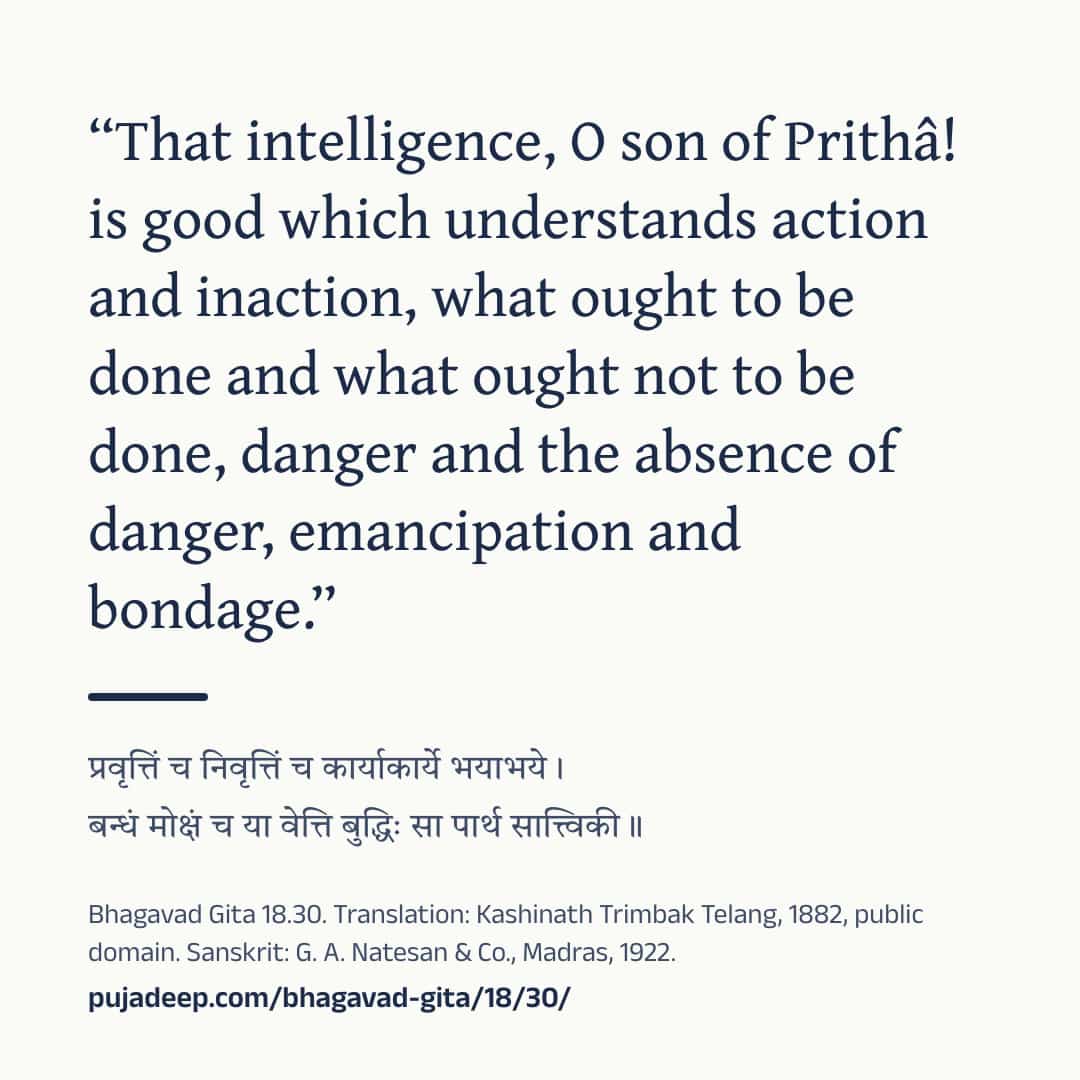
Drawing the picture
See the words
Bhagavad Gita 18.30

प्रवृत्तिं च निवृत्तिं च कार्याकार्ये भयाभये ।
बन्धं मोक्षं च या वेत्ति बुद्धिः सा पार्थ सात्त्विकी ॥

“That intelligence, O son of Prithâ! is good which understands action and inaction, what ought to be done and what ought not to be done, danger and the absence of danger, emancipation and bondage.”
(K. T. Telang, The Bhagavadgîtâ (The Sacred Books of the East, vol. VIII, Oxford: Clarendon Press, 1882), p. 125, public domain)

“That which knoweth action and inaction, what ought to be done and what ought not to done, fear and fearlessness, bondage and liberation, that Buddhi is sâttvic, O Pârtha.”
(Annie Besant, The Bhagavad Gîtâ, or The Lord's Song (London: Theosophical Publishing Society, 1895), p. 158, public domain)

“That which knows the paths of work and renunciation, right and wrong action, fear and fearlessness, bondage and liberation, that intellect, O Pârtha, is Sátvic.”
(Swami Swarupananda, Srimad-Bhagavad-Gita (Mayavati: Prabuddha Bharata Press, 1909; first printed in Prabuddha Bharata, 1907–1909), p. 332, public domain)

Sanskrit: G. A. Natesan & Co., Madras, 1922.
https://pujadeep.com/bhagavad-gita/18/30/ Nothing is sent from this site. Your own app sends it, to the chat you choose. The picture quotes the translation you chose on this page, with its name and year.
Sanskrit text: The Bhagavad-Gita, or The Lord's Song, with the text in Devanagari and an English translation, 1922. Meanings: written for Pujadeep and checked against the cited edition. Source and changes
Questions families ask
Who speaks Bhagavad Gita 18.30?
Krishna speaks this verse, in chapter 18 (Moksha Sannyasa Yoga).
Where does the Sanskrit text come from?
Sanskrit text: The Bhagavad-Gita, or The Lord's Song, with the text in Devanagari and an English translation, 1922. Meanings: written for Pujadeep and checked against the cited edition. See the source
Is the meaning on this page a translation?
Explanation written for this site from the sources listed here, and checked against the cited edition. It is not a translation and not the only way to read the text. Free to quote with credit.
Source and licence
- Sanskrit text
- The Bhagavad-Gita, or The Lord's Song, with the text in Devanagari and an English translation (Annie Besant, G. A. Natesan & Co., Madras, 1922). Public domain. The Sanskrit on these pages was read from this printing’s page images.
- Translation
- The Bhagavadgîtâ with the Sanatsugâtîya and the Anugîtâ, translated by Kâshinâth Trimbak Telang (The Sacred Books of the East, vol. VIII, ed. F. Max Müller) (Kashinath Trimbak Telang, F. Max Müller, Clarendon Press, Oxford, 1882). Public domain. Shown verbatim, as printed.
- Translation
- The Bhagavad Gîtâ, or The Lord's Song, translated by Annie Besant (Annie Besant, Theosophical Publishing Society, London, 1895). Public domain. Shown verbatim, as printed.
- Translation
- Srimad-Bhagavad-Gita, with Sanskrit Text; Paraphrase with Word-by-word Literal Translation; English Rendering and Comments, Index, &c., by the Swami Swarupananda (Himalayan Series, No. XX) (Swami Swarupananda, The Editors and Publishers, Advaita Ashrama, Mayavati, Prabuddha Bharata Press, Mayavati, Almora, Himalayas, 1909). Public domain. Shown verbatim, as printed.
- Common wording
- In this text, 32 words follow today's common wording, checked against sanskritdocuments.org; Sanskrit Wikisource; Gita Press, Gorakhpur; GRETIL, Göttingen and Bhaktivedanta Book Trust.
- Our explanation
- Explanation written for this site from the sources listed here, and checked against the cited edition. It is not a translation and not the only way to read the text. Free to quote with credit.
- Checked
- Checked against the cited edition, October 15, 2026.
- Updated
- October 25, 2026