भगवद्गीता 18.34: अर्थ और अनुवाद
अध्याय 18: मोक्षसंन्यासयोग। कृष्ण कहते हैं
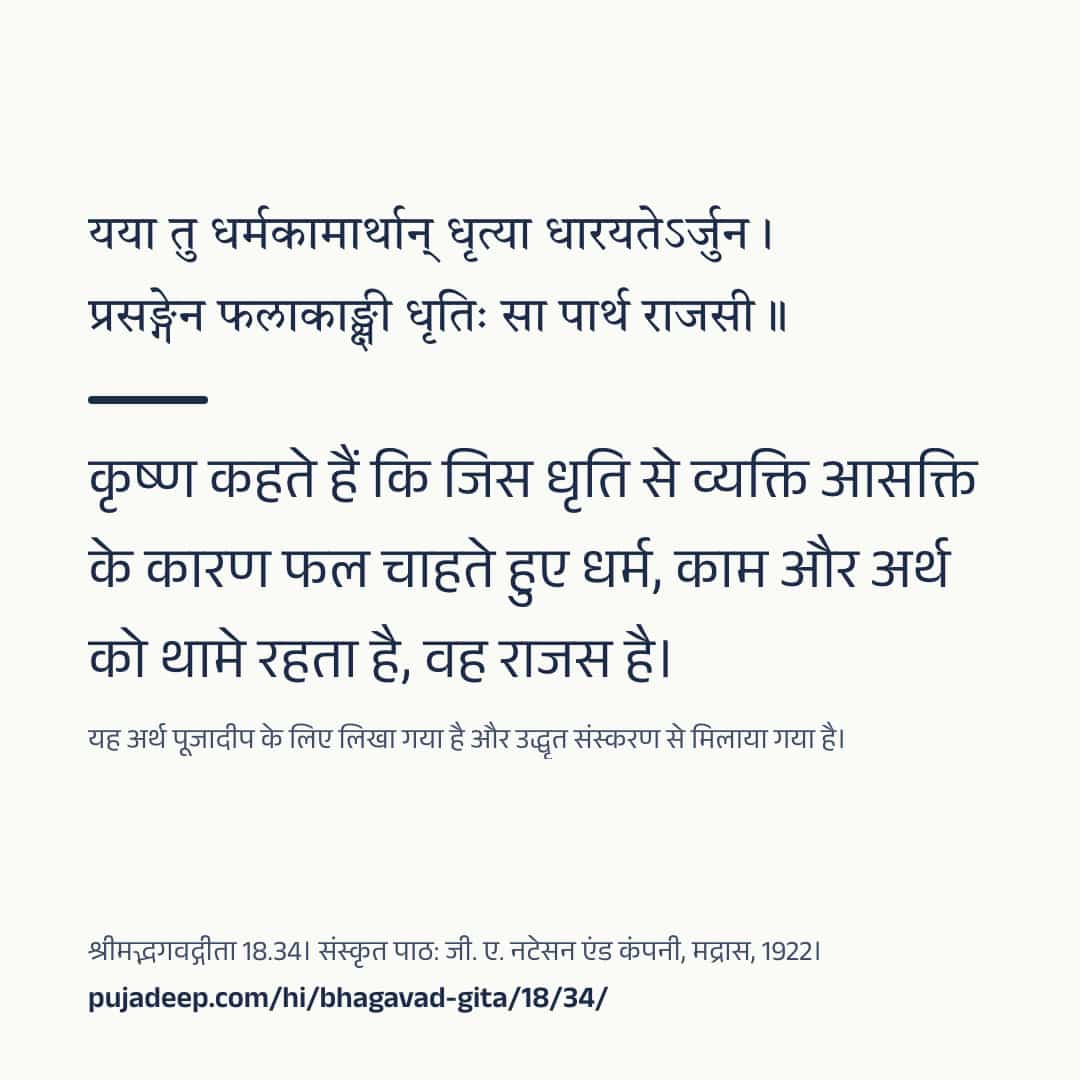
श्रीमद्भगवद्गीता (Bhagavad Gita) 18.34: कृष्ण कहते हैं कि जिस धृति से व्यक्ति आसक्ति के कारण फल चाहते हुए धर्म, काम और अर्थ को थामे रहता है, वह राजस है।
किसी शब्द पर क्लिक करें या उसे छुएँ, उसका अर्थ और कोश का पृष्ठ देखें।
दिखावट
दिखावट
ये चुनाव इसी ब्राउज़र में रहते हैं।
श्रीमद्भगवद्गीता 18.34
यया तु धर्मकामार्थान् धृत्या धारयतेऽर्जुन ।प्रसङ्गेन फलाकाङ्क्षी धृतिः सा पार्थ राजसी ॥
Yaya tu dharmakamarthan dhritya dharayaterjunaPrasangena phalakankshi dhritih sa partha rajasi
yayā tu dharmakāmārthān dhṛtyā dhārayate’rjuna |prasaṅgena phalākāṅkṣī dhṛtiḥ sā pārtha rājasī ||
भावार्थ कृष्ण कहते हैं कि जिस धृति से व्यक्ति आसक्ति के कारण फल चाहते हुए धर्म, काम और अर्थ को थामे रहता है, वह राजस है। तेलंग की टिप्पणी बताती है कि ये जीवन के चार लक्ष्यों (पुरुषार्थों) में से तीन हैं, चौथा मोक्ष है।
English meaning Krishna says that the steadiness by which one holds on to dharma, desire and wealth, wanting their fruit out of attachment, is steadiness of the nature of rajas. Telang's note explains these as three of the aims of life, the fourth being liberation.
शब्दार्थ
हर शब्द, शब्दकोश के पृष्ठ के साथ
शब्दार्थ
- यया yayā · जिस (सर्वनाम (स्त्रीलिंग), तृतीया एकवचन) शब्दकोश: yad, मोनियर-विलियम्स 1899, पृ. 844, स्तंभ 2
who, which, what, whichever, whatever, that
- तु tu · परंतु (अव्यय) शब्दकोश: 2. tu, मोनियर-विलियम्स 1899, पृ. 449, स्तंभ 3
but
- धर्मकामार्थान् dharmakāmārthān · धर्म, काम और अर्थ को (समास (पुंलिंग), द्वितीया बहुवचन) शब्दकोश: 1. dharma, मोनियर-विलियम्स 1899, पृ. 510, स्तंभ 3
usage, practice, customary observance or prescribed conduct, duty
; kāma, मोनियर-विलियम्स 1899, पृ. 271, स्तंभ 3wish, desire, longing
; artha, मोनियर-विलियम्स 1899, पृ. 90, स्तंभ 3substance, wealth, property, opulence, money
- धृत्या dhṛtyā · धृति से (संज्ञा (स्त्रीलिंग), तृतीया एकवचन) शब्दकोश: dhṛti, मोनियर-विलियम्स 1899, पृ. 519, स्तंभ 3
firmness, constancy, resolution, will, command
- धारयते dhārayate · धारण करता है (णिजन्त, वर्तमान काल (लट्), प्रथम पुरुष एकवचन) शब्दकोश: dhṛ, मोनियर-विलियम्स 1899, पृ. 519, स्तंभ 1
to hold, bear (also = bring forth), carry, maintain, preserve, keep, possess
- अर्जुन arjuna · हे अर्जुन (संज्ञा (पुंलिंग), संबोधन एकवचन) शब्दकोश: arjuna, मोनियर-विलियम्स 1899, पृ. 90, स्तंभ 1
of the third of the Pāṇḍava princes (who was a son of Indra and Kuntī)
- प्रसङ्गेन prasaṅgena · आसक्ति के कारण (संज्ञा (पुंलिंग), तृतीया एकवचन) शब्दकोश: pra-saṅga, मोनियर-विलियम्स 1899, पृ. 696, स्तंभ 2
adherence, attachment, inclination or devotion to, indulgence in, fondness for
- फलाकाङ्क्षी phalākāṅkṣī · फल चाहने वाला (समास (पुंलिंग), प्रथमा एकवचन) शब्दकोश: phala, मोनियर-विलियम्स 1899, पृ. 716, स्तंभ 2
fruit (met.), consequence, effect, result, retribution (good or bad)
; ākāṅkṣin, मोनियर-विलियम्स 1899, पृ. 126, स्तंभ 3ifc. wishing, desirous, hoping, expecting
- धृतिः dhṛtiḥ · धृति (संज्ञा (स्त्रीलिंग), प्रथमा एकवचन) शब्दकोश: dhṛti, मोनियर-विलियम्स 1899, पृ. 519, स्तंभ 3
firmness, constancy, resolution, will, command
- सा sā · वह (सर्वनाम (स्त्रीलिंग), प्रथमा एकवचन) शब्दकोश: tad, मोनियर-विलियम्स 1899, पृ. 434, स्तंभ 1
m. he, f. she, n. it, that, this
- पार्थ pārtha · हे पार्थ (संज्ञा (पुंलिंग), संबोधन एकवचन) शब्दकोश: 2. pārtha, मोनियर-विलियम्स 1899, पृ. 621, स्तंभ 3
metron. of Yudhi-shṭhira or Bhīma-sena or Arjuna
- राजसी rājasī · राजसी (विशेषण (स्त्रीलिंग), प्रथमा एकवचन) शब्दकोश: rājasa, मोनियर-विलियम्स 1899, पृ. 875, स्तंभ 2
belonging or relating to the quality rajas
1 छपाई में पाठभेद
संस्करणों के अंतर। कोई दूसरा मुद्रण या पाठ इस स्थान को अलग ढंग से पढ़ता है।
- वर्तनी एक डिजिटल प्रति में पाठ है अक्षर वही हैं। 1922 का संस्करण धर्मकामार्थान् धृत्या को दो शब्दों में छापता है।
पुराने अंग्रेज़ी अनुवाद
Kashinath Trimbak Telang, 1882। सार्वजनिक डोमेन (कॉपीराइट-मुक्त)। पृष्ठ 125–126।
But, O Arguna! that courage is passionate, by which one adheres to piety, lust, and wealth1, and through attachment2 wishes, O son of Prithâ! for the fruit.
पाद-टिप्पणियाँ (अनुवादक की अपनी) - Three of the aims of mankind, the highest being final emancipation. In the view of the Gîtâ, piety, leading only to heaven, is of doubtful benefit. ↩
- I. e. to the action for attaining them, in the belief that one is the doer of it; the 'fruit' scil. of the action performed with an eye to the three things named. ↩
3 अनुवादों की तुलना करें
Kashinath Trimbak Telang, 1882। सार्वजनिक डोमेन (कॉपीराइट-मुक्त)। पृष्ठ 125–126।
But, O Arguna! that courage is passionate, by which one adheres to piety, lust, and wealth1, and through attachment2 wishes, O son of Prithâ! for the fruit.
पाद-टिप्पणियाँ (अनुवादक की अपनी) - Three of the aims of mankind, the highest being final emancipation. In the view of the Gîtâ, piety, leading only to heaven, is of doubtful benefit. ↩
- I. e. to the action for attaining them, in the belief that one is the doer of it; the 'fruit' scil. of the action performed with an eye to the three things named. ↩
आप यही पढ़ रहे हैं
Annie Besant, 1895। सार्वजनिक डोमेन (कॉपीराइट-मुक्त)। पृष्ठ 159।
The firmness, O Arjuna, by which one holdeth fast Dharma, pleasure and wealth, (and is) from attachment desirous of fruit, that firmness, O Pârtha, is râjasic.
आप यही पढ़ रहे हैं
Swami Swarupananda, 1909 (पहली बार 1907 में छपा)। सार्वजनिक डोमेन (कॉपीराइट-मुक्त)। पृष्ठ 333–334।
But the fortitude by which one regulates (one's mind) to Dharma, desire and wealth, desirous of the fruit of each from attachment, that fortitude, O Pârtha, is Rájasic.
आप यही पढ़ रहे हैं
इस श्लोक का हवाला दें
अनुवाद: K. T. Telang, The Bhagavadgîtâ (The Sacred Books of the East, vol. VIII, Oxford: Clarendon Press, 1882), पृष्ठ 125–126। भगवद्गीता 18.34।
अनुवाद: Annie Besant, The Bhagavad Gîtâ, or The Lord's Song (London: Theosophical Publishing Society, 1895), पृष्ठ 159। भगवद्गीता 18.34।
अनुवाद: Swami Swarupananda, Srimad-Bhagavad-Gita (Mayavati: Prabuddha Bharata Press, 1909; first printed in Prabuddha Bharata, 1907–1909), पृष्ठ 333–334। भगवद्गीता 18.34।
हमारी व्याख्या: “भगवद्गीता 18.34: अर्थ और अनुवाद”। पूजादीप। अद्यतन 25 अक्टूबर 2026। https://pujadeep.com/hi/bhagavad-gita/18/34/
पूजादीप की व्याख्याएँ श्रेय देकर उद्धृत की जा सकती हैं: पूजादीप का नाम और पृष्ठ का लिंक दें। श्रेय कैसे दें
शास्त्रीय व्याख्याएँ, संप्रदाय के अनुसार
इस श्लोक पर अभी संप्रदायों की व्याख्या नहीं है।
भेजें
साझा करने के तरीके दिखाएँ
एक तस्वीर या पाठ एक चैट में भेजें। तस्वीर पर उसका स्रोत और इस पृष्ठ का पता लिखा है।
तस्वीर बन रही है
शब्द देखें
श्रीमद्भगवद्गीता 18.34

यया तु धर्मकामार्थान् धृत्या धारयतेऽर्जुन ।
प्रसङ्गेन फलाकाङ्क्षी धृतिः सा पार्थ राजसी ॥

“But, O Arguna! that courage is passionate, by which one adheres to piety, lust, and wealth, and through attachment wishes, O son of Prithâ! for the fruit.”
(K. T. Telang, The Bhagavadgîtâ (The Sacred Books of the East, vol. VIII, Oxford: Clarendon Press, 1882), pp. 125–126, public domain)

“The firmness, O Arjuna, by which one holdeth fast Dharma, pleasure and wealth, (and is) from attachment desirous of fruit, that firmness, O Pârtha, is râjasic.”
(Annie Besant, The Bhagavad Gîtâ, or The Lord's Song (London: Theosophical Publishing Society, 1895), p. 159, public domain)

“But the fortitude by which one regulates (one's mind) to Dharma, desire and wealth, desirous of the fruit of each from attachment, that fortitude, O Pârtha, is Rájasic.”
(Swami Swarupananda, Srimad-Bhagavad-Gita (Mayavati: Prabuddha Bharata Press, 1909; first printed in Prabuddha Bharata, 1907–1909), pp. 333–334, public domain)

संस्कृत पाठ: जी. ए. नटेसन एंड कंपनी, मद्रास, 1922।
https://pujadeep.com/hi/bhagavad-gita/18/34/
इस साइट से कुछ नहीं भेजा जाता। आपका अपना ऐप उसे आपकी चुनी हुई चैट में भेजता है। तस्वीर में वही अनुवाद है जो आपने इस पृष्ठ पर चुना है, उसके नाम और वर्ष के साथ।
संस्कृत पाठ: 1922 का मद्रास मुद्रण। अर्थ: पूजादीप के लिए लिखे और जाँचे गए। स्रोत और बदलाव
परिवारों के प्रश्न
गीता 18.34 कौन कहता है?
यह श्लोक कृष्ण कहते हैं, अध्याय 18 (मोक्षसंन्यासयोग) में।
संस्कृत पाठ कहाँ से लिया गया है?
संस्कृत पाठ: 1922 का मद्रास मुद्रण। अर्थ: पूजादीप के लिए लिखे और जाँचे गए। स्रोत देखें
क्या इस पृष्ठ का अर्थ अनुवाद है?
इस साइट के लिए यहाँ दिए स्रोतों के आधार पर लिखी और उद्धृत संस्करण से मिलाई गई व्याख्या। यह अनुवाद नहीं है, और पाठ को पढ़ने का एकमात्र तरीका भी नहीं है। श्रेय देकर आप इसे उद्धृत कर सकते हैं।
स्रोत और लाइसेंस
- संस्कृत पाठ
- The Bhagavad-Gita, or The Lord's Song, with the text in Devanagari and an English translation (Annie Besant, G. A. Natesan & Co., Madras, 1922). सार्वजनिक डोमेन (कॉपीराइट-मुक्त)। इन पृष्ठों का संस्कृत पाठ इसी मुद्रण के पृष्ठ-चित्रों से पढ़ा गया है।
- अनुवाद
- The Bhagavadgîtâ with the Sanatsugâtîya and the Anugîtâ, translated by Kâshinâth Trimbak Telang (The Sacred Books of the East, vol. VIII, ed. F. Max Müller) (Kashinath Trimbak Telang, F. Max Müller, Clarendon Press, Oxford, 1882). सार्वजनिक डोमेन (कॉपीराइट-मुक्त)। जैसा छपा है, वैसा ही दिखाया गया।
- अनुवाद
- The Bhagavad Gîtâ, or The Lord's Song, translated by Annie Besant (Annie Besant, Theosophical Publishing Society, London, 1895). सार्वजनिक डोमेन (कॉपीराइट-मुक्त)। जैसा छपा है, वैसा ही दिखाया गया।
- अनुवाद
- Srimad-Bhagavad-Gita, with Sanskrit Text; Paraphrase with Word-by-word Literal Translation; English Rendering and Comments, Index, &c., by the Swami Swarupananda (Himalayan Series, No. XX) (Swami Swarupananda, The Editors and Publishers, Advaita Ashrama, Mayavati, Prabuddha Bharata Press, Mayavati, Almora, Himalayas, 1909). सार्वजनिक डोमेन (कॉपीराइट-मुक्त)। जैसा छपा है, वैसा ही दिखाया गया।
- प्रचलित पाठ
- इस पाठ में 32 शब्द आज के प्रचलित रूप में हैं; इन्हें sanskritdocuments.org; संस्कृत विकिस्रोत; गीता प्रेस, गोरखपुर; ग्रेटिल, गॉटिंगेन और भक्तिवेदांत बुक ट्रस्ट के पाठ से मिलाकर जाँचा गया।
- हमारी व्याख्या
- इस साइट के लिए यहाँ दिए स्रोतों के आधार पर लिखी और उद्धृत संस्करण से मिलाई गई व्याख्या। यह अनुवाद नहीं है, और पाठ को पढ़ने का एकमात्र तरीका भी नहीं है। श्रेय देकर आप इसे उद्धृत कर सकते हैं।
- जाँच
- उद्धृत संस्करण से मिलाया गया, 15 अक्टूबर 2026।
- अद्यतन
- 25 अक्टूबर 2026