Bhagavad Gita 3.43: meaning and translation
Chapter 3: Karma Yoga. Krishna says
In the last verse of the chapter, Krishna tells Arjuna, the mighty-armed, to know what is higher than the understanding, to steady the self by the self, and so to slay this enemy in the form of desire, which is hard to overcome.
Click or tap a word for its meaning and its dictionary page.
Text and layers
Text and layers
These choices stay in this browser.
Bhagavad Gita 3.43
एवं बुद्धेः परं बुध्वा संस्तभ्यात्मानमात्मना ।जहि शत्रुं महाबाहो कामरूपं दुरासदम् ॥
Evam buddheh param budhva sanstabhyatmanamatmanaJahi shatrum mahabaho kamarupam durasadam
evaṃ buddheḥ paraṃ budhvā saṃstabhyātmānamātmanā |jahi śatruṃ mahābāho kāmarūpaṃ durāsadam ||
Our explanation In the last verse of the chapter, Krishna tells Arjuna, the mighty-armed, to know what is higher than the understanding, to steady the self by the self, and so to slay this enemy in the form of desire, which is hard to overcome. The schools differ here as in 3.42 (see the views).
हिंदी अर्थ अध्याय के अंतिम श्लोक में कृष्ण महाबाहो अर्जुन से कहते हैं कि बुद्धि से परे जो है उसे जानो, आत्मा को आत्मा से स्थिर करो, और इस तरह कामना रूपी इस शत्रु को मारो, जिसे जीतना कठिन है। यहाँ भी परंपराओं के मत 3.42 की तरह अलग हैं।
Word by word
Every word, with its dictionary page
Word by word
- एवम् evam · thus (indeclinable) Dictionary: evam, Monier-Williams 1899, p. 232, col. 2 “thus, in this way, in such a manner”
- बुद्धेः buddheḥ · than the understanding (noun (feminine), ablative singular) Dictionary: buddhi, Monier-Williams 1899, p. 733, col. 3 “intelligence, reason, intellect, mind, discernment, judgment”
- परम् param · what is higher (adjective (masculine), accusative singular) Dictionary: 1. para, Monier-Williams 1899, p. 586, col. 1 “highest, supreme, chief”
- बुध्वा budhvā · having known (absolutive (having done)) Dictionary: 1. budh, Monier-Williams 1899, p. 733, col. 2 “to perceive, notice, learn, understand, become or be aware of”
- संस्तभ्य saṃstabhya · steadying (absolutive (having done)) Dictionary: saṃ-stabhya, Monier-Williams 1899, p. 1121, col. 1 “having supported or confirmed or strengthened or encouraged”; saṃ-stambh, Monier-Williams 1899, p. 1121, col. 1 “to make firm”
- आत्मानम् ātmānam · oneself, the mind (noun (masculine), accusative singular) Dictionary: ātman, Monier-Williams 1899, p. 135, col. 1 “the individual soul, self”
- आत्मना ātmanā · by the self (noun (masculine), instrumental singular) Dictionary: ātman, Monier-Williams 1899, p. 135, col. 1 “the individual soul, self”
- जहि jahi · slay (imperative, 2nd person singular) Dictionary: 1. han, Monier-Williams 1899, p. 1287, col. 2 “to smite, slay, hit, kill, mar, destroy”
- शत्रुम् śatrum · the enemy (noun (masculine), accusative singular) Dictionary: śatru, Monier-Williams 1899, p. 1051, col. 1 “an enemy, foe, rival”
- महाबाहो mahābāho · O mighty-armed (noun (masculine), vocative singular) Dictionary: mahā-bāhu, Monier-Williams 1899, p. 798, col. 1 “long-armed”
- कामरूपम् kāmarūpam · in the form of desire (compound (masculine), accusative singular) Dictionary: kāma, Monier-Williams 1899, p. 271, col. 3 “wish, desire, longing”; rūpa, Monier-Williams 1899, p. 885, col. 3 “any outward appearance or phenomenon or colour (often pl.), form, shape, figure”
- दुरासदम् durāsadam · hard to overcome (adjective (masculine), accusative singular) Dictionary: dur-āsada, Monier-Williams 1899, p. 485, col. 1 “dangerous to be approached”
2 printings differ
Edition differences. Another printing or text reads this place differently.
- Spelling A digital text reads Same word. The 1922 edition prints बुध्वा with one द्, the accepted optional spelling also seen in प्रसिध्येत् (3.8; Pāṇini 8.4.65); this e-text writes बुद्ध्वा.
- Spelling A digital text reads Writes buddhvā, like another digital text.
Old translations
Kashinath Trimbak Telang, 1882. Public domain. Page 57–58.
Thus knowing that which is higher than the understanding, and restraining (your)self by (your)self, O you of mighty arms! destroy this unmanageable enemy in the shape of desire.
Compare 3 translations
Kashinath Trimbak Telang, 1882. Public domain. Page 57–58.
Thus knowing that which is higher than the understanding, and restraining (your)self by (your)self, O you of mighty arms! destroy this unmanageable enemy in the shape of desire.
You are reading this one
Annie Besant, 1895. Public domain. Page 48.
Thus understanding Him as greater than Buddhi, restraining the self by the SELF, slay thou, O mighty-armed, the enemy in the form of desire, difficult to overcome.
You are reading this one
Swami Swarupananda, 1909 (first printed 1907). Public domain. Page 83.
Thus, knowing Him who is the superior of the intellect, and restraining the self by the Self destroy, O mighty-armed, that enemy, the unseizable foe, of desire.
You are reading this one
Cite this verse
The translation: K. T. Telang, The Bhagavadgîtâ (The Sacred Books of the East, vol. VIII, Oxford: Clarendon Press, 1882), pp. 57–58. Bhagavad Gita 3.43.
The translation: Annie Besant, The Bhagavad Gîtâ, or The Lord's Song (London: Theosophical Publishing Society, 1895), p. 48. Bhagavad Gita 3.43.
The translation: Swami Swarupananda, Srimad-Bhagavad-Gita (Mayavati: Prabuddha Bharata Press, 1909; first printed in Prabuddha Bharata, 1907–1909), p. 83. Bhagavad Gita 3.43.
Our explanation: “Bhagavad Gita 3.43: meaning and translation.” Pujadeep. Updated October 27, 2026. https://pujadeep.com/bhagavad-gita/3/43/
Pujadeep’s explanations are free to quote with credit: name Pujadeep and link to the page. How to credit
Classical readings, by school
Each reading is named by its school. None is presented as the only meaning.
What Advaita, Vishishtadvaita and Dvaita teach, in short
Shankara Advaita
Shankara says that Arjuna, knowing the Self that is beyond the understanding and steadying the mind by means of the self, is to slay desire. It is hard to conquer, he adds, because its nature is complex and hard to grasp.
Source: The Bhagavad-Gita, with the commentary of Sri Sankaracharya, translated by A. Mahadeva Sastri (2nd ed., Mysore: G. T. A. Printing Works, 1901), commentary on 3.43, p. 103. Summarised in our own words; none of its text is reproduced.
Ramanuja Vishishtadvaita
Ramanuja says that, knowing desire to be stronger even than the understanding, Arjuna should steady his mind with his understanding, keep it fixed on the self, and destroy this enemy.
Source: Sri Bhagavad-Gita with Sri Ramanujacharya's Visishtadvaita commentary, translated by A. Govindacharya (Madras, 1898), commentary on 3.43, p. 127. Summarised in our own words; none of its text is reproduced.
Share
Show the ways to share
Send one picture or the text to one chat. The picture names its source and the address of this page.
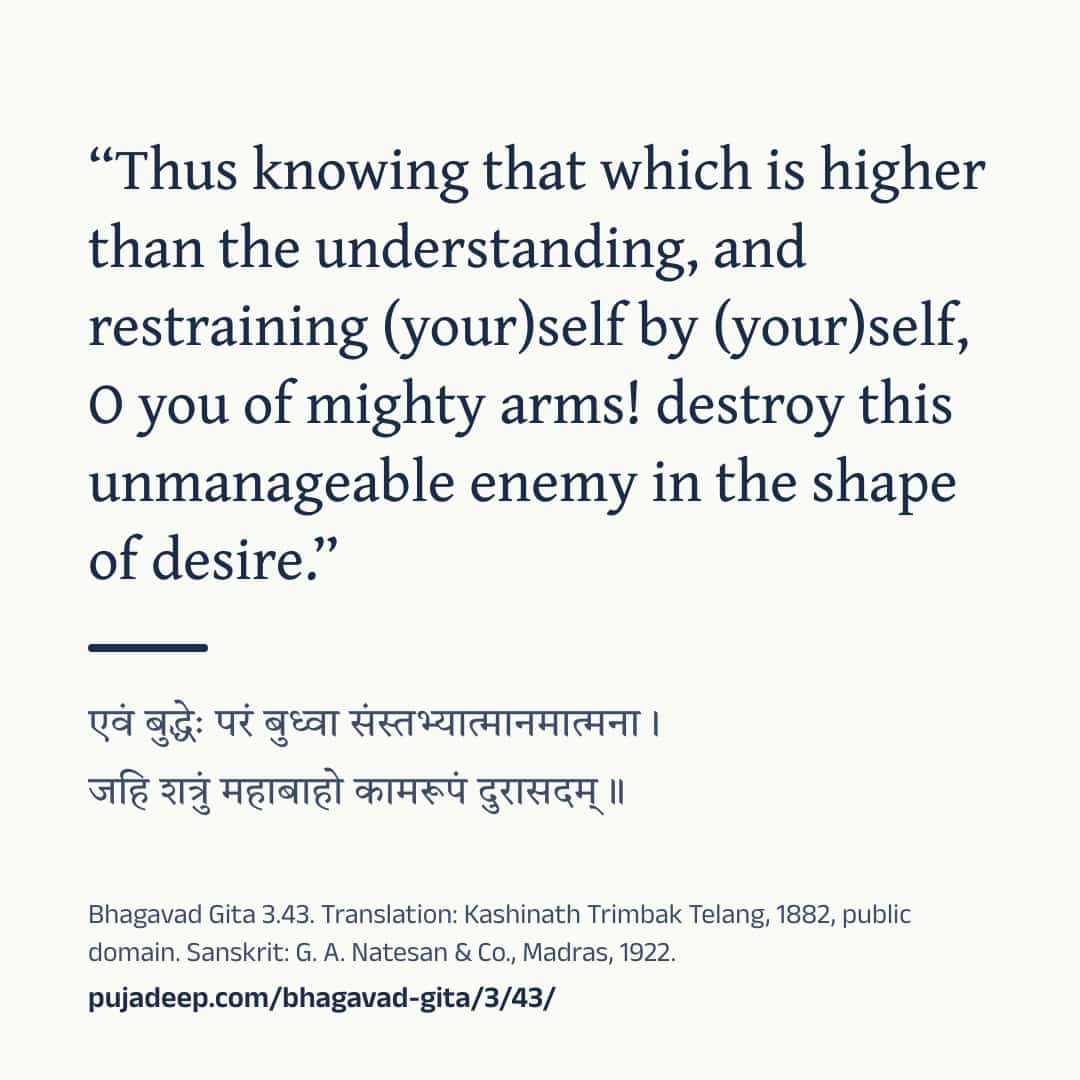
Drawing the picture
See the words
Bhagavad Gita 3.43

एवं बुद्धेः परं बुध्वा संस्तभ्यात्मानमात्मना ।
जहि शत्रुं महाबाहो कामरूपं दुरासदम् ॥

“Thus knowing that which is higher than the understanding, and restraining (your)self by (your)self, O you of mighty arms! destroy this unmanageable enemy in the shape of desire.”
(K. T. Telang, The Bhagavadgîtâ (The Sacred Books of the East, vol. VIII, Oxford: Clarendon Press, 1882), pp. 57–58, public domain)

“Thus understanding Him as greater than Buddhi, restraining the self by the SELF, slay thou, O mighty-armed, the enemy in the form of desire, difficult to overcome.”
(Annie Besant, The Bhagavad Gîtâ, or The Lord's Song (London: Theosophical Publishing Society, 1895), p. 48, public domain)

“Thus, knowing Him who is the superior of the intellect, and restraining the self by the Self destroy, O mighty-armed, that enemy, the unseizable foe, of desire.”
(Swami Swarupananda, Srimad-Bhagavad-Gita (Mayavati: Prabuddha Bharata Press, 1909; first printed in Prabuddha Bharata, 1907–1909), p. 83, public domain)

Sanskrit: G. A. Natesan & Co., Madras, 1922.
https://pujadeep.com/bhagavad-gita/3/43/ Nothing is sent from this site. Your own app sends it, to the chat you choose. The picture quotes the translation you chose on this page, with its name and year.
Sanskrit text: The Bhagavad-Gita, or The Lord's Song, with the text in Devanagari and an English translation, 1922. Meanings: written for Pujadeep and checked against the cited edition. Source and changes
Questions families ask
Who speaks Bhagavad Gita 3.43?
Krishna speaks this verse, in chapter 3 (Karma Yoga).
Where does the Sanskrit text come from?
Sanskrit text: The Bhagavad-Gita, or The Lord's Song, with the text in Devanagari and an English translation, 1922. Meanings: written for Pujadeep and checked against the cited edition. See the source
Is the meaning on this page a translation?
Explanation written for this site from the sources listed here, and checked against the cited edition. It is not a translation and not the only way to read the text. Free to quote with credit.
Source and licence
- Sanskrit text
- The Bhagavad-Gita, or The Lord's Song, with the text in Devanagari and an English translation (Annie Besant, G. A. Natesan & Co., Madras, 1922). Public domain. The Sanskrit on these pages was read from this printing’s page images.
- Translation
- The Bhagavadgîtâ with the Sanatsugâtîya and the Anugîtâ, translated by Kâshinâth Trimbak Telang (The Sacred Books of the East, vol. VIII, ed. F. Max Müller) (Kashinath Trimbak Telang, F. Max Müller, Clarendon Press, Oxford, 1882). Public domain. Shown verbatim, as printed.
- Translation
- The Bhagavad Gîtâ, or The Lord's Song, translated by Annie Besant (Annie Besant, Theosophical Publishing Society, London, 1895). Public domain. Shown verbatim, as printed.
- Translation
- Srimad-Bhagavad-Gita, with Sanskrit Text; Paraphrase with Word-by-word Literal Translation; English Rendering and Comments, Index, &c., by the Swami Swarupananda (Himalayan Series, No. XX) (Swami Swarupananda, The Editors and Publishers, Advaita Ashrama, Mayavati, Prabuddha Bharata Press, Mayavati, Almora, Himalayas, 1909). Public domain. Shown verbatim, as printed.
- Commentary
- The Bhagavad-Gita, with the commentary of Sri Sankaracharya, translated by A. Mahadeva Sastri (2nd ed., Mysore: G. T. A. Printing Works, 1901) (Public-domain scan, University of California Libraries). Summarised in our own words; none of its text is reproduced.
- Commentary
- Sri Bhagavad-Gita with Sri Ramanujacharya's Visishtadvaita commentary, translated by A. Govindacharya (Madras, 1898) (Scan uploaded to archive.org (folkscanomy collection)). Summarised in our own words; none of its text is reproduced.
- Common wording
- In this text, 32 words follow today's common wording, checked against sanskritdocuments.org; Sanskrit Wikisource; Gita Press, Gorakhpur; GRETIL, Göttingen and Bhaktivedanta Book Trust.
- Our explanation
- Explanation written for this site from the sources listed here, and checked against the cited edition. It is not a translation and not the only way to read the text. Free to quote with credit.
- Checked
- Checked against the cited edition, October 27, 2026.