Bhagavad Gita 3.36: meaning and translation
Chapter 3: Karma Yoga. Arjuna says
Arjuna asks: then what drives a person to do wrong (pāpa), even against his own wish, as if pushed by force?
Click or tap a word for its meaning and its dictionary page.
Text and layers
Text and layers
These choices stay in this browser.
Bhagavad Gita 3.36
अर्जुन उवाच ।
अथ केन प्रयुक्तोऽयं पापं चरति पूरुषः ।अनिच्छन्नपि वार्ष्णेय बलादिव नियोजितः ॥
Atha kena prayuktoyam papam charati purushahAnichchhannapi varshneya baladiva niyojitah
atha kena prayukto’yaṃ pāpaṃ carati pūruṣaḥ |anicchannapi vārṣṇeya balādiva niyojitaḥ ||
Our explanation Arjuna asks: then what drives a person to do wrong (pāpa), even against his own wish, as if pushed by force? He calls Krishna Varshneya, one of the Vrishni clan.
हिंदी अर्थ अर्जुन पूछते हैं: फिर किस प्रेरणा से मनुष्य, न चाहते हुए भी, मानो बलपूर्वक धकेला गया हो, पाप करता है? वे कृष्ण को वार्ष्णेय (वृष्णि वंश में जन्मे) कहकर पुकारते हैं।
Word by word
Every word, with its dictionary page
Word by word
- अथ atha · then (indeclinable) Dictionary: atha, Monier-Williams 1899, p. 17, col. 3 “now; then; moreover”
- केन kena · by what (pronoun (masculine), instrumental singular) Dictionary: kim, Monier-Williams 1899, p. 282, col. 2 “what? how? whence? wherefore? why?”
- प्रयुक्तः prayuktaḥ · driven, impelled (past participle (masculine), nominative singular) Dictionary: pra-yukta, Monier-Williams 1899, p. 688, col. 2 “urged, ordered, bidden”
- अयम् ayam · this (person) (pronoun (masculine), nominative singular) Dictionary: 1. idam, Monier-Williams 1899, p. 165, col. 2
- पापम् pāpam · wrong, sin (noun (neuter), accusative singular) Dictionary: pāpa, Monier-Williams 1899, p. 618, col. 2 “sin, vice, crime, guilt”
- चरति carati · does (present, 3rd person singular) Dictionary: car, Monier-Williams 1899, p. 389, col. 1 “to move one's self, go, walk, move, stir, roam about, wander”
- पूरुषः pūruṣaḥ · a person (noun (masculine), nominative singular) Dictionary: pūruṣa, Monier-Williams 1899, p. 643, col. 1; puruṣa, Monier-Williams 1899, p. 637, col. 1 “a person”
- अनिच्छन् anicchan · not wishing (present participle (masculine), nominative singular) Dictionary: an-icchat, Monier-Williams 1899, p. 29, col. 2 “undesirous, averse, unwilling; not intending”
- अपि api · even (indeclinable) Dictionary: api, Monier-Williams 1899, p. 55, col. 1 “even, also, very”
- वार्ष्णेय vārṣṇeya · O Varshneya (Krishna) (noun (masculine), vocative singular) Dictionary: vārṣṇeya, Monier-Williams 1899, p. 946, col. 1 “of Kṛishṇa, Bhag.”
- बलात् balāt · by force (noun (neuter), ablative singular) Dictionary: bala, Monier-Williams 1899, p. 722, col. 3 “power, strength, might, vigour, force”
- इव iva · as if (indeclinable) Dictionary: iva, Monier-Williams 1899, p. 168, col. 3 “as it were, as if”
- नियोजितः niyojitaḥ · pushed, made to act (past participle (masculine), nominative singular) Dictionary: ni-yuj, Monier-Williams 1899, p. 552, col. 2 “to enjoin, urge, impel, coerce, appoint”
Old translations
Kashinath Trimbak Telang, 1882. Public domain. Page 56.
Arguna said:
But by whom, O descendant of Vrishni! is man impelled, even though unwilling, and, as it were, constrained by force, to commit sin?
Compare 3 translations
Kashinath Trimbak Telang, 1882. Public domain. Page 56.
Arguna said:
But by whom, O descendant of Vrishni! is man impelled, even though unwilling, and, as it were, constrained by force, to commit sin?
You are reading this one
Annie Besant, 1895. Public domain. Page 47.
Arjuna said:
But dragged on by what does a man commit sin, reluctantly indeed, O Vârshneya, as it were by force constrained?
You are reading this one
Swami Swarupananda, 1909 (first printed 1907). Public domain. Page 79.
Arjuna said:
But by what impelled does man commit sin, though against his wishes, O Vârshneya, constrained as it were, by force?
You are reading this one
Cite this verse
The translation: K. T. Telang, The Bhagavadgîtâ (The Sacred Books of the East, vol. VIII, Oxford: Clarendon Press, 1882), p. 56. Bhagavad Gita 3.36.
The translation: Annie Besant, The Bhagavad Gîtâ, or The Lord's Song (London: Theosophical Publishing Society, 1895), p. 47. Bhagavad Gita 3.36.
The translation: Swami Swarupananda, Srimad-Bhagavad-Gita (Mayavati: Prabuddha Bharata Press, 1909; first printed in Prabuddha Bharata, 1907–1909), p. 79. Bhagavad Gita 3.36.
Our explanation: “Bhagavad Gita 3.36: meaning and translation.” Pujadeep. Updated October 27, 2026. https://pujadeep.com/bhagavad-gita/3/36/
Pujadeep’s explanations are free to quote with credit: name Pujadeep and link to the page. How to credit
Classical readings, by school
No readings by school on this verse yet.
Share
Show the ways to share
Send one picture or the text to one chat. The picture names its source and the address of this page.
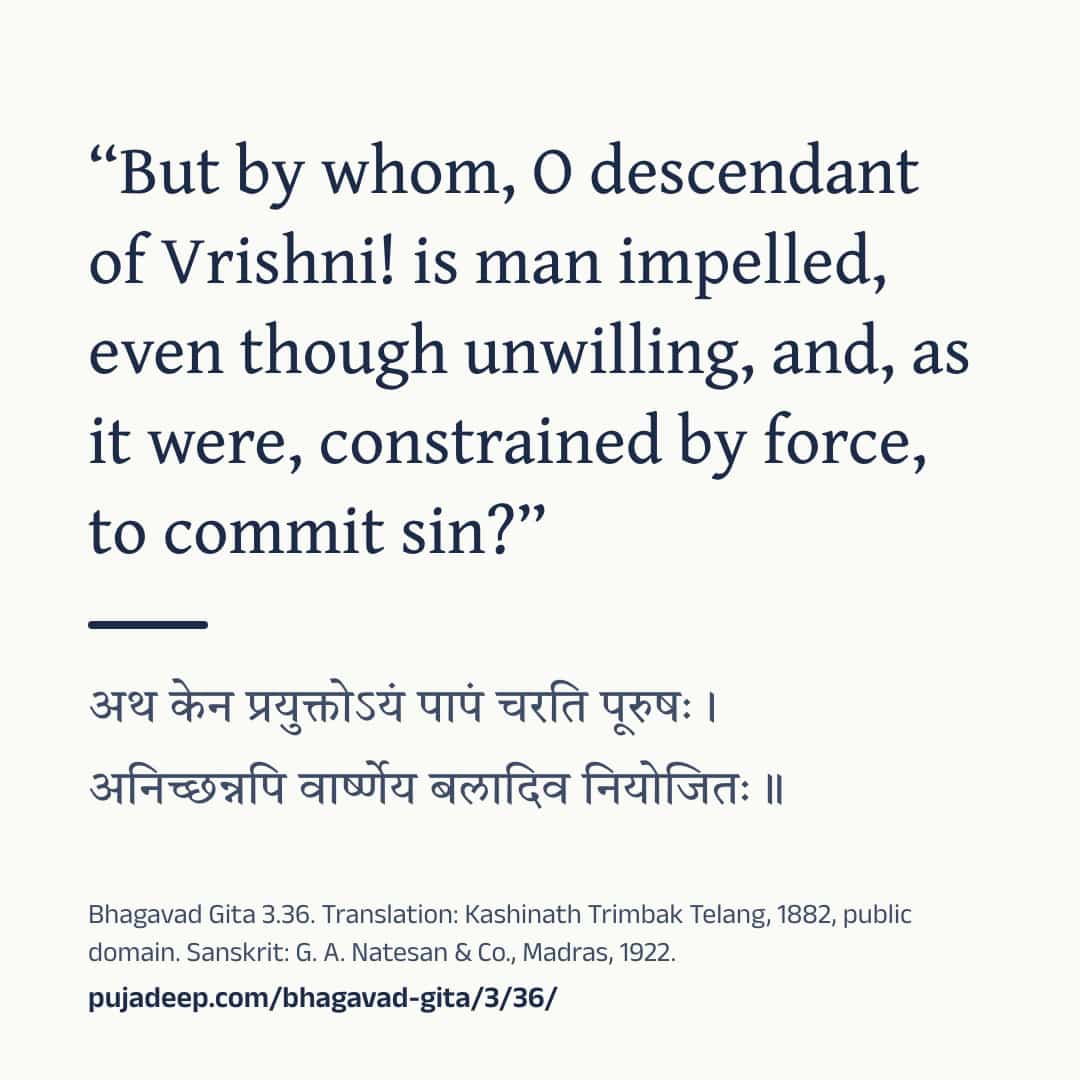
Drawing the picture
See the words
Bhagavad Gita 3.36

अथ केन प्रयुक्तोऽयं पापं चरति पूरुषः ।
अनिच्छन्नपि वार्ष्णेय बलादिव नियोजितः ॥

“But by whom, O descendant of Vrishni! is man impelled, even though unwilling, and, as it were, constrained by force, to commit sin?”
(K. T. Telang, The Bhagavadgîtâ (The Sacred Books of the East, vol. VIII, Oxford: Clarendon Press, 1882), p. 56, public domain)

“But dragged on by what does a man commit sin, reluctantly indeed, O Vârshneya, as it were by force constrained?”
(Annie Besant, The Bhagavad Gîtâ, or The Lord's Song (London: Theosophical Publishing Society, 1895), p. 47, public domain)

“But by what impelled does man commit sin, though against his wishes, O Vârshneya, constrained as it were, by force?”
(Swami Swarupananda, Srimad-Bhagavad-Gita (Mayavati: Prabuddha Bharata Press, 1909; first printed in Prabuddha Bharata, 1907–1909), p. 79, public domain)

Sanskrit: G. A. Natesan & Co., Madras, 1922.
https://pujadeep.com/bhagavad-gita/3/36/ Nothing is sent from this site. Your own app sends it, to the chat you choose. The picture quotes the translation you chose on this page, with its name and year.
Sanskrit text: The Bhagavad-Gita, or The Lord's Song, with the text in Devanagari and an English translation, 1922. Meanings: written for Pujadeep and checked against the cited edition. Source and changes
Questions families ask
Who speaks Bhagavad Gita 3.36?
Arjuna speaks this verse, in chapter 3 (Karma Yoga).
Where does the Sanskrit text come from?
Sanskrit text: The Bhagavad-Gita, or The Lord's Song, with the text in Devanagari and an English translation, 1922. Meanings: written for Pujadeep and checked against the cited edition. See the source
Is the meaning on this page a translation?
Explanation written for this site from the sources listed here, and checked against the cited edition. It is not a translation and not the only way to read the text. Free to quote with credit.
Source and licence
- Sanskrit text
- The Bhagavad-Gita, or The Lord's Song, with the text in Devanagari and an English translation (Annie Besant, G. A. Natesan & Co., Madras, 1922). Public domain. The Sanskrit on these pages was read from this printing’s page images.
- Translation
- The Bhagavadgîtâ with the Sanatsugâtîya and the Anugîtâ, translated by Kâshinâth Trimbak Telang (The Sacred Books of the East, vol. VIII, ed. F. Max Müller) (Kashinath Trimbak Telang, F. Max Müller, Clarendon Press, Oxford, 1882). Public domain. Shown verbatim, as printed.
- Translation
- The Bhagavad Gîtâ, or The Lord's Song, translated by Annie Besant (Annie Besant, Theosophical Publishing Society, London, 1895). Public domain. Shown verbatim, as printed.
- Translation
- Srimad-Bhagavad-Gita, with Sanskrit Text; Paraphrase with Word-by-word Literal Translation; English Rendering and Comments, Index, &c., by the Swami Swarupananda (Himalayan Series, No. XX) (Swami Swarupananda, The Editors and Publishers, Advaita Ashrama, Mayavati, Prabuddha Bharata Press, Mayavati, Almora, Himalayas, 1909). Public domain. Shown verbatim, as printed.
- Common wording
- In this text, 32 words follow today's common wording, checked against sanskritdocuments.org; Sanskrit Wikisource; Gita Press, Gorakhpur; GRETIL, Göttingen and Bhaktivedanta Book Trust.
- Our explanation
- Explanation written for this site from the sources listed here, and checked against the cited edition. It is not a translation and not the only way to read the text. Free to quote with credit.
- Checked
- Checked against the cited edition, October 27, 2026.