Bhagavad Gita 3.26: meaning and translation
Chapter 3: Karma Yoga. Krishna says
A wise person should not unsettle the understanding of the unwise who are attached to action, Krishna says.
Click or tap a word for its meaning and its dictionary page.
Text and layers
Text and layers
These choices stay in this browser.
Bhagavad Gita 3.26
न बुद्धिभेदं जनयेदज्ञानां कर्मसङ्गिनाम् ।जोषयेत्सर्वकर्माणि विद्वान्युक्तः समाचरन् ॥
Na buddhibhedam janayedajnanam karmasanginamJoshayetsarvakarmani vidvanyuktah samacharan
na buddhibhedaṃ janayedajñānāṃ karmasaṅginām |joṣayetsarvakarmāṇi vidvānyuktaḥ samācaran ||
Our explanation A wise person should not unsettle the understanding of the unwise who are attached to action, Krishna says. Acting steadily in yoga (yukta), the wise should do all work and lead others to do it gladly. Telang reads the last words as making the unwise apply themselves to all action, Besant as rendering all action attractive.
हिंदी अर्थ कृष्ण कहते हैं कि ज्ञानी को कर्म में आसक्त अज्ञानियों की बुद्धि में भेद (उलझन) नहीं डालना चाहिए। योग में स्थित (युक्त) रहकर, स्वयं सब कर्म करते हुए, उसे दूसरों को भी प्रसन्नता से कर्म में लगाना चाहिए। तेलंग अंतिम शब्दों का अर्थ लेते हैं कि ज्ञानी अज्ञानियों को सब कर्मों में लगाए; बेसेंट, कि वह सब कर्मों को आकर्षक बनाए।
Word by word
Every word, with its dictionary page
Word by word
- न na · not (indeclinable) Dictionary: 2. na, Monier-Williams 1899, p. 523, col. 1 “not, no, nor, neither”
- बुद्धिभेदम् buddhibhedam · unsettling of the understanding (compound (masculine), accusative singular) Dictionary: buddhi, Monier-Williams 1899, p. 733, col. 3 “intelligence, reason, intellect, mind, discernment, judgment”; bheda, Monier-Williams 1899, p. 766, col. 1 “disturbance, interruption, violation, dissolution”
- जनयेत् janayet · should cause (causative optative, 3rd person singular) Dictionary: jan, Monier-Williams 1899, p. 410, col. 1 “to generate, beget, produce, create, cause”
- अज्ञानाम् ajñānām · of the unwise (adjective (masculine), genitive plural) Dictionary: a-jña, Monier-Williams 1899, p. 10, col. 3 “not knowing; ignorant, inexperienced”
- कर्मसङ्गिनाम् karmasaṅginām · attached to action (compound (masculine), genitive plural) Dictionary: karman, Monier-Williams 1899, p. 258, col. 2 “act, action, performance, business”; saṅgin, Monier-Williams 1899, p. 1133, col. 1 “attached or devoted or addicted to, fond of, intent on”
- जोषयेत् joṣayet · should lead to do gladly (causative optative, 3rd person singular) Dictionary: 1. juṣ, Monier-Williams 1899, p. 424, col. 1 “to like, be fond of, delight in”
- सर्वकर्माणि sarvakarmāṇi · all actions (compound (neuter), accusative plural) Dictionary: sarva, Monier-Williams 1899, p. 1184, col. 3 “whole, entire, all, every”; karman, Monier-Williams 1899, p. 258, col. 2 “act, action, performance, business”
- विद्वान् vidvān · the wise (adjective (masculine), nominative singular) Dictionary: vidvas, Monier-Williams 1899, p. 964, col. 3 “one who knows, knowing, understanding, learned, intelligent, wise”
- युक्तः yuktaḥ · steady in yoga (past participle (masculine), nominative singular) Dictionary: yukta, Monier-Williams 1899, p. 853, col. 2 “absorbed in abstract meditation, concentrated, attentive”
- समाचरन् samācaran · acting well (present participle (masculine), nominative singular) Dictionary: sam-ā-car, Monier-Williams 1899, p. 1159, col. 1 “to practise, perform thoroughly, do, accomplish”
Old translations
Kashinath Trimbak Telang, 1882. Public domain. Page 55.
A wise man should not shake the convictions of the ignorant who are attached to action, but acting with devotion (himself) should make them apply themselves to all action.
Compare 3 translations
Kashinath Trimbak Telang, 1882. Public domain. Page 55.
A wise man should not shake the convictions of the ignorant who are attached to action, but acting with devotion (himself) should make them apply themselves to all action.
You are reading this one
Annie Besant, 1895. Public domain. Page 45.
Let no wise man unsettle the mind of ignorant people attached to action; but acting in harmony (with Me) let him render all action attractive,
You are reading this one
Swami Swarupananda, 1909 (first printed 1907). Public domain. Page 75.
One should not unsettle the understanding of the ignorant, attached to action; the wise, (himself) steadily acting, should engage (the ignorant) in all work.
You are reading this one
Cite this verse
The translation: K. T. Telang, The Bhagavadgîtâ (The Sacred Books of the East, vol. VIII, Oxford: Clarendon Press, 1882), p. 55. Bhagavad Gita 3.26.
The translation: Annie Besant, The Bhagavad Gîtâ, or The Lord's Song (London: Theosophical Publishing Society, 1895), p. 45. Bhagavad Gita 3.26.
The translation: Swami Swarupananda, Srimad-Bhagavad-Gita (Mayavati: Prabuddha Bharata Press, 1909; first printed in Prabuddha Bharata, 1907–1909), p. 75. Bhagavad Gita 3.26.
Our explanation: “Bhagavad Gita 3.26: meaning and translation.” Pujadeep. Updated October 27, 2026. https://pujadeep.com/bhagavad-gita/3/26/
Pujadeep’s explanations are free to quote with credit: name Pujadeep and link to the page. How to credit
Classical readings, by school
No readings by school on this verse yet.
Share
Show the ways to share
Send one picture or the text to one chat. The picture names its source and the address of this page.
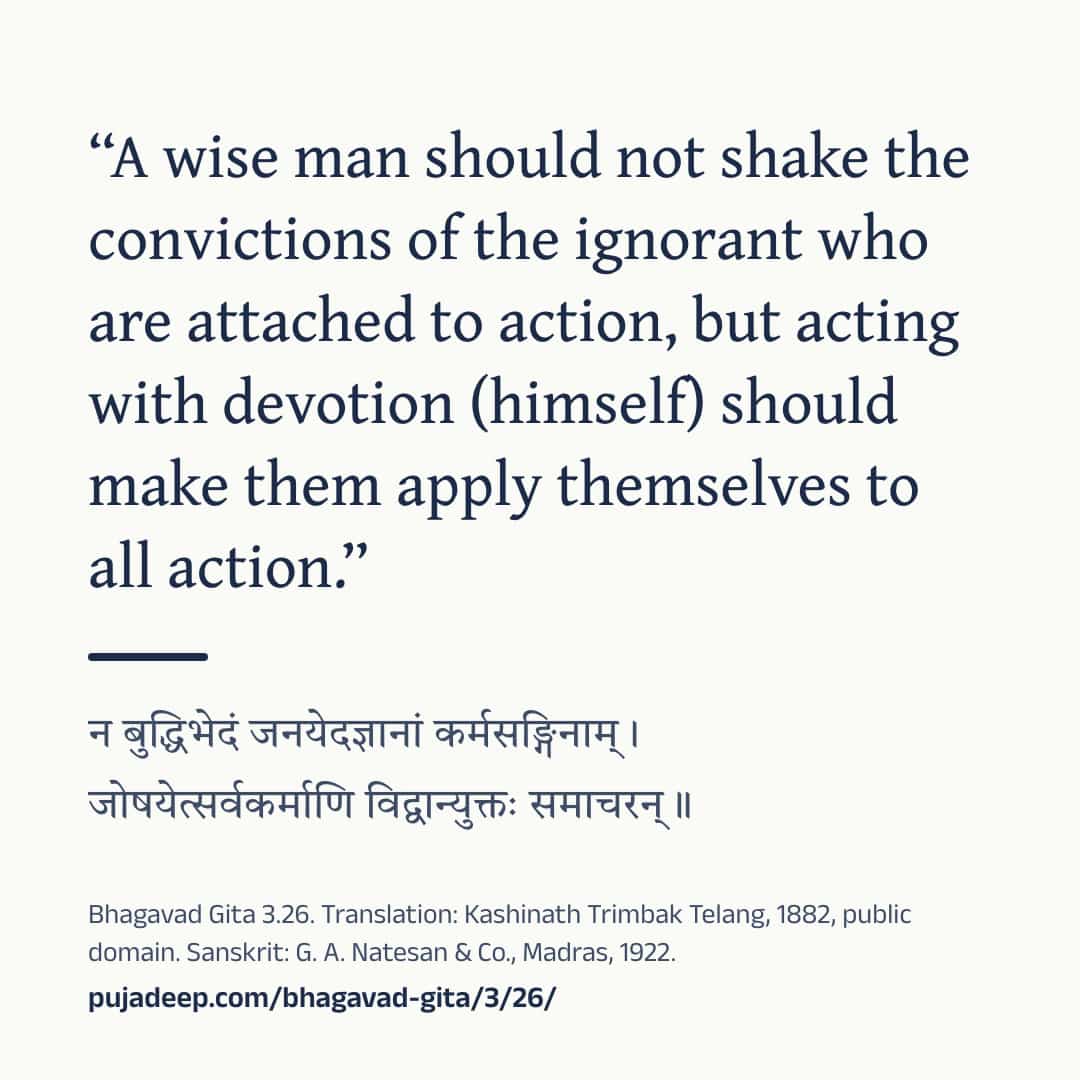
Drawing the picture
See the words
Bhagavad Gita 3.26

न बुद्धिभेदं जनयेदज्ञानां कर्मसङ्गिनाम् ।
जोषयेत्सर्वकर्माणि विद्वान्युक्तः समाचरन् ॥

“A wise man should not shake the convictions of the ignorant who are attached to action, but acting with devotion (himself) should make them apply themselves to all action.”
(K. T. Telang, The Bhagavadgîtâ (The Sacred Books of the East, vol. VIII, Oxford: Clarendon Press, 1882), p. 55, public domain)

“Let no wise man unsettle the mind of ignorant people attached to action; but acting in harmony (with Me) let him render all action attractive,”
(Annie Besant, The Bhagavad Gîtâ, or The Lord's Song (London: Theosophical Publishing Society, 1895), p. 45, public domain)

“One should not unsettle the understanding of the ignorant, attached to action; the wise, (himself) steadily acting, should engage (the ignorant) in all work.”
(Swami Swarupananda, Srimad-Bhagavad-Gita (Mayavati: Prabuddha Bharata Press, 1909; first printed in Prabuddha Bharata, 1907–1909), p. 75, public domain)

Sanskrit: G. A. Natesan & Co., Madras, 1922.
https://pujadeep.com/bhagavad-gita/3/26/ Nothing is sent from this site. Your own app sends it, to the chat you choose. The picture quotes the translation you chose on this page, with its name and year.
Sanskrit text: The Bhagavad-Gita, or The Lord's Song, with the text in Devanagari and an English translation, 1922. Meanings: written for Pujadeep and checked against the cited edition. Source and changes
Questions families ask
Who speaks Bhagavad Gita 3.26?
Krishna speaks this verse, in chapter 3 (Karma Yoga).
Where does the Sanskrit text come from?
Sanskrit text: The Bhagavad-Gita, or The Lord's Song, with the text in Devanagari and an English translation, 1922. Meanings: written for Pujadeep and checked against the cited edition. See the source
Is the meaning on this page a translation?
Explanation written for this site from the sources listed here, and checked against the cited edition. It is not a translation and not the only way to read the text. Free to quote with credit.
Source and licence
- Sanskrit text
- The Bhagavad-Gita, or The Lord's Song, with the text in Devanagari and an English translation (Annie Besant, G. A. Natesan & Co., Madras, 1922). Public domain. The Sanskrit on these pages was read from this printing’s page images.
- Translation
- The Bhagavadgîtâ with the Sanatsugâtîya and the Anugîtâ, translated by Kâshinâth Trimbak Telang (The Sacred Books of the East, vol. VIII, ed. F. Max Müller) (Kashinath Trimbak Telang, F. Max Müller, Clarendon Press, Oxford, 1882). Public domain. Shown verbatim, as printed.
- Translation
- The Bhagavad Gîtâ, or The Lord's Song, translated by Annie Besant (Annie Besant, Theosophical Publishing Society, London, 1895). Public domain. Shown verbatim, as printed.
- Translation
- Srimad-Bhagavad-Gita, with Sanskrit Text; Paraphrase with Word-by-word Literal Translation; English Rendering and Comments, Index, &c., by the Swami Swarupananda (Himalayan Series, No. XX) (Swami Swarupananda, The Editors and Publishers, Advaita Ashrama, Mayavati, Prabuddha Bharata Press, Mayavati, Almora, Himalayas, 1909). Public domain. Shown verbatim, as printed.
- Common wording
- In this text, 32 words follow today's common wording, checked against sanskritdocuments.org; Sanskrit Wikisource; Gita Press, Gorakhpur; GRETIL, Göttingen and Bhaktivedanta Book Trust.
- Our explanation
- Explanation written for this site from the sources listed here, and checked against the cited edition. It is not a translation and not the only way to read the text. Free to quote with credit.
- Checked
- Checked against the cited edition, October 27, 2026.