Bhagavad Gita 3.21: meaning and translation
Chapter 3: Karma Yoga. Krishna says
Whatever a leading person (śreṣṭha) does, other people do the same, Krishna says.
Click or tap a word for its meaning and its dictionary page.
Text and layers
Text and layers
These choices stay in this browser.
Bhagavad Gita 3.21
यद्यदाचरति श्रेष्ठस्तत्तदेवेतरो जनः ।स यत्प्रमाणं कुरुते लोकस्तदनुवर्तते ॥
Yadyadacharati shreshthastattadevetaro janahSa yatpramanam kurute lokastadanuvartate
yadyadācarati śreṣṭhastattadevetaro janaḥ |sa yatpramāṇaṃ kurute lokastadanuvartate ||
Our explanation Whatever a leading person (śreṣṭha) does, other people do the same, Krishna says. Whatever standard such a person sets, the world follows.
हिंदी अर्थ कृष्ण कहते हैं कि श्रेष्ठ व्यक्ति जो-जो करता है, दूसरे लोग भी वही करते हैं। वह जो मानदंड बनाता है, संसार उसी के अनुसार चलता है।
Word by word
Every word, with its dictionary page
Word by word
- यत् yat · whatever (pronoun (neuter), accusative singular) Dictionary: yad, Monier-Williams 1899, p. 844, col. 2 “who, which, what, whichever, whatever, that”
- यत् yat · whatever (pronoun (neuter), accusative singular) Dictionary: yad, Monier-Williams 1899, p. 844, col. 2 “who, which, what, whichever, whatever, that”
- आचरति ācarati · does (present, 3rd person singular) Dictionary: ā-car, Monier-Williams 1899, p. 131, col. 3 “to act, undertake, do, exercise, practise, perform”
- श्रेष्ठः śreṣṭhaḥ · a leading person (adjective (masculine), nominative singular) Dictionary: śreṣṭha, Monier-Williams 1899, p. 1102, col. 3 “most excellent, best, first, chief”
- तत् tat · that (pronoun (neuter), accusative singular) Dictionary: tad, Monier-Williams 1899, p. 434, col. 1 “m. he, f. she, n. it, that, this”
- तत् tat · that (pronoun (neuter), accusative singular) Dictionary: tad, Monier-Williams 1899, p. 434, col. 1 “m. he, f. she, n. it, that, this”
- एव eva · the same (indeclinable) Dictionary: 1. eva, Monier-Williams 1899, p. 232, col. 2 “just, exactly, very, same, only, even, alone, merely”
- इतरः itaraḥ · other (adjective (masculine), nominative singular) Dictionary: itara, Monier-Williams 1899, p. 164, col. 3 “the other (of two), another; (pl.) the rest”
- जनः janaḥ · people (noun (masculine), nominative singular) Dictionary: jana, Monier-Williams 1899, p. 410, col. 1 “creature, living being, man, person, race”
- सः saḥ · he (pronoun (masculine), nominative singular) Dictionary: tad, Monier-Williams 1899, p. 434, col. 1 “m. he, f. she, n. it, that, this”
- यत् yat · what (pronoun (neuter), accusative singular) Dictionary: yad, Monier-Williams 1899, p. 844, col. 2 “who, which, what, whichever, whatever, that”
- प्रमाणम् pramāṇam · standard (noun (neuter), accusative singular) Dictionary: pramāṇa, Monier-Williams 1899, p. 685, col. 3 “measure, scale, standard”
- कुरुते kurute · sets (present, 3rd person singular) Dictionary: 1. kṛ, Monier-Williams 1899, p. 301, col. 1 “to do, make, perform, accomplish, cause, effect”
- लोकः lokaḥ · the world, people (noun (masculine), nominative singular) Dictionary: loka, Monier-Williams 1899, p. 906, col. 1 “the wide space or world”
- तत् tat · that (pronoun (neuter), accusative singular) Dictionary: tad, Monier-Williams 1899, p. 434, col. 1 “m. he, f. she, n. it, that, this”
- अनुवर्तते anuvartate · follows (present, 3rd person singular) Dictionary: anu-vṛt, Monier-Williams 1899, p. 39, col. 1 “to go after; to follow, pursue”
Old translations
Kashinath Trimbak Telang, 1882. Public domain. Page 54.
Whatever a great man does, that other men also do. And people follow whatever he receives as authority.
Compare 3 translations
Kashinath Trimbak Telang, 1882. Public domain. Page 54.
Whatever a great man does, that other men also do. And people follow whatever he receives as authority.
You are reading this one
Annie Besant, 1895. Public domain. Page 44.
Whatsoever a great man doeth, that other men also do; the standard he setteth up, by that the people go.
You are reading this one
Swami Swarupananda, 1909 (first printed 1907). Public domain. Page 72–73.
Whatsoever the superior person does, that is followed by others. What he demonstrates by action, that, people follow.
You are reading this one
Cite this verse
The translation: K. T. Telang, The Bhagavadgîtâ (The Sacred Books of the East, vol. VIII, Oxford: Clarendon Press, 1882), p. 54. Bhagavad Gita 3.21.
The translation: Annie Besant, The Bhagavad Gîtâ, or The Lord's Song (London: Theosophical Publishing Society, 1895), p. 44. Bhagavad Gita 3.21.
The translation: Swami Swarupananda, Srimad-Bhagavad-Gita (Mayavati: Prabuddha Bharata Press, 1909; first printed in Prabuddha Bharata, 1907–1909), pp. 72–73. Bhagavad Gita 3.21.
Our explanation: “Bhagavad Gita 3.21: meaning and translation.” Pujadeep. Updated October 27, 2026. https://pujadeep.com/bhagavad-gita/3/21/
Pujadeep’s explanations are free to quote with credit: name Pujadeep and link to the page. How to credit
Classical readings, by school
No readings by school on this verse yet.
This verse is on our page of well-known Gita verses, by theme
Share
Show the ways to share
Send one picture or the text to one chat. The picture names its source and the address of this page.
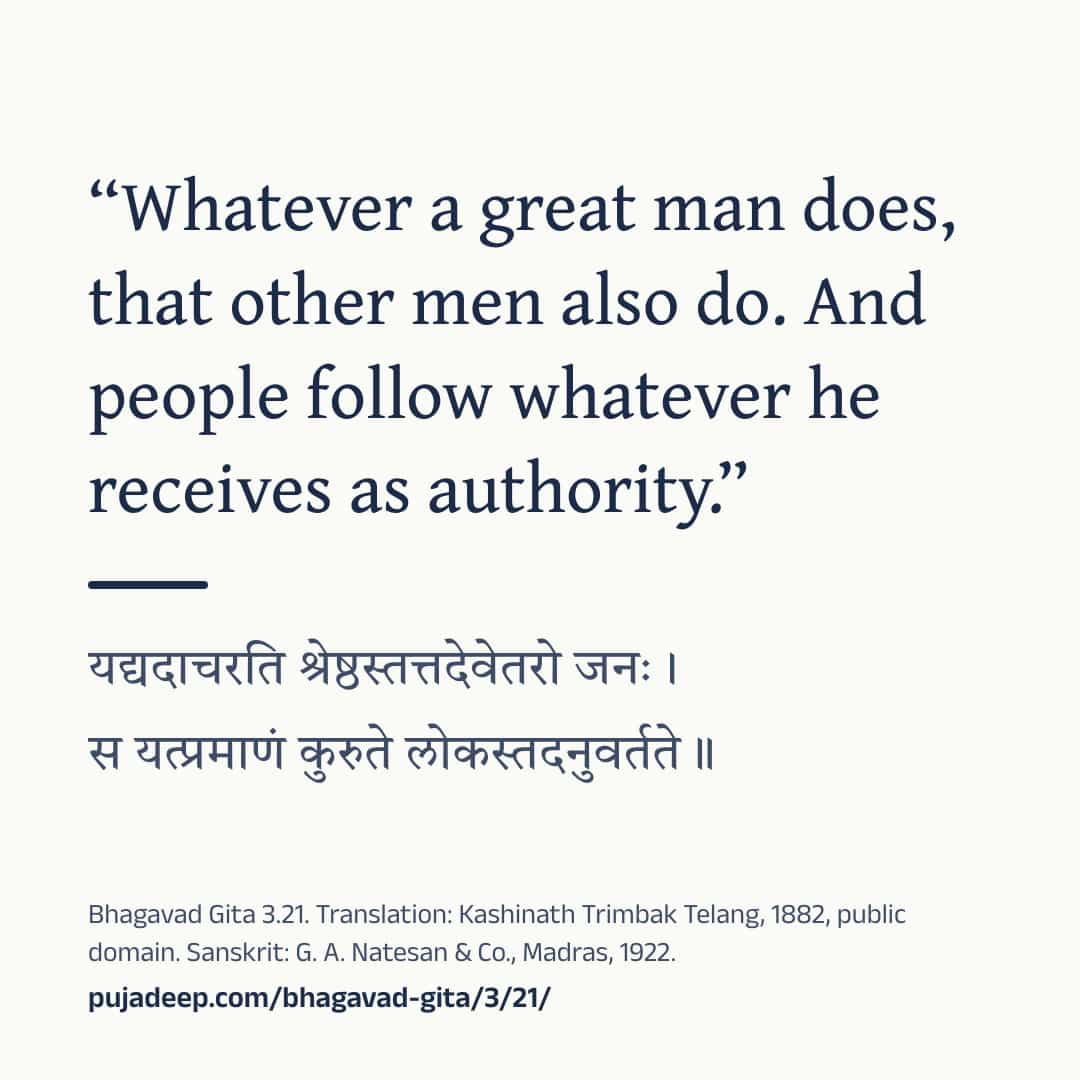
Drawing the picture
See the words
Bhagavad Gita 3.21

यद्यदाचरति श्रेष्ठस्तत्तदेवेतरो जनः ।
स यत्प्रमाणं कुरुते लोकस्तदनुवर्तते ॥

“Whatever a great man does, that other men also do. And people follow whatever he receives as authority.”
(K. T. Telang, The Bhagavadgîtâ (The Sacred Books of the East, vol. VIII, Oxford: Clarendon Press, 1882), p. 54, public domain)

“Whatsoever a great man doeth, that other men also do; the standard he setteth up, by that the people go.”
(Annie Besant, The Bhagavad Gîtâ, or The Lord's Song (London: Theosophical Publishing Society, 1895), p. 44, public domain)

“Whatsoever the superior person does, that is followed by others. What he demonstrates by action, that, people follow.”
(Swami Swarupananda, Srimad-Bhagavad-Gita (Mayavati: Prabuddha Bharata Press, 1909; first printed in Prabuddha Bharata, 1907–1909), pp. 72–73, public domain)

Sanskrit: G. A. Natesan & Co., Madras, 1922.
https://pujadeep.com/bhagavad-gita/3/21/ Nothing is sent from this site. Your own app sends it, to the chat you choose. The picture quotes the translation you chose on this page, with its name and year.
Sanskrit text: The Bhagavad-Gita, or The Lord's Song, with the text in Devanagari and an English translation, 1922. Meanings: written for Pujadeep and checked against the cited edition. Source and changes
Questions families ask
Who speaks Bhagavad Gita 3.21?
Krishna speaks this verse, in chapter 3 (Karma Yoga).
Where does the Sanskrit text come from?
Sanskrit text: The Bhagavad-Gita, or The Lord's Song, with the text in Devanagari and an English translation, 1922. Meanings: written for Pujadeep and checked against the cited edition. See the source
Is the meaning on this page a translation?
Explanation written for this site from the sources listed here, and checked against the cited edition. It is not a translation and not the only way to read the text. Free to quote with credit.
Source and licence
- Sanskrit text
- The Bhagavad-Gita, or The Lord's Song, with the text in Devanagari and an English translation (Annie Besant, G. A. Natesan & Co., Madras, 1922). Public domain. The Sanskrit on these pages was read from this printing’s page images.
- Translation
- The Bhagavadgîtâ with the Sanatsugâtîya and the Anugîtâ, translated by Kâshinâth Trimbak Telang (The Sacred Books of the East, vol. VIII, ed. F. Max Müller) (Kashinath Trimbak Telang, F. Max Müller, Clarendon Press, Oxford, 1882). Public domain. Shown verbatim, as printed.
- Translation
- The Bhagavad Gîtâ, or The Lord's Song, translated by Annie Besant (Annie Besant, Theosophical Publishing Society, London, 1895). Public domain. Shown verbatim, as printed.
- Translation
- Srimad-Bhagavad-Gita, with Sanskrit Text; Paraphrase with Word-by-word Literal Translation; English Rendering and Comments, Index, &c., by the Swami Swarupananda (Himalayan Series, No. XX) (Swami Swarupananda, The Editors and Publishers, Advaita Ashrama, Mayavati, Prabuddha Bharata Press, Mayavati, Almora, Himalayas, 1909). Public domain. Shown verbatim, as printed.
- Common wording
- In this text, 32 words follow today's common wording, checked against sanskritdocuments.org; Sanskrit Wikisource; Gita Press, Gorakhpur; GRETIL, Göttingen and Bhaktivedanta Book Trust.
- Our explanation
- Explanation written for this site from the sources listed here, and checked against the cited edition. It is not a translation and not the only way to read the text. Free to quote with credit.
- Checked
- Checked against the cited edition, October 27, 2026.