Bhagavad Gita 3.25: meaning and translation
Chapter 3: Karma Yoga. Krishna says
As the unwise act with attachment to action, Krishna says, so the wise should act without attachment, wishing to hold the world together (loka-saṅgraha).
Click or tap a word for its meaning and its dictionary page.
Text and layers
Text and layers
These choices stay in this browser.
Bhagavad Gita 3.25
सक्ताः कर्मण्यविद्वांसो यथा कुर्वन्ति भारत ।कुर्याद्विद्वांस्तथाऽसक्तश्चिकीर्षुर्लोकसङ्ग्रहम् ॥
Saktah karmanyavidvanso yatha kurvanti bharataKuryadvidvanstathasaktashchikirshurlokasangraham
saktāḥ karmaṇyavidvāṃso yathā kurvanti bhārata |kuryādvidvāṃstathā’saktaścikīrṣurlokasaṅgraham ||
Our explanation As the unwise act with attachment to action, Krishna says, so the wise should act without attachment, wishing to hold the world together (loka-saṅgraha). He calls Arjuna Bharata.
हिंदी अर्थ कृष्ण कहते हैं कि हे भारत, जैसे अज्ञानी लोग कर्म में आसक्त होकर कर्म करते हैं, वैसे ही ज्ञानी को लोकसंग्रह की इच्छा से, आसक्ति के बिना, कर्म करना चाहिए।
Word by word
Every word, with its dictionary page
Word by word
- सक्ताः saktāḥ · attached (past participle (masculine), nominative plural) Dictionary: sakta, Monier-Williams 1899, p. 1132, col. 3 “fond of, engaged in, occupied with”
- कर्मणि karmaṇi · to action (noun (neuter), locative singular) Dictionary: karman, Monier-Williams 1899, p. 258, col. 2 “act, action, performance, business”
- अविद्वांसः avidvāṃsaḥ · the unwise (adjective (masculine), nominative plural) Dictionary: a-vidvas, Monier-Williams 1899, p. 108, col. 3 “not knowing, ignorant”
- यथा yathā · as (indeclinable) Dictionary: yathā, Monier-Williams 1899, p. 841, col. 2 “in which manner or way, according as, as, like”
- कुर्वन्ति kurvanti · act (present, 3rd person plural) Dictionary: 1. kṛ, Monier-Williams 1899, p. 301, col. 1 “to do, make, perform, accomplish, cause, effect”
- भारत bhārata · O Bharata (noun (masculine), vocative singular) Dictionary: bhārata, Monier-Williams 1899, p. 753, col. 1
- कुर्यात् kuryāt · should act (optative, 3rd person singular) Dictionary: 1. kṛ, Monier-Williams 1899, p. 301, col. 1 “to do, make, perform, accomplish, cause, effect”
- विद्वान् vidvān · the wise (adjective (masculine), nominative singular) Dictionary: vidvas, Monier-Williams 1899, p. 964, col. 3 “one who knows, knowing, understanding, learned, intelligent, wise”
- तथा tathā · so, in the same way (indeclinable) Dictionary: tathā, Monier-Williams 1899, p. 433, col. 3 “in that manner, so, thus”
- असक्तः asaktaḥ · unattached (past participle (masculine), nominative singular) Dictionary: a-sakta, Monier-Williams 1899, p. 118, col. 1 “detached from worldly feelings or passions, unattached or indifferent to (loc.)”
- चिकीर्षुः cikīrṣuḥ · wishing to bring about (adjective (masculine), nominative singular) Dictionary: cikīrṣu, Monier-Williams 1899, p. 394, col. 3 “intending to make or do or perform”
- लोकसङ्ग्रहम् lokasaṅgraham · holding the world together (compound (masculine), accusative singular) Dictionary: loka, Monier-Williams 1899, p. 906, col. 1 “the wide space or world”; saṃ-graha, Monier-Williams 1899, p. 1129, col. 2 “drawing together”
1 printing differs
Edition differences. Another printing or text reads this place differently.
- Spelling A digital text reads Same words. The 1922 edition writes तथाऽसक्तः with an avagraha, which shows the reading tathā asaktaḥ ('so, unattached'); this e-text writes तथासक्तः without it. Both translations follow the reading the avagraha shows ('without attachment').
Old translations
Kashinath Trimbak Telang, 1882. Public domain. Page 55.
As the ignorant act, O descendant of Bharata! with attachment to action, so should a wise man act without attachment, wishing to keep the people (to their duties).
Compare 3 translations
Kashinath Trimbak Telang, 1882. Public domain. Page 55.
As the ignorant act, O descendant of Bharata! with attachment to action, so should a wise man act without attachment, wishing to keep the people (to their duties).
You are reading this one
Annie Besant, 1895. Public domain. Page 45.
As the ignorant act from attachment to action, O Bhârata, so should the wise act without attachment, desiring the maintenance of mankind.
You are reading this one
Swami Swarupananda, 1909 (first printed 1907). Public domain. Page 74.
As do the unwise attached to work, act, so should the wise act, O descendant of Bharata, (though) without attachment, desirous for the guidance of the world.
You are reading this one
Cite this verse
The translation: K. T. Telang, The Bhagavadgîtâ (The Sacred Books of the East, vol. VIII, Oxford: Clarendon Press, 1882), p. 55. Bhagavad Gita 3.25.
The translation: Annie Besant, The Bhagavad Gîtâ, or The Lord's Song (London: Theosophical Publishing Society, 1895), p. 45. Bhagavad Gita 3.25.
The translation: Swami Swarupananda, Srimad-Bhagavad-Gita (Mayavati: Prabuddha Bharata Press, 1909; first printed in Prabuddha Bharata, 1907–1909), p. 74. Bhagavad Gita 3.25.
Our explanation: “Bhagavad Gita 3.25: meaning and translation.” Pujadeep. Updated October 27, 2026. https://pujadeep.com/bhagavad-gita/3/25/
Pujadeep’s explanations are free to quote with credit: name Pujadeep and link to the page. How to credit
Classical readings, by school
No readings by school on this verse yet.
Share
Show the ways to share
Send one picture or the text to one chat. The picture names its source and the address of this page.
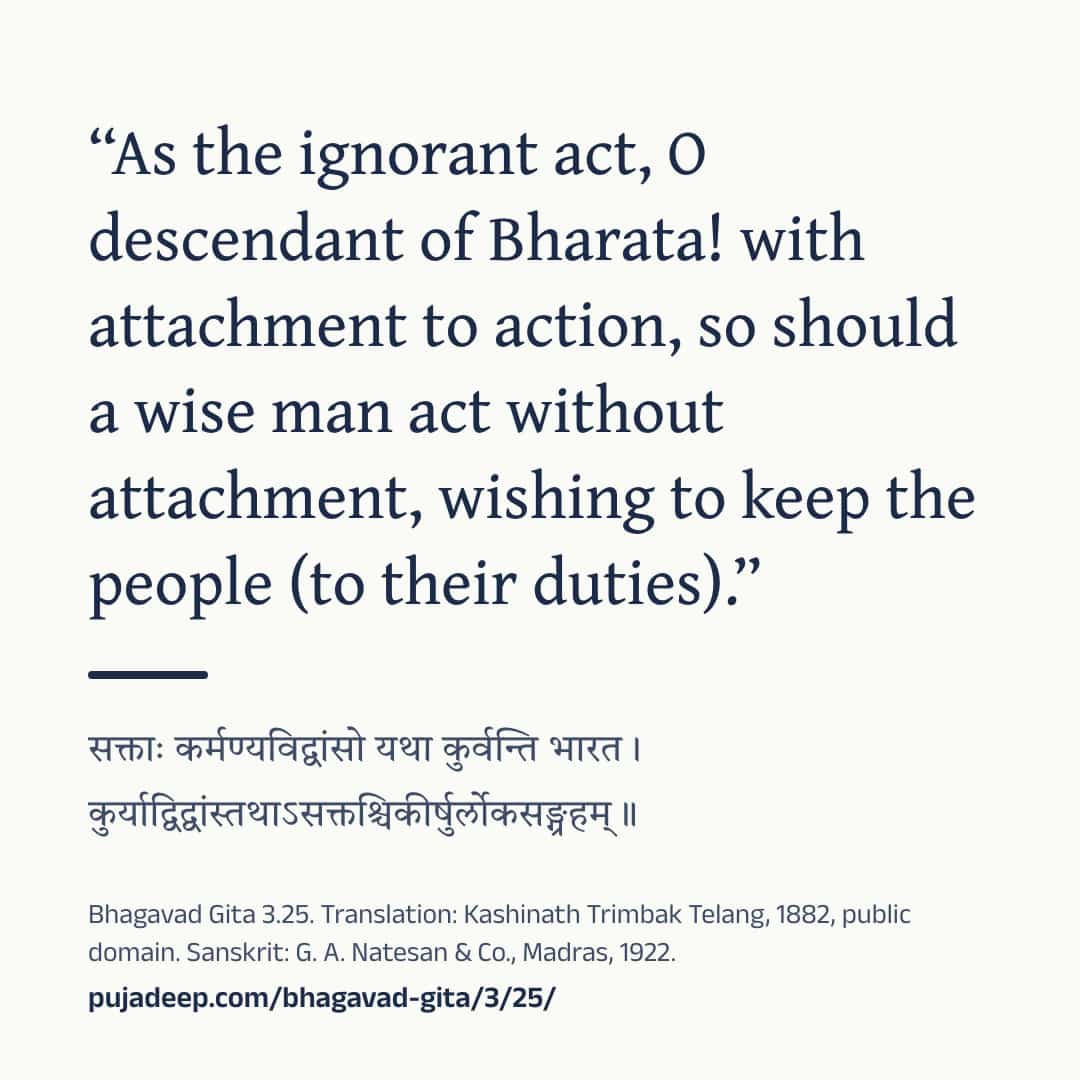
Drawing the picture
See the words
Bhagavad Gita 3.25

सक्ताः कर्मण्यविद्वांसो यथा कुर्वन्ति भारत ।
कुर्याद्विद्वांस्तथाऽसक्तश्चिकीर्षुर्लोकसङ्ग्रहम् ॥

“As the ignorant act, O descendant of Bharata! with attachment to action, so should a wise man act without attachment, wishing to keep the people (to their duties).”
(K. T. Telang, The Bhagavadgîtâ (The Sacred Books of the East, vol. VIII, Oxford: Clarendon Press, 1882), p. 55, public domain)

“As the ignorant act from attachment to action, O Bhârata, so should the wise act without attachment, desiring the maintenance of mankind.”
(Annie Besant, The Bhagavad Gîtâ, or The Lord's Song (London: Theosophical Publishing Society, 1895), p. 45, public domain)

“As do the unwise attached to work, act, so should the wise act, O descendant of Bharata, (though) without attachment, desirous for the guidance of the world.”
(Swami Swarupananda, Srimad-Bhagavad-Gita (Mayavati: Prabuddha Bharata Press, 1909; first printed in Prabuddha Bharata, 1907–1909), p. 74, public domain)

Sanskrit: G. A. Natesan & Co., Madras, 1922.
https://pujadeep.com/bhagavad-gita/3/25/ Nothing is sent from this site. Your own app sends it, to the chat you choose. The picture quotes the translation you chose on this page, with its name and year.
Sanskrit text: The Bhagavad-Gita, or The Lord's Song, with the text in Devanagari and an English translation, 1922. Meanings: written for Pujadeep and checked against the cited edition. Source and changes
Questions families ask
Who speaks Bhagavad Gita 3.25?
Krishna speaks this verse, in chapter 3 (Karma Yoga).
Where does the Sanskrit text come from?
Sanskrit text: The Bhagavad-Gita, or The Lord's Song, with the text in Devanagari and an English translation, 1922. Meanings: written for Pujadeep and checked against the cited edition. See the source
Is the meaning on this page a translation?
Explanation written for this site from the sources listed here, and checked against the cited edition. It is not a translation and not the only way to read the text. Free to quote with credit.
Source and licence
- Sanskrit text
- The Bhagavad-Gita, or The Lord's Song, with the text in Devanagari and an English translation (Annie Besant, G. A. Natesan & Co., Madras, 1922). Public domain. The Sanskrit on these pages was read from this printing’s page images.
- Translation
- The Bhagavadgîtâ with the Sanatsugâtîya and the Anugîtâ, translated by Kâshinâth Trimbak Telang (The Sacred Books of the East, vol. VIII, ed. F. Max Müller) (Kashinath Trimbak Telang, F. Max Müller, Clarendon Press, Oxford, 1882). Public domain. Shown verbatim, as printed.
- Translation
- The Bhagavad Gîtâ, or The Lord's Song, translated by Annie Besant (Annie Besant, Theosophical Publishing Society, London, 1895). Public domain. Shown verbatim, as printed.
- Translation
- Srimad-Bhagavad-Gita, with Sanskrit Text; Paraphrase with Word-by-word Literal Translation; English Rendering and Comments, Index, &c., by the Swami Swarupananda (Himalayan Series, No. XX) (Swami Swarupananda, The Editors and Publishers, Advaita Ashrama, Mayavati, Prabuddha Bharata Press, Mayavati, Almora, Himalayas, 1909). Public domain. Shown verbatim, as printed.
- Common wording
- In this text, 32 words follow today's common wording, checked against sanskritdocuments.org; Sanskrit Wikisource; Gita Press, Gorakhpur; GRETIL, Göttingen and Bhaktivedanta Book Trust.
- Our explanation
- Explanation written for this site from the sources listed here, and checked against the cited edition. It is not a translation and not the only way to read the text. Free to quote with credit.
- Checked
- Checked against the cited edition, October 27, 2026.