Bhagavad Gita 3.15: meaning and translation
Chapter 3: Karma Yoga. Krishna says
Action, Krishna says, comes from brahma, and brahma comes from the Imperishable (akṣara).
Click or tap a word for its meaning and its dictionary page.
Text and layers
Text and layers
These choices stay in this browser.
Bhagavad Gita 3.15
कर्म ब्रह्मोद्भवं विद्धि ब्रह्माऽक्षरसमुद्भवम् ।तस्मात्सर्वगतं ब्रह्म नित्यं यज्ञे प्रतिष्ठितम् ॥
Karma brahmodbhavam viddhi brahmaksharasamudbhavamTasmatsarvagatam brahma nityam yajne pratishthitam
karma brahmodbhavaṃ viddhi brahmā’kṣarasamudbhavam |tasmātsarvagataṃ brahma nityaṃ yajñe pratiṣṭhitam ||
Our explanation Action, Krishna says, comes from brahma, and brahma comes from the Imperishable (akṣara). So the all-pervading brahma always rests in sacrifice. The word brahma is read in different ways here: Telang translates it as “the Vedas”; Besant keeps the Sanskrit word and notes that some take it to mean the Vedas; the commentators differ (see the views).
हिंदी अर्थ कृष्ण कहते हैं कि कर्म ब्रह्म से उत्पन्न होता है, और ब्रह्म अक्षर (अविनाशी) से। इसलिए सर्वव्यापी ब्रह्म सदा यज्ञ में स्थित है। यहाँ “ब्रह्म” शब्द को अलग-अलग ढंग से समझा गया है: तेलंग इसका अनुवाद “वेद” करते हैं; बेसेंट संस्कृत शब्द ही रखती हैं और लिखती हैं कि कुछ लोग इसका अर्थ वेद लेते हैं; टीकाकारों के मत भी अलग हैं।
Word by word
Every word, with its dictionary page
Word by word
- कर्म karma · action (noun (neuter), accusative singular) Dictionary: karman, Monier-Williams 1899, p. 258, col. 2 “act, action, performance, business”
- ब्रह्मोद्भवम् brahmodbhavam · arising from brahma (compound (neuter), accusative singular) Dictionary: brahman, Monier-Williams 1899, p. 737, col. 3 “the sacred word (as opp. to vāc, the word of man), the Veda”; brahman, Monier-Williams 1899, p. 738, col. 1 “one self-existent impersonal Spirit, the one universal Soul”; ud-bhava, Monier-Williams 1899, p. 190, col. 2 “existence, generation, origin, production, birth”
- विद्धि viddhi · know (imperative, 2nd person singular) Dictionary: 1. vid, Monier-Williams 1899, p. 963, col. 2 “to know, understand, perceive, learn”
- ब्रह्म brahma · brahma (noun (neuter), nominative singular) Dictionary: brahman, Monier-Williams 1899, p. 737, col. 3 “the sacred word (as opp. to vāc, the word of man), the Veda”; brahman, Monier-Williams 1899, p. 738, col. 1 “one self-existent impersonal Spirit, the one universal Soul”
- अक्षरसमुद्भवम् akṣarasamudbhavam · arising from the Imperishable (compound (neuter), nominative singular) Dictionary: a-kṣara, Monier-Williams 1899, p. 3, col. 2 “imperishable; unalterable”; sam-udbhava, Monier-Williams 1899, p. 1168, col. 2 “existence, production, origin”
- तस्मात् tasmāt · therefore (indeclinable) Dictionary: tasmāt, Monier-Williams 1899, p. 441, col. 2 “from that, on that account, therefore”
- सर्वगतम् sarvagatam · all-pervading (compound (neuter), nominative singular) Dictionary: sarva-gata, Monier-Williams 1899, p. 1185, col. 1
- ब्रह्म brahma · brahma (noun (neuter), nominative singular) Dictionary: brahman, Monier-Williams 1899, p. 737, col. 3 “the sacred word (as opp. to vāc, the word of man), the Veda”; brahman, Monier-Williams 1899, p. 738, col. 1 “one self-existent impersonal Spirit, the one universal Soul”
- नित्यम् nityam · always (indeclinable) Dictionary: nitya, Monier-Williams 1899, p. 547, col. 2 “continual, perpetual, eternal”
- यज्ञे yajñe · in sacrifice (noun (masculine), locative singular) Dictionary: yajña, Monier-Williams 1899, p. 839, col. 2 “act of worship or devotion, offering, oblation, sacrifice”
- प्रतिष्ठितम् pratiṣṭhitam · rests, is established (past participle (neuter), nominative singular) Dictionary: prati-ṣṭhita, Monier-Williams 1899, p. 671, col. 3 “standing, stationed, placed, situated in or on”
1 printing differs
Edition differences. Another printing or text reads this place differently.
- Spelling A digital text reads Same words. The 1922 edition marks the merged vowel with an avagraha (ब्रह्माऽक्षर…); this e-text does not.
Old translations
Kashinath Trimbak Telang, 1882. Public domain. Page 54.
know that action has its source in the Vedas; the Vedas come from the Indestructible. Therefore the all-comprehending Vedas are always concerned with sacrifices1.
This sentence begins in 3.14.
Footnotes (the translator’s own) - The commentators explain this to mean that though the Vedas elucidate all matters, their principal subject is the sacrifice. ↩
Compare 3 translations
Kashinath Trimbak Telang, 1882. Public domain. Page 54.
know that action has its source in the Vedas; the Vedas come from the Indestructible. Therefore the all-comprehending Vedas are always concerned with sacrifices1.
This sentence begins in 3.14.
Footnotes (the translator’s own) - The commentators explain this to mean that though the Vedas elucidate all matters, their principal subject is the sacrifice. ↩
You are reading this one
Annie Besant, 1895. Public domain. Page 43.
Know thou from Brahmâ1 action groweth, and Brahmâ from the Imperishable cometh. Therefore Brahman, the all-permeating, is ever present in sacrifice.
This sentence begins in 3.14.
Footnotes (the translator’s own) - An Indian of much knowledge translates Brahmâ here as "the Vedas." ↩
You are reading this one
Swami Swarupananda, 1909 (first printed 1907). Public domain. Page 70.
Know Karma to have risen from the Veda, and the Veda from the Imperishable. Therefore the all-pervading Veda, is ever centred in Yajna.
You are reading this one
Cite this verse
The translation: K. T. Telang, The Bhagavadgîtâ (The Sacred Books of the East, vol. VIII, Oxford: Clarendon Press, 1882), p. 54. Bhagavad Gita 3.15.
The translation: Annie Besant, The Bhagavad Gîtâ, or The Lord's Song (London: Theosophical Publishing Society, 1895), p. 43. Bhagavad Gita 3.15.
The translation: Swami Swarupananda, Srimad-Bhagavad-Gita (Mayavati: Prabuddha Bharata Press, 1909; first printed in Prabuddha Bharata, 1907–1909), p. 70. Bhagavad Gita 3.15.
Our explanation: “Bhagavad Gita 3.15: meaning and translation.” Pujadeep. Updated October 27, 2026. https://pujadeep.com/bhagavad-gita/3/15/
Pujadeep’s explanations are free to quote with credit: name Pujadeep and link to the page. How to credit
Classical readings, by school
Each reading is named by its school. None is presented as the only meaning.
What Advaita, Vishishtadvaita and Dvaita teach, in short
Shankara Advaita
Shankara takes brahma to be the Veda, and the Imperishable to be the Supreme Self, from which the Veda comes forth like breath. “Brahma rests in sacrifice” means that the Veda, though it reveals all things, deals mainly with sacrifice.
Source: The Bhagavad-Gita, with the commentary of Sri Sankaracharya, translated by A. Mahadeva Sastri (2nd ed., Mysore: G. T. A. Printing Works, 1901), commentary on 3.14–15, pp. 88–89. Summarised in our own words; none of its text is reproduced.
Ramanuja Vishishtadvaita
Ramanuja takes brahma here to be the body, made of matter, and the Imperishable to be the individual self (jīvātman), which lives in the body and acts through it. So actions come from the body, and the body, which every worshipper has, is needed for sacrifice. He says that reading brahma here as the Supreme or as the Veda does not fit the passage.
Source: Sri Bhagavad-Gita with Sri Ramanujacharya's Visishtadvaita commentary, translated by A. Govindacharya (Madras, 1898), commentary on 3.14–16, pp. 102–103. Summarised in our own words; none of its text is reproduced.
Share
Show the ways to share
Send one picture or the text to one chat. The picture names its source and the address of this page.
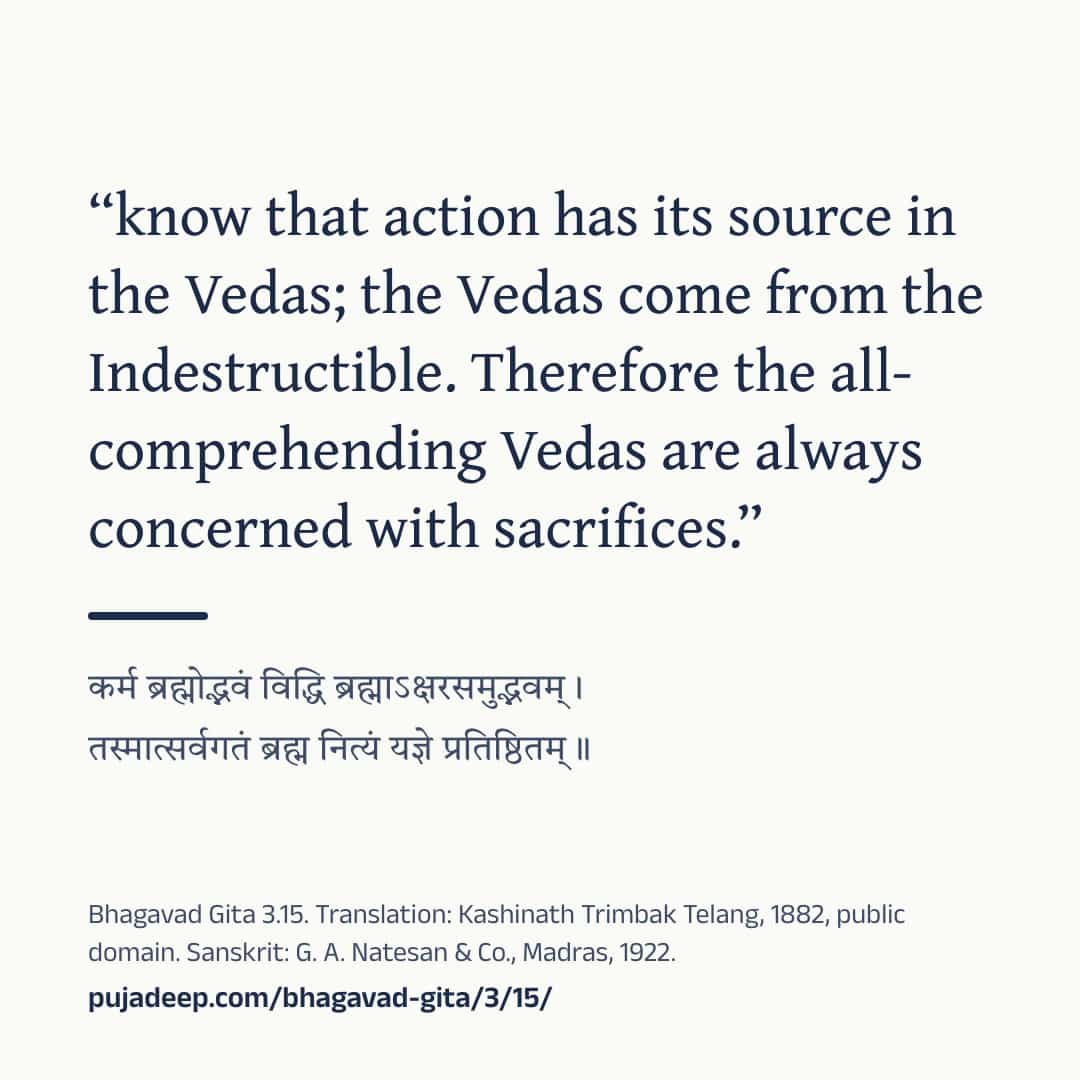
Drawing the picture
See the words
Bhagavad Gita 3.15

कर्म ब्रह्मोद्भवं विद्धि ब्रह्माऽक्षरसमुद्भवम् ।
तस्मात्सर्वगतं ब्रह्म नित्यं यज्ञे प्रतिष्ठितम् ॥

“know that action has its source in the Vedas; the Vedas come from the Indestructible. Therefore the all-comprehending Vedas are always concerned with sacrifices.”
(K. T. Telang, The Bhagavadgîtâ (The Sacred Books of the East, vol. VIII, Oxford: Clarendon Press, 1882), p. 54, public domain)
This sentence begins in 3.14.

“Know thou from Brahmâ action groweth, and Brahmâ from the Imperishable cometh. Therefore Brahman, the all-permeating, is ever present in sacrifice.”
(Annie Besant, The Bhagavad Gîtâ, or The Lord's Song (London: Theosophical Publishing Society, 1895), p. 43, public domain)
This sentence begins in 3.14.

“Know Karma to have risen from the Veda, and the Veda from the Imperishable. Therefore the all-pervading Veda, is ever centred in Yajna.”
(Swami Swarupananda, Srimad-Bhagavad-Gita (Mayavati: Prabuddha Bharata Press, 1909; first printed in Prabuddha Bharata, 1907–1909), p. 70, public domain)

Sanskrit: G. A. Natesan & Co., Madras, 1922.
https://pujadeep.com/bhagavad-gita/3/15/ Nothing is sent from this site. Your own app sends it, to the chat you choose. The picture quotes the translation you chose on this page, with its name and year.
Sanskrit text: The Bhagavad-Gita, or The Lord's Song, with the text in Devanagari and an English translation, 1922. Meanings: written for Pujadeep and checked against the cited edition. Source and changes
Questions families ask
Who speaks Bhagavad Gita 3.15?
Krishna speaks this verse, in chapter 3 (Karma Yoga).
Where does the Sanskrit text come from?
Sanskrit text: The Bhagavad-Gita, or The Lord's Song, with the text in Devanagari and an English translation, 1922. Meanings: written for Pujadeep and checked against the cited edition. See the source
Is the meaning on this page a translation?
Explanation written for this site from the sources listed here, and checked against the cited edition. It is not a translation and not the only way to read the text. Free to quote with credit.
Source and licence
- Sanskrit text
- The Bhagavad-Gita, or The Lord's Song, with the text in Devanagari and an English translation (Annie Besant, G. A. Natesan & Co., Madras, 1922). Public domain. The Sanskrit on these pages was read from this printing’s page images.
- Translation
- The Bhagavadgîtâ with the Sanatsugâtîya and the Anugîtâ, translated by Kâshinâth Trimbak Telang (The Sacred Books of the East, vol. VIII, ed. F. Max Müller) (Kashinath Trimbak Telang, F. Max Müller, Clarendon Press, Oxford, 1882). Public domain. Shown verbatim, as printed.
- Translation
- The Bhagavad Gîtâ, or The Lord's Song, translated by Annie Besant (Annie Besant, Theosophical Publishing Society, London, 1895). Public domain. Shown verbatim, as printed.
- Translation
- Srimad-Bhagavad-Gita, with Sanskrit Text; Paraphrase with Word-by-word Literal Translation; English Rendering and Comments, Index, &c., by the Swami Swarupananda (Himalayan Series, No. XX) (Swami Swarupananda, The Editors and Publishers, Advaita Ashrama, Mayavati, Prabuddha Bharata Press, Mayavati, Almora, Himalayas, 1909). Public domain. Shown verbatim, as printed.
- Commentary
- The Bhagavad-Gita, with the commentary of Sri Sankaracharya, translated by A. Mahadeva Sastri (2nd ed., Mysore: G. T. A. Printing Works, 1901) (Public-domain scan, University of California Libraries). Summarised in our own words; none of its text is reproduced.
- Commentary
- Sri Bhagavad-Gita with Sri Ramanujacharya's Visishtadvaita commentary, translated by A. Govindacharya (Madras, 1898) (Scan uploaded to archive.org (folkscanomy collection)). Summarised in our own words; none of its text is reproduced.
- Common wording
- In this text, 32 words follow today's common wording, checked against sanskritdocuments.org; Sanskrit Wikisource; Gita Press, Gorakhpur; GRETIL, Göttingen and Bhaktivedanta Book Trust.
- Our explanation
- Explanation written for this site from the sources listed here, and checked against the cited edition. It is not a translation and not the only way to read the text. Free to quote with credit.
- Checked
- Checked against the cited edition, October 27, 2026.