Bhagavad Gita 3.23: meaning and translation
Chapter 3: Karma Yoga. Krishna says
If he did not keep acting, untiringly, Krishna says, people everywhere would follow his path, Partha.
Click or tap a word for its meaning and its dictionary page.
Text and layers
Text and layers
These choices stay in this browser.
Bhagavad Gita 3.23
यदि ह्यहं न वर्तेयं जातु कर्मण्यतन्द्रितः ।मम वर्त्मानुवर्तन्ते मनुष्याः पार्थ सर्वशः ॥
Yadi hyaham na varteyam jatu karmanyatandritahMama vartmanuvartante manushyah partha sarvashah
yadi hyahaṃ na varteyaṃ jātu karmaṇyatandritaḥ |mama vartmānuvartante manuṣyāḥ pārtha sarvaśaḥ ||
Our explanation If he did not keep acting, untiringly, Krishna says, people everywhere would follow his path, Partha.
हिंदी अर्थ कृष्ण कहते हैं कि यदि वे बिना थके कर्म में न लगे रहें, तो हे पार्थ, लोग हर प्रकार से उन्हीं के मार्ग पर चलेंगे।
Word by word
Every word, with its dictionary page
Word by word
- यदि yadi · if (indeclinable) Dictionary: yadi, Monier-Williams 1899, p. 844, col. 3 “if, in case that”
- हि hi · for (indeclinable) Dictionary: 2. hi, Monier-Williams 1899, p. 1297, col. 3 “for, because, on account of”
- अहम् aham · "I" (pronoun, nominative singular) Dictionary: aham, Monier-Williams 1899, p. 124, col. 2 “nom. sg. ‘I,’”
- न na · not (indeclinable) Dictionary: 2. na, Monier-Williams 1899, p. 523, col. 1 “not, no, nor, neither”
- वर्तेयम् varteyam · were to go on (optative, 1st person singular) Dictionary: 1. vṛt, Monier-Williams 1899, p. 1009, col. 1 “be engaged in or occupied with”
- जातु jātu · ever (indeclinable) Dictionary: jātu, Monier-Williams 1899, p. 418, col. 2 “Na jātu, not at all, by no means, never”
- कर्मणि karmaṇi · in action (noun (neuter), locative singular) Dictionary: karman, Monier-Williams 1899, p. 258, col. 2 “act, action, performance, business”
- अतन्द्रितः atandritaḥ · untiring (adjective (masculine), nominative singular) Dictionary: a-tandrita, Monier-Williams 1899, p. 12, col. 1; a-tandra, Monier-Williams 1899, p. 12, col. 1 “free from lassitude, alert, unwearied”
- मम mama · "my" (pronoun, genitive singular) Dictionary: 1. mad, Monier-Williams 1899, p. 777, col. 2 “base of the first pers. pron. in the sg. number”
- वर्त्म vartma · path (noun (neuter), accusative singular) Dictionary: vartman, Monier-Williams 1899, p. 925, col. 3 “the track or rut of a wheel, path, road, way, course”
- अनुवर्तन्ते anuvartante · follow (present, 3rd person plural) Dictionary: anu-vṛt, Monier-Williams 1899, p. 39, col. 1 “to go after; to follow, pursue”
- मनुष्याः manuṣyāḥ · people (noun (masculine), nominative plural) Dictionary: manuṣya, Monier-Williams 1899, p. 784, col. 3 “a man, human being”
- पार्थ pārtha · O Partha (noun (masculine), vocative singular) Dictionary: 2. pārtha, Monier-Williams 1899, p. 621, col. 3
- सर्वशः sarvaśaḥ · in every way, everywhere (indeclinable) Dictionary: sarvaśas, Monier-Williams 1899, p. 1189, col. 2 “wholly, completely, entirely, thoroughly, collectively, altogether”
Old translations
Kashinath Trimbak Telang, 1882. Public domain. Page 55.
For should I at any time not engage without sloth in action, men would follow in my path from all sides, O son of Prithâ!
Compare 3 translations
Kashinath Trimbak Telang, 1882. Public domain. Page 55.
For should I at any time not engage without sloth in action, men would follow in my path from all sides, O son of Prithâ!
You are reading this one
Annie Besant, 1895. Public domain. Page 44.
For if I mingled not ever in action, unwearied, men all around would follow My path, O son of Prithâ.
You are reading this one
Swami Swarupananda, 1909 (first printed 1907). Public domain. Page 73.
If ever, I did not continue in work, without relaxation, men, O son of Prithâ, would in every way, follow in my wake.
You are reading this one
Cite this verse
The translation: K. T. Telang, The Bhagavadgîtâ (The Sacred Books of the East, vol. VIII, Oxford: Clarendon Press, 1882), p. 55. Bhagavad Gita 3.23.
The translation: Annie Besant, The Bhagavad Gîtâ, or The Lord's Song (London: Theosophical Publishing Society, 1895), p. 44. Bhagavad Gita 3.23.
The translation: Swami Swarupananda, Srimad-Bhagavad-Gita (Mayavati: Prabuddha Bharata Press, 1909; first printed in Prabuddha Bharata, 1907–1909), p. 73. Bhagavad Gita 3.23.
Our explanation: “Bhagavad Gita 3.23: meaning and translation.” Pujadeep. Updated October 27, 2026. https://pujadeep.com/bhagavad-gita/3/23/
Pujadeep’s explanations are free to quote with credit: name Pujadeep and link to the page. How to credit
Classical readings, by school
No readings by school on this verse yet.
Share
Show the ways to share
Send one picture or the text to one chat. The picture names its source and the address of this page.
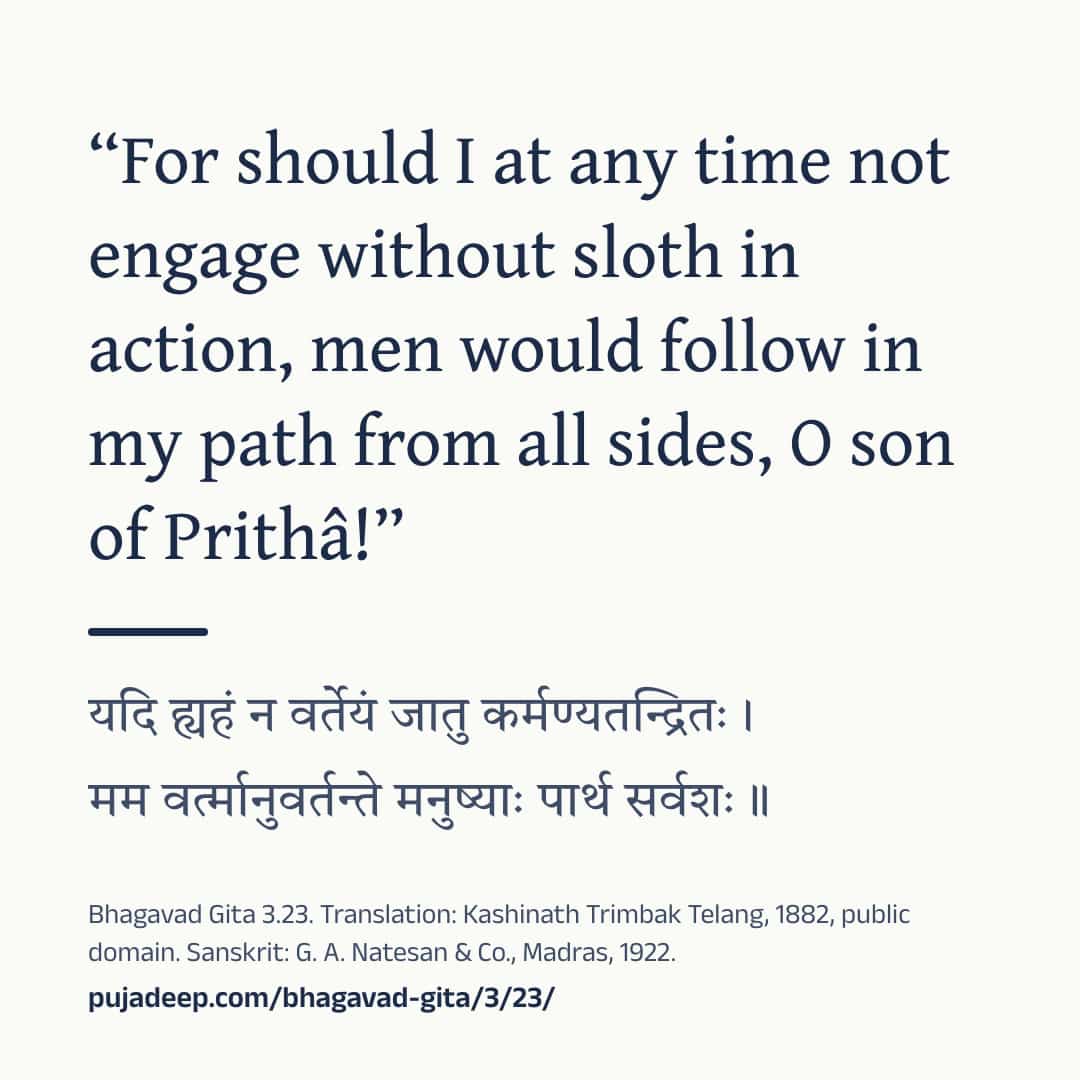
Drawing the picture
See the words
Bhagavad Gita 3.23

यदि ह्यहं न वर्तेयं जातु कर्मण्यतन्द्रितः ।
मम वर्त्मानुवर्तन्ते मनुष्याः पार्थ सर्वशः ॥

“For should I at any time not engage without sloth in action, men would follow in my path from all sides, O son of Prithâ!”
(K. T. Telang, The Bhagavadgîtâ (The Sacred Books of the East, vol. VIII, Oxford: Clarendon Press, 1882), p. 55, public domain)

“For if I mingled not ever in action, unwearied, men all around would follow My path, O son of Prithâ.”
(Annie Besant, The Bhagavad Gîtâ, or The Lord's Song (London: Theosophical Publishing Society, 1895), p. 44, public domain)

“If ever, I did not continue in work, without relaxation, men, O son of Prithâ, would in every way, follow in my wake.”
(Swami Swarupananda, Srimad-Bhagavad-Gita (Mayavati: Prabuddha Bharata Press, 1909; first printed in Prabuddha Bharata, 1907–1909), p. 73, public domain)

Sanskrit: G. A. Natesan & Co., Madras, 1922.
https://pujadeep.com/bhagavad-gita/3/23/ Nothing is sent from this site. Your own app sends it, to the chat you choose. The picture quotes the translation you chose on this page, with its name and year.
Sanskrit text: The Bhagavad-Gita, or The Lord's Song, with the text in Devanagari and an English translation, 1922. Meanings: written for Pujadeep and checked against the cited edition. Source and changes
Questions families ask
Who speaks Bhagavad Gita 3.23?
Krishna speaks this verse, in chapter 3 (Karma Yoga).
Where does the Sanskrit text come from?
Sanskrit text: The Bhagavad-Gita, or The Lord's Song, with the text in Devanagari and an English translation, 1922. Meanings: written for Pujadeep and checked against the cited edition. See the source
Is the meaning on this page a translation?
Explanation written for this site from the sources listed here, and checked against the cited edition. It is not a translation and not the only way to read the text. Free to quote with credit.
Source and licence
- Sanskrit text
- The Bhagavad-Gita, or The Lord's Song, with the text in Devanagari and an English translation (Annie Besant, G. A. Natesan & Co., Madras, 1922). Public domain. The Sanskrit on these pages was read from this printing’s page images.
- Translation
- The Bhagavadgîtâ with the Sanatsugâtîya and the Anugîtâ, translated by Kâshinâth Trimbak Telang (The Sacred Books of the East, vol. VIII, ed. F. Max Müller) (Kashinath Trimbak Telang, F. Max Müller, Clarendon Press, Oxford, 1882). Public domain. Shown verbatim, as printed.
- Translation
- The Bhagavad Gîtâ, or The Lord's Song, translated by Annie Besant (Annie Besant, Theosophical Publishing Society, London, 1895). Public domain. Shown verbatim, as printed.
- Translation
- Srimad-Bhagavad-Gita, with Sanskrit Text; Paraphrase with Word-by-word Literal Translation; English Rendering and Comments, Index, &c., by the Swami Swarupananda (Himalayan Series, No. XX) (Swami Swarupananda, The Editors and Publishers, Advaita Ashrama, Mayavati, Prabuddha Bharata Press, Mayavati, Almora, Himalayas, 1909). Public domain. Shown verbatim, as printed.
- Common wording
- In this text, 32 words follow today's common wording, checked against sanskritdocuments.org; Sanskrit Wikisource; Gita Press, Gorakhpur; GRETIL, Göttingen and Bhaktivedanta Book Trust.
- Our explanation
- Explanation written for this site from the sources listed here, and checked against the cited edition. It is not a translation and not the only way to read the text. Free to quote with credit.
- Checked
- Checked against the cited edition, October 27, 2026.