Bhagavad Gita 3.29: meaning and translation
Chapter 3: Karma Yoga. Krishna says
People deluded by the qualities of nature become attached to the workings of the qualities, Krishna says.
Click or tap a word for its meaning and its dictionary page.
Text and layers
Text and layers
These choices stay in this browser.
Bhagavad Gita 3.29
प्रकृतेर्गुणसम्मूढाः सज्जन्ते गुणकर्मसु ।तानकृत्स्नविदो मन्दान्कृत्स्नविन्न विचालयेत् ॥
Prakritergunasammudhah sajjante gunakarmasuTanakritsnavido mandankritsnavinna vichalayet
prakṛterguṇasammūḍhāḥ sajjante guṇakarmasu |tānakṛtsnavido mandānkṛtsnavinna vicālayet ||
Our explanation People deluded by the qualities of nature become attached to the workings of the qualities, Krishna says. The one who knows the whole should not unsettle those slow people who know only in part.
हिंदी अर्थ कृष्ण कहते हैं कि प्रकृति के गुणों से मोहित लोग गुणों के कर्मों में आसक्त हो जाते हैं। जो पूरा जानता है, उसे उन मंद लोगों को, जो अधूरा जानते हैं, विचलित नहीं करना चाहिए।
Word by word
Every word, with its dictionary page
Word by word
- प्रकृतेः prakṛteḥ · of nature (noun (feminine), genitive singular) Dictionary: pra-kṛti, Monier-Williams 1899, p. 654, col. 1 “the original producer of (or rather passive power of creating) the material world”
- गुणसम्मूढाः guṇasammūḍhāḥ · deluded by the qualities (compound (masculine), nominative plural) Dictionary: guṇa, Monier-Williams 1899, p. 357, col. 1 “a quality, peculiarity, attribute or property”; sam-mūḍha, Monier-Williams 1899, p. 1181, col. 1 “completely stupefied, astounded, perplexed, bewildered”
- सज्जन्ते sajjante · become attached (present passive, 3rd person plural) Dictionary: 2. sañj, Monier-Williams 1899, p. 1132, col. 3 “to be attached or fastened, adhere, cling, stick”
- गुणकर्मसु guṇakarmasu · to the workings of the qualities (compound (neuter), locative plural) Dictionary: guṇa, Monier-Williams 1899, p. 357, col. 1 “a quality, peculiarity, attribute or property”; karman, Monier-Williams 1899, p. 258, col. 2 “act, action, performance, business”
- तान् tān · those (pronoun (masculine), accusative plural) Dictionary: tad, Monier-Williams 1899, p. 434, col. 1 “m. he, f. she, n. it, that, this”
- अकृत्स्नविदः akṛtsnavidaḥ · knowing only in part (compound (masculine), accusative plural) Dictionary: a-kṛtsna, Monier-Williams 1899, p. 2, col. 3 “incomplete”; 2. vid, Monier-Williams 1899, p. 963, col. 3 “knowing, understanding, a knower”
- मन्दान् mandān · slow, dull (adjective (masculine), accusative plural) Dictionary: manda, Monier-Williams 1899, p. 787, col. 3 “dull-witted, silly, stupid, foolish”
- कृत्स्नवित् kṛtsnavit · the knower of the whole (compound (masculine), nominative singular) Dictionary: kṛtsna-vid, Monier-Williams 1899, p. 304, col. 3 “omniscient”; kṛtsna, Monier-Williams 1899, p. 304, col. 3 “all, whole, entire”; 2. vid, Monier-Williams 1899, p. 963, col. 3 “knowing, understanding, a knower”
- न na · not (indeclinable) Dictionary: 2. na, Monier-Williams 1899, p. 523, col. 1 “not, no, nor, neither”
- विचालयेत् vicālayet · should unsettle (causative optative, 3rd person singular) Dictionary: vi-cal, Monier-Williams 1899, p. 958, col. 3 “to cause to move, loosen, shake”
Old translations
Kashinath Trimbak Telang, 1882. Public domain. Page 55.
But those who are deluded by the qualities of nature form attachments to the actions of the qualities1. A man of perfect knowledge should not shake these men of imperfect knowledge (in their convictions).
Footnotes (the translator’s own) - I. e. all mundane affairs. ↩
Compare 3 translations
Kashinath Trimbak Telang, 1882. Public domain. Page 55.
But those who are deluded by the qualities of nature form attachments to the actions of the qualities1. A man of perfect knowledge should not shake these men of imperfect knowledge (in their convictions).
Footnotes (the translator’s own) - I. e. all mundane affairs. ↩
You are reading this one
Annie Besant, 1895. Public domain. Page 46.
Those deluded by the energies of Nature are attached to the functions of the energies. The man of perfect knowledge should not unsettle the foolish whose knowledge is imperfect.
You are reading this one
Swami Swarupananda, 1909 (first printed 1907). Public domain. Page 76.
Men of perfect knowledge should not unsettle (the understanding of) people of dull wit and imperfect knowledge, who deluded by the Gunas of Prakriti attach (themselves) to the functions of the Gunas.
You are reading this one
Cite this verse
The translation: K. T. Telang, The Bhagavadgîtâ (The Sacred Books of the East, vol. VIII, Oxford: Clarendon Press, 1882), p. 55. Bhagavad Gita 3.29.
The translation: Annie Besant, The Bhagavad Gîtâ, or The Lord's Song (London: Theosophical Publishing Society, 1895), p. 46. Bhagavad Gita 3.29.
The translation: Swami Swarupananda, Srimad-Bhagavad-Gita (Mayavati: Prabuddha Bharata Press, 1909; first printed in Prabuddha Bharata, 1907–1909), p. 76. Bhagavad Gita 3.29.
Our explanation: “Bhagavad Gita 3.29: meaning and translation.” Pujadeep. Updated October 27, 2026. https://pujadeep.com/bhagavad-gita/3/29/
Pujadeep’s explanations are free to quote with credit: name Pujadeep and link to the page. How to credit
Classical readings, by school
No readings by school on this verse yet.
Share
Show the ways to share
Send one picture or the text to one chat. The picture names its source and the address of this page.
Drawing the picture
See the words
Bhagavad Gita 3.29

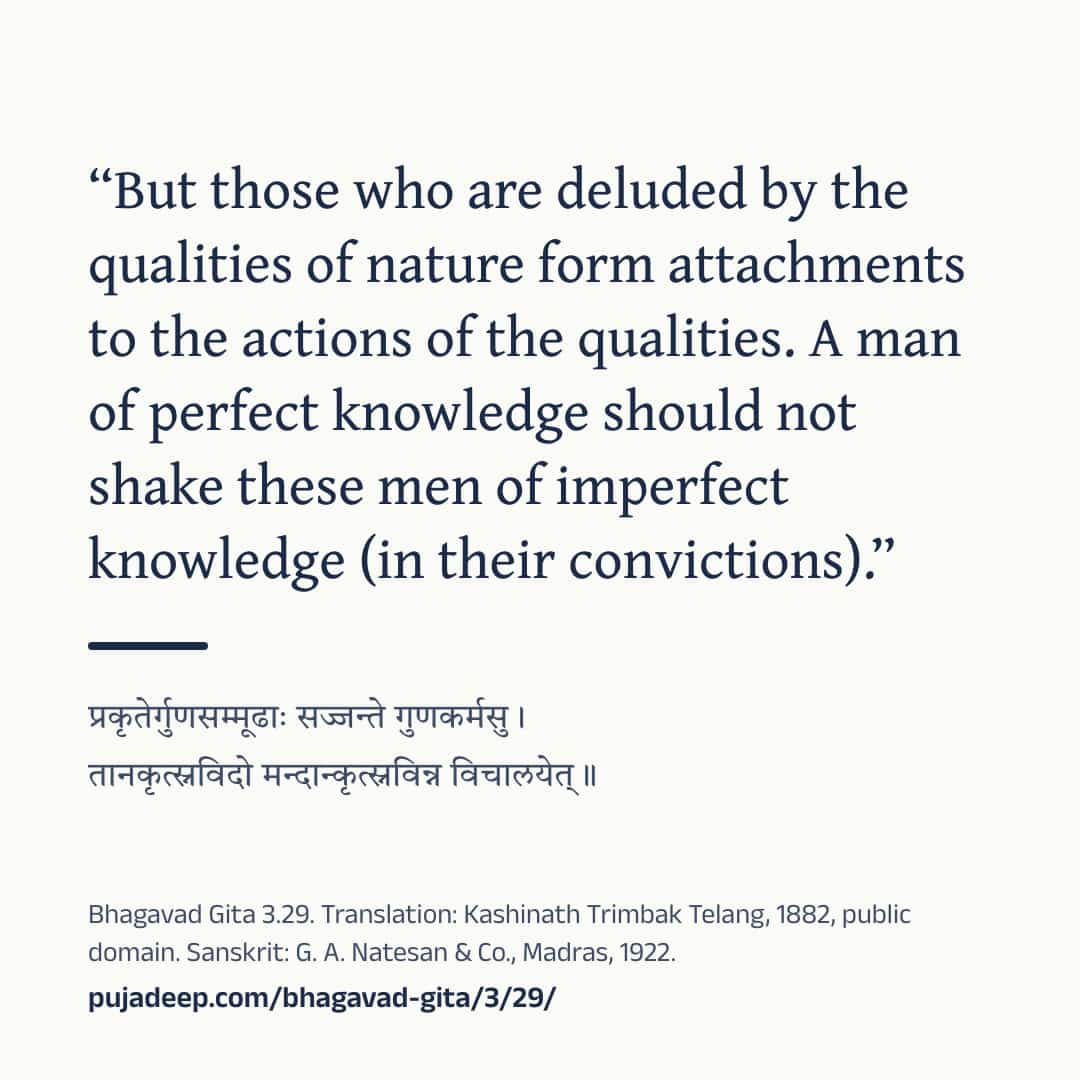
प्रकृतेर्गुणसम्मूढाः सज्जन्ते गुणकर्मसु ।
तानकृत्स्नविदो मन्दान्कृत्स्नविन्न विचालयेत् ॥

“But those who are deluded by the qualities of nature form attachments to the actions of the qualities. A man of perfect knowledge should not shake these men of imperfect knowledge (in their convictions).”
(K. T. Telang, The Bhagavadgîtâ (The Sacred Books of the East, vol. VIII, Oxford: Clarendon Press, 1882), p. 55, public domain)

“Those deluded by the energies of Nature are attached to the functions of the energies. The man of perfect knowledge should not unsettle the foolish whose knowledge is imperfect.”
(Annie Besant, The Bhagavad Gîtâ, or The Lord's Song (London: Theosophical Publishing Society, 1895), p. 46, public domain)

“Men of perfect knowledge should not unsettle (the understanding of) people of dull wit and imperfect knowledge, who deluded by the Gunas of Prakriti attach (themselves) to the functions of the Gunas.”
(Swami Swarupananda, Srimad-Bhagavad-Gita (Mayavati: Prabuddha Bharata Press, 1909; first printed in Prabuddha Bharata, 1907–1909), p. 76, public domain)

Sanskrit: G. A. Natesan & Co., Madras, 1922.
https://pujadeep.com/bhagavad-gita/3/29/ Nothing is sent from this site. Your own app sends it, to the chat you choose. The picture quotes the translation you chose on this page, with its name and year.
Sanskrit text: The Bhagavad-Gita, or The Lord's Song, with the text in Devanagari and an English translation, 1922. Meanings: written for Pujadeep and checked against the cited edition. Source and changes
Questions families ask
Who speaks Bhagavad Gita 3.29?
Krishna speaks this verse, in chapter 3 (Karma Yoga).
Where does the Sanskrit text come from?
Sanskrit text: The Bhagavad-Gita, or The Lord's Song, with the text in Devanagari and an English translation, 1922. Meanings: written for Pujadeep and checked against the cited edition. See the source
Is the meaning on this page a translation?
Explanation written for this site from the sources listed here, and checked against the cited edition. It is not a translation and not the only way to read the text. Free to quote with credit.
Source and licence
- Sanskrit text
- The Bhagavad-Gita, or The Lord's Song, with the text in Devanagari and an English translation (Annie Besant, G. A. Natesan & Co., Madras, 1922). Public domain. The Sanskrit on these pages was read from this printing’s page images.
- Translation
- The Bhagavadgîtâ with the Sanatsugâtîya and the Anugîtâ, translated by Kâshinâth Trimbak Telang (The Sacred Books of the East, vol. VIII, ed. F. Max Müller) (Kashinath Trimbak Telang, F. Max Müller, Clarendon Press, Oxford, 1882). Public domain. Shown verbatim, as printed.
- Translation
- The Bhagavad Gîtâ, or The Lord's Song, translated by Annie Besant (Annie Besant, Theosophical Publishing Society, London, 1895). Public domain. Shown verbatim, as printed.
- Translation
- Srimad-Bhagavad-Gita, with Sanskrit Text; Paraphrase with Word-by-word Literal Translation; English Rendering and Comments, Index, &c., by the Swami Swarupananda (Himalayan Series, No. XX) (Swami Swarupananda, The Editors and Publishers, Advaita Ashrama, Mayavati, Prabuddha Bharata Press, Mayavati, Almora, Himalayas, 1909). Public domain. Shown verbatim, as printed.
- Common wording
- In this text, 32 words follow today's common wording, checked against sanskritdocuments.org; Sanskrit Wikisource; Gita Press, Gorakhpur; GRETIL, Göttingen and Bhaktivedanta Book Trust.
- Our explanation
- Explanation written for this site from the sources listed here, and checked against the cited edition. It is not a translation and not the only way to read the text. Free to quote with credit.
- Checked
- Checked against the cited edition, October 27, 2026.