Bhagavad Gita 3.40: meaning and translation
Chapter 3: Karma Yoga. Krishna says
The senses, the mind (manas) and the understanding (buddhi) are said to be its seat, Krishna says.
Click or tap a word for its meaning and its dictionary page.
Text and layers
Text and layers
These choices stay in this browser.
Bhagavad Gita 3.40
इन्द्रियाणि मनो बुद्धिरस्याधिष्ठानमुच्यते ।एतैर्विमोहयत्येष ज्ञानमावृत्य देहिनम् ॥
Indriyani mano buddhirasyadhishthanamuchyateEtairvimohayatyesha jnanamavritya dehinam
indriyāṇi mano buddhirasyādhiṣṭhānamucyate |etairvimohayatyeṣa jñānamāvṛtya dehinam ||
Our explanation The senses, the mind (manas) and the understanding (buddhi) are said to be its seat, Krishna says. Through them desire covers knowledge and deludes the embodied self (dehin).
हिंदी अर्थ कृष्ण कहते हैं कि इंद्रियाँ, मन और बुद्धि इसके निवास-स्थान कहे जाते हैं। इन्हीं के द्वारा कामना ज्ञान को ढककर देहधारी (देही) को मोहित करती है।
Word by word
Every word, with its dictionary page
Word by word
- इन्द्रियाणि indriyāṇi · the senses (noun (neuter), nominative plural) Dictionary: indriya, Monier-Williams 1899, p. 167, col. 2 “faculty of sense, sense, organ of sense”
- मनः manaḥ · the mind (noun (neuter), nominative singular) Dictionary: manas, Monier-Williams 1899, p. 783, col. 3 “mind (in its widest sense as applied to all the mental powers)”
- बुद्धिः buddhiḥ · the understanding (noun (feminine), nominative singular) Dictionary: buddhi, Monier-Williams 1899, p. 733, col. 3 “intelligence, reason, intellect, mind, discernment, judgment”
- अस्य asya · its (pronoun (masculine), genitive singular) Dictionary: 1. idam, Monier-Williams 1899, p. 165, col. 2
- अधिष्ठानम् adhiṣṭhānam · seat (noun (neuter), nominative singular) Dictionary: adhi-ṣṭhāna, Monier-Williams 1899, p. 22, col. 2 “standing by, being at hand, approach; standing or resting upon; a basis, base”
- उच्यते ucyate · is said to be (present passive, 3rd person singular) Dictionary: vac, Monier-Williams 1899, p. 912, col. 1 “to speak, say, tell, utter, announce”
- एतैः etaiḥ · through these (pronoun (neuter), instrumental plural) Dictionary: etad, Monier-Williams 1899, p. 231, col. 2 “this, this here, here”
- विमोहयति vimohayati · deludes (causative present, 3rd person singular) Dictionary: vi-muh, Monier-Williams 1899, p. 980, col. 3 “to be confused, become bewildered or stupefied”
- एषः eṣaḥ · this (pronoun (masculine), nominative singular) Dictionary: etad, Monier-Williams 1899, p. 231, col. 2 “this, this here, here”
- ज्ञानम् jñānam · knowledge (noun (neuter), accusative singular) Dictionary: jñāna, Monier-Williams 1899, p. 426, col. 1 “knowing, becoming acquainted with, knowledge”
- आवृत्य āvṛtya · having covered (absolutive (having done)) Dictionary: 1. ā-vṛtya, Monier-Williams 1899, p. 156, col. 1 “having covered”; 1. ā-vṛ, Monier-Williams 1899, p. 156, col. 1 “to cover, hide, conceal”
- देहिनम् dehinam · the embodied one (noun (masculine), accusative singular) Dictionary: dehin, Monier-Williams 1899, p. 497, col. 1 “m. the spirit, soul”
Old translations
Kashinath Trimbak Telang, 1882. Public domain. Page 57.
The senses, the mind, and the understanding are said to be its seat1; with these it deludes the embodied (self) after enveloping knowledge.
Footnotes (the translator’s own) - The mind is that which ponders over things as such or such; the understanding is that which finally determines (cf. Lewes' History of Philosophy, II, 463–465). These and the senses are the 'seat' of desire, because the perception of an object by the sense, the pondering over it by the mind, and the determination about it by the understanding are the preliminaries to the awakening of the desire; supra, p. 50. ↩
Compare 3 translations
Kashinath Trimbak Telang, 1882. Public domain. Page 57.
The senses, the mind, and the understanding are said to be its seat1; with these it deludes the embodied (self) after enveloping knowledge.
Footnotes (the translator’s own) - The mind is that which ponders over things as such or such; the understanding is that which finally determines (cf. Lewes' History of Philosophy, II, 463–465). These and the senses are the 'seat' of desire, because the perception of an object by the sense, the pondering over it by the mind, and the determination about it by the understanding are the preliminaries to the awakening of the desire; supra, p. 50. ↩
You are reading this one
Annie Besant, 1895. Public domain. Page 48.
The senses, Manas and Buddhi are said to be its seat; by these enveloping wisdom, it bewilders the Dweller in the body.
You are reading this one
Swami Swarupananda, 1909 (first printed 1907). Public domain. Page 81.
The senses, the mind and the intellect are said to be its abode: through these, it deludes the embodied by veiling his wisdom.
You are reading this one
Cite this verse
The translation: K. T. Telang, The Bhagavadgîtâ (The Sacred Books of the East, vol. VIII, Oxford: Clarendon Press, 1882), p. 57. Bhagavad Gita 3.40.
The translation: Annie Besant, The Bhagavad Gîtâ, or The Lord's Song (London: Theosophical Publishing Society, 1895), p. 48. Bhagavad Gita 3.40.
The translation: Swami Swarupananda, Srimad-Bhagavad-Gita (Mayavati: Prabuddha Bharata Press, 1909; first printed in Prabuddha Bharata, 1907–1909), p. 81. Bhagavad Gita 3.40.
Our explanation: “Bhagavad Gita 3.40: meaning and translation.” Pujadeep. Updated October 27, 2026. https://pujadeep.com/bhagavad-gita/3/40/
Pujadeep’s explanations are free to quote with credit: name Pujadeep and link to the page. How to credit
Classical readings, by school
No readings by school on this verse yet.
Share
Show the ways to share
Send one picture or the text to one chat. The picture names its source and the address of this page.
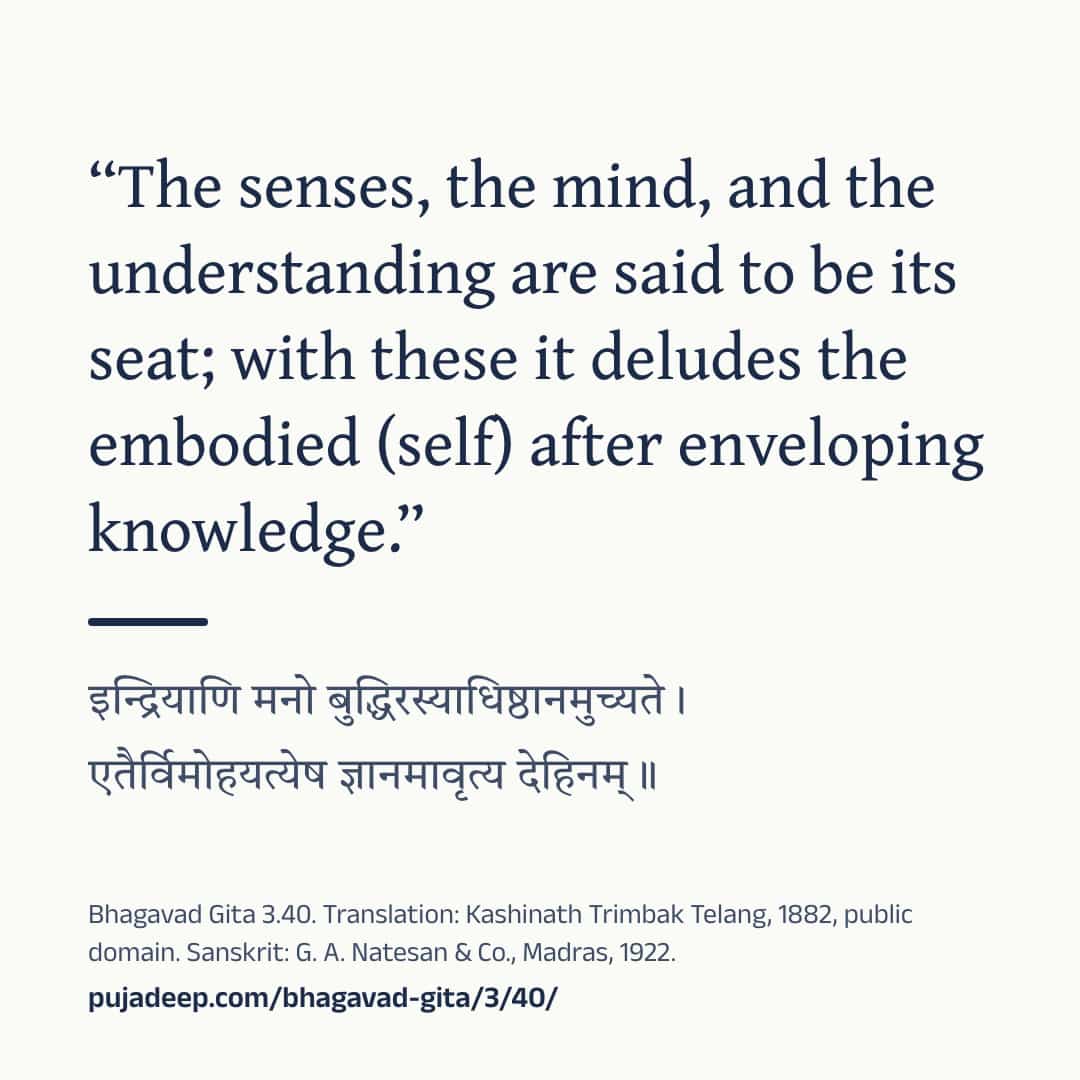
Drawing the picture
See the words
Bhagavad Gita 3.40

इन्द्रियाणि मनो बुद्धिरस्याधिष्ठानमुच्यते ।
एतैर्विमोहयत्येष ज्ञानमावृत्य देहिनम् ॥

“The senses, the mind, and the understanding are said to be its seat; with these it deludes the embodied (self) after enveloping knowledge.”
(K. T. Telang, The Bhagavadgîtâ (The Sacred Books of the East, vol. VIII, Oxford: Clarendon Press, 1882), p. 57, public domain)

“The senses, Manas and Buddhi are said to be its seat; by these enveloping wisdom, it bewilders the Dweller in the body.”
(Annie Besant, The Bhagavad Gîtâ, or The Lord's Song (London: Theosophical Publishing Society, 1895), p. 48, public domain)

“The senses, the mind and the intellect are said to be its abode: through these, it deludes the embodied by veiling his wisdom.”
(Swami Swarupananda, Srimad-Bhagavad-Gita (Mayavati: Prabuddha Bharata Press, 1909; first printed in Prabuddha Bharata, 1907–1909), p. 81, public domain)

Sanskrit: G. A. Natesan & Co., Madras, 1922.
https://pujadeep.com/bhagavad-gita/3/40/ Nothing is sent from this site. Your own app sends it, to the chat you choose. The picture quotes the translation you chose on this page, with its name and year.
Sanskrit text: The Bhagavad-Gita, or The Lord's Song, with the text in Devanagari and an English translation, 1922. Meanings: written for Pujadeep and checked against the cited edition. Source and changes
Questions families ask
Who speaks Bhagavad Gita 3.40?
Krishna speaks this verse, in chapter 3 (Karma Yoga).
Where does the Sanskrit text come from?
Sanskrit text: The Bhagavad-Gita, or The Lord's Song, with the text in Devanagari and an English translation, 1922. Meanings: written for Pujadeep and checked against the cited edition. See the source
Is the meaning on this page a translation?
Explanation written for this site from the sources listed here, and checked against the cited edition. It is not a translation and not the only way to read the text. Free to quote with credit.
Source and licence
- Sanskrit text
- The Bhagavad-Gita, or The Lord's Song, with the text in Devanagari and an English translation (Annie Besant, G. A. Natesan & Co., Madras, 1922). Public domain. The Sanskrit on these pages was read from this printing’s page images.
- Translation
- The Bhagavadgîtâ with the Sanatsugâtîya and the Anugîtâ, translated by Kâshinâth Trimbak Telang (The Sacred Books of the East, vol. VIII, ed. F. Max Müller) (Kashinath Trimbak Telang, F. Max Müller, Clarendon Press, Oxford, 1882). Public domain. Shown verbatim, as printed.
- Translation
- The Bhagavad Gîtâ, or The Lord's Song, translated by Annie Besant (Annie Besant, Theosophical Publishing Society, London, 1895). Public domain. Shown verbatim, as printed.
- Translation
- Srimad-Bhagavad-Gita, with Sanskrit Text; Paraphrase with Word-by-word Literal Translation; English Rendering and Comments, Index, &c., by the Swami Swarupananda (Himalayan Series, No. XX) (Swami Swarupananda, The Editors and Publishers, Advaita Ashrama, Mayavati, Prabuddha Bharata Press, Mayavati, Almora, Himalayas, 1909). Public domain. Shown verbatim, as printed.
- Common wording
- In this text, 32 words follow today's common wording, checked against sanskritdocuments.org; Sanskrit Wikisource; Gita Press, Gorakhpur; GRETIL, Göttingen and Bhaktivedanta Book Trust.
- Our explanation
- Explanation written for this site from the sources listed here, and checked against the cited edition. It is not a translation and not the only way to read the text. Free to quote with credit.
- Checked
- Checked against the cited edition, October 27, 2026.