Bhagavad Gita 3.34: meaning and translation
Chapter 3: Karma Yoga. Krishna says
Liking and dislike (rāga and dveṣa) are fixed in each sense towards its objects, Krishna says.
Click or tap a word for its meaning and its dictionary page.
Text and layers
Text and layers
These choices stay in this browser.
Bhagavad Gita 3.34
इन्द्रियस्येन्द्रियस्यार्थे रागद्वेषौ व्यवस्थितौ ।तयोर्न वशमागच्छेत्तौ ह्यस्य परिपन्थिनौ ॥
Indriyasyendriyasyarthe ragadveshau vyavasthitauTayorna vashamagachchhettau hyasya paripanthinau
indriyasyendriyasyārthe rāgadveṣau vyavasthitau |tayorna vaśamāgacchettau hyasya paripanthinau ||
Our explanation Liking and dislike (rāga and dveṣa) are fixed in each sense towards its objects, Krishna says. One should not come under their power, for they are one's enemies on the way (paripanthin, robbers on the road).
हिंदी अर्थ कृष्ण कहते हैं कि हर इंद्रिय के अपने विषयों के प्रति राग और द्वेष स्थित रहते हैं। मनुष्य को उनके वश में नहीं आना चाहिए, क्योंकि वे उसके मार्ग के शत्रु (परिपंथी, रास्ते के लुटेरे) हैं।
Word by word
Every word, with its dictionary page
Word by word
- इन्द्रियस्य indriyasya · of each sense (noun (neuter), genitive singular) Dictionary: indriya, Monier-Williams 1899, p. 167, col. 2 “faculty of sense, sense, organ of sense”
- इन्द्रियस्य indriyasya · of each sense (noun (neuter), genitive singular) Dictionary: indriya, Monier-Williams 1899, p. 167, col. 2 “faculty of sense, sense, organ of sense”
- अर्थे arthe · towards its object (noun (masculine), locative singular) Dictionary: artha, Monier-Williams 1899, p. 90, col. 3 “aim, purpose”
- रागद्वेषौ rāgadveṣau · liking and dislike (compound (masculine), nominative dual) Dictionary: rāga, Monier-Williams 1899, p. 872, col. 1 “any feeling or passion, (esp.) love, affection or sympathy for”; dveṣa, Monier-Williams 1899, p. 507, col. 1 “hatred, dislike, repugnance, enmity”
- व्यवस्थितौ vyavasthitau · are fixed (past participle (masculine), nominative dual) Dictionary: vy-ava-sthita, Monier-Williams 1899, p. 1034, col. 1 “settled, established, fixed, exactly determined”
- तयोः tayoḥ · of these two (pronoun (masculine), genitive dual) Dictionary: tad, Monier-Williams 1899, p. 434, col. 1 “m. he, f. she, n. it, that, this”
- न na · not (indeclinable) Dictionary: 2. na, Monier-Williams 1899, p. 523, col. 1 “not, no, nor, neither”
- वशम् vaśam · power, control (noun (masculine), accusative singular) Dictionary: 1. vaśa, Monier-Williams 1899, p. 929, col. 2 “authority, power, control, dominion”
- आगच्छेत् āgacchet · should come under (optative, 3rd person singular) Dictionary: ā-gam, Monier-Williams 1899, p. 129, col. 2 “to come, make one's appearance, come near”
- तौ tau · these two (pronoun (masculine), nominative dual) Dictionary: tad, Monier-Williams 1899, p. 434, col. 1 “m. he, f. she, n. it, that, this”
- हि hi · for (indeclinable) Dictionary: 2. hi, Monier-Williams 1899, p. 1297, col. 3 “for, because, on account of”
- अस्य asya · his, one's (pronoun (masculine), genitive singular) Dictionary: 1. idam, Monier-Williams 1899, p. 165, col. 2
- परिपन्थिनौ paripanthinau · enemies on the way (noun (masculine), nominative dual) Dictionary: pari-panthin, Monier-Williams 1899, p. 597, col. 1 “standing in the way, hindering”
Old translations
Kashinath Trimbak Telang, 1882. Public domain. Page 56.
Every sense has its affections and aversions towards its objects fixed. One should not become subject to them, for they are one's opponents1.
Footnotes (the translator’s own) - Cf. Sutta Nipâta, p. 101, as to 'likings and dislikings.' ↩
Compare 3 translations
Kashinath Trimbak Telang, 1882. Public domain. Page 56.
Every sense has its affections and aversions towards its objects fixed. One should not become subject to them, for they are one's opponents1.
Footnotes (the translator’s own) - Cf. Sutta Nipâta, p. 101, as to 'likings and dislikings.' ↩
You are reading this one
Annie Besant, 1895. Public domain. Page 46.
Affection and aversion for the objects of sense abide in the senses; let none come under the dominion of these two; they are his adversaries,
You are reading this one
Swami Swarupananda, 1909 (first printed 1907). Public domain. Page 78.
Attachment and aversion of the senses for their respective objects are natural: let none come under their sway: they are his foes.
You are reading this one
Cite this verse
The translation: K. T. Telang, The Bhagavadgîtâ (The Sacred Books of the East, vol. VIII, Oxford: Clarendon Press, 1882), p. 56. Bhagavad Gita 3.34.
The translation: Annie Besant, The Bhagavad Gîtâ, or The Lord's Song (London: Theosophical Publishing Society, 1895), p. 46. Bhagavad Gita 3.34.
The translation: Swami Swarupananda, Srimad-Bhagavad-Gita (Mayavati: Prabuddha Bharata Press, 1909; first printed in Prabuddha Bharata, 1907–1909), p. 78. Bhagavad Gita 3.34.
Our explanation: “Bhagavad Gita 3.34: meaning and translation.” Pujadeep. Updated October 27, 2026. https://pujadeep.com/bhagavad-gita/3/34/
Pujadeep’s explanations are free to quote with credit: name Pujadeep and link to the page. How to credit
Classical readings, by school
No readings by school on this verse yet.
Share
Show the ways to share
Send one picture or the text to one chat. The picture names its source and the address of this page.
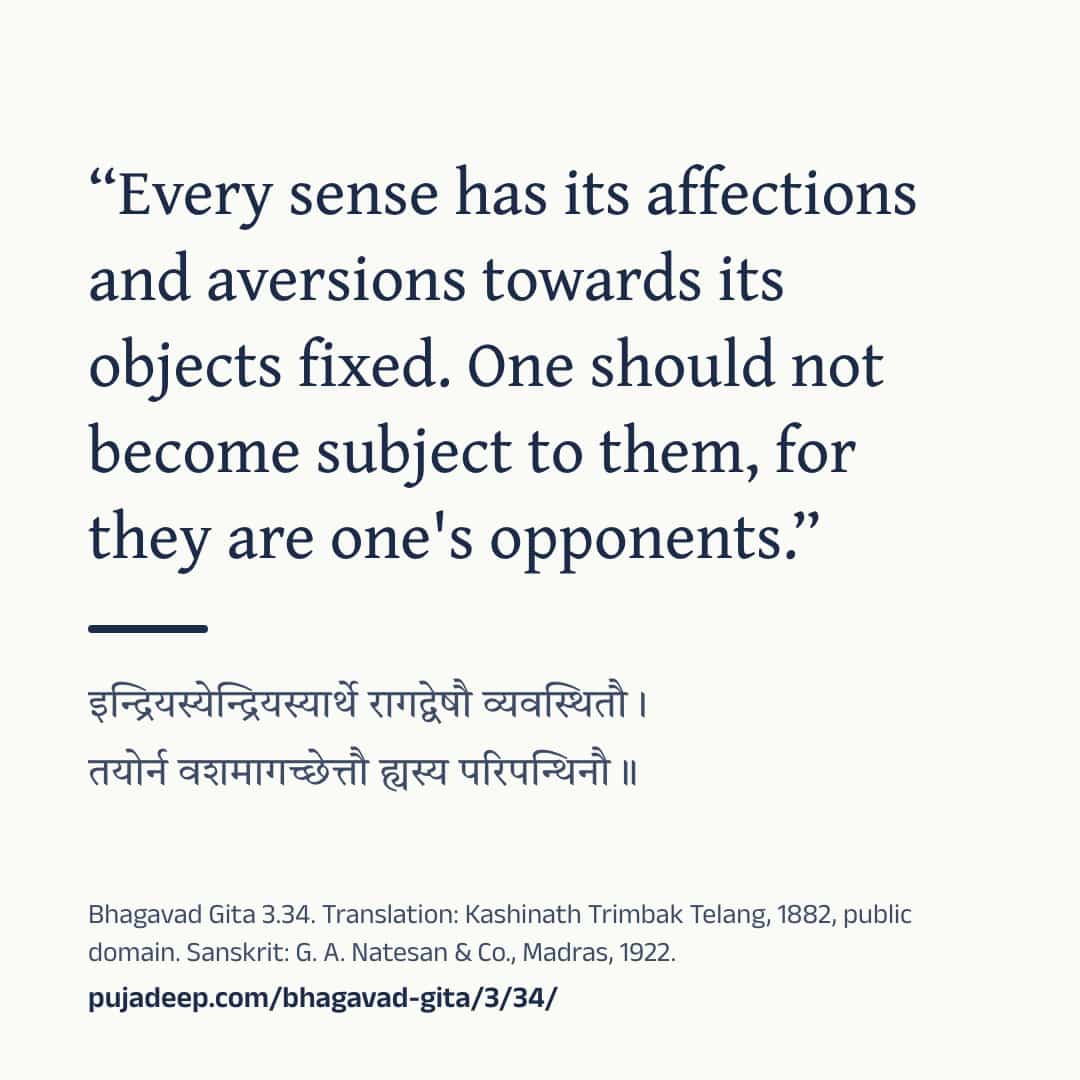
Drawing the picture
See the words
Bhagavad Gita 3.34

इन्द्रियस्येन्द्रियस्यार्थे रागद्वेषौ व्यवस्थितौ ।
तयोर्न वशमागच्छेत्तौ ह्यस्य परिपन्थिनौ ॥

“Every sense has its affections and aversions towards its objects fixed. One should not become subject to them, for they are one's opponents.”
(K. T. Telang, The Bhagavadgîtâ (The Sacred Books of the East, vol. VIII, Oxford: Clarendon Press, 1882), p. 56, public domain)

“Affection and aversion for the objects of sense abide in the senses; let none come under the dominion of these two; they are his adversaries,”
(Annie Besant, The Bhagavad Gîtâ, or The Lord's Song (London: Theosophical Publishing Society, 1895), p. 46, public domain)

“Attachment and aversion of the senses for their respective objects are natural: let none come under their sway: they are his foes.”
(Swami Swarupananda, Srimad-Bhagavad-Gita (Mayavati: Prabuddha Bharata Press, 1909; first printed in Prabuddha Bharata, 1907–1909), p. 78, public domain)

Sanskrit: G. A. Natesan & Co., Madras, 1922.
https://pujadeep.com/bhagavad-gita/3/34/ Nothing is sent from this site. Your own app sends it, to the chat you choose. The picture quotes the translation you chose on this page, with its name and year.
Sanskrit text: The Bhagavad-Gita, or The Lord's Song, with the text in Devanagari and an English translation, 1922. Meanings: written for Pujadeep and checked against the cited edition. Source and changes
Questions families ask
Who speaks Bhagavad Gita 3.34?
Krishna speaks this verse, in chapter 3 (Karma Yoga).
Where does the Sanskrit text come from?
Sanskrit text: The Bhagavad-Gita, or The Lord's Song, with the text in Devanagari and an English translation, 1922. Meanings: written for Pujadeep and checked against the cited edition. See the source
Is the meaning on this page a translation?
Explanation written for this site from the sources listed here, and checked against the cited edition. It is not a translation and not the only way to read the text. Free to quote with credit.
Source and licence
- Sanskrit text
- The Bhagavad-Gita, or The Lord's Song, with the text in Devanagari and an English translation (Annie Besant, G. A. Natesan & Co., Madras, 1922). Public domain. The Sanskrit on these pages was read from this printing’s page images.
- Translation
- The Bhagavadgîtâ with the Sanatsugâtîya and the Anugîtâ, translated by Kâshinâth Trimbak Telang (The Sacred Books of the East, vol. VIII, ed. F. Max Müller) (Kashinath Trimbak Telang, F. Max Müller, Clarendon Press, Oxford, 1882). Public domain. Shown verbatim, as printed.
- Translation
- The Bhagavad Gîtâ, or The Lord's Song, translated by Annie Besant (Annie Besant, Theosophical Publishing Society, London, 1895). Public domain. Shown verbatim, as printed.
- Translation
- Srimad-Bhagavad-Gita, with Sanskrit Text; Paraphrase with Word-by-word Literal Translation; English Rendering and Comments, Index, &c., by the Swami Swarupananda (Himalayan Series, No. XX) (Swami Swarupananda, The Editors and Publishers, Advaita Ashrama, Mayavati, Prabuddha Bharata Press, Mayavati, Almora, Himalayas, 1909). Public domain. Shown verbatim, as printed.
- Common wording
- In this text, 32 words follow today's common wording, checked against sanskritdocuments.org; Sanskrit Wikisource; Gita Press, Gorakhpur; GRETIL, Göttingen and Bhaktivedanta Book Trust.
- Our explanation
- Explanation written for this site from the sources listed here, and checked against the cited edition. It is not a translation and not the only way to read the text. Free to quote with credit.
- Checked
- Checked against the cited edition, October 27, 2026.