Bhagavad Gita 3.33: meaning and translation
Chapter 3: Karma Yoga. Krishna says
Even a person of knowledge acts according to his own nature (prakṛti), Krishna says.
Click or tap a word for its meaning and its dictionary page.
Text and layers
Text and layers
These choices stay in this browser.
Bhagavad Gita 3.33
सदृशं चेष्टते स्वस्याः प्रकृतेर्ज्ञानवानपि ।प्रकृतिं यान्ति भूतानि निग्रहः किं करिष्यति ॥
Sadrisham cheshtate svasyah prakriterjnanavanapiPrakritim yanti bhutani nigrahah kim karishyati
sadṛśaṃ ceṣṭate svasyāḥ prakṛterjñānavānapi |prakṛtiṃ yānti bhūtāni nigrahaḥ kiṃ kariṣyati ||
Our explanation Even a person of knowledge acts according to his own nature (prakṛti), Krishna says. All beings follow their nature; what can forcing it (nigraha) do? The commentators explain “nature” here as the tendencies a person brings from past actions (see the views).
हिंदी अर्थ कृष्ण कहते हैं कि ज्ञानी भी अपनी प्रकृति (स्वभाव) के अनुसार ही चेष्टा करता है। सब प्राणी अपनी प्रकृति का अनुसरण करते हैं; उसे बलपूर्वक रोकना (निग्रह) क्या करेगा? टीकाकार यहाँ “प्रकृति” का अर्थ उन प्रवृत्तियों से लेते हैं जो व्यक्ति पिछले कर्मों से साथ लाता है।
Word by word
Every word, with its dictionary page
Word by word
- सदृशम् sadṛśam · in keeping with (adjective (neuter), accusative singular) Dictionary: sadṛśa, Monier-Williams 1899, p. 1140, col. 1 “like, resembling, similar to”
- चेष्टते ceṣṭate · acts (present, 3rd person singular) Dictionary: ceṣṭ, Monier-Williams 1899, p. 402, col. 1 “to act, do, perform”
- स्वस्याः svasyāḥ · his own (pronoun (feminine), genitive singular) Dictionary: 1. sva, Monier-Williams 1899, p. 1275, col. 1 “own, one's own, my own, thy own, his own, her own, our own, their own &c.”
- प्रकृतेः prakṛteḥ · nature (noun (feminine), genitive singular) Dictionary: pra-kṛti, Monier-Williams 1899, p. 654, col. 1 “nature, character, constitution, temper, disposition”
- ज्ञानवान् jñānavān · a person of knowledge (adjective (masculine), nominative singular) Dictionary: jñāna-vat, Monier-Williams 1899, p. 426, col. 2 “endowed with knowledge or science, intelligent, wise, having spiritual knowledge”
- अपि api · even (indeclinable) Dictionary: api, Monier-Williams 1899, p. 55, col. 1 “even, also, very”
- प्रकृतिम् prakṛtim · nature (noun (feminine), accusative singular) Dictionary: pra-kṛti, Monier-Williams 1899, p. 654, col. 1 “nature, character, constitution, temper, disposition”
- यान्ति yānti · follow (present, 3rd person plural) Dictionary: 1. yā, Monier-Williams 1899, p. 849, col. 1 “to go towards or against, go or come to, enter, approach, arrive at, reach”
- भूतानि bhūtāni · beings (noun (neuter), nominative plural) Dictionary: bhūta, Monier-Williams 1899, p. 761, col. 3 “that which is or exists, any living being”
- निग्रहः nigrahaḥ · restraint, forcing (noun (masculine), nominative singular) Dictionary: ni-graha, Monier-Williams 1899, p. 546, col. 1 “keeping down or back, restraining, binding, coercion, suppression, subjugation, Mn.; MBh. &c.”
- किम् kim · what (pronoun (neuter), accusative singular) Dictionary: kim, Monier-Williams 1899, p. 282, col. 2 “what? how? whence? wherefore? why?”
- करिष्यति kariṣyati · will do (future, 3rd person singular) Dictionary: 1. kṛ, Monier-Williams 1899, p. 301, col. 1 “to do, make, perform, accomplish, cause, effect”
Old translations
Kashinath Trimbak Telang, 1882. Public domain. Page 56.
Even a man of knowledge acts consonantly to his own nature1. All beings follow nature. What will restraint effect?
Footnotes (the translator’s own) - Which is the result of the virtues and vices of a preceding life. The sequence of ideas here is as follows:—The true view stated here about the 'difference from qualities and actions' is disregarded by some, owing to their 'nature' as now explained. Then the question is, If nature is so potent, what is the good of the Sâstras? The answer is, Nature only acts through our likes and dislikes. Withstand them and then you can follow the Sâstras. It is under the influence of these likes and dislikes, that some may say, we shall practise duties prescribed for others (our own being bad ones) as they are equally prescribed by the Sâstras. That, as stated in the last sentence here, is wrong. ↩
Compare 3 translations
Kashinath Trimbak Telang, 1882. Public domain. Page 56.
Even a man of knowledge acts consonantly to his own nature1. All beings follow nature. What will restraint effect?
Footnotes (the translator’s own) - Which is the result of the virtues and vices of a preceding life. The sequence of ideas here is as follows:—The true view stated here about the 'difference from qualities and actions' is disregarded by some, owing to their 'nature' as now explained. Then the question is, If nature is so potent, what is the good of the Sâstras? The answer is, Nature only acts through our likes and dislikes. Withstand them and then you can follow the Sâstras. It is under the influence of these likes and dislikes, that some may say, we shall practise duties prescribed for others (our own being bad ones) as they are equally prescribed by the Sâstras. That, as stated in the last sentence here, is wrong. ↩
You are reading this one
Annie Besant, 1895. Public domain. Page 46.
Even the man of knowledge acteth according to his own nature; beings follow nature; what shall restraint avail?
You are reading this one
Swami Swarupananda, 1909 (first printed 1907). Public domain. Page 78.
Even a wise man acts in accordance with his own nature: beings follow nature: what can restraint do?
You are reading this one
Cite this verse
The translation: K. T. Telang, The Bhagavadgîtâ (The Sacred Books of the East, vol. VIII, Oxford: Clarendon Press, 1882), p. 56. Bhagavad Gita 3.33.
The translation: Annie Besant, The Bhagavad Gîtâ, or The Lord's Song (London: Theosophical Publishing Society, 1895), p. 46. Bhagavad Gita 3.33.
The translation: Swami Swarupananda, Srimad-Bhagavad-Gita (Mayavati: Prabuddha Bharata Press, 1909; first printed in Prabuddha Bharata, 1907–1909), p. 78. Bhagavad Gita 3.33.
Our explanation: “Bhagavad Gita 3.33: meaning and translation.” Pujadeep. Updated October 27, 2026. https://pujadeep.com/bhagavad-gita/3/33/
Pujadeep’s explanations are free to quote with credit: name Pujadeep and link to the page. How to credit
Classical readings, by school
Each reading is named by its school. None is presented as the only meaning.
What Advaita, Vishishtadvaita and Dvaita teach, in short
Shankara Advaita
Shankara takes “nature” (prakṛti) to be the impressions (saṃskāra) of past right and wrong deeds, which show themselves from the start of this life. Not even the wise can simply override it. He then explains, at 3.34, that the teaching still has a use: a person can master the liking and dislike through which nature works.
Source: The Bhagavad-Gita, with the commentary of Sri Sankaracharya, translated by A. Mahadeva Sastri (2nd ed., Mysore: G. T. A. Printing Works, 1901), commentary on 3.33–34, pp. 98–99. Summarised in our own words; none of its text is reproduced.
Ramanuja Vishishtadvaita
Ramanuja says that even the wise, who know that the self is distinct from matter, are carried along by habits formed through long contact with matter. He reads this verse and the rest of the chapter as showing the difficulties and dangers of the path of knowledge.
Source: Sri Bhagavad-Gita with Sri Ramanujacharya's Visishtadvaita commentary, translated by A. Govindacharya (Madras, 1898), commentary on 3.33, p. 119. Summarised in our own words; none of its text is reproduced.
Share
Show the ways to share
Send one picture or the text to one chat. The picture names its source and the address of this page.
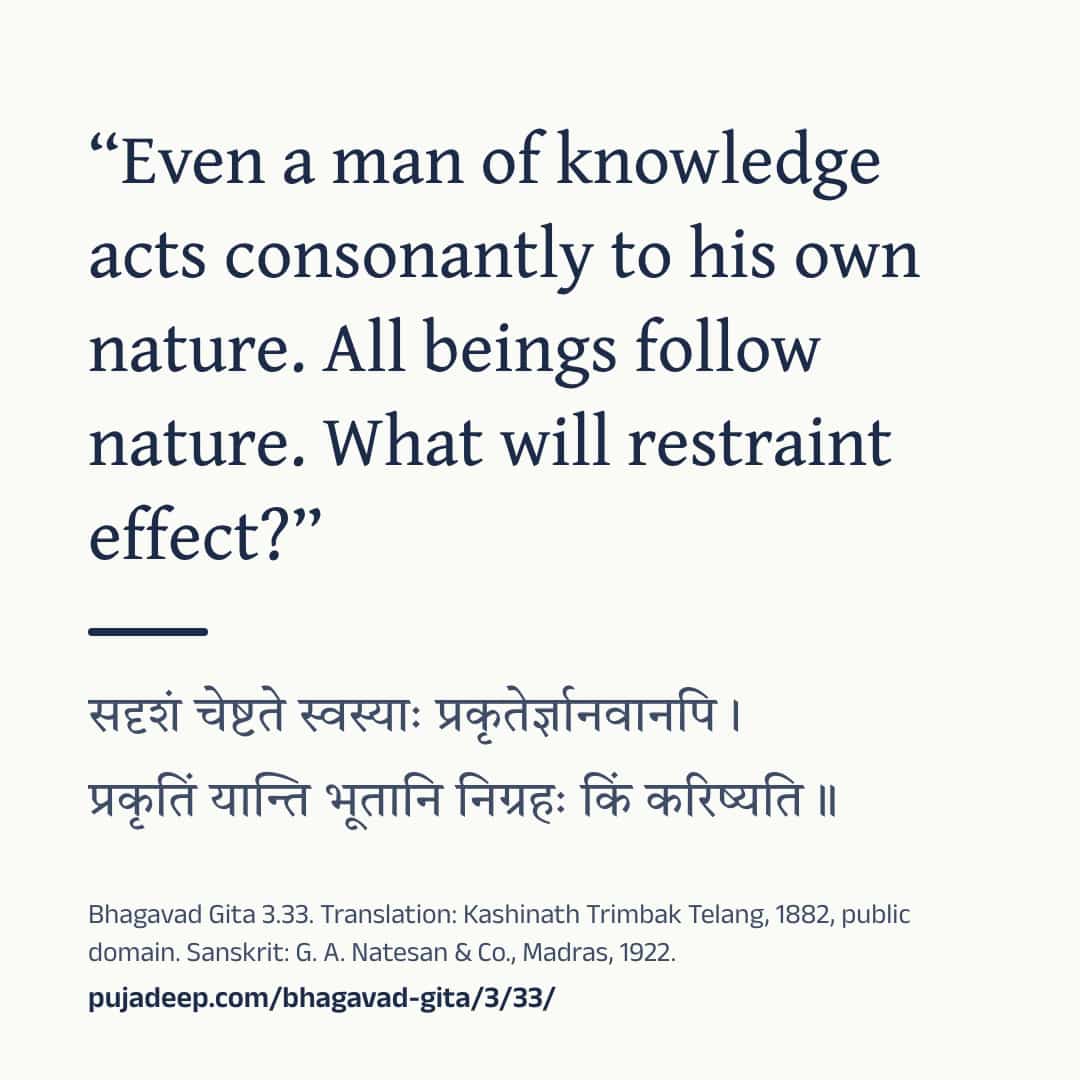
Drawing the picture
See the words
Bhagavad Gita 3.33

सदृशं चेष्टते स्वस्याः प्रकृतेर्ज्ञानवानपि ।
प्रकृतिं यान्ति भूतानि निग्रहः किं करिष्यति ॥

“Even a man of knowledge acts consonantly to his own nature. All beings follow nature. What will restraint effect?”
(K. T. Telang, The Bhagavadgîtâ (The Sacred Books of the East, vol. VIII, Oxford: Clarendon Press, 1882), p. 56, public domain)

“Even the man of knowledge acteth according to his own nature; beings follow nature; what shall restraint avail?”
(Annie Besant, The Bhagavad Gîtâ, or The Lord's Song (London: Theosophical Publishing Society, 1895), p. 46, public domain)

“Even a wise man acts in accordance with his own nature: beings follow nature: what can restraint do?”
(Swami Swarupananda, Srimad-Bhagavad-Gita (Mayavati: Prabuddha Bharata Press, 1909; first printed in Prabuddha Bharata, 1907–1909), p. 78, public domain)

Sanskrit: G. A. Natesan & Co., Madras, 1922.
https://pujadeep.com/bhagavad-gita/3/33/ Nothing is sent from this site. Your own app sends it, to the chat you choose. The picture quotes the translation you chose on this page, with its name and year.
Sanskrit text: The Bhagavad-Gita, or The Lord's Song, with the text in Devanagari and an English translation, 1922. Meanings: written for Pujadeep and checked against the cited edition. Source and changes
Questions families ask
Who speaks Bhagavad Gita 3.33?
Krishna speaks this verse, in chapter 3 (Karma Yoga).
Where does the Sanskrit text come from?
Sanskrit text: The Bhagavad-Gita, or The Lord's Song, with the text in Devanagari and an English translation, 1922. Meanings: written for Pujadeep and checked against the cited edition. See the source
Is the meaning on this page a translation?
Explanation written for this site from the sources listed here, and checked against the cited edition. It is not a translation and not the only way to read the text. Free to quote with credit.
Source and licence
- Sanskrit text
- The Bhagavad-Gita, or The Lord's Song, with the text in Devanagari and an English translation (Annie Besant, G. A. Natesan & Co., Madras, 1922). Public domain. The Sanskrit on these pages was read from this printing’s page images.
- Translation
- The Bhagavadgîtâ with the Sanatsugâtîya and the Anugîtâ, translated by Kâshinâth Trimbak Telang (The Sacred Books of the East, vol. VIII, ed. F. Max Müller) (Kashinath Trimbak Telang, F. Max Müller, Clarendon Press, Oxford, 1882). Public domain. Shown verbatim, as printed.
- Translation
- The Bhagavad Gîtâ, or The Lord's Song, translated by Annie Besant (Annie Besant, Theosophical Publishing Society, London, 1895). Public domain. Shown verbatim, as printed.
- Translation
- Srimad-Bhagavad-Gita, with Sanskrit Text; Paraphrase with Word-by-word Literal Translation; English Rendering and Comments, Index, &c., by the Swami Swarupananda (Himalayan Series, No. XX) (Swami Swarupananda, The Editors and Publishers, Advaita Ashrama, Mayavati, Prabuddha Bharata Press, Mayavati, Almora, Himalayas, 1909). Public domain. Shown verbatim, as printed.
- Commentary
- The Bhagavad-Gita, with the commentary of Sri Sankaracharya, translated by A. Mahadeva Sastri (2nd ed., Mysore: G. T. A. Printing Works, 1901) (Public-domain scan, University of California Libraries). Summarised in our own words; none of its text is reproduced.
- Commentary
- Sri Bhagavad-Gita with Sri Ramanujacharya's Visishtadvaita commentary, translated by A. Govindacharya (Madras, 1898) (Scan uploaded to archive.org (folkscanomy collection)). Summarised in our own words; none of its text is reproduced.
- Common wording
- In this text, 32 words follow today's common wording, checked against sanskritdocuments.org; Sanskrit Wikisource; Gita Press, Gorakhpur; GRETIL, Göttingen and Bhaktivedanta Book Trust.
- Our explanation
- Explanation written for this site from the sources listed here, and checked against the cited edition. It is not a translation and not the only way to read the text. Free to quote with credit.
- Checked
- Checked against the cited edition, October 27, 2026.