Bhagavad Gita 3.24: meaning and translation
Chapter 3: Karma Yoga. Krishna says
If he did not act, these worlds would fall into ruin, Krishna says; he would be the cause of confusion (saṅkara) and would destroy these beings.
Click or tap a word for its meaning and its dictionary page.
Text and layers
Text and layers
These choices stay in this browser.
Bhagavad Gita 3.24
उत्सीदेयुरिमे लोका न कुर्यां कर्म चेदहम् ।सङ्करस्य च कर्ता स्यामुपहन्यामिमाः प्रजाः ॥
Utsideyurime loka na kuryam karma chedahamSankarasya cha karta syamupahanyamimah prajah
utsīdeyurime lokā na kuryāṃ karma cedaham |saṅkarasya ca kartā syāmupahanyāmimāḥ prajāḥ ||
Our explanation If he did not act, these worlds would fall into ruin, Krishna says; he would be the cause of confusion (saṅkara) and would destroy these beings. Saṅkara means mixing or confusion; both translators render it as the confusion of castes, the word Arjuna used in chapter 1 (1.41–1.42).
हिंदी अर्थ कृष्ण कहते हैं कि यदि वे कर्म न करें तो ये लोक नष्ट हो जाएँगे; वे संकर (गड़बड़ी, मिश्रण) के कारण बनेंगे और इन प्राणियों का नाश करेंगे। संकर का अर्थ है मिलावट या गड़बड़ी; दोनों अनुवादक इसे वर्णों की गड़बड़ी के रूप में लेते हैं, वही शब्द जो अर्जुन ने अध्याय 1 (1.41–1.42) में कहा था।
Word by word
Every word, with its dictionary page
Word by word
- उत्सीदेयुः utsīdeyuḥ · would fall into ruin (optative, 3rd person plural) Dictionary: ut-sad, Monier-Williams 1899, p. 182, col. 1 “to sink, settle down, fall into ruin or decay, be abolished”
- इमे ime · these (pronoun (masculine), nominative plural) Dictionary: 1. idam, Monier-Williams 1899, p. 165, col. 2
- लोकाः lokāḥ · worlds (noun (masculine), nominative plural) Dictionary: loka, Monier-Williams 1899, p. 906, col. 1 “the wide space or world”
- न na · not (indeclinable) Dictionary: 2. na, Monier-Williams 1899, p. 523, col. 1 “not, no, nor, neither”
- कुर्याम् kuryām · were to do (optative, 1st person singular) Dictionary: 1. kṛ, Monier-Williams 1899, p. 301, col. 1 “to do, make, perform, accomplish, cause, effect”
- कर्म karma · action (noun (neuter), accusative singular) Dictionary: karman, Monier-Williams 1899, p. 258, col. 2 “act, action, performance, business”
- चेत् cet · if (indeclinable) Dictionary: ced, Monier-Williams 1899, p. 401, col. 3 “if”
- अहम् aham · "I" (pronoun, nominative singular) Dictionary: aham, Monier-Williams 1899, p. 124, col. 2 “nom. sg. ‘I,’”
- सङ्करस्य saṅkarasya · of confusion (saṅkara) (noun (masculine), genitive singular) Dictionary: saṃ-kara, Monier-Williams 1899, p. 1126, col. 2 “mixing together, commingling, intermixture, confusion”
- च ca · and (indeclinable) Dictionary: 2. ca, Monier-Williams 1899, p. 380, col. 1 “and, both, also, moreover, as well as”
- कर्ता kartā · the cause, the maker (noun (masculine), nominative singular) Dictionary: kartṛ, Monier-Williams 1899, p. 257, col. 3 “one who makes or does or acts or effects, a doer, maker, agent, author”
- स्याम् syām · would be (optative, 1st person singular) Dictionary: 1. as, Monier-Williams 1899, p. 117, col. 2 “to be, live, exist, be present”
- उपहन्याम् upahanyām · would destroy (optative, 1st person singular) Dictionary: upa-han, Monier-Williams 1899, p. 211, col. 3 “to hit, hurt, damage, visit, afflict, impede, spoil”
- इमाः imāḥ · these (pronoun (feminine), accusative plural) Dictionary: 1. idam, Monier-Williams 1899, p. 165, col. 2 “this, this here, referring to something near the speaker”
- प्रजाः prajāḥ · beings, people (noun (feminine), accusative plural) Dictionary: prajā, Monier-Williams 1899, p. 658, col. 2 “a creature, animal, man, mankind”
Old translations
Kashinath Trimbak Telang, 1882. Public domain. Page 55.
If I did not perform actions, these worlds would be destroyed, I should be the cause of caste-interminglings; and I should be ruining these people.
Compare 3 translations
Kashinath Trimbak Telang, 1882. Public domain. Page 55.
If I did not perform actions, these worlds would be destroyed, I should be the cause of caste-interminglings; and I should be ruining these people.
You are reading this one
Annie Besant, 1895. Public domain. Page 45.
These worlds would fall into ruin, if I did not perform action; I should be the author of confusion of castes, and should destroy these creatures.
You are reading this one
Swami Swarupananda, 1909 (first printed 1907). Public domain. Page 74.
If I did not do work, these worlds would perish. I should be the cause of the admixture of races, and I should ruin these beings.
You are reading this one
Cite this verse
The translation: K. T. Telang, The Bhagavadgîtâ (The Sacred Books of the East, vol. VIII, Oxford: Clarendon Press, 1882), p. 55. Bhagavad Gita 3.24.
The translation: Annie Besant, The Bhagavad Gîtâ, or The Lord's Song (London: Theosophical Publishing Society, 1895), p. 45. Bhagavad Gita 3.24.
The translation: Swami Swarupananda, Srimad-Bhagavad-Gita (Mayavati: Prabuddha Bharata Press, 1909; first printed in Prabuddha Bharata, 1907–1909), p. 74. Bhagavad Gita 3.24.
Our explanation: “Bhagavad Gita 3.24: meaning and translation.” Pujadeep. Updated October 27, 2026. https://pujadeep.com/bhagavad-gita/3/24/
Pujadeep’s explanations are free to quote with credit: name Pujadeep and link to the page. How to credit
Classical readings, by school
No readings by school on this verse yet.
Share
Show the ways to share
Send one picture or the text to one chat. The picture names its source and the address of this page.
Drawing the picture
See the words
Bhagavad Gita 3.24

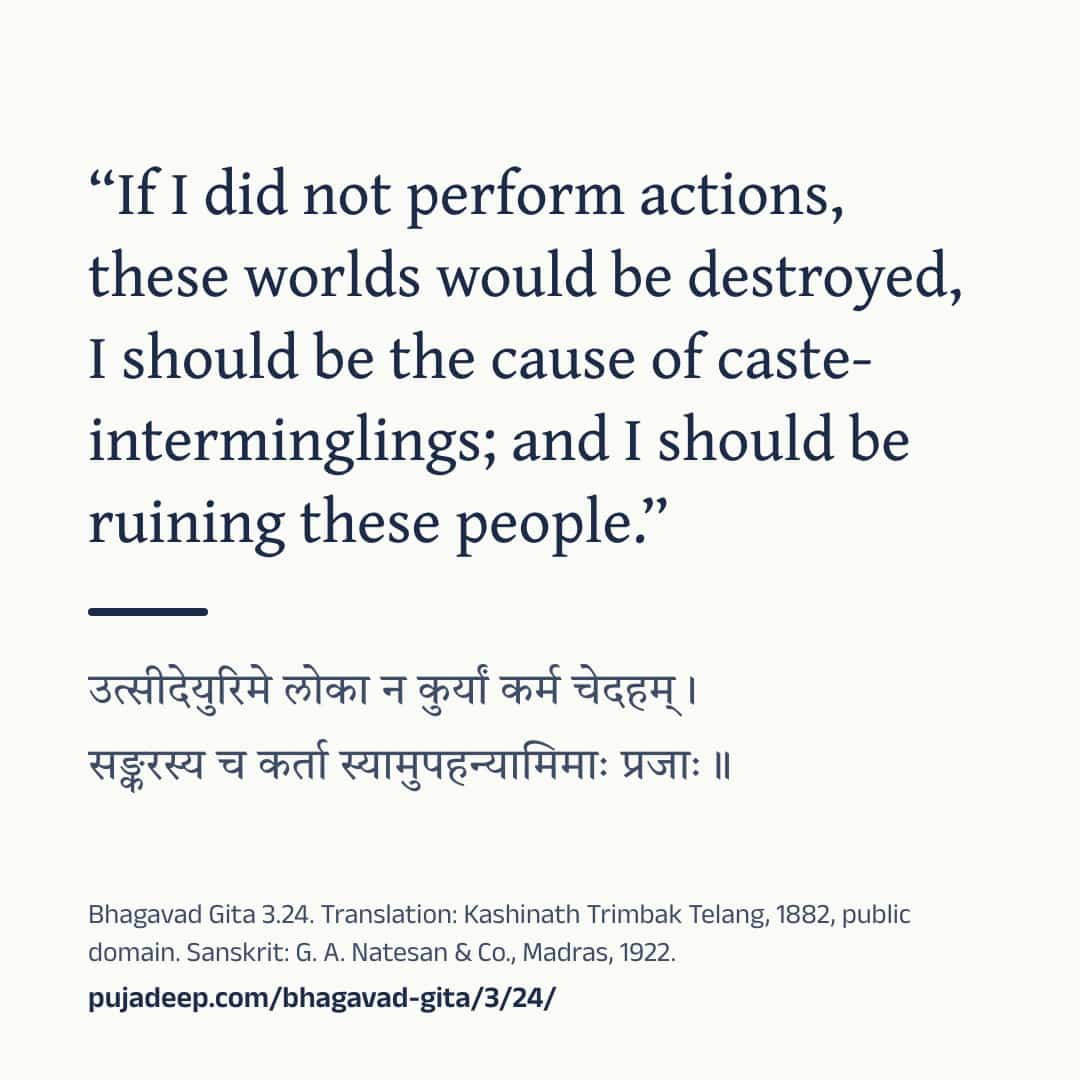
उत्सीदेयुरिमे लोका न कुर्यां कर्म चेदहम् ।
सङ्करस्य च कर्ता स्यामुपहन्यामिमाः प्रजाः ॥

“If I did not perform actions, these worlds would be destroyed, I should be the cause of caste-interminglings; and I should be ruining these people.”
(K. T. Telang, The Bhagavadgîtâ (The Sacred Books of the East, vol. VIII, Oxford: Clarendon Press, 1882), p. 55, public domain)

“These worlds would fall into ruin, if I did not perform action; I should be the author of confusion of castes, and should destroy these creatures.”
(Annie Besant, The Bhagavad Gîtâ, or The Lord's Song (London: Theosophical Publishing Society, 1895), p. 45, public domain)

“If I did not do work, these worlds would perish. I should be the cause of the admixture of races, and I should ruin these beings.”
(Swami Swarupananda, Srimad-Bhagavad-Gita (Mayavati: Prabuddha Bharata Press, 1909; first printed in Prabuddha Bharata, 1907–1909), p. 74, public domain)

Sanskrit: G. A. Natesan & Co., Madras, 1922.
https://pujadeep.com/bhagavad-gita/3/24/ Nothing is sent from this site. Your own app sends it, to the chat you choose. The picture quotes the translation you chose on this page, with its name and year.
Sanskrit text: The Bhagavad-Gita, or The Lord's Song, with the text in Devanagari and an English translation, 1922. Meanings: written for Pujadeep and checked against the cited edition. Source and changes
Questions families ask
Who speaks Bhagavad Gita 3.24?
Krishna speaks this verse, in chapter 3 (Karma Yoga).
Where does the Sanskrit text come from?
Sanskrit text: The Bhagavad-Gita, or The Lord's Song, with the text in Devanagari and an English translation, 1922. Meanings: written for Pujadeep and checked against the cited edition. See the source
Is the meaning on this page a translation?
Explanation written for this site from the sources listed here, and checked against the cited edition. It is not a translation and not the only way to read the text. Free to quote with credit.
Source and licence
- Sanskrit text
- The Bhagavad-Gita, or The Lord's Song, with the text in Devanagari and an English translation (Annie Besant, G. A. Natesan & Co., Madras, 1922). Public domain. The Sanskrit on these pages was read from this printing’s page images.
- Translation
- The Bhagavadgîtâ with the Sanatsugâtîya and the Anugîtâ, translated by Kâshinâth Trimbak Telang (The Sacred Books of the East, vol. VIII, ed. F. Max Müller) (Kashinath Trimbak Telang, F. Max Müller, Clarendon Press, Oxford, 1882). Public domain. Shown verbatim, as printed.
- Translation
- The Bhagavad Gîtâ, or The Lord's Song, translated by Annie Besant (Annie Besant, Theosophical Publishing Society, London, 1895). Public domain. Shown verbatim, as printed.
- Translation
- Srimad-Bhagavad-Gita, with Sanskrit Text; Paraphrase with Word-by-word Literal Translation; English Rendering and Comments, Index, &c., by the Swami Swarupananda (Himalayan Series, No. XX) (Swami Swarupananda, The Editors and Publishers, Advaita Ashrama, Mayavati, Prabuddha Bharata Press, Mayavati, Almora, Himalayas, 1909). Public domain. Shown verbatim, as printed.
- Common wording
- In this text, 32 words follow today's common wording, checked against sanskritdocuments.org; Sanskrit Wikisource; Gita Press, Gorakhpur; GRETIL, Göttingen and Bhaktivedanta Book Trust.
- Our explanation
- Explanation written for this site from the sources listed here, and checked against the cited edition. It is not a translation and not the only way to read the text. Free to quote with credit.
- Checked
- Checked against the cited edition, October 27, 2026.