Bhagavad Gita 3.18: meaning and translation
Chapter 3: Karma Yoga. Krishna says
Such a person, Krishna says, has no purpose to gain here by what is done or by what is left undone, and does not depend on any being for any purpose.
Click or tap a word for its meaning and its dictionary page.
Text and layers
Text and layers
These choices stay in this browser.
Bhagavad Gita 3.18
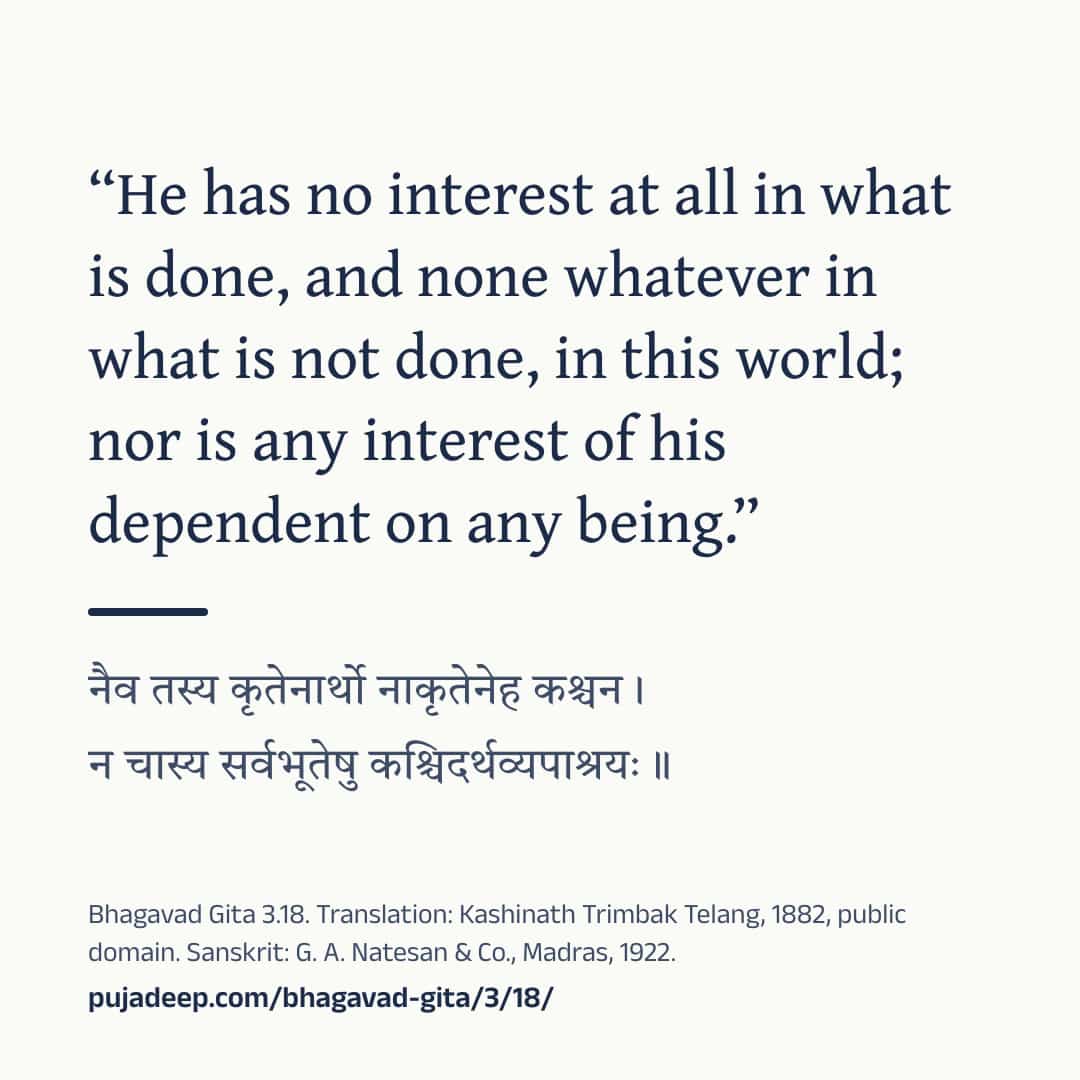
नैव तस्य कृतेनार्थो नाकृतेनेह कश्चन ।न चास्य सर्वभूतेषु कश्चिदर्थव्यपाश्रयः ॥
Naiva tasya kritenartho nakriteneha kashchanaNa chasya sarvabhuteshu kashchidarthavyapashrayah
naiva tasya kṛtenārtho nākṛteneha kaścana |na cāsya sarvabhūteṣu kaścidarthavyapāśrayaḥ ||
Our explanation Such a person, Krishna says, has no purpose to gain here by what is done or by what is left undone, and does not depend on any being for any purpose.
हिंदी अर्थ कृष्ण कहते हैं कि ऐसे व्यक्ति का इस संसार में न कुछ करने से कोई प्रयोजन है, न कुछ न करने से; और उसे किसी प्रयोजन के लिए किसी प्राणी पर निर्भर नहीं रहना पड़ता।
Word by word
Every word, with its dictionary page
Word by word
- न na · not (indeclinable) Dictionary: 2. na, Monier-Williams 1899, p. 523, col. 1 “not, no, nor, neither”
- एव eva · at all (indeclinable) Dictionary: 1. eva, Monier-Williams 1899, p. 232, col. 2 “just, exactly, very, same, only, even, alone, merely”
- तस्य tasya · for him (pronoun (masculine), genitive singular) Dictionary: tad, Monier-Williams 1899, p. 434, col. 1 “m. he, f. she, n. it, that, this”
- कृतेन kṛtena · by what is done (past participle (neuter), instrumental singular) Dictionary: 1. kṛta, Monier-Williams 1899, p. 301, col. 3 “done, made, accomplished, performed”
- अर्थः arthaḥ · purpose, gain (noun (masculine), nominative singular) Dictionary: artha, Monier-Williams 1899, p. 90, col. 3 “aim, purpose”
- न na · nor (indeclinable) Dictionary: 2. na, Monier-Williams 1899, p. 523, col. 1 “not, no, nor, neither”
- अकृतेन akṛtena · by what is not done (past participle (neuter), instrumental singular) Dictionary: a-kṛta, Monier-Williams 1899, p. 2, col. 2 “undone, not committed”
- इह iha · here (indeclinable) Dictionary: iha, Monier-Williams 1899, p. 169, col. 3 “in this place, here”
- कश्चन kaścana · any (pronoun (masculine), nominative singular) Dictionary: kim, Monier-Williams 1899, p. 282, col. 2 “what? how? whence? wherefore? why?”; cana, Monier-Williams 1899, p. 386, col. 2
- न na · not (indeclinable) Dictionary: 2. na, Monier-Williams 1899, p. 523, col. 1 “not, no, nor, neither”
- च ca · and (indeclinable) Dictionary: 2. ca, Monier-Williams 1899, p. 380, col. 1 “and, both, also, moreover, as well as”
- अस्य asya · his (pronoun (masculine), genitive singular) Dictionary: 1. idam, Monier-Williams 1899, p. 165, col. 2
- सर्वभूतेषु sarvabhūteṣu · among all beings (compound (neuter), locative plural) Dictionary: sarva, Monier-Williams 1899, p. 1184, col. 3 “whole, entire, all, every”; bhūta, Monier-Williams 1899, p. 761, col. 3 “that which is or exists, any living being”
- कश्चित् kaścit · any (pronoun (masculine), nominative singular) Dictionary: kim, Monier-Williams 1899, p. 282, col. 2 “what? how? whence? wherefore? why?”; 2. cid, Monier-Williams 1899, p. 398, col. 1 “even, indeed, also”
- अर्थव्यपाश्रयः arthavyapāśrayaḥ · dependence for a purpose (compound (masculine), nominative singular) Dictionary: artha, Monier-Williams 1899, p. 90, col. 3 “aim, purpose”; 2. vyapāśraya, Monier-Williams 1899, p. 1032, col. 1 “place of refuge, shelter, support”
Old translations
Kashinath Trimbak Telang, 1882. Public domain. Page 54.
He has no interest at all in what is done, and none whatever in what is not done, in this world1; nor is any interest of his dependent on any being.
Footnotes (the translator’s own) - No good or evil accrues to him from anything he does or omits to do. ↩
Compare 3 translations
Kashinath Trimbak Telang, 1882. Public domain. Page 54.
He has no interest at all in what is done, and none whatever in what is not done, in this world1; nor is any interest of his dependent on any being.
Footnotes (the translator’s own) - No good or evil accrues to him from anything he does or omits to do. ↩
You are reading this one
Annie Besant, 1895. Public domain. Page 44.
For him there is no interest in things done in this world, nor any in things not done, nor doth any object of his depend on any being.
This sentence begins in 3.17.
You are reading this one
Swami Swarupananda, 1909 (first printed 1907). Public domain. Page 71.
He has no object in this world (to gain) by doing (an action), nor (does he incur any loss) by non-performance of action,—nor has he (need of) depending on any being for any object.
You are reading this one
Cite this verse
The translation: K. T. Telang, The Bhagavadgîtâ (The Sacred Books of the East, vol. VIII, Oxford: Clarendon Press, 1882), p. 54. Bhagavad Gita 3.18.
The translation: Annie Besant, The Bhagavad Gîtâ, or The Lord's Song (London: Theosophical Publishing Society, 1895), p. 44. Bhagavad Gita 3.18.
The translation: Swami Swarupananda, Srimad-Bhagavad-Gita (Mayavati: Prabuddha Bharata Press, 1909; first printed in Prabuddha Bharata, 1907–1909), p. 71. Bhagavad Gita 3.18.
Our explanation: “Bhagavad Gita 3.18: meaning and translation.” Pujadeep. Updated October 27, 2026. https://pujadeep.com/bhagavad-gita/3/18/
Pujadeep’s explanations are free to quote with credit: name Pujadeep and link to the page. How to credit
Classical readings, by school
No readings by school on this verse yet.
Share
Show the ways to share
Send one picture or the text to one chat. The picture names its source and the address of this page.
Drawing the picture
See the words
Bhagavad Gita 3.18

नैव तस्य कृतेनार्थो नाकृतेनेह कश्चन ।
न चास्य सर्वभूतेषु कश्चिदर्थव्यपाश्रयः ॥

“He has no interest at all in what is done, and none whatever in what is not done, in this world; nor is any interest of his dependent on any being.”
(K. T. Telang, The Bhagavadgîtâ (The Sacred Books of the East, vol. VIII, Oxford: Clarendon Press, 1882), p. 54, public domain)

“For him there is no interest in things done in this world, nor any in things not done, nor doth any object of his depend on any being.”
(Annie Besant, The Bhagavad Gîtâ, or The Lord's Song (London: Theosophical Publishing Society, 1895), p. 44, public domain)
This sentence begins in 3.17.

“He has no object in this world (to gain) by doing (an action), nor (does he incur any loss) by non-performance of action,—nor has he (need of) depending on any being for any object.”
(Swami Swarupananda, Srimad-Bhagavad-Gita (Mayavati: Prabuddha Bharata Press, 1909; first printed in Prabuddha Bharata, 1907–1909), p. 71, public domain)

Sanskrit: G. A. Natesan & Co., Madras, 1922.
https://pujadeep.com/bhagavad-gita/3/18/ Nothing is sent from this site. Your own app sends it, to the chat you choose. The picture quotes the translation you chose on this page, with its name and year.
Sanskrit text: The Bhagavad-Gita, or The Lord's Song, with the text in Devanagari and an English translation, 1922. Meanings: written for Pujadeep and checked against the cited edition. Source and changes
Questions families ask
Who speaks Bhagavad Gita 3.18?
Krishna speaks this verse, in chapter 3 (Karma Yoga).
Where does the Sanskrit text come from?
Sanskrit text: The Bhagavad-Gita, or The Lord's Song, with the text in Devanagari and an English translation, 1922. Meanings: written for Pujadeep and checked against the cited edition. See the source
Is the meaning on this page a translation?
Explanation written for this site from the sources listed here, and checked against the cited edition. It is not a translation and not the only way to read the text. Free to quote with credit.
Source and licence
- Sanskrit text
- The Bhagavad-Gita, or The Lord's Song, with the text in Devanagari and an English translation (Annie Besant, G. A. Natesan & Co., Madras, 1922). Public domain. The Sanskrit on these pages was read from this printing’s page images.
- Translation
- The Bhagavadgîtâ with the Sanatsugâtîya and the Anugîtâ, translated by Kâshinâth Trimbak Telang (The Sacred Books of the East, vol. VIII, ed. F. Max Müller) (Kashinath Trimbak Telang, F. Max Müller, Clarendon Press, Oxford, 1882). Public domain. Shown verbatim, as printed.
- Translation
- The Bhagavad Gîtâ, or The Lord's Song, translated by Annie Besant (Annie Besant, Theosophical Publishing Society, London, 1895). Public domain. Shown verbatim, as printed.
- Translation
- Srimad-Bhagavad-Gita, with Sanskrit Text; Paraphrase with Word-by-word Literal Translation; English Rendering and Comments, Index, &c., by the Swami Swarupananda (Himalayan Series, No. XX) (Swami Swarupananda, The Editors and Publishers, Advaita Ashrama, Mayavati, Prabuddha Bharata Press, Mayavati, Almora, Himalayas, 1909). Public domain. Shown verbatim, as printed.
- Common wording
- In this text, 32 words follow today's common wording, checked against sanskritdocuments.org; Sanskrit Wikisource; Gita Press, Gorakhpur; GRETIL, Göttingen and Bhaktivedanta Book Trust.
- Our explanation
- Explanation written for this site from the sources listed here, and checked against the cited edition. It is not a translation and not the only way to read the text. Free to quote with credit.
- Checked
- Checked against the cited edition, October 27, 2026.