Bhagavad Gita 3.10: meaning and translation
Chapter 3: Karma Yoga. Krishna says
Krishna recalls an old account.
Click or tap a word for its meaning and its dictionary page.
Text and layers
Text and layers
These choices stay in this browser.
Bhagavad Gita 3.10
सहयज्ञाः प्रजाः सृष्ट्वा पुरोवाच प्रजापतिः ।अनेन प्रसविष्यध्वमेष वोऽस्त्विष्टकामधुक् ॥
Sahayajnah prajah srishtva purovacha prajapatihAnena prasavishyadhvamesha vostvishtakamadhuk
sahayajñāḥ prajāḥ sṛṣṭvā purovāca prajāpatiḥ |anena prasaviṣyadhvameṣa vo’stviṣṭakāmadhuk ||
Our explanation Krishna recalls an old account. In the beginning, Prajapati, the lord of creatures, created people together with sacrifice and said: “By this you shall multiply. Let this be your wish-giving cow (kāmadhuk).” Prajapati's words continue to verse 12.
हिंदी अर्थ कृष्ण एक पुरानी बात बताते हैं। आरंभ में प्रजापति (प्राणियों के स्वामी) ने यज्ञ के साथ-साथ प्रजा को रचा और कहा: “इसके द्वारा तुम बढ़ो; यह तुम्हारे लिए इच्छित वस्तुएँ देने वाली कामधेनु (कामधुक्) हो।” प्रजापति के वचन श्लोक 12 तक चलते हैं।
Word by word
Every word, with its dictionary page
Word by word
- सहयज्ञाः sahayajñāḥ · together with sacrifice (compound (feminine), accusative plural) Dictionary: saha-yajña, Monier-Williams 1899, p. 1194, col. 2 “with sacrifices, Bhag.”; yajña, Monier-Williams 1899, p. 839, col. 2 “act of worship or devotion, offering, oblation, sacrifice”
- प्रजाः prajāḥ · people, beings (noun (feminine), accusative plural) Dictionary: prajā, Monier-Williams 1899, p. 658, col. 2 “a creature, animal, man, mankind”
- सृष्ट्वा sṛṣṭvā · having created (absolutive (having done)) Dictionary: 1. sṛj, Monier-Williams 1899, p. 1245, col. 2 “to emit from one's self, i.e. create, procreate, produce, beget”
- पुरा purā · in the beginning (indeclinable) Dictionary: purā, Monier-Williams 1899, p. 634, col. 3 “at first, in the beginning”
- उवाच uvāca · said (perfect, 3rd person singular) Dictionary: vac, Monier-Williams 1899, p. 912, col. 1 “to speak, say, tell, utter, announce”
- प्रजापतिः prajāpatiḥ · Prajapati, lord of creatures (noun (masculine), nominative singular) Dictionary: prajā-pati, Monier-Williams 1899, p. 658, col. 3 “lord of creatures, creator”
- अनेन anena · by this (pronoun (masculine), instrumental singular) Dictionary: 1. idam, Monier-Williams 1899, p. 165, col. 2 “this, this here, referring to something near the speaker”
- प्रसविष्यध्वम् prasaviṣyadhvam · you shall multiply (future, 2nd person plural) Dictionary: pra-sū, Monier-Williams 1899, p. 698, col. 1 “to procreate, beget, bring forth, obtain offspring or bear fruit, produce”
- एषः eṣaḥ · this (pronoun (masculine), nominative singular) Dictionary: etad, Monier-Williams 1899, p. 231, col. 2 “this, this here, here”
- वः vaḥ · your (pronoun, genitive plural) Dictionary: yuṣmad, Monier-Williams 1899, p. 855, col. 3 “the base of the 2nd pers. pron. as used in comp.”
- अस्तु astu · let it be (imperative, 3rd person singular) Dictionary: 1. as, Monier-Williams 1899, p. 117, col. 2 “to be, live, exist, be present”
- इष्टकामधुक् iṣṭakāmadhuk · the giver of what you wish (compound, nominative singular) Dictionary: iṣṭa, Monier-Williams 1899, p. 169, col. 2 “wished, desired; liked, beloved; agreeable; cherished”; kāma-duh, Monier-Williams 1899, p. 272, col. 2; kāma-dugha, Monier-Williams 1899, p. 272, col. 2 “yielding objects of desire like milk, yielding what one wishes”
Old translations
Kashinath Trimbak Telang, 1882. Public domain. Page 53.
The Creator, having in olden times created men together with the sacrifice, said: 'Propagate with this. May it be the giver to you of the things you desire.
Compare 3 translations
Kashinath Trimbak Telang, 1882. Public domain. Page 53.
The Creator, having in olden times created men together with the sacrifice, said: 'Propagate with this. May it be the giver to you of the things you desire.
You are reading this one
Annie Besant, 1895. Public domain. Page 42.
Having in ancient times emanated mankind by sacrifice, the Lord of Emanation1 said: "By this shall ye propagate; be this to you the Kâmaduk2;
This sentence goes on in 3.11.
Footnotes (the translator’s own) You are reading this one
Swami Swarupananda, 1909 (first printed 1907). Public domain. Page 67–68.
The Prajapati having in the beginning, created mankind together with Yajna, said,—"By this shall ye multiply: this shall be the milch cow of your desires.
You are reading this one
Cite this verse
The translation: K. T. Telang, The Bhagavadgîtâ (The Sacred Books of the East, vol. VIII, Oxford: Clarendon Press, 1882), p. 53. Bhagavad Gita 3.10.
The translation: Annie Besant, The Bhagavad Gîtâ, or The Lord's Song (London: Theosophical Publishing Society, 1895), p. 42. Bhagavad Gita 3.10.
The translation: Swami Swarupananda, Srimad-Bhagavad-Gita (Mayavati: Prabuddha Bharata Press, 1909; first printed in Prabuddha Bharata, 1907–1909), pp. 67–68. Bhagavad Gita 3.10.
Our explanation: “Bhagavad Gita 3.10: meaning and translation.” Pujadeep. Updated October 27, 2026. https://pujadeep.com/bhagavad-gita/3/10/
Pujadeep’s explanations are free to quote with credit: name Pujadeep and link to the page. How to credit
Classical readings, by school
No readings by school on this verse yet.
Share
Show the ways to share
Send one picture or the text to one chat. The picture names its source and the address of this page.
Drawing the picture
See the words
Bhagavad Gita 3.10

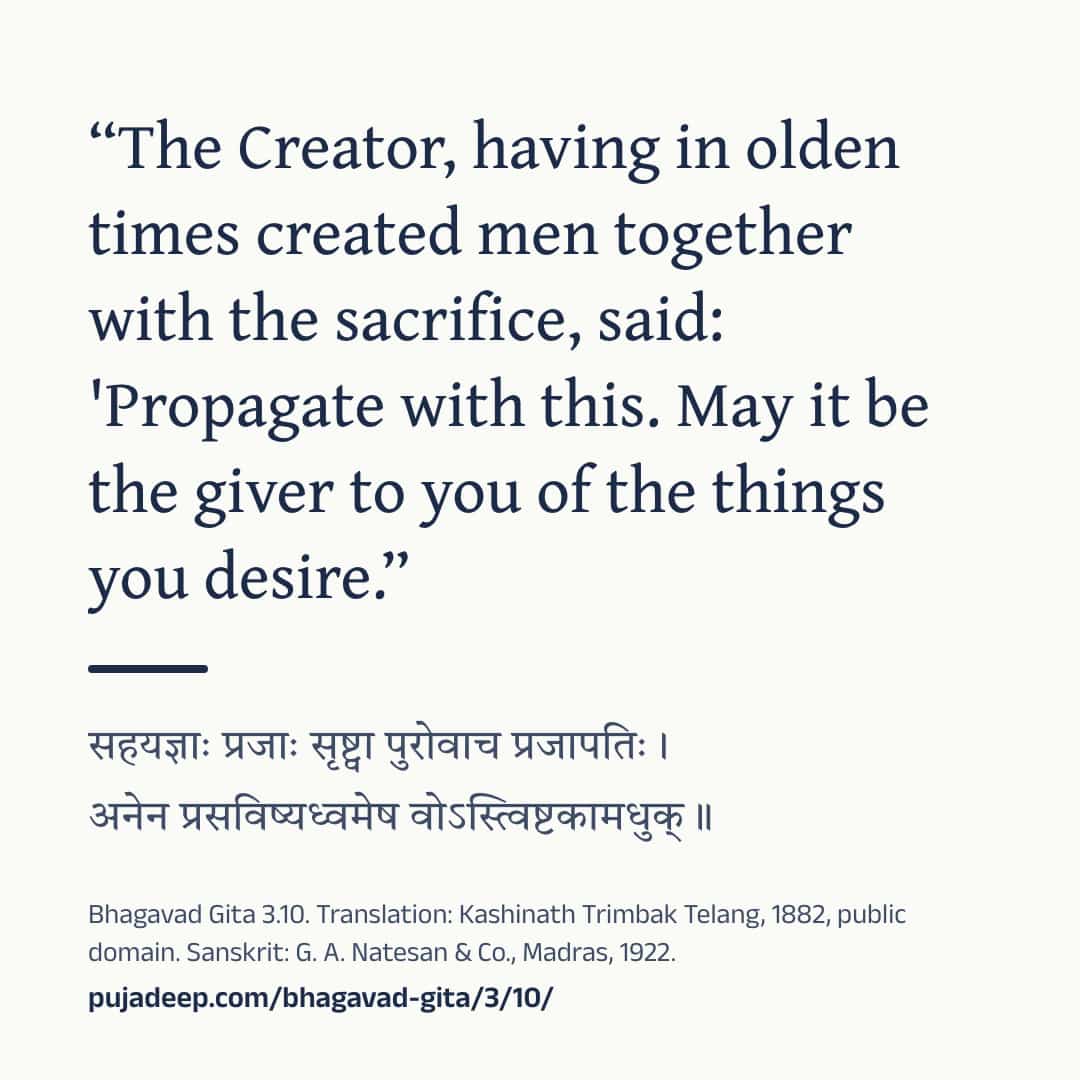
सहयज्ञाः प्रजाः सृष्ट्वा पुरोवाच प्रजापतिः ।
अनेन प्रसविष्यध्वमेष वोऽस्त्विष्टकामधुक् ॥

“The Creator, having in olden times created men together with the sacrifice, said: 'Propagate with this. May it be the giver to you of the things you desire.”
(K. T. Telang, The Bhagavadgîtâ (The Sacred Books of the East, vol. VIII, Oxford: Clarendon Press, 1882), p. 53, public domain)

“Having in ancient times emanated mankind by sacrifice, the Lord of Emanation said: "By this shall ye propagate; be this to you the Kâmaduk;”
(Annie Besant, The Bhagavad Gîtâ, or The Lord's Song (London: Theosophical Publishing Society, 1895), p. 42, public domain)
This sentence goes on in 3.11.

“The Prajapati having in the beginning, created mankind together with Yajna, said,—"By this shall ye multiply: this shall be the milch cow of your desires.”
(Swami Swarupananda, Srimad-Bhagavad-Gita (Mayavati: Prabuddha Bharata Press, 1909; first printed in Prabuddha Bharata, 1907–1909), pp. 67–68, public domain)

Sanskrit: G. A. Natesan & Co., Madras, 1922.
https://pujadeep.com/bhagavad-gita/3/10/ Nothing is sent from this site. Your own app sends it, to the chat you choose. The picture quotes the translation you chose on this page, with its name and year.
Sanskrit text: The Bhagavad-Gita, or The Lord's Song, with the text in Devanagari and an English translation, 1922. Meanings: written for Pujadeep and checked against the cited edition. Source and changes
Questions families ask
Who speaks Bhagavad Gita 3.10?
Krishna speaks this verse, in chapter 3 (Karma Yoga).
Where does the Sanskrit text come from?
Sanskrit text: The Bhagavad-Gita, or The Lord's Song, with the text in Devanagari and an English translation, 1922. Meanings: written for Pujadeep and checked against the cited edition. See the source
Is the meaning on this page a translation?
Explanation written for this site from the sources listed here, and checked against the cited edition. It is not a translation and not the only way to read the text. Free to quote with credit.
Source and licence
- Sanskrit text
- The Bhagavad-Gita, or The Lord's Song, with the text in Devanagari and an English translation (Annie Besant, G. A. Natesan & Co., Madras, 1922). Public domain. The Sanskrit on these pages was read from this printing’s page images.
- Translation
- The Bhagavadgîtâ with the Sanatsugâtîya and the Anugîtâ, translated by Kâshinâth Trimbak Telang (The Sacred Books of the East, vol. VIII, ed. F. Max Müller) (Kashinath Trimbak Telang, F. Max Müller, Clarendon Press, Oxford, 1882). Public domain. Shown verbatim, as printed.
- Translation
- The Bhagavad Gîtâ, or The Lord's Song, translated by Annie Besant (Annie Besant, Theosophical Publishing Society, London, 1895). Public domain. Shown verbatim, as printed.
- Translation
- Srimad-Bhagavad-Gita, with Sanskrit Text; Paraphrase with Word-by-word Literal Translation; English Rendering and Comments, Index, &c., by the Swami Swarupananda (Himalayan Series, No. XX) (Swami Swarupananda, The Editors and Publishers, Advaita Ashrama, Mayavati, Prabuddha Bharata Press, Mayavati, Almora, Himalayas, 1909). Public domain. Shown verbatim, as printed.
- Common wording
- In this text, 32 words follow today's common wording, checked against sanskritdocuments.org; Sanskrit Wikisource; Gita Press, Gorakhpur; GRETIL, Göttingen and Bhaktivedanta Book Trust.
- Our explanation
- Explanation written for this site from the sources listed here, and checked against the cited edition. It is not a translation and not the only way to read the text. Free to quote with credit.
- Checked
- Checked against the cited edition, October 27, 2026.