Bhagavad Gita 3.4: meaning and translation
Chapter 3: Karma Yoga. Krishna says
Krishna says that a person does not reach freedom from action (naiṣkarmya) by not starting actions, and does not reach perfection (siddhi) by renunciation alone.
Click or tap a word for its meaning and its dictionary page.
Text and layers
Text and layers
These choices stay in this browser.
Bhagavad Gita 3.4
न कर्मणामनारम्भान्नैष्कर्म्यं पुरुषोऽश्नुते ।न च संन्यसनादेव सिद्धिं समधिगच्छति ॥
Na karmanamanarambhannaishkarmyam purushoshnuteNa cha sannyasanadeva siddhim samadhigachchhati
na karmaṇāmanārambhānnaiṣkarmyaṃ puruṣo’śnute |na ca saṃnyasanādeva siddhiṃ samadhigacchati ||
Our explanation Krishna says that a person does not reach freedom from action (naiṣkarmya) by not starting actions, and does not reach perfection (siddhi) by renunciation alone. The schools explain what this freedom from action is (see the views).
हिंदी अर्थ कृष्ण कहते हैं कि कर्मों को आरंभ न करने से मनुष्य नैष्कर्म्य (कर्म से मुक्ति की अवस्था) तक नहीं पहुँचता, और केवल संन्यास (त्याग) से सिद्धि नहीं पाता। अलग-अलग परंपराएँ बताती हैं कि यह नैष्कर्म्य क्या है।
Word by word
Every word, with its dictionary page
Word by word
- न na · not (indeclinable) Dictionary: 2. na, Monier-Williams 1899, p. 523, col. 1 “not, no, nor, neither”
- कर्मणाम् karmaṇām · of actions (noun (neuter), genitive plural) Dictionary: karman, Monier-Williams 1899, p. 258, col. 2 “act, action, performance, business”
- अनारम्भात् anārambhāt · by not starting (noun (masculine), ablative singular) Dictionary: an-ārambha, Monier-Williams 1899, p. 28, col. 2 “absence of beginning, non-commencement, not attempting or undertaking”
- नैष्कर्म्यम् naiṣkarmyam · freedom from action (noun (neuter), accusative singular) Dictionary: naiṣkarmya, Monier-Williams 1899, p. 570, col. 2 “inactivity, abstinence or exemption from acts and their consequences”
- पुरुषः puruṣaḥ · a person (noun (masculine), nominative singular) Dictionary: puruṣa, Monier-Williams 1899, p. 637, col. 1 “a person”
- अश्नुते aśnute · reaches, attains (present, 3rd person singular) Dictionary: 1. aś, Monier-Williams 1899, p. 112, col. 2 “to reach, come to, arrive at, get, gain, obtain”
- न na · not (indeclinable) Dictionary: 2. na, Monier-Williams 1899, p. 523, col. 1 “not, no, nor, neither”
- च ca · and (indeclinable) Dictionary: 2. ca, Monier-Williams 1899, p. 380, col. 1 “and, both, also, moreover, as well as”
- संन्यसनात् saṃnyasanāt · by renunciation (noun (neuter), ablative singular) Dictionary: saṃ-nyasana, Monier-Williams 1899, p. 1148, col. 1 “throwing down, laying aside, giving up, resignation, renunciation of worldly concerns”
- एव eva · alone, merely (indeclinable) Dictionary: 1. eva, Monier-Williams 1899, p. 232, col. 2 “just, exactly, very, same, only, even, alone, merely”
- सिद्धिम् siddhim · perfection (noun (feminine), accusative singular) Dictionary: 2. siddhi, Monier-Williams 1899, p. 1216, col. 2 “accomplishment, performance, fulfilment, complete attainment (of any object), success”
- समधिगच्छति samadhigacchati · reaches (present, 3rd person singular) Dictionary: sam-adhi-gam, Monier-Williams 1899, p. 1154, col. 1 “to acquire, obtain”
Old translations
Kashinath Trimbak Telang, 1882. Public domain. Page 52.
A man does not attain freedom from action1 merely by not engaging in action; nor does he attain perfection2 by mere3 renunciation.
Footnotes (the translator’s own) Compare 3 translations
Kashinath Trimbak Telang, 1882. Public domain. Page 52.
A man does not attain freedom from action1 merely by not engaging in action; nor does he attain perfection2 by mere3 renunciation.
Footnotes (the translator’s own) You are reading this one
Annie Besant, 1895. Public domain. Page 41.
Man winneth not freedom from activity by abstaining from action, nor by mere renunciation (of activity) doth he rise to perfection.
You are reading this one
Swami Swarupananda, 1909 (first printed 1907). Public domain. Page 65.
Without performing work none reaches worklessness; by merely giving up action no one attains to perfection.
You are reading this one
Cite this verse
The translation: K. T. Telang, The Bhagavadgîtâ (The Sacred Books of the East, vol. VIII, Oxford: Clarendon Press, 1882), p. 52. Bhagavad Gita 3.4.
The translation: Annie Besant, The Bhagavad Gîtâ, or The Lord's Song (London: Theosophical Publishing Society, 1895), p. 41. Bhagavad Gita 3.4.
The translation: Swami Swarupananda, Srimad-Bhagavad-Gita (Mayavati: Prabuddha Bharata Press, 1909; first printed in Prabuddha Bharata, 1907–1909), p. 65. Bhagavad Gita 3.4.
Our explanation: “Bhagavad Gita 3.4: meaning and translation.” Pujadeep. Updated October 27, 2026. https://pujadeep.com/bhagavad-gita/3/4/
Pujadeep’s explanations are free to quote with credit: name Pujadeep and link to the page. How to credit
Classical readings, by school
Each reading is named by its school. None is presented as the only meaning.
What Advaita, Vishishtadvaita and Dvaita teach, in short
Shankara Advaita
Shankara takes freedom from action (naiṣkarmya) to mean steadiness in knowledge, the state of the actionless Self. Works such as worship purify the mind, and in a pure mind knowledge arises; so action is a means to knowledge. Giving up action without knowledge does not bring this perfection.
Source: The Bhagavad-Gita, with the commentary of Sri Sankaracharya, translated by A. Mahadeva Sastri (2nd ed., Mysore: G. T. A. Printing Works, 1901), commentary on 3.4, pp. 82–84. Summarised in our own words; none of its text is reproduced.
Ramanuja Vishishtadvaita
Ramanuja also takes freedom from action to be the state of knowledge (jñāna). One does not reach it by not doing the works scripture prescribes, or by dropping them once begun. Work done as worship of the Supreme Person, without expecting reward, is what makes a person fit for knowledge.
Source: Sri Bhagavad-Gita with Sri Ramanujacharya's Visishtadvaita commentary, translated by A. Govindacharya (Madras, 1898), commentary on 3.4, p. 93. Summarised in our own words; none of its text is reproduced.
Share
Show the ways to share
Send one picture or the text to one chat. The picture names its source and the address of this page.
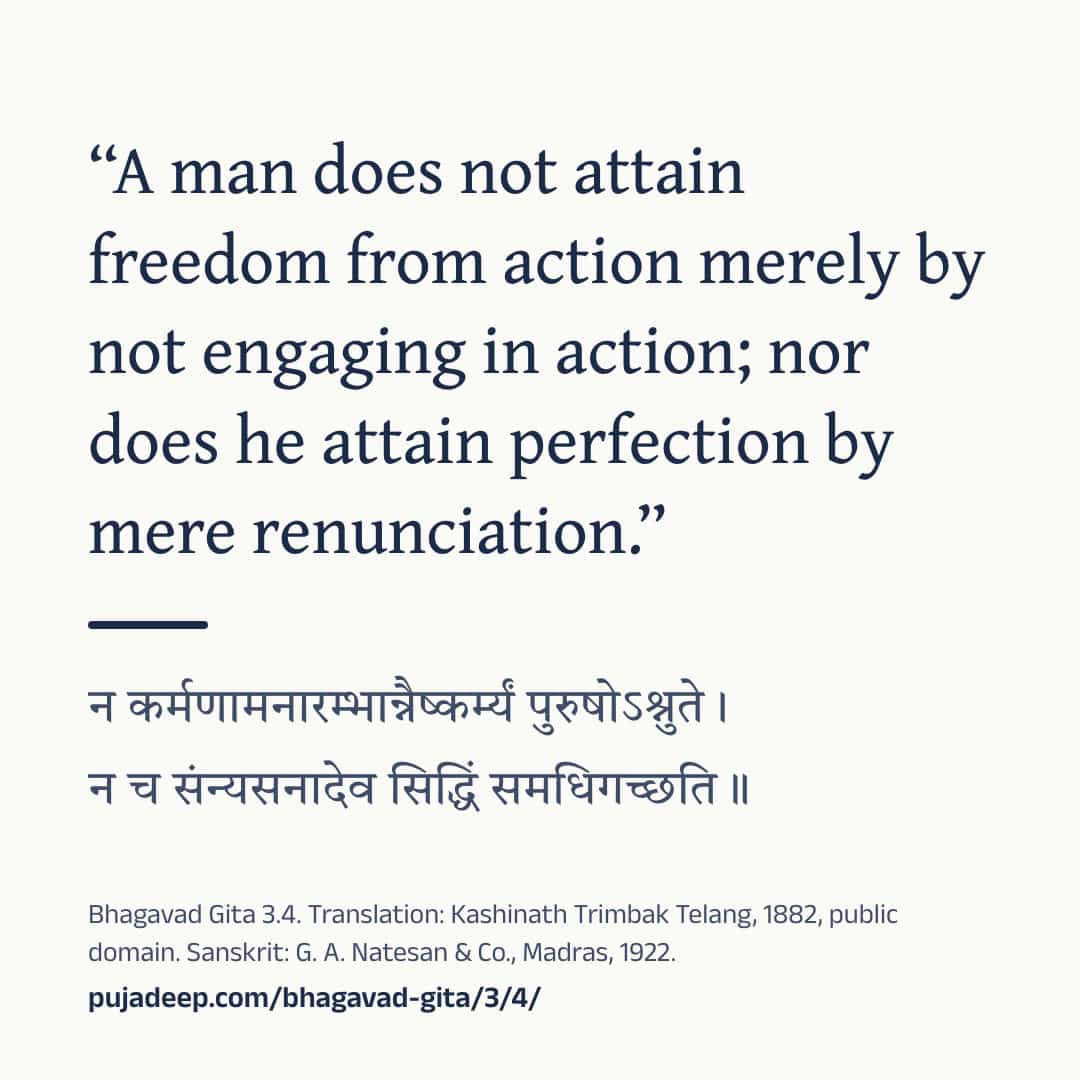
Drawing the picture
See the words
Bhagavad Gita 3.4

न कर्मणामनारम्भान्नैष्कर्म्यं पुरुषोऽश्नुते ।
न च संन्यसनादेव सिद्धिं समधिगच्छति ॥

“A man does not attain freedom from action merely by not engaging in action; nor does he attain perfection by mere renunciation.”
(K. T. Telang, The Bhagavadgîtâ (The Sacred Books of the East, vol. VIII, Oxford: Clarendon Press, 1882), p. 52, public domain)

“Man winneth not freedom from activity by abstaining from action, nor by mere renunciation (of activity) doth he rise to perfection.”
(Annie Besant, The Bhagavad Gîtâ, or The Lord's Song (London: Theosophical Publishing Society, 1895), p. 41, public domain)

“Without performing work none reaches worklessness; by merely giving up action no one attains to perfection.”
(Swami Swarupananda, Srimad-Bhagavad-Gita (Mayavati: Prabuddha Bharata Press, 1909; first printed in Prabuddha Bharata, 1907–1909), p. 65, public domain)

Sanskrit: G. A. Natesan & Co., Madras, 1922.
https://pujadeep.com/bhagavad-gita/3/4/ Nothing is sent from this site. Your own app sends it, to the chat you choose. The picture quotes the translation you chose on this page, with its name and year.
Sanskrit text: The Bhagavad-Gita, or The Lord's Song, with the text in Devanagari and an English translation, 1922. Meanings: written for Pujadeep and checked against the cited edition. Source and changes
Questions families ask
Who speaks Bhagavad Gita 3.4?
Krishna speaks this verse, in chapter 3 (Karma Yoga).
Where does the Sanskrit text come from?
Sanskrit text: The Bhagavad-Gita, or The Lord's Song, with the text in Devanagari and an English translation, 1922. Meanings: written for Pujadeep and checked against the cited edition. See the source
Is the meaning on this page a translation?
Explanation written for this site from the sources listed here, and checked against the cited edition. It is not a translation and not the only way to read the text. Free to quote with credit.
Source and licence
- Sanskrit text
- The Bhagavad-Gita, or The Lord's Song, with the text in Devanagari and an English translation (Annie Besant, G. A. Natesan & Co., Madras, 1922). Public domain. The Sanskrit on these pages was read from this printing’s page images.
- Translation
- The Bhagavadgîtâ with the Sanatsugâtîya and the Anugîtâ, translated by Kâshinâth Trimbak Telang (The Sacred Books of the East, vol. VIII, ed. F. Max Müller) (Kashinath Trimbak Telang, F. Max Müller, Clarendon Press, Oxford, 1882). Public domain. Shown verbatim, as printed.
- Translation
- The Bhagavad Gîtâ, or The Lord's Song, translated by Annie Besant (Annie Besant, Theosophical Publishing Society, London, 1895). Public domain. Shown verbatim, as printed.
- Translation
- Srimad-Bhagavad-Gita, with Sanskrit Text; Paraphrase with Word-by-word Literal Translation; English Rendering and Comments, Index, &c., by the Swami Swarupananda (Himalayan Series, No. XX) (Swami Swarupananda, The Editors and Publishers, Advaita Ashrama, Mayavati, Prabuddha Bharata Press, Mayavati, Almora, Himalayas, 1909). Public domain. Shown verbatim, as printed.
- Commentary
- The Bhagavad-Gita, with the commentary of Sri Sankaracharya, translated by A. Mahadeva Sastri (2nd ed., Mysore: G. T. A. Printing Works, 1901) (Public-domain scan, University of California Libraries). Summarised in our own words; none of its text is reproduced.
- Commentary
- Sri Bhagavad-Gita with Sri Ramanujacharya's Visishtadvaita commentary, translated by A. Govindacharya (Madras, 1898) (Scan uploaded to archive.org (folkscanomy collection)). Summarised in our own words; none of its text is reproduced.
- Common wording
- In this text, 32 words follow today's common wording, checked against sanskritdocuments.org; Sanskrit Wikisource; Gita Press, Gorakhpur; GRETIL, Göttingen and Bhaktivedanta Book Trust.
- Our explanation
- Explanation written for this site from the sources listed here, and checked against the cited edition. It is not a translation and not the only way to read the text. Free to quote with credit.
- Checked
- Checked against the cited edition, October 27, 2026.